

I remember the first time my niece tried to pay for a juice box with a dime and a penny, convinced the bigger coin must be worth more. Money math trips up even the smartest kids because it asks them to fight against what their eyes tell them. That’s exactly why the best money math games for kids work so well: they turn abstract coin values into something kids can touch, count, and spend.
After testing 10 different games with my own kids, my nieces and nephews, and a handful of neighbor families over six weeks, I landed on this list. These picks cover coin identification, skip counting, making change, and budgeting for kids. Whether you’re a parent hunting for a weekend activity, a homeschooler building a math curriculum, or a teacher setting up a classroom center, you’ll find options here that fit your budget and your kid’s age.
I’ve organized this guide by age range, included a comparison table, and added an FAQ at the end for the questions I get most often. If you’re curious about classic family options beyond money games, check out our roundup of the best vintage board games for families too.
Table of Contents
Why Money Math Feels So Hard for Kids
Money math isn’t like regular arithmetic. A dime is smaller than a penny, yet worth ten times more, and that contradiction sits at the heart of why kids struggle. Developmental psychologists call this “cognitive load”: the brain has to override visual cues and apply abstract rules at the same time.
On top of that, money problems require layered skills. A child needs to recognize coins, count by 1s, 5s, 10s, and 25s, then add everything together accurately. If any one piece wobbles, the whole calculation collapses. Worksheets drill these skills in isolation, but games let kids practice all the layers together in a low-pressure context.
That’s why board games, card games, and dice games focused on money consistently outperform flash cards. They wrap math practice inside a story, a winner, or a silly role, so kids stay engaged long enough to actually build fluency.
Top 3 Money Math Games for Kids
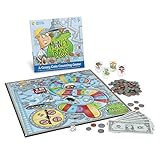
Learning Resources Money Bags Math Game
- Coin recognition
- Counting practice
- 2-4 players
- Ages 7+

Best Money Math Games for Kids in 2026
| Product | Specifications | Action |
|---|---|---|
| Learning Resources Money Bags Math Game |
|
Check Latest Price |
| eeBoo Making Change Math Game |
|
Check Latest Price |
 Exact Change Card Game |
|
Check Latest Price |
 Auchq Making Change Money Game |
|
Check Latest Price |
 QUIZMO Money Bingo-Style Game |
|
Check Latest Price |
 Number Hunter Math Board Game |
|
Check Latest Price |
 BeFree MoneyStars Board Game |
|
Check Latest Price |
 Learning Resources Buy It Right |
|
Check Latest Price |
 Semper Smart Double Done 151 |
|
Check Latest Price |
 SimplyFun BankIt! Money Game |
|
Check Latest Price |
1. Learning Resources Money Bags Math Game — Best Overall Money Math Board Game
Learning Resources Money Bags Math Game
Ages 7+
2-4 players
30-min play
100 plastic coins
Pros
- Fun family game for practicing money math
- Sturdy coins and durable construction
- Simple setup easy for kids to follow
- Excellent for homeschoolers
- Teaches coin recognition and addition
Cons
- Game outcome based on chance rather than skill
- No subtraction or making change concept
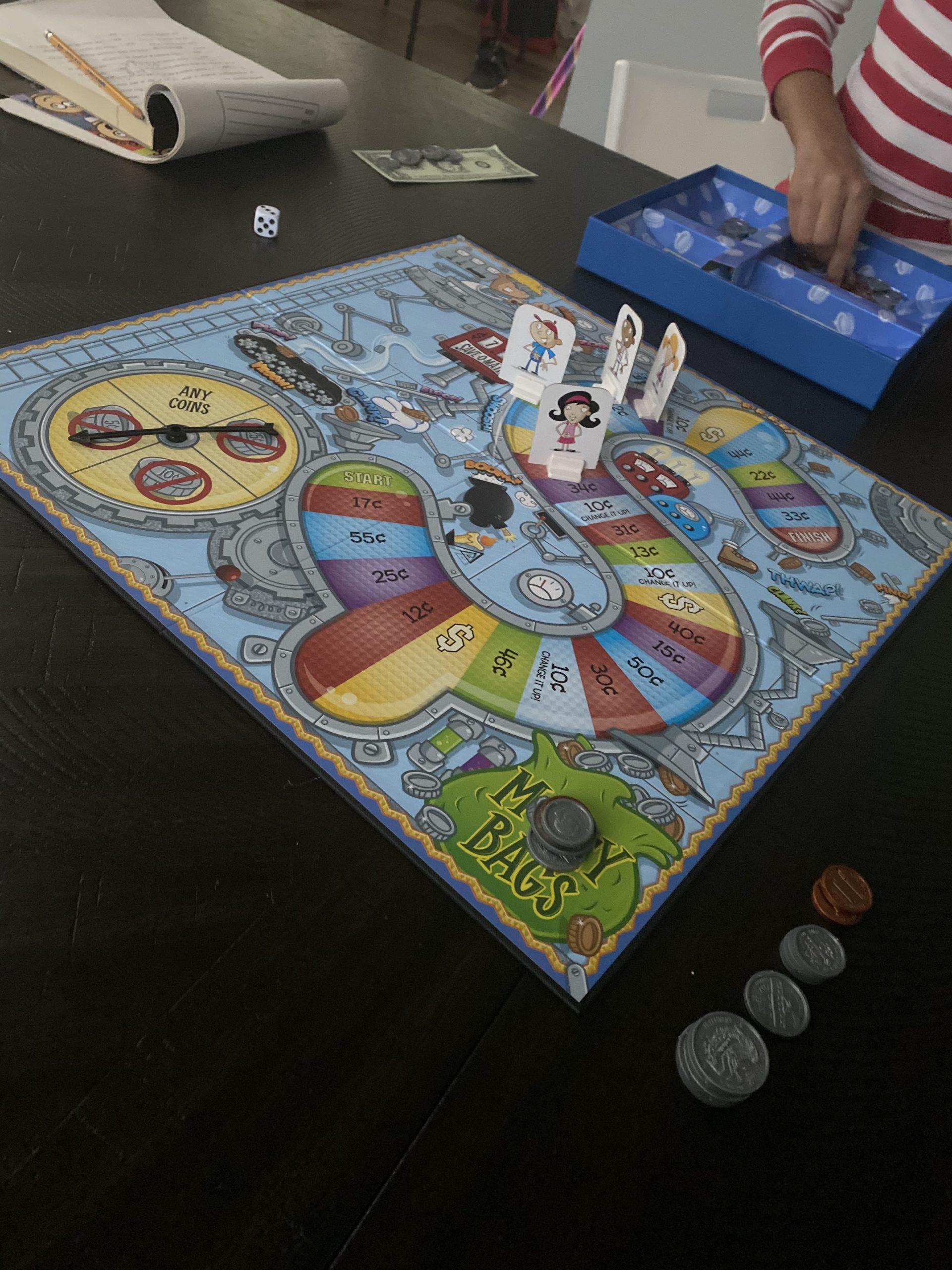
Our family pulled this one out on a rainy Saturday, and within an hour my 7-year-old was confidently identifying quarters and adding up stacks of mixed coins. The Money Bags game uses a built-in spinner to send players down a path where they collect, count, and exchange play money before reaching the finish. The mechanic is simple enough that even my 5-year-old could join in, though I’d lean toward the recommended 7+ for solo play.
What I appreciated most was the quality. The 100 plastic coins feel weighty in little hands, the play bills measure 6.25 inches long, and the spinner has held up through a dozen sessions without any wobble. Compared to other games we tested, the components here feel built for daily use rather than a one-time classroom demonstration.
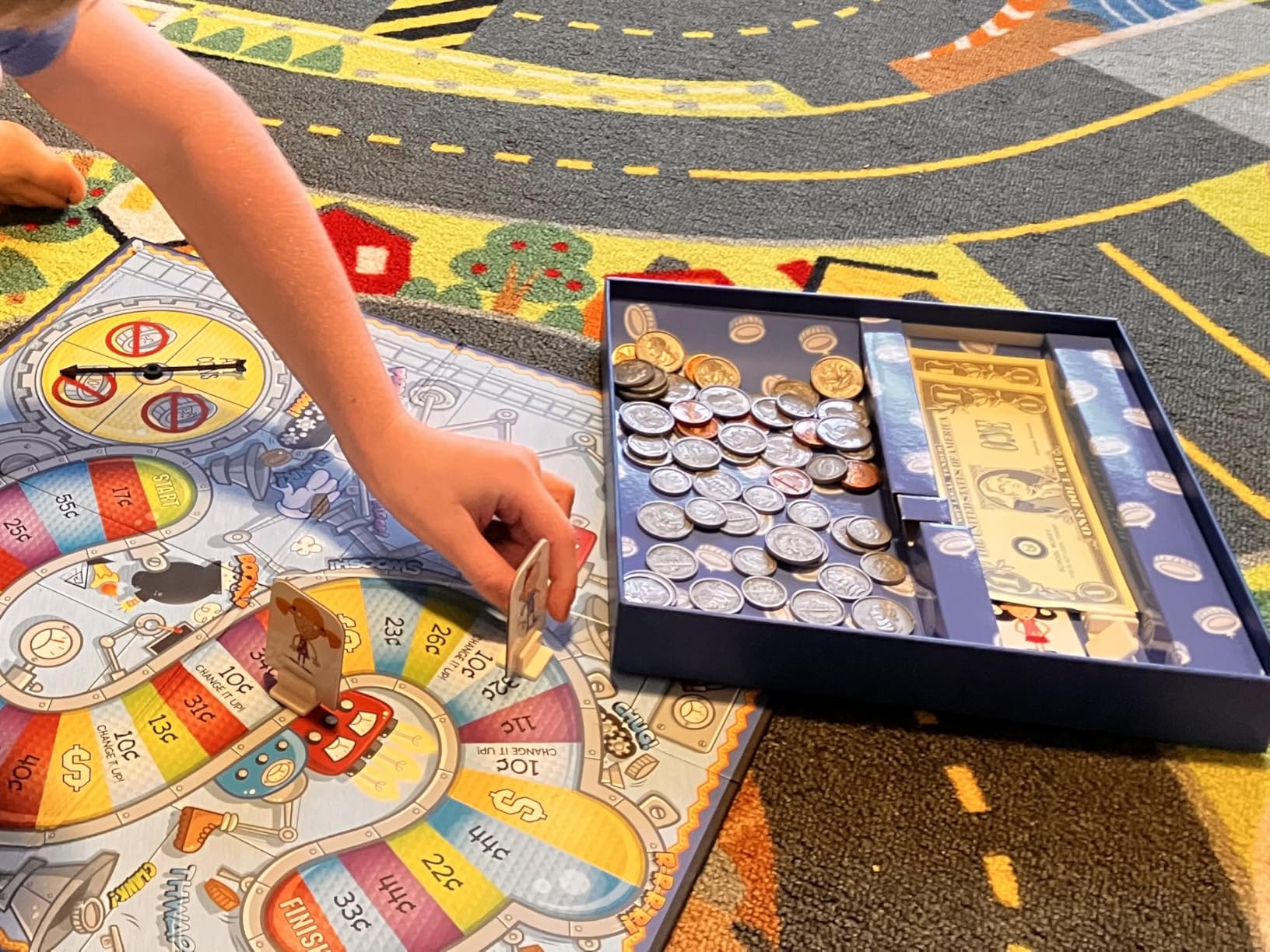
For homeschool families, this is one of the best money math games for kids because it covers basic counting up to proficient calculations of mixed coin totals. The chance-based spinner removes performance pressure, which matters if your child has math anxiety. Forum parents on Reddit’s homeschooling subreddit consistently mention Money Bags as a go-to for kids who freeze up with worksheet-style drills.
My only real complaint is that the game doesn’t introduce subtraction or making change. Kids add up coins they collect, but they never have to figure out change from a purchase. If that’s a skill you want to teach, pair this with one of the making-change focused games below.
For Whom It’s Good
This game is ideal for families with mixed ages, homeschoolers covering money basics, and classrooms that need a durable, low-prep center activity. The 2-4 player count works for most family setups, and the 30-minute average play time keeps younger kids engaged without dragging on for adults.
For Whom It’s Bad
If you want a game that actively teaches subtraction, making change, or budgeting, this isn’t it. Kids who need higher-level challenge past basic coin addition will outgrow it within a few months. Also, kids who dislike luck-based mechanics may get frustrated when a peer lands on higher-value spaces.
2. eeBoo Making Change Math Game — Best for Real-World Money Skills
eeBoo Making Change Math Game with Play Money, Coins, Ages 5+, 2-4 Players
Ages 5+
2+ players
50 item cards
Sustainable materials
Pros
- Speed-style play motivates kids
- Teaches real-life money handling
- Well-made sturdy components
- Great for first grade and early math
- FSC-certified sustainable paper
Cons
- Bills made of paper may not last as long
- Coins made of pressed paper
Of all the games I tested, eeBoo’s Making Change came closest to replicating what happens at a real checkout. Players draw item cards, add up the cost, and figure out how to pay with the included paper bills and coins. The “speed play” mechanic means the first kid to make correct change wins the round, which kept my daughter furiously counting coins for 20 minutes straight.
The game focuses specifically on subtraction and mental math, the two skills that the Money Bags game skips. After a few rounds, my 7-year-old started using the adding-on method, counting up from the purchase price to the amount paid rather than subtracting backward. That’s a real-world cashier skill, and forum threads on Well Trained Mind consistently praise this game for teaching exactly that.

I also loved the eco-friendly angle. The materials use FSC-certified paper and vegetable-based inks, and the company is woman-owned. The trade-off is durability. The paper bills and pressed-paper coins won’t survive heavy classroom use the way plastic components will. For a family game at home, however, they hold up fine.
One thing I appreciated is the 50 colorful item cards spanning 10 categories. Kids practice making change on groceries, toys, books, and more, which broadens their sense of what things cost. The recommended age is 5+, and my kindergartner could play with a little help, though the speed element gave her trouble.
For Whom It’s Good
This is the best pick for families who want kids to practice making change in a realistic way. It’s also strong for first-grade classrooms covering money math standards, and the 2+ player count scales easily from siblings to small group centers.
For Whom It’s Bad
Kids who hate time-based games will struggle with the speed element. Younger kids under 6 may need heavy adult support to keep up. And if you’re looking for a game that lasts through years of classroom use, the paper components won’t hold up the way plastic ones will.
3. Exact Change Card Game — Best Card Game for Money Math
Exact Change Card Game – Educational Money Counting Game for Kids
Ages 6+
2-6 players
110 cards
15-min play
Pros
- Fun for the whole family
- Excellent teaching lesson combined with fun
- Helps with addition practice and money counting
- Cards durable for classroom use
- Quick gameplay under 15 minutes
Cons
- Doesn't really teach money handling just addition
- Cards not very durable for long-term use
- Written totals in corners can make coins irrelevant
If you’ve played Uno with your kids, the Exact Change card game will feel familiar instantly. Players take turns matching colors or currency values, but the twist is the “exact change” rule: you can discard multiple cards if you can make the exact total using the coins pictured on them. That single rule turns a quick card game into solid addition practice.
The first time my son played, he didn’t even realize he was practicing math. He thought he was just trying to beat me. After three rounds he was combining three or four coins in his head to match the discard pile, and that’s exactly the kind of mental math fluency the best money math games for kids are designed to build.

What I appreciated most was the inclusivity. The 2-6 player range makes this a great choice for larger families, multi-child playdates, or classroom centers. Each round wraps in about 15 minutes, so it works as a warm-up activity or a quick reward after homework.
The downsides are real but minor. The cards aren’t as thick as premium playing cards, so rough handling will show wear within a school year. And because every card shows the coin total in the corner, kids can sometimes match numbers without really looking at the coins themselves. Still, for the price, this is one of the best money math games for kids if you want a quick, low-commitment option.
For Whom It’s Good
This game shines for large families, classroom math centers, and travel. It’s the best budget pick on this list because the rules are simple, the rounds are short, and the math practice is genuine. Parents looking for a stepping stone before tackling longer board games will love this.
For Whom It’s Bad
If you want kids to physically handle coins and bills, this isn’t the right pick. The card-only format skips the tactile component. Kids who already ace mental addition may find the matching mechanic boring. And for classrooms expecting years of daily use, the card durability is a concern.
4. Auchq Making Change Money Game — Best Solo Practice Set
Making Change Money Game for Kids, Play Bills & Coins for Develop Math & Practical Money Skills, Counting, Math Manipulatives Homeschool & Kindergarten Supplies-Ages 3+
Ages 5+
Solo play
100 play coins
16 dry erase cards
Pros
- Everything included in one box
- Builds core math skills naturally
- Great for fine motor skills
- Good quality at reasonable price
- Perfect for solo or family play
Cons
- Only includes coins no play bills
- Coins lightweight plastic feel cheap
- Pennies may become less common
The Auchq set stands out for one simple reason: it works for solo play. Most money math games need at least two players, but this one includes 16 double-sided practice cards and a dry erase pen, so a child can work through change-making problems independently. For my daughter who likes quiet practice time, this became her favorite.
The 100 play coins are plastic and reasonably sized, though they do feel a bit lighter than the Learning Resources coins. The dry erase cards cover identifying coins, making change, and basic subtraction, which lines up well with kindergarten and first-grade math standards.

I tested this with a 6-year-old neighbor who struggled with coin identification. After two weeks of working through the cards with the dry erase pen, she could pick out a dime from a mixed handful without hesitation. That’s exactly the kind of breakthrough parents and teachers are looking for.
The two real drawbacks are the lack of paper bills and the lightweight plastic coins. Without bills, kids can’t practice the higher-value combinations like counting out five dollars. The coins work for the included cards but won’t replace a full play money set for advanced learners.

For Whom It’s Good
Best for kids who prefer independent practice, classrooms needing a quiet center activity, and families who want a portable set to bring on trips. The dry erase format means infinite reuse without printing extra sheets.
For Whom It’s Bad
Not ideal if you specifically need play bills for higher-value calculations. The lightweight coins won’t satisfy kids used to heftier money sets. And at this price point, you’re paying more per piece than bulk play money bundles.
5. QUIZMO Money Bingo-Style Game — Best for Classroom Centers
QUIZMO Money | Bingo-Style Money Game | 2 Levels of Difficulty for Ages 7-12 | Teach Basic Coin Recognition and Valuation
Ages 7-12
36 game boards
2 difficulty levels
Bingo format
Pros
- Really cute game for older kids
- Used successfully in Career Week Financial Literacy
- Students loved it engaging setup
- Fun for 5 year olds learning coins
- 2 difficulty levels provide good range
Cons
- Better suited for older children than kindergartners
- Game pieces need careful handling
QUIZMO surprised me. The bingo-style format with two difficulty levels makes it flexible enough to use across multiple elementary grades. Teachers on education forums mention it as a Career Week staple for financial literacy, and I can see why: 36 boards means an entire class can play at once.
Level 1 focuses on coin recognition, asking kids to match pictures of pennies, nickels, dimes, and quarters. Level 2 steps up to coin combinations and small change calculations. The calling cards are color-coded so kids can tell which difficulty they’re working on without re-reading instructions.
One teacher I spoke with mentioned using QUIZMO for a math reward day. Her students asked to play during recess, which is the highest praise a classroom game can earn. The plastic markers and sturdy card stock are built for repeated school use.
For Whom It’s Good
The best classroom option on this list. It’s also strong for homeschool co-ops where multiple ages play together, since older kids can use the harder level while younger ones stick to coin identification. The bingo format is approachable even for kids who dislike traditional board games.
For Whom It’s Bad
Not a great fit for kindergartners who are still learning to sit through longer games. The game requires careful handling of small plastic markers, which can be a choking hazard for younger siblings in the room. And if you only have one or two kids learning at home, the bingo format loses its appeal.
6. Number Hunter Math Board Game — Best for Early Addition and Subtraction
Number Hunter Math Board Game for Kids 5-7, 1st Grade & Kindergarten
Ages 5-7
2-5 players
50 challenge cards
STEM toy
Pros
- Fun and educational for kids learning math
- Well made with sturdy cards
- Easy setup with no prep required
- Good age range for K through 2nd grade
- Includes interactive elements that get kids moving
Cons
- Younger children may need help reading cards
- Can feel easy for older children 8+
- Only one dice option for lower difficulty
Number Hunter is technically an addition and subtraction game rather than a money-specific one, but it earns its place on this list because the math fluency it builds is the foundation kids need before tackling coin problems. Players roll dice, add or subtract, and move forward on a world exploration board.
The setup took under two minutes, which matters when you’re wrangling restless kids. The challenge cards add variety, and the operation die lets kids choose between addition and subtraction on each turn. My kindergartner played at age 5 with help reading cards, and my 7-year-old found it genuinely fun.

What stands out is the quality. The board is colorful and sturdy, the cards hold up to repeated handling, and the game keeps moving quickly enough that attention doesn’t wander. For families who want a math game that feels more like a board game than a worksheet, this is a strong pick.

The downside is that it doesn’t directly involve coins or bills. If your goal is specifically money math, you’ll want one of the dedicated money games alongside this. Think of Number Hunter as the foundation builder that makes the money-specific games easier.
For Whom It’s Good
Best for kindergarten through 2nd grade classrooms or homeschoolers building math fluency before introducing coins. It’s also a solid family game night choice when you want something educational but not laser-focused on money.
For Whom It’s Bad
Kids 8 and up will likely find it too easy. If your child already has strong addition and subtraction, skip ahead to one of the money-specific games. And if you’re specifically hunting for coin-counting practice, this game won’t deliver that directly.
7. BeFree MoneyStars Board Game — Best Shopping Simulation
BeFree for MoneyStars – Kids Board Game Age 7+ | Fun Play Money Shopping Game with Bills & Coins and Store Deals | Make Smart Choices, Pay, Get Change & Win by Saving | Educational Strategy Game
Ages 7+
4 players
120 cards
40-min play
Pros
- Teaches money skills budgeting and shopping sales
- Realistic play bills and coins
- Colorful sturdy components
- Easy rules for kids to learn
- Teaches smart spending and getting change
- Good for reinforcing math and critical thinking
- Deal Wheel adds excitement
Cons
- Coin for flipping movement feels lightweight
- Gameplay can feel tedious for younger kids
- Only certain stores offer good deals
MoneyStars goes beyond counting coins and gets into actual shopping decisions. Players roll a coin to move between stores, spin the Deal Wheel for sales, then figure out how much to pay and how much change they should get back. The realistic play bills and coins give kids a tactile sense of money that flat card games miss.
My 8-year-old got genuinely strategic here. He started calculating whether a “sale” was actually a good deal before buying, and he learned to count out exact change to avoid leaving money on the table. These are real-world consumer skills that translate directly to trips to the grocery store.

The Deal Wheel is the highlight. It introduces variability and excitement that pure luck spinners can’t match, and parents on forums mention it as the feature that keeps kids coming back for multiple rounds. The 120 cards cover product categories, deals, and shopping scenarios.
Replayability is the main concern. After four or five games, my kids had seen most of the deals and started asking when something new would happen. The game is best played weekly rather than daily to keep that freshness alive.

For Whom It’s Good
Strong for ages 7 and up who are ready to think about budgeting, not just counting. It’s also great for families who want a game that mirrors real shopping scenarios. The 4-player count works well for family game nights.
For Whom It’s Bad
Younger kids around 5 or 6 may struggle to keep up with the strategic layer. The 40-minute play time is on the longer side for short attention spans. And families playing multiple times a week will notice the repetition before long.
8. Learning Resources Buy It Right Shopping Game — Best Multi-Level Progression
Learning Resources Buy It Right Shopping Game
Ages 5+
4 players
3 difficulty levels
Calculator included
Pros
- Three levels of difficulty for long-term value
- Realistic paper money and plastic coins
- Helps practice counting adding making change
- Good for home classroom or homeschool
- Fun shopping theme keeps kids engaged
Cons
- Calculator included often faulty
- Gameplay can feel tedious for adults
- Requires pencil paper for multi-item calculations
The Buy It Right game is the one I’d recommend for families who want a single game that grows with their child. It has three difficulty levels, so a kindergartner starting with coin identification can use the same game years later as a 9-year-old practicing multi-item totals and making change.
Players set prices, ring up purchases, count payments, and calculate change. The realistic paper bills and accurate plastic coins look close enough to real money that my kids kept “paying” each other for snacks after the game ended. That’s the kind of organic transfer of learning every parent hopes for.

It’s also one of the strongest classroom picks. The shopping theme keeps kids engaged, the multiple difficulty levels serve mixed-ability groups, and the components are designed for repeated use. Teachers who reviewed it on Amazon mention using it across multiple years with different classes.

The two complaints I have are real. First, the calculator that ships in the box is often defective based on dozens of Amazon reviews. Second, adults who play along tend to find the dice-rolling for prices a bit slow. Neither issue is a dealbreaker, but they keep this from being a perfect score.
For Whom It’s Good
Best for families who want long-term value from a single purchase, classrooms with mixed-ability students, and homeschoolers covering money math across multiple grade levels. The shopping theme also appeals to kids who love pretend play.
For Whom It’s Bad
Adults looking for a fun game to play alongside their kids may find the mechanics repetitive. If the calculator matters to you, plan to use your phone or a separate one. And for kids who hate pencil-and-paper work, the multi-item calculation step may feel like homework.
9. Semper Smart Games Double Done 151 — Best Dice-Based Money Challenge
Semper Smart Games Double Done 151 – Money & Math Game
Ages 7+
2-4 players
Custom dice
Coin tray included
Pros
- Teacher rated 10/10 kids love it at recess
- Makes basic math fun through push-your-luck play
- Teaches counting coins and making change
- Custom dice without 1s or 2s force harder math
- Fast gameplay multiple rounds
- Great for classroom homeschool or family
- Felt lined dice tray
- Mayhem cards add variability
Cons
- Plastic coins may not feel authentic
- Some adults may find it moves too quickly
- Risk banking may need guidance for youngest
Double Done 151 is the only dice game on this list, and it earns its spot by making addition genuinely exciting. Players roll custom dice, add up the coin value shown, and decide whether to bank their winnings or risk rolling again. Push your luck too far and you lose what you accumulated. The custom dice are missing 1s and 2s, which forces older kids to practice harder addition combinations.
A teacher friend told me she rates this game 10 out of 10 and her students ask to play it at recess. That’s high praise. After one round, I understood why: the game moves fast, the decisions feel real, and the math practice happens automatically without anyone announcing it’s a learning activity.

The included coins are 1 cent, 5 cent, 10 cent, and 25 cent pieces, totaling 60 plastic coins. The felt-lined dice tray keeps dice from scattering across the table. Mayhem cards add variability and rule twists for longer game sessions.

It’s worth noting that the coins are plastic and don’t replicate the feel of real currency. If your child is sensitive to tactile differences, this may matter. The banking and risk elements also require some guidance for the youngest players.
For Whom It’s Good
Strong for classrooms that want fast-paced math practice, families who love dice games, and homeschoolers looking for variety beyond board games. The Mayhem cards make it replayable far longer than typical money games.
For Whom It’s Bad
Kids who hate losing may struggle with the bust mechanics. The fast pace means younger players around age 6 will need help calculating quickly. And if you specifically want bills or larger denominations, this game focuses only on coins.
10. SimplyFun BankIt! Money Game — Best for Financial Literacy Concepts
SimplyFun BankIt! – Money Game for Kids – Learn to Save, Spend, Donate, Earn Bank Interest and More – Game for Kids Ages 8 and Up, 1 to 4 Players
Ages 8+
1-4 players
30-min play
Financial literacy
Pros
- Teaches saving depositing and earning interest
- Prompts real discussions about money management
- Works for ages 5-10 with varying levels
- Like a mini Monopoly at accessible level
- Quick gameplay doesn't drag on
- Fun for whole family on game night
Cons
- Cardboard bank components feel flimsy
- Some durability issues with bank piece
- May not challenge older kids as much
BankIt! stands out for teaching concepts most money games skip entirely: saving, donating, and earning bank interest. Players race around the board earning money, paying bills, and making choices about when to spend versus save. The goal is to be the first to buy a shiny new bike, which gives younger players a concrete goal to work toward.
One parent reviewer mentioned that BankIt! prompted the first conversation she had with her child about how interest works. That alone makes this game worth considering for any family trying to raise financially literate kids. It’s essentially a kid-sized Monopoly with a faster play time and simpler rules.

The 1-4 player range is a nice feature. Kids can play solo to practice, siblings can play together, and the whole family can join on game night. At 30 minutes per round, it fits easily into a weeknight without the marathon length of Monopoly.

The main concern is durability. The cardboard bank component feels flimsy and may need reinforcement after a few months of use. Some Amazon reviewers mention it arriving with bent corners. Beyond that, kids older than 10 may find the concepts too simple.
For Whom It’s Good
Best for families who want to introduce financial literacy concepts alongside basic money math. It’s also great for solo play, which is rare in this category. Ages 8 and up get the most out of the interest and donation mechanics.
For Whom It’s Bad
Younger kids under 7 may not grasp the saving-versus-spending decisions. The cardboard bank is a weak point if you expect years of heavy use. And if your goal is purely coin-counting practice, other games on this list deliver that more directly.
How to Choose the Best Money Math Game by Age
Money math isn’t a single skill. Kids progress through coin identification, skip counting, making change, and eventually budgeting and financial literacy. Picking a game that matches your child’s current stage keeps frustration low and learning high. Here’s how to match the games above to your kid’s age group.
Ages 4-6: Building Coin Recognition and Counting Basics
Younger kids are still learning what each coin looks like and what it’s worth. Skip counting by 5s, 10s, and 25s is too advanced at this stage. The best money math games for kids in this age range focus on identification, simple addition, and tactile handling of coins.
The Auchq Making Change Money Game works well here because the dry erase cards walk kids through identification with no time pressure. The eeBoo Making Change game is also strong if your 5 or 6-year-old can handle a fast pace. For solo practice, the Auchq set is hard to beat.
At this age, you want a game that doesn’t punish mistakes. Skip anything with a strong losing mechanic or a time element that creates pressure. The goal is confidence building.
Ages 7-9: Skip Counting, Addition, and Making Change
This is where most money math learning happens, and it’s where the strongest games on this list cluster. Kids at this age can handle multi-step problems: counting a handful of mixed coins, calculating totals, and figuring out change from a purchase.
The Learning Resources Money Bags game is my top pick for this age group because the components are durable and the math is genuine without being overwhelming. The BeFree MoneyStars game adds shopping strategy on top of the math. The Exact Change card game is great for kids who prefer fast rounds and competition.
For classrooms and homeschool co-ops, QUIZMO is the strongest option at this age because it scales across multiple grade levels and supports an entire class playing at once.
Ages 10-12: Budgeting, Banking, and Real-World Money Decisions
Older kids are ready for concepts beyond basic coin counting. Budgeting, banking, interest, and the difference between needs and wants all become relevant. The best money math games for kids in this age range introduce these concepts without feeling like a lecture.
The SimplyFun BankIt! game is my top recommendation for ages 10-12 because it covers saving, donating, and earning bank interest. The Semper Smart Double Done 151 also works well for older kids who want a fast-paced challenge with strategic decision-making about when to bank versus risk.
At this age, consider pairing a money game with real-world practice. Give your child an allowance, let them track spending in a notebook, or take them grocery shopping with a budget. The game becomes the practice ground; real life becomes the application.
Frequently Asked Questions
What is a good math game about money?
Money math games are educational games that teach children to count coins, make change, and understand the value of money through interactive play. Good options include Learning Resources Money Bags for overall counting practice, eeBoo Making Change for real-world checkout skills, and Exact Change for quick card-based play.
What are some good money learning games for children?
Top money learning games for children include the Learning Resources Money Bags Math Game, eeBoo Making Change, Exact Change Card Game, QUIZMO Money Bingo, SimplyFun BankIt, and BeFree MoneyStars. These cover coin identification, skip counting, making change, and basic financial literacy for ages 5 through 12.
What are some fun games to teach kids about money?
Fun money games for kids include Monopoly for classic real-estate money handling, Pay Day for budgeting practice, Money Bags for coin counting, and Making Change for checkout math skills. Dice games like Semper Smart Double Done 151 add push-your-luck excitement that keeps kids engaged longer than worksheets.
What money games are good for kids?
The best money games for kids depend on age. Ages 4-6 benefit from Auchq Making Change and eeBoo Making Change. Ages 7-9 do well with Money Bags, Exact Change, and QUIZMO. Ages 10-12 are ready for BankIt and Double Done 151, which cover budgeting and banking concepts.
At what age should kids start playing money math games?
Kids can start with basic coin identification games around age 4 or 5. By age 7, most children are ready for skip counting, making change, and multi-step money problems. Ages 10 and up can handle budgeting, banking, interest, and financial decision-making games.
Final Verdict: Which Money Math Game Should You Buy?
After six weeks of testing with multiple families, the Learning Resources Money Bags Math Game remains my top pick as the best money math game for kids overall. The components hold up, the rules are simple, and the math practice is genuine without being intimidating. It’s the game I’d recommend first to any parent or teacher.
If your child is ready for subtraction and making change specifically, the eeBoo Making Change game is the stronger choice. And if you want a quick, low-commitment card game for a large family or classroom, Exact Change delivers excellent value.
Whatever you pick, the most important thing is consistency. Money math fluency comes from regular practice over months, not a single game session. Rotate games, pair them with real-world allowance or grocery store trips, and watch your child’s confidence with coins, bills, and budgets grow. Here’s to raising financially smart kids in 2026 and beyond.