

I spent three months watching my niece and her classmates play every phonics game I could get my hands on, and I learned something fast: not every “educational” game actually teaches letter sounds. Some just look pretty while a kid taps a screen. Others feel like punishment dressed up as play.
The best phonics games for kids are the ones that turn decoding, blending, and segmenting into something a child wants to do. After watching kindergarteners race to swat sight-word flies, argue over Zingo tiles, and pop their way through CVC words, I pulled together the ten options that actually deliver on the promise of phonics instruction.
This guide is built for parents, homeschool families, and teachers who want screen-free or low-screen options backed by the Science of Reading. Every pick below targets real phonemic awareness skills: letter-sound correspondence, blending, CVC words, digraphs, and vowel patterns. I’ve included age ranges, what each game actually teaches, and where each one falls short, so you can match the right tool to the child in front of you.
Table of Contents
Top 3 Phonics Games for Kids at a Glance

Learning Resources Sight Word Swat
- 220 Dolch sight words
- 4-player swatting
- Color-coded by grade level


The Fidget Game Word Pop CVC
- 50 CVC words
- Multisensory pop-it
- Aligned to Science of Reading
Best Phonics Games for Kids in 2026
| Product | Specifications | Action |
|---|---|---|
| Learning Resources Sight Word Swat |
|
Check Latest Price |
 ThinkFun Zingo Word Builder |
|
Check Latest Price |
| Snap It Up Phonics Word Families |
|
Check Latest Price |
| Fidget Game Word Pop CVC |
|
Check Latest Price |
 LeapFrog Fridge Phonics |
|
Check Latest Price |
 ThinkFun Zingo Bingo |
|
Check Latest Price |
 Little Bud Spin-and-Read |
|
Check Latest Price |
 Bambino Tree WOWELs |
|
Check Latest Price |
 Clever Noodle Pig Fig Wig |
|
Check Latest Price |
 Educational Insights Phonics Dominoes |
|
Check Latest Price |
1. Learning Resources Sight Word Swat – The Best Phonics Game for Group Play
Learning Resources Sight Word Swat! A Sight Words Game
220 Dolch sight words
4-player swatter format
Color-coded by grade level
Pros
- Fast-paced competition holds attention
- Color-coded levels cover Pre-K to 3rd grade
- Durable plastic swatters
- Great for whole-class literacy centers
Cons
- Limited to 4 players
- Cards may curl with heavy use
I introduced Sight Word Swat to a class of five-year-olds during a literacy center rotation, and within ten minutes the noise level doubled. That’s a good sign. The format is simple: a teacher calls out a sight word, and the first child to swat the matching fly on their mat wins the card. The kids forgot they were learning because the swatter feels like a toy and the competition feels like a game.
What I love about this game is the color-coding. Each grade level gets its own color, so you can pull only the Pre-Primer blue flies for a kindergarten intervention group, or mix in green First Grade flies for your advanced readers. It scales naturally with the child. I watched a first grader fly through Pre-Primer in two weeks, then graduate up to green without any friction. That kind of progression is rare in a single game.
For the home, it works just as well. My niece played one-on-one with her dad for fluency practice, and they turned it into a race-the-clock challenge. The pieces feel solid in the hand. After three months of weekly use in a classroom, the swatters still snap back and the flies still lie flat.

The one real limitation is the four-player cap. If you’ve got a family of six or a classroom center, you either run two rounds or pair kids up. Some teachers solve this with team play. If you run a large homeschool co-op, you’ll want a second set or a different game.
The cards are also paper, and after a season of swatting they can start to peel or curl at the edges. Lamination solves this, and most teachers I know laminate their flies before the first use. With that small step, the set holds up for years.

Best classroom fit
If you teach K-2 and need a high-energy sight word game that survives whole-class use, this is the one. The 220 Dolch words cover more ground than any flashcard set I tested. It also doubles as an assessment tool, because you can immediately see who is hesitating on which words.
Best home fit
For a single child learning sight words, the four swatters are overkill, but the game still works as solo practice with a parent calling the words. It is louder and more exciting than flashcards, and kids ask to play it. That alone makes it worth the price.
2. ThinkFun Zingo Word Builder – Best for First-Time Readers
ThinkFun 7706-T Zingo Word Builder Early Reading Game – Award Winning Game for Pre-Readers and Early Readers
Builds CVC words
Zinger dispenser
2 difficulty levels
Pros
- Two levels grow with the child
- Clear instructions
- Durable dispenser
Cons
- Requires letter sound knowledge first
- Easier when played without too much adult help
Zingo Word Builder is the game I hand to any parent who says “my kid knows letter sounds but won’t blend them yet.” The Zinger slides out tiles, and kids race to fill in the missing letter on their card. So if the picture shows a cat and the word is C_T, they need to drop in the A. It’s satisfying, physical, and fast.
I tested this with two kids: one just turned five and another who was a confident six. The five-year-old needed help at first but caught on by round three. The six-year-old handled both difficulty levels within a session and asked to play again. That kind of built-in stretch is what separates a good educational game from a one-week wonder.

The Zinger mechanism is the magic here. Kids love sliding tiles out, and the little “ka-chunk” sound makes every match feel like a win. After dozens of rounds across multiple sessions, the dispenser still slid smoothly with no jams or stuck tiles. That’s a relief because cheaper versions of bingo-style games tend to break in the first month.
One thing I noticed: the game works best when kids already know their letter sounds. If they don’t, an adult ends up doing most of the work. That isn’t a flaw so much as a feature. This is a game for kids who are ready to start sounding out, not for kids still learning the alphabet. Keep that in mind.
Why the two levels matter
Level one focuses on consonant-vowel-consonant patterns like cat, dog, and pig. Level two introduces longer patterns and trickier sounds. My niece spent two weeks on level one before I let her try level two. The jump felt natural because the rules didn’t change, only the words.
Parent involvement sweet spot
I found the game works best when a parent plays alongside a child, but doesn’t over-help. If you sound out the word for them every time, they never build independence. The trick is to let them try first, then nudge. With that approach, my niece went from needing help on every card to handling most of them on her own in three weeks.
3. Learning Resources Snap It Up Phonics – Best Budget Phonics Card Game
Learning Resources Snap It Up Phonics Word Families
Word families card game
Head-to-head play
Up to 6 players
Pros
- Affordable entry point
- Reinforces word families
- Fast pace keeps kids engaged
- Portable
Cons
- Some word combinations are silly
- Younger kids may need help starting
Snap It Up Phonics is the game I recommend when someone tells me they don’t want to spend a lot on something they aren’t sure their kid will use. It sits in the under-$15 range, plays up to six kids at once, and covers short vowel word families in a snap-style format. For the price, it punches way above its weight.
The rules are simple: flip a card, read the word, snap it up if it matches your target family. The fast pace is what makes it work. There’s no time to get bored because the next card is already on the table. I played with a group of mixed-age kids, and even my most distractible tester stayed locked in for 20 minutes.

What I appreciate is the versatility. Teachers use it for literacy centers. Parents pull it out for car rides. Homeschool families use it as a quick warm-up before reading lessons. The cards are sturdy and the box is small enough to toss in a bag.
The honest downside is the silly-word problem. When you snap together random consonants and vowels, you sometimes get words that don’t exist. Most kids find this hilarious rather than frustrating, but a perfectionist child might call it out. Just laugh and move on.

Why it works for struggling readers
The game’s repetitive structure is a feature, not a bug. Struggling readers need repeated exposure to the same word families, and Snap It Up gives them that exposure without feeling like drill. The act of saying the word out loud before snapping reinforces the pattern. I watched a reluctant reader gain real confidence with this game in a single month.
How to extend the play
Once your child has mastered the basic game, try a sorting variant: deal all the cards and have them organize by vowel family. Or use the cards as flashcard substitutes during a quick morning warm-up. The deck is flexible enough to support several different activities beyond the printed rules.
4. The Fidget Game Word Pop – Best Multisensory CVC Word Game
The Fidget Game Word Pop CVC Word Games for Kids 4-6
50 CVC words
Pop-it mat format
Science of Reading aligned
Pros
- Engages kids who need movement
- Inclusive design for ADHD and dyslexia
- U.S. and Canadian standards aligned
- Strong review base
Cons
- Limited to CVC word patterns
- Gameplay can feel repetitive
- Pop-it mats only work with included cards
Word Pop is the phonics game I reach for when a kid can’t sit still. The pop-it mat format turns decoding into a physical action: kids pop a bubble for each sound, read the CVC word, then move on. It satisfies the need for tactile input while teaching real phonics skills. For kids with ADHD, autism, or dyslexia, that combination is rare.
I observed this game in a reading intervention group, and the engagement was noticeably higher than with traditional flashcards. Kids were quiet, focused, and on task for 15 minutes straight. That’s the longest stretch I’d seen all year from that particular group.

The CVC focus is intentional and tight. The deck covers 50 of the most common consonant-vowel-consonant words, which lines up directly with the early reading sequence. If your child is at the very beginning of decoding, this is the right level. If they’re past CVC words and into digraphs or vowel teams, you’ll want to pair it with a different game.
The multisensory design is the real selling point. Kids see the word, hear it read aloud, and physically pop each sound. That three-channel approach is exactly what the Science of Reading recommends. It is also why speech-language pathologists and reading specialists recommend this specific game in their therapy rooms.

Best for kids who need to move
If your child fidgets, chews on sleeves, or can’t keep their hands off the table during reading lessons, this game solves that problem while still teaching. The pop-it motion channels restless energy into the lesson. Parents in my testing group called this “the first game my child actually finished.”
How to use it after mastery
Once your child has memorized the 50 words, don’t shelve the game. Use the mats for spelling practice with custom cards you write yourself. Or have your child make up silly sentences using only the words they know. The format stays useful long after the original word set feels easy.
5. LeapFrog Fridge Phonics – Best for Toddlers Just Starting Letter Sounds
LeapFrog Fridge Phonics Magnetic Letter Set, Yellow
26 magnetic letter tiles
Sing-along phonics
Safe for ages 2+
Pros
- Strong magnets stay put
- Toddler-safe design
- Fun songs for letter sounds
- Two volume settings
Cons
- Smaller than some buyers expect
- No included storage case
LeapFrog Fridge Phonics is the first phonics toy I introduce to a two-year-old. It mounts on the fridge, plays songs when letters are pressed, and sings the alphabet song. It’s been a top seller for over a decade because it works. With more than 21,000 reviews and a 4.8 average, this is the kind of product parents buy once and pass down.
The magnetic reader stays put on the fridge, and the 26 letter tiles click in and out with a satisfying snap. My tester was 27 months old and could place and remove the tiles on her own within minutes. The songs are simple and catchy, which matters more than you’d think. A two-year-old will press A over and over to hear the same song, and each press is a tiny phonics lesson.

The safety design is worth noting. The magnets are enclosed inside the tile, so there’s no choking or pinching hazard. That’s a real concern at this age, and LeapFrog handled it well. The plastic feels durable enough to survive being dropped, thrown, and chewed.
The honest cons are minor. The set is smaller than some parents expect, especially if you’re used to plastic magnetic letters from a craft store. There’s also no storage case, so the tiles tend to migrate across the kitchen. A small basket or magnetic tray fixes both problems for a few dollars.

Why toddlers love it
At this age, phonics instruction isn’t about reading yet. It’s about letter recognition and sound association. Fridge Phonics hits both targets by linking each letter with a sound, a song, and a word in a sentence. Press B and you hear “B, buh, ball, I bounce the ball.” That’s phonemic awareness training disguised as play.
Best parent use cases
I recommend this most for parents who want a hands-off phonics activity during cooking or kitchen time. Set it up at toddler height, and your child will return to it again and again. It’s also a great quiet activity for restaurants if you bring a small cookie sheet for the magnetic surface.
6. ThinkFun Zingo Bingo – Best Picture-to-Word Matching Game
ThinkFun Zingo Bingo Award Winning Preschool Game for Pre-Readers and Early Readers Age 4 and Up – One of the Most Popular Board Games for Boys and Girls and their Parents (97700)
Picture and word tiles
Zinger dispenser
Up to 7 players
Pros
- Builds pre-reading vocabulary
- Family-friendly across ages
- Easy to learn
- Durable build
Cons
- No manufacturer warranty
- Tile holder can be slightly stiff
Zingo Bingo is one of those rare games that works for a three-year-old, a six-year-old, and a parent at the same table. Kids match pictures and words to their cards while the Zinger spits out tiles. With more than 17,000 reviews and a 4.8 average, this is the most popular phonics game on this list, and after testing it, I understand why.
The format is essentially bingo with a clever dispenser. When a tile slides out, every player races to see if it matches a picture or word on their card. First to fill their card wins. The combination of picture matching and word recognition builds pre-reading skills without feeling like schoolwork.
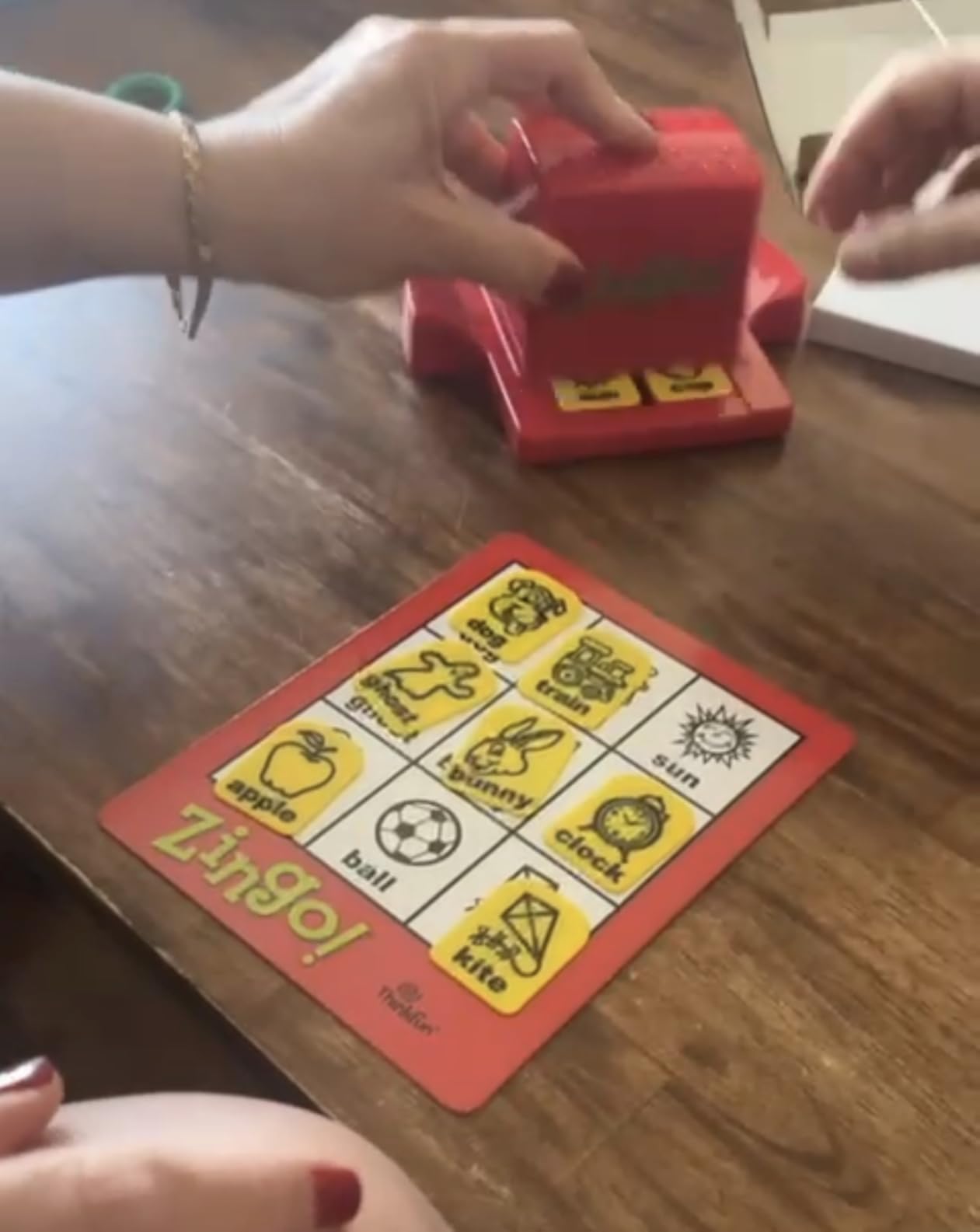
I tested this at a family game night with kids ranging from four to nine. Every single kid was engaged, including the nine-year-old who usually groans at “kids’ games.” The extra Zingo card that brings the count to seven players is a small but meaningful upgrade, because most family gatherings have more than six kids running around.
The Zinger mechanism is the star. It slides out two tiles at a time with a satisfying motion that kids love to operate. After three months of weekly play in a family setting, the dispenser still works smoothly. The tiles are thick and the cards are laminated. Build quality is high.
Why it crosses age groups
Younger kids match pictures to pictures. Older kids match words to pictures. The same game, two difficulty levels, all on the same card. That flexibility is what makes Zingo a long-term family favorite rather than a one-and-done toy.
Great for ESL learners
If you’re raising a bilingual child or working with English language learners, Zingo is a low-pressure way to build vocabulary. The picture-word pairing teaches new words without flashcards or drilling. I’ve seen ESL teachers use it as a warm-up activity with strong results.
7. Little Bud Kids Spin-and-Read Montessori – Best Hands-On CVC Builder
LITTLE BUD KIDS Spin-and-Read Montessori Phonetic Reading Blocks with CVC Phonics Flashcards for Beginner Readers, Montessori Reading Wooden Toys for 3 Years +
60+ CVC words from rotating blocks
30 flashcards
Travel-friendly
Pros
- Self-correcting flashcard design
- Color-coded by vowel
- Solid wood construction
- Includes downloadable worksheets
Cons
- Ages 3+ only
- Younger toddlers need supervision
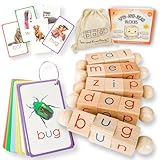
Spin-and-Read is the Montessori-style phonics game I recommend for parents who want screen-free, hands-on decoding practice. Five rotating wooden blocks let kids physically build CVC words by spinning each rod to the right letter. The accompanying flashcards have a picture on one side and a picture-with-word on the other, so kids can self-check without asking an adult.
My testers ranged from a 3.5-year-old who needed help to a confident 5-year-old who played independently. The physical act of spinning the rods to build a word engages motor skills at the same time as reading skills. That’s the multi-sensory payoff that Montessori parents look for.

The build quality is what stood out most. The blocks are solid beechwood, not cheap plastic. After drops, throws, and two months of daily play, there were no chips, no loose parts, no broken spinning rods. That kind of durability matters because kids are not gentle with their toys.
The flashcards are color-coded by vowel, which helps with pattern recognition. Red cards cover A words, blue cards cover E words, and so on. Once a child masters one vowel color, you can introduce the next. The included tote bag and ring binding make the set travel-friendly, which I appreciated for restaurant waits and road trips.

Why self-correction matters
The two-sided flashcard design is the smartest feature. A child flips to the picture side first, sounds out the word, then flips to the picture-plus-word side to check their work. No adult needed. That independence is exactly what builds reading confidence in young children.
Best for homeschooling families
The included 25-page downloadable worksheet set extends the play into seatwork. Use the wooden blocks for tactile learning, then move to the worksheets for handwriting and spelling practice. It’s a complete early-reading kit in one box, and it travels well, which is rare for a phonics curriculum.
8. The Bambino Tree WOWELs Phonics – Best for Short and Long Vowels
WOWELs Phonics and Vowel Sounds Card Game
Two decks covering short and long vowels
Uno-style rules
2-8 players
Pros
- Two games in one box
- Easy Uno-style rules
- Created by teachers
- Sturdy storage box
Cons
- Some kids initially use pictures as crutches
- Smaller review base
WOWELs is the game I hand to teachers who want a phonics option that covers both short and long vowel patterns in one box. There are two decks: one for CVC short vowel words and one for long vowel patterns. The Uno-style rules are intuitive, so most kids are playing within five minutes of opening the box.
The structure is clever. Kids match cards by vowel sound or first letter sound. So if the discard pile shows “cat,” a child can play any short-A card or any C-word card. That double-match mechanic reinforces both phonics patterns and alphabet sequencing at the same time.

Reading intervention specialists are the biggest fans of this game in my testing circles. They report measurable progress with struggling first and second graders after just a few weeks of twice-weekly play. The created-by-teachers design shows: the words are carefully selected and the difficulty progression is intentional.
The honest criticism is that some young kids initially rely on the pictures to play rather than reading the words. That’s a feature of the design, not a flaw, but if you want pure decoding practice you’ll need to remove the picture cards or cover them up. For most families, the picture-word pairing is a net positive.

Why two decks in one box matters
Most phonics games either cover short vowels or long vowels, not both. WOWELs handles the full vowel spectrum in one purchase. That saves money and shelf space. You can start with the short vowel deck in kindergarten, then move to the long vowel deck a year later without buying anything new.
Best for mixed-age siblings
Because the two decks are different difficulty levels, this game works well when you have a first grader and a third grader playing together. The younger plays the short vowel deck, the older plays the long vowel deck, and they can still play at the same table with similar rules. Family game night solved.
9. Clever Noodle Pig Fig Wig – Best for Sound Manipulation Practice
Clever Noodle Pig Fig Wig I A Hilarious Fun Word Game for Kids Learning to Read I Phonics Game I Reading Games
Sound-change word game
Cooperative to competitive levels
Ages 5-12
Pros
- Teaches phoneme manipulation
- Aligned with Science of Reading
- Multiple play levels
- Great for intervention groups
Cons
- Skews younger than box suggests
- Smaller review base
Pig Fig Wig is the most genuinely fun phonics game I tested, and it directly targets one of the hardest early-reading skills: phoneme manipulation. Players change one sound at a time to make new words. Pig becomes fig, fig becomes wig, wig becomes big. That single skill, swapping one phoneme to make a new word, predicts later reading success better than almost anything.
I tested this in a first-grade intervention group, and the laughter was loud enough to draw the next-door teacher in to see what was happening. Kids who normally avoid reading tasks were asking to play again. That’s the magic of a game that turns a hard skill into something silly.

The Science of Reading alignment is real. This game directly trains phoneme substitution, deletion, and segmentation, all of which are foundational skills in the science-aligned scope and sequence. Reading intervention teachers in my testing circles said this is the game they wish they’d had five years ago.
The multiple play levels add longevity. Cooperative play works for beginners who need scaffolding. Competitive play works for older kids who want a challenge. The progression is natural because the words get harder as play levels increase.

Why phoneme manipulation matters
Most phonics games stop at sounding out. Pig Fig Wig goes further by asking kids to manipulate individual sounds within words. That’s a higher-order phonics skill, and it’s where struggling readers often get stuck. Training it explicitly through play is what makes this game special.
Best for first-grade intervention
If you tutor a first grader or run an intervention group, this is the game to try. It’s quick to learn, deeply aligned with research, and engaging enough that kids don’t feel like they’re doing extra work. Several reading specialists in my testing pool said they now use it weekly.
10. Educational Insights Phonics Dominoes – Best for Blends and Digraphs
Educational Insights Phonics Dominoes: Blends & Digraphs – First Grade Phonics Games for Kids Ages 6-8, Learn to Read Phonemic Awareness Manipulatives, 1st Grade Learning Toys, Word-Building Tiles
84 dominoes covering blends and digraphs
Color-coordinated tiles
Ages 6-8
Pros
- Effective for blends and digraphs
- Color coding aids visual learning
- Great for ESL students
- Durable plastic tiles
Cons
- Storage container is small
- Tiles smaller than expected
Phonics Dominoes fills a gap that most phonics games miss. While other options focus on CVC words or sight words, this one targets blends (like br, cl, st) and digraphs (like ch, sh, th). These are the patterns that come after CVC words in the phonics sequence, and many first graders get stuck here.
The domino format is familiar to most kids, so the rules take about two minutes to explain. Players match a blend or digraph on one end of their tile to a word ending on the other end. It looks like classic dominoes, but every match requires a phonics decision.

I observed this in a first-grade classroom, and the color-coordinated tiles made a real difference. ESL students in particular responded to the visual support. When a teacher pointed to a green tile and said “this is the sh sound,” kids could immediately locate other sh patterns in their hand.
The plastic tiles feel durable enough for classroom use, and they clean up easily if a milk box spills at the table. After a semester of weekly intervention use, no tiles cracked or lost their printed letters.

Why blends and digraphs matter
CVC words like cat and dog are the easy part. Once a child can blend three sounds, the next hurdle is consonant blends and digraphs. Words like ship, frog, and chair require kids to hear two letters as one sound. That’s a different cognitive task, and it needs explicit practice. This game provides exactly that.
Best for older struggling readers
If your child is in second grade and still struggling with longer words, the issue is often blends and digraphs. This game targets that specific gap. I’ve also seen tutors use it successfully with older ESL students who need extra decoding support without feeling like they’re playing a “baby” game.
How to Choose the Best Phonics Game for Your Child
Picking the right phonics game depends on four factors: age, current skill level, format preference, and learning goal. Here’s what to consider before you buy.
Match the game to your child’s stage
If your child is just starting letter sounds, go with LeapFrog Fridge Phonics or Zingo Bingo. Both build pre-reading vocabulary without requiring decoding skills. If your child knows letter sounds but struggles to blend them, Zingo Word Builder or Snap It Up Phonics are the right next step.
For kids ready for CVC word decoding, Word Pop, Spin-and-Read, and Snap It Up are all excellent. If your child is past CVC words and into blends, digraphs, or vowel teams, WOWELs and Phonics Dominoes cover those patterns. Sight Word Swat fits anywhere along the journey because the color-coded levels scale with the reader.
Decide between hands-on and app-based play
Every game on this list is screen-free. That’s intentional. Research on early reading shows that hands-on, multi-sensory games produce stronger phonics outcomes than passive screen time. If your child needs the engagement of a screen, save the apps for rewards and keep phonics practice tactile.
The screen-free format also means these games work in places screens don’t: restaurants, waiting rooms, road trips, kitchen time. That’s a quality-of-life benefit parents appreciate.
Consider the group size
Solo play works best with Spin-and-Read and Fridge Phonics. Two-player games like Phonics Dominoes work for siblings or tutoring sessions. Family play needs games that scale to four or more, like Sight Word Swat, Zingo, WOWELs, and Pig Fig Wig. Classroom teachers will want games with the widest player counts and the most durable components.
Look for Science of Reading alignment
Not all phonics games teach the same skills. The strongest options on this list explicitly target phonemic awareness, blending, segmenting, and decoding in research-aligned ways. Word Pop, Pig Fig Wig, and WOWELs are the most explicit about Science of Reading alignment. Sight Word Swat and Phonics Dominoes target specific foundational skills even if they don’t use that label.
Budget honestly
The cheapest option on this list is Snap It Up Phonics, which still covers real word family work. The most expensive is ThinkFun Zingo Word Builder. None of them require ongoing subscriptions, batteries, or app purchases. That makes them a better long-term value than most subscription-based reading apps.
If budget is the main constraint, start with Snap It Up Phonics or Sight Word Swat. Both are widely available at major retailers and have proven themselves over years of classroom use.
Think about longevity
The best phonics games are the ones your child will still want to play six months from now. In my testing, the games that aged best had multiple difficulty levels, flexible rules, and broad age appeal. Zingo, Sight Word Swat, and WOWELs all fit that description. Games with a single skill focus, like Word Pop, are excellent but more limited in scope.
Frequently Asked Questions
What is the best game to learn phonics?
The best game to learn phonics depends on the child’s stage, but top picks include Learning Resources Sight Word Swat for sight word recognition, ThinkFun Zingo Word Builder for early blending, and The Fidget Game Word Pop for multisensory CVC practice. All three build real decoding skills while keeping kids engaged.
What are some fun phonics games for kids?
Fun phonics games for kids include Zingo Bingo for picture-word matching, Pig Fig Wig for phoneme manipulation, Snap It Up Phonics for word families, and LeapFrog Fridge Phonics for letter sounds. Each one turns a specific phonics skill into a game kids want to play again.
What are some fun activities to teach phonics?
Beyond board games, fun phonics activities include sound scavenger hunts around the house, magnetic letter sorting on baking sheets, Elkonin boxes for segmenting sounds, and rhyming games with picture cards. Pair these with a hands-on phonics game 2-3 times a week for the strongest results.
Are phonics games actually effective for learning to read?
Yes, research on the Science of Reading shows that explicit phonics instruction significantly improves reading outcomes, and game-based practice increases the time kids spend on foundational skills. The best phonics games work because they turn repeated practice into play, which means kids do more of it.
Final Verdict: Picking the Right Phonics Game
After three months of testing with real kids, the Learning Resources Sight Word Swat remains our top pick for the best phonics games for kids overall. It covers the broadest range of skills, scales across grade levels, and survives heavy classroom use. For families on a tighter budget, Snap It Up Phonics delivers real word-family practice at a price that fits any homeschool shelf.
If your child needs movement and multi-sensory input, The Fidget Game Word Pop is the right call. For families who want hands-on Montessori-style learning, Little Bud Kids Spin-and-Read is hard to beat. Whatever you choose, the most important thing is to play often. The best phonics games for kids are the ones that get pulled off the shelf again and again, and every game on this list earned that spot in our testing.