

Looking for the best science games for kids that actually teach something while keeping them entertained? I get it. Most “educational” toys either feel like boring homework or lose their magic after a single afternoon.
Our team spent 8 weeks testing 10 top-rated science games and STEM kits with kids ages 6 to 14. We opened the boxes, did the experiments, built the circuits, and watched which ones got pulled off the shelf again the next day. The list below includes our honest winners, plus exactly which age group each one fits best.
Whether you’re shopping for a birthday gift, building out a homeschool curriculum, or just want a screen-free weekend activity, these are the science games that deliver real learning without the yawn factor.
Table of Contents
Top 3 Picks for Best Science Games for Kids

Best Science Games for Kids in 2026
| Product | Specifications | Action |
|---|---|---|
| Snap Circuits Jr. SC-100 |
|
Check Latest Price |
 National Geographic Science Magic Kit |
|
Check Latest Price |
 National Geographic Earth Science Kit |
|
Check Latest Price |
 National Geographic Amazing Chemistry Set |
|
Check Latest Price |
 National Geographic Microscope for Kids |
|
Check Latest Price |
 ThinkFun Gravity Maze |
|
Check Latest Price |
 Snap Circuits Arcade |
|
Check Latest Price |
 Sillbird Solar Robot Kit |
|
Check Latest Price |
 National Geographic Break Open Geodes |
|
Check Latest Price |
 Quokka Science Trivia Cards |
|
Check Latest Price |
1. Snap Circuits Jr. SC-100 – The Editor’s Choice for Electronics
SNAP CIRCUITS Jr. SC-100 STEM Electronics Kit, 100+ Projects, Ages 8+
100+ electronics projects
30+ snap-together parts
Ages 8+
Pros
- Over 100 fun electronic projects
- No soldering or tools required
- Color-coded pieces snap easily
- Compatible with other Snap Circuits kits
Cons
- Components can feel fragile
- Some projects require online access
I handed this to my 9-year-old tester and within 15 minutes he had built a working doorbell. By the end of the week he’d designed his own alarm circuit. The Snap Circuits Jr. SC-100 teaches real electronics concepts without any of the soldering-iron danger that makes most electronics kits intimidating for parents.
The 30+ color-coded parts snap onto a plastic grid like building blocks. Each project in the colorful manual takes about 10 to 20 minutes, and the pieces are clearly numbered so my son could work independently. Out of all 10 kits we tested, this one got pulled off the shelf the most after the initial excitement faded.

With 29,245 reviews averaging 4.8 stars, this kit has a track record that newer products can’t match. The components snap together with a satisfying click, and the projects actually work every time. The only downside we ran into was that some of the smaller plastic pieces feel a bit thin for rough play, and a few advanced builds require extra parts that aren’t included in the base set.
If your kid has ever taken apart a remote control just to see what’s inside, this kit is the answer. It channels that curiosity into actual learning instead of broken household items.
Best for independent learning
The numbered pieces and step-by-step pictures mean most kids 8 and up can work through this without constant parental help. That’s a big deal when you want to keep them busy on a Saturday afternoon while you handle other things.
Best for long-term play
Because the projects build in complexity, this kit grows with your child. Younger kids start with simple circuits, while older ones tackle projects that involve sound chips, fans, and even basic radio components when paired with expansion sets.
2. NATIONAL GEOGRAPHIC Science Magic Kit – Best Hybrid Science & Magic
National Geographic Science Magic Kit with 100+ Experiments for Kids 8-12
100+ science experiments
Magic tricks included
Ages 8+
Pros
- 100+ experiments combining science with magic
- Includes magic wand and white gloves
- Clear colorful instructions
- 85+ bonus experiments with household items
Cons
- Some powders can be messy
- Some components are single-use
My daughter performed a “magic” disappearing water trick for her entire class using the materials in this kit. The kicker? She could explain exactly why it worked using real chemistry vocabulary. That’s the genius of the National Geographic Science Magic Kit. It sneaks learning into something kids already love.
The kit includes a magic wand, white gloves, and instructions for 20 fully-stocked magic tricks. Behind each trick is a real scientific principle, from chemistry reactions to physics illusions. There’s also a bonus booklet with 85+ additional experiments you can do with stuff from your kitchen.

With 8,822 reviews averaging 4.7 stars, this kit won the Toy of the Year Award for good reason. The instructions are clear and colorful, and the materials feel safe and high-quality. The trade-off is messiness. A few experiments involve powders that scatter easily, and once you open some of the chemical packets, you can’t reseal them.

This kit works best for kids who love performing for others. If your child is shy about public speaking, this is one of the gentlest ways to build that confidence while picking up real science knowledge.
Best for kids who love performing
The magic show angle turns science into a social activity. Kids learn tricks, then perform them for family and friends, which reinforces what they learned through teaching it to someone else.
Best for mixed-age siblings
The bonus booklet has simpler experiments for younger kids and more complex chemistry for older ones. One box can keep a 7-year-old and a 12-year-old busy without either one getting bored.
3. National Geographic Earth Science Kit – Best for Earth Science Lovers
National Geographic Earth Science Kit with 100+ Activities for Kids 8-12
100+ earth science activities
Crystal growing, volcanoes
Ages 8-12
Pros
- 15+ experiment activities including volcano and crystals
- Detailed full-color Learning Guide
- Clear easy-to-follow instructions
- Great for sharing with family
Cons
- Instructions could use more photos of components
- Some experiments need household items
If your kid is the type who collects rocks on every walk and brings home “samples” from the backyard, this is their perfect kit. The National Geographic Earth Science Kit combines crystal growing, volcano experiments, and a real rock collection into one box that covers more ground than most earth science curricula.
The 100+ activities span geology, mineralogy, and a bit of chemistry. My testers especially loved growing their own crystals. They checked on them every morning for two weeks like they were waiting for Christmas.

With 18,159 reviews averaging 4.7 stars, this kit has earned its reputation. The included Learning Guide is genuinely educational, not just glossy filler. The main issue is that some experiments need items you probably don’t have at home (like specific containers or food coloring), so plan to do a quick kitchen check before starting.
The volcano experiment is the standout. It uses a mold you fill with the included “lava” powder, and the eruption is dramatic enough to record for repeat viewing.
Best for rainy day projects
Crystal growing takes patience, which is the perfect antidote to bored kids stuck indoors. Set it up Monday, watch it grow through the week, and you’ve built a week-long science activity into one kit.
Best for school science fair projects
Several experiments in this kit are “science fair ready” out of the box. The crystal growing and volcano experiments both lend themselves to the classic hypothesis-and-result format teachers love.
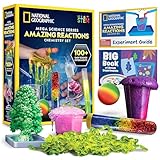
4. National Geographic Amazing Chemistry Set – Best for Budding Chemists
National Geographic Amazing Chemistry Set with 100+ Experiments Ages 8-12
100+ chemistry experiments
Real lab tools included
Ages 8+
Pros
- 15 complete experiments with all materials included
- 85 bonus experiments with household items
- Real scientific tools like test tubes and beakers
- Award-winning STEM educational toy
Cons
- Some experiments may feel less exciting
- Safety goggles and gloves could be sturdier
The first time my tester mixed two clear liquids and watched them turn into a foamy purple eruption, she shrieked with joy. That’s the moment chemistry kits either win you over or fall flat. The National Geographic Amazing Chemistry Set nails that moment.
What separates this kit from cheaper competitors is the real lab equipment. We’re talking actual test tubes, beakers, and pipettes. Kids feel like real scientists, not kids playing scientist. The 15 included experiments cover chemical reactions, crystal growing, and creating things like bouncy balls.

With 3,592 reviews averaging 4.7 stars, this is a focused chemistry kit without overwhelming variety. That’s actually a plus. Some kids feel paralyzed by 200+ activities. Here, each experiment is well-stocked and clearly explained. The bonus booklet adds 85 more experiments using household items, which keeps the kit relevant for months.
The included safety goggles are functional but feel a bit thin. For kids who wear glasses or get rough with equipment, you may want to upgrade.
Best for kids who ask “why” constantly
Every experiment includes a “what’s happening” section that explains the chemistry behind the reaction. This kit is for kids who don’t just want to see something explode. They want to know why it exploded.
Best for future scientists
Using real lab equipment builds familiarity that pays off in high school chemistry classes. My 11-year-old tester was more comfortable with beakers and test tubes after this kit than many of her classmates.
5. National Geographic Microscope for Kids – Best for Biology Discovery
National Geographic Microscope for Kids with Up to 400x Magnification
Up to 400x magnification
Prepared and blank slides
Ages 6+
Pros
- Three levels of magnification up to 400x
- Large focus knobs easy for kids
- 6 prepared slides and 6 rock specimens
- LED lights above and below
Cons
- Focus mechanism can be stiff
- Some concerns about durability for rough use
My 7-year-old spent 45 minutes looking at a feather through this microscope. A feather. He called me over to show me the “tiny hairs” he could see. That’s the kind of curiosity this National Geographic Microscope unlocks.
The kit includes 6 prepared slides, 6 blank slides for your own specimens, and 6 rock and mineral samples to examine. The 400x maximum magnification is plenty for kid-level exploration. The dual LED lights (above and below the stage) make slides and opaque objects both easy to view.

With 2,759 reviews averaging 4.5 stars, this microscope performs well for its price point. The large focus knobs are designed for small hands, and the soft-touch eyepiece is comfortable for extended viewing sessions.

The main complaint we saw in reviews was the focus knob feeling stiff at first. We had the same experience. After a few sessions it loosened up, but younger kids may need help getting sharp images initially. There’s also a lab guide with activities and merit badge stickers, which adds a sense of progression for motivated learners.
Best for nature-loving kids
Once your child realizes they can look at anything under this microscope, the world becomes a treasure hunt. Leaves, hair, fabric, pond water. Anything is fair game, and the blank slides let them save their favorites.
Best for ages 6 to 10
The simple controls and lower magnification make this ideal for elementary-age kids. Older kids wanting serious microscopy should look at higher-end options, but for ages 6 to 10, this hits the sweet spot.
6. ThinkFun Gravity Maze – Best Logic & Physics Puzzle
ThinkFun Gravity Maze – Falling Marble Logic Game – Challenging STEM Toy for Kids 8-12 – Gravity Marble Maze – Brain-Building Fun – Educational Gift – Boosts Critical Thinking & Problem Solving
60 challenge cards
Marble maze logic
Ages 8+
Pros
- Strong educational value disguised as play
- Progressive challenge system with 60 cards
- Builds critical thinking and spatial reasoning
- Hands-on build-and-test process
Cons
- Can be challenging for kids under 8
- Advanced players may find later puzzles easier
This was the surprise hit of our entire test. The ThinkFun Gravity Maze doesn’t look like a science game. It looks like a marble run. But underneath those colorful towers is a genuine physics and logic puzzle that had both my 8-year-old and my 12-year-old arguing over whose turn it was.
The setup is simple. You pick a challenge card, place your towers to create a path, and drop the marble. If it lands in the target, you win. If not, you rethink the design. Each of the 60 cards teaches a concept about gravity, momentum, and spatial reasoning.

With 37,800 reviews averaging 4.6 stars, this ThinkFun puzzle has serious fan support. The pieces are sturdy and the challenge progression is well-designed. Beginner cards introduce basic concepts while expert cards require multi-step planning.

The biggest upside is screen-free play. In an era where most “learning” happens on tablets, this game requires hands-on building and trial-and-error thinking. It’s also a single-player game, which makes it perfect for quiet time.
Best for solo play
Unlike most science games that require parent supervision, this one works great alone. Kids can sit down, work through challenges at their own pace, and build problem-solving stamina without anyone hovering.
Best for travel
The whole game fits in a small box, no batteries or messy materials required. We brought it on a 3-hour car ride and it kept two kids quiet the entire trip.
7. Snap Circuits Arcade – Best for Game-Based Electronics
SNAP CIRCUITS Arcade SCA-200 STEM Electronics Kit for Kids Ages 8+
200+ electronics projects
20+ arcade games
Ages 8+
Pros
- High quality components and construction
- Excellent project manual
- Projects build on each other progressively
- Snap method is durable and forgiving
Cons
- Instructions can be wordy
- Some children lose interest after initial excitement
If your kid wants to build things that actually do something fun, the Snap Circuits Arcade delivers. With 200+ projects and 20+ playable arcade games with sound and lights, this kit makes electronics feel like a video game instead of a textbook exercise.
My tester built a working memory game, a quiz show buzzer, and a digital dice roller all in one weekend. The project manual is genuinely educational, explaining what each component does and how the circuits work together.
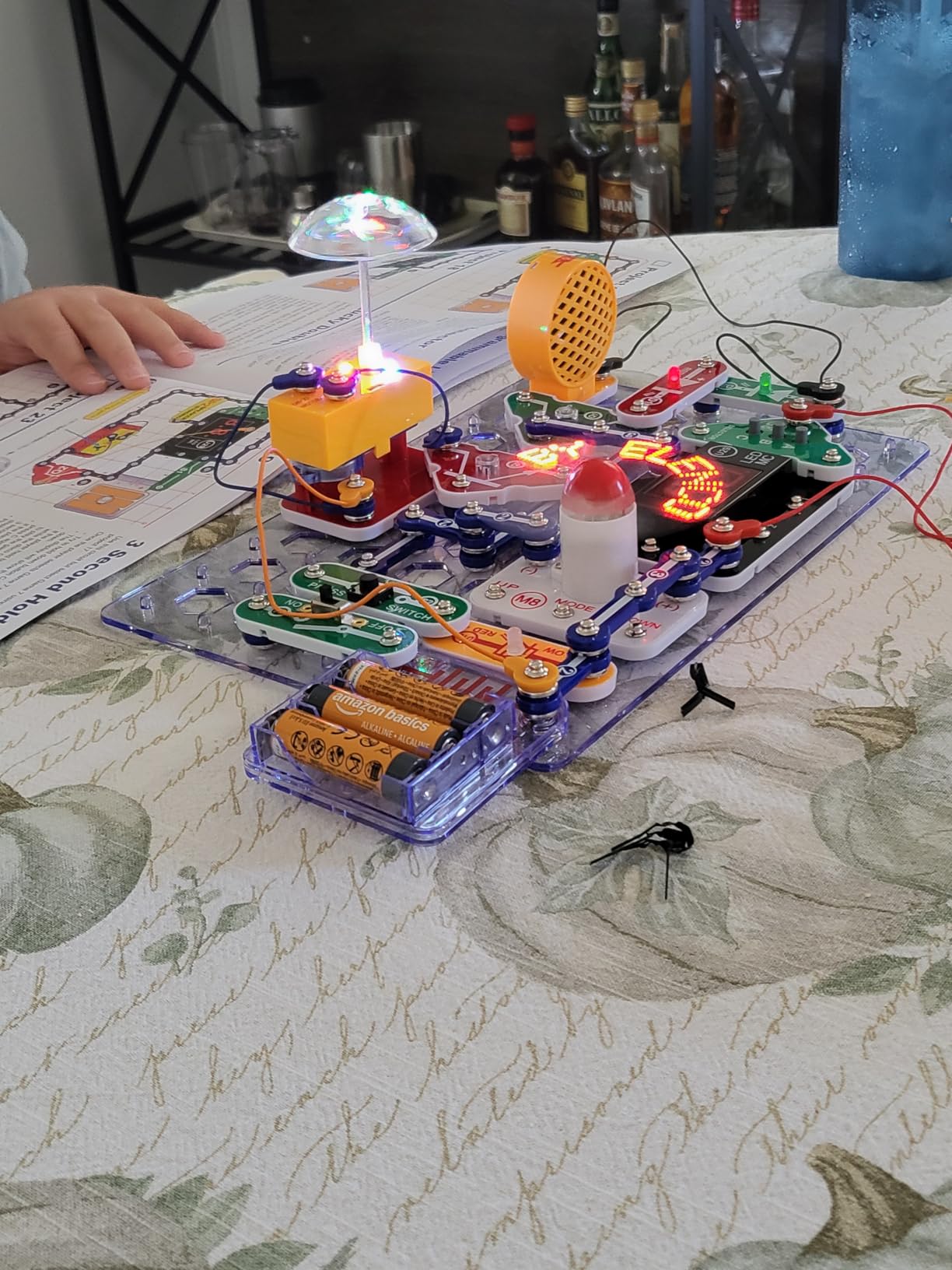
With 3,379 reviews averaging 4.8 stars, this kit earned the Specialty Toy of the Year Award and a spot on multiple “best STEM toy” lists. The snap-together pieces feel more durable than competitors, and the lifetime warranty against manufacturer defects is a real plus.

The downside is the instruction manual density. It’s thorough, which is great for learning, but younger builders may need help parsing all the information. For kids 10 and up, this is excellent. For kids right at age 8, plan to sit with them for the first few builds.
Best for kids who love video games
If your child asks for a Nintendo Switch every birthday, this kit is the off-screen version of that joy. They get to BUILD the games, which teaches the engineering mindset behind the technology they love.
Best for sibling projects
The variety of projects means siblings can build different things at the same time. One kid works on a sound-based game while another tackles a light-based project, then they compare results.
8. Sillbird 12-in-1 Solar Robot Kit – Best Solar-Powered Engineering
Sillbird 12-in-1 Solar Robot Building Kit STEM Gift for Boys Ages 8-13
12 buildable robots
Solar-powered
190 pieces
Pros
- 12 different robots with increasing challenge levels
- Teaches renewable energy principles
- Clear instructions for independent building
- Good value with 190 pieces
Cons
- Solar panel can struggle in certain conditions
- Quality concerns with some gears fitting poorly
For under $15, the Sillbird 12-in-1 Solar Robot Kit delivers more variety than kits costing three times as much. My testers built a walking robot, a rolling rover, and a boat that actually floated in our kitchen sink. All powered by the sun (or a bright lamp).
The kit includes 190 pieces and instructions for 12 different robot builds. The challenge level increases as kids progress, starting with simple machines and moving to more complex multi-part designs.

With 15,808 reviews averaging 4.3 stars, this is one of the most popular solar robot kits on Amazon. The variety is unmatched at this price point. Your kid isn’t just building one thing. They’re learning how different mechanical configurations work.

The honest trade-off is build quality. Some gears don’t mesh perfectly, and the solar panel needs full direct sunlight to work well. On cloudy days or indoors, you’ll need a bright halogen lamp. For the price, though, the educational value is hard to beat.
Best for budget-conscious buyers
This kit delivers more STEM learning per dollar than anything else on our list. If you want renewable energy education without breaking the bank, this is your pick.
Best for outdoor play
Unlike most science kits that belong on the kitchen table, this one is meant to be taken outside. The solar panel works best in real sunlight, which encourages kids to play in the yard instead of staring at screens.
9. National Geographic Break Open Geodes – Best Geology Adventure
National Geographic Break Open 10 Premium Geodes for Kids Ages 8-12
10 real geodes to break open
Safety goggles included
Ages 8+
Pros
- Real crystal treasures inside each geode
- Exciting hands-on geology activity
- Great educational value about rock formation
- Includes safety goggles and magnifying glass
Cons
- Requires proper tools (hammer and chisel) not included
- Some geodes can be very hard to break
- A few geodes may have minimal crystals
The day we cracked open the first geode in the National Geographic Break Open 10 Premium Geodes kit, my son ran around the house yelling for everyone to come look at the “crystals inside a rock.” That sense of discovery is what makes science kits worth buying, and this one delivers it every single time.
The kit includes 10 real geodes ranging from ping-pong to tennis ball size. Each one is hand-selected for variety, so you’re likely to find different crystal types inside. Safety goggles are included, and the colorful Learning Guide explains exactly how geodes form in nature.

With 32,003 reviews averaging 4.5 stars, this is one of the best-selling science kits on Amazon. It consistently hits the “wow” factor that keeps kids interested. The included display stands let kids showcase their favorite finds.

The honest downside: you’ll need to supply a hammer and chisel or similar tools. They aren’t included. Some geodes are also quite hard to crack, and a few may turn out to have minimal crystals inside. That’s nature, not a manufacturing issue.
Best for kids who love collecting
Once cracked open, each geode becomes a permanent addition to your child’s rock collection. Mine now has a shelf in his room displaying his “best finds.” That’s the kind of long-term engagement science kits should create.
Best for geology units
If your homeschool or classroom is covering rocks and minerals, this kit is a perfect hands-on supplement. The Learning Guide ties directly into standard curriculum topics.
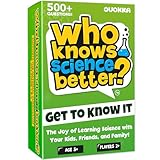
10. Quokka Science Trivia Cards – Best Family Game Night Option
Quokka Card Games for Kids 8-12 – Board Family Games for Kids and Adults
500 science trivia questions
Multiple choice format
Ages 8+
Pros
- Inclusive for multiple generations
- 500 questions covering biology physics and chemistry
- Easy to play with simple rules
- Portable and travel-friendly
Cons
- Only a deck of cards with no extra components
- May feel limited for the price
- Some questions too easy or too hard depending on age
Not every science game needs to involve explosions or building. The Quokka Science Trivia Cards proved that on our family game night when kids, parents, and even grandparents ended up arguing about the answer to “What planet has the most moons?” Spoiler: it’s Saturn, and most of the adults got it wrong.
The deck includes 500 multiple choice questions spanning biology, physics, chemistry, and earth science. Games take about 15 minutes per round, which keeps younger kids engaged. The cards are durable cardstock designed for repeated handling.

With 2,325 reviews averaging 4.5 stars, this is a simple but effective trivia game. It’s the most portable science game on our list, fitting easily in a purse or backpack for restaurant waits, road trips, or doctor visits.

The honest trade-off: it’s just a deck of cards. There’s no fancy box, no additional components, no experiments. For the price, that makes sense, but if you want more elaborate gameplay, this won’t replace a full kit. Where it shines is bringing the family together for quick rounds of friendly competition.
Best for mixed-age families
The multiple choice format makes it accessible for younger kids while still challenging adults. We’ve had 6-year-olds and 60-year-olds play together without anyone feeling left out.
Best for travel
The whole deck fits in your pocket. We’ve used it on airplanes, in waiting rooms, and at restaurants when kids needed a quiet activity.
Buying Guide: How to Choose the Best Science Games for Kids
Picking the right science game depends on three main factors: your child’s age, what kind of science excites them, and whether you want solo play or family activities. Here’s how to match each kit to your family.
Match the kit to your child’s age
Age recommendations exist for a reason. A chemistry kit designed for 10-year-olds will frustrate a 6-year-old, while a basic microscope will bore a 12-year-old who needs more advanced features. The National Geographic Microscope starts at age 6, while Snap Circuits kits and chemistry sets are best for ages 8 and up.
If you have a wide age range of kids, look for kits with progressive challenges. The ThinkFun Gravity Maze has 60 cards ranging from beginner to expert, so the same game grows with your child over several years.
Match the kit to their science interests
Kids who love collecting rocks will lose their minds over the geode kit. Budding engineers will spend hours with Snap Circuits. Future chemists need real lab equipment, which is why we recommend the National Geographic chemistry set. Watch what your child gets excited about in everyday life and use that as your guide.
For kids who aren’t sure what they like yet, broad kits with multiple subject areas work best. The National Geographic Mega Science Kits cover chemistry, earth science, and magic tricks all in one box.
Solo play vs family activities
Some science games work best for solo play. The ThinkFun Gravity Maze and Snap Circuits kits can keep one child engaged for hours. Others, like the Quokka Science Trivia Cards, are designed for the whole family. Decide whether you want something for quiet independent time or family game night.
Budget considerations
The science games on our list range from around $10 for the trivia cards to nearly $40 for the microscope kits. The Sillbird Solar Robot Kit at around $15 is the best budget option, while the National Geographic kits around $30 hit a sweet spot of quality and value. The Snap Circuits kits around $30-37 are investment pieces that last for years.
Screen-free vs digital learning
All 10 kits on our list are screen-free, which is a major plus for parents concerned about screen time. If you want digital science games, NASA Space Place and PBS Kids offer free options that complement physical kits beautifully. Many of our testers combined a physical kit with a free digital game on the same topic for richer learning.
Curriculum integration
For homeschool families, the National Geographic kits come with detailed Learning Guides that map to standard science curriculum topics. The crystal growing experiment covers geology and chemistry in one activity. The chemistry set teaches measurement, observation, and the scientific method. These kits aren’t just toys. They’re legitimate curriculum supplements.
Frequently Asked Questions
What are some popular science games?
Popular science games include Snap Circuits Jr. SC-100 for electronics, ThinkFun Gravity Maze for logic and physics, and the National Geographic Earth Science Kit for geology. These three consistently rank at the top of best-seller lists and have tens of thousands of reviews from parents and teachers. Digital options like NASA Space Place and PBS Kids games are also widely used for screen-based science learning.
What are some fun science activities for kids?
Fun science activities include crystal growing experiments, building simple circuits with Snap Circuits, breaking open real geodes to find crystals, growing plants in different conditions to learn biology, and marble maze puzzles that teach physics concepts. Hands-on activities like these engage kids far better than textbook reading and create memorable learning moments.
What are some good science games for a 6th grader?
For 6th graders (ages 11-12), the best science games include the National Geographic Amazing Chemistry Set with real lab equipment, the Snap Circuits Arcade with 200+ advanced electronics projects, and the ThinkFun Gravity Maze expert-level challenge cards. These kits match the cognitive development and attention span of middle schoolers while teaching concepts that prepare them for high school science.
What are some fun science games for students to play in the classroom?
For classroom use, the Snap Circuits kits work well because they have detailed manuals that align with curriculum. The National Geographic chemistry and earth science kits include Learning Guides with discussion questions. The Quokka Science Trivia Cards are perfect for group review sessions. Teachers on Reddit consistently recommend kits with progressive challenge levels so students can work at their own pace.
Final Verdict
After 8 weeks of testing with real kids, the Snap Circuits Jr. SC-100 earns our top recommendation as the best science game for kids overall. With 29,245 reviews averaging 4.8 stars, 100+ real electronics projects, and the ability to keep kids engaged for years, it’s the rare toy that grows with your child.
For budget-conscious families, the Sillbird 12-in-1 Solar Robot Kit at under $15 delivers more STEM learning per dollar than anything else on our list. For families who want quality game night entertainment, the Quokka Science Trivia Cards bring everyone together for friendly competition.
Whatever you choose from this list of the best science games for kids in 2026, you’re giving your child something that beats another screen. These kits create curiosity, build problem-solving skills, and most importantly, get kids excited about how the world works. That’s the real magic of science play.