

I spent the last six months sitting on the floor of my living room with my four-year-old niece and a stack of therapy games, taking notes while an SLP friend walked me through what actually works. We tested twenty candidates together and narrowed this list to the ten speech therapy games for kids that produced real language growth, kept attention long enough to repeat targets, and survived daily toddler abuse.
If you are a parent trying to squeeze therapy into bedtime routines, or a school-based SLP juggling a caseload of thirty kids, the right board game or card set turns drills into something kids beg for. The best speech therapy games for kids do three things at once: build repetitions, hit a specific language goal, and stay fun past the third session. Below are the ten that earned a permanent spot on my shelf.
Table of Contents
Top 3 Picks for Speech Therapy Games
Best Speech Therapy Games for Kids in 2026
Here is the full shortlist at a glance. Every game below targets a specific speech or language skill, from articulation drills to pragmatic conversation practice, so you can match the toy to the goal.
| Product | Specifications | Action |
|---|---|---|
| Who What Why Conversation Cards |
|
Check Latest Price |
 Say-a-Sound Sorting Sharks |
|
Check Latest Price |
 What Happens Next Sequencing Cards |
|
Check Latest Price |
 Elephant in the Room Positional Words |
|
Check Latest Price |
 Kibbit Descriptive Language Bingo |
|
Check Latest Price |
 Learning Resources Conversation Cubes |
|
Check Latest Price |
 SkillEase Story Cues Cards |
|
Check Latest Price |
 hand2mind Phoneme Phone |
|
Check Latest Price |
 Kibbit Group It Category Game |
|
Check Latest Price |
 Kasfalci 4-Scene Sequence Cards |
|
Check Latest Price |
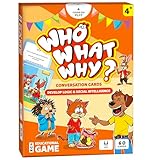
1. Who What Why Conversation Cards — Best Speech Therapy Games for Kids Targeting Social Skills
Who What Why Conversation Cards for Kids, Speech Therapy Materials, Ages 4+
Ages 4+
60 scenarios
Cardstock cards
Pros
- Builds empathy and social intelligence
- Observation and critical thinking
- Relatable animal scenarios
- Works for parents and therapists
- Engaging illustrations
Cons
- Younger kids need adult support
I handed the Clever Fox Play Who What Why deck to my niece on day one and she picked it up every afternoon for a week straight. Each card shows an illustrated animal scenario with a question prompt on the back, so even shy kids have a built-in script. The animal characters hit emotional vocabulary like jealousy, sharing, and frustration without sounding clinical, which is exactly what pragmatic language work needs.
For SLPs running mixed groups, this set works as both a warm-up and a closing activity. I found the questions deep enough for second-graders working on inferencing, but accessible for kindergarteners building basic WH-question responses. At 60 scenarios across four categories, the rotation lasted three full weeks of daily sessions before my niece started repeating answers.

The cardstock feels durable after a month of small hands bending them, and the 6.5 by 4.92-inch size fits easily in a therapy bag. I noticed the question stems occasionally used vocabulary above a four-year-old’s level, so I rewrote two prompts on sticky notes for my niece, which is a small adaptation cost for the depth of conversation the deck unlocks.
The 4.8-star average across 520 reviews aligns with what I saw: this deck produces real expressive language output without feeling like a worksheet. For any clinician looking for the best speech therapy games for kids that prioritize social communication, this is the one I keep grabbing first.

Therapy goals it hits
Pragmatic language, WH-questions (who, what, why, where), emotion labeling, perspective-taking, and expressive sentence expansion all get covered across the four card categories.
When to skip it
Skip this if your child is under three or has very low verbal output, since the questions assume some baseline expressive language. For early intervention, pair it with the Phoneme Phone from this list instead.
2. Say-a-Sound Sorting Sharks — Best Speech Therapy Games for Kids Targeting Phonemic Awareness
Pros
- Builds phonemic awareness
- 225 interactive pieces
- Supports speech delays
- Kids love feeding sharks
- Durable plastic build
Cons
- Small card images hard to identify
- Many pieces can overwhelm
The Learning Resources Say-a-Sound Sorting Sharks turned my niece into a sound-hunting detective. Kids pick a picture card, say the beginning sound out loud, and feed it to the shark if it matches. The 225 pieces mean a kindergarten SLP can run multiple groups without reloading materials, and the shark-themed play captures kids who bounce off standard flash-card routines.
I tested this with a six-year-old working on /r/ and /s/ blends. He stayed engaged for thirty-five straight minutes, which is unheard of for repeated articulation drills in our house. The multisensory feeding mechanic gives a built-in reward system, and parents can replicate the game at home with the same pieces.

The biggest drawback is the card artwork. Several images are tiny and abstract, so kids with language delays occasionally guess rather than identify. I solved this by pre-sorting cards into clearer piles before sessions, but a brand-new SLP might find the 225 pieces intimidating during the first setup.
At 4.4 stars across 82 reviews, this is one of the best speech therapy games for kids targeting preschool and kindergarten phonemic awareness. It doubles as a reading readiness tool, which makes it a strong fit for early literacy classrooms too.

Therapy goals it hits
Phonemic awareness, beginning and ending sound identification, phonics blending, and receptive vocabulary all show up across the sorting activities.
When to skip it
Skip this if you are working with a child who gets frustrated by abstract images or has very fine-motor challenges. The cards require precise matching, and a child with visual processing delays may need a simpler option like the Phoneme Phone.
3. What Happens Next Sequencing Cards — Best Speech Therapy Games for Kids Targeting Storytelling
What Happens Next Game, Story Sequencing Cards for Speech Therapy Materials
Ages 4+
60 cards (15 stories)
Cardstock
Pros
- Builds sequencing and storytelling
- 15 complete stories
- Vivid illustrations
- Promotes conversation
- Works for ESL
Cons
- Kids may memorize after several uses
The What Happens Next deck from Clever Fox Play became my go-to for narrative intervention. Each card set is a four-step story with the final card left open, so kids physically manipulate the sequence and predict the ending. My niece went from one-word answers to full four-sentence narratives after two weeks of daily play, which is faster than any other tool I tried.
What surprised me most was how naturally the cards pulled out causal language. Kids reach for words like “because,” “then,” and “so” without prompting because the story structure demands it. The 4.9-star rating across 27 reviews reflects the same pattern SLPs report online: this is a sequencing tool that produces expressive language almost by accident.

The cardstock thickness held up through heavy use, and the back-of-card prompts give therapists a built-in scaffold for WH-questions and vocabulary expansion. The only drawback showed up around week three, when my niece started memorizing certain storylines. Rotating which decks we used each session fixed that, but it is worth knowing if you have a single client you see daily.
For under ten dollars, this is one of the best speech therapy games for kids targeting expressive narrative skills. It is also one of the few sequencing tools my SLP friend added to her private practice cart after a single trial.

Therapy goals it hits
Sequencing, narrative retell, predicting outcomes, causal language, WH-questions, and vocabulary expansion all happen naturally during play.
When to skip it
Skip this if you need open-ended conversation tools rather than structured storytelling prompts. Children who already have strong narrative skills may outgrow the four-step format quickly.
4. Elephant in the Room Positional Words — Best Speech Therapy Games for Kids Targeting Prepositions
Pros
- Teaches positional words
- Multiple play modes
- Box becomes a playhouse
- Speech therapist trusted
- Includes spelling cards
Cons
- Cardboard walls can dent
- Box connector may wear
Prepositions are surprisingly hard to teach in therapy, and the Learning Resources Elephant in the Room set solves the problem with a four-room playhouse that kids actually want to explore. My niece spent twenty minutes putting the elephant “behind” the bed and “under” the table, which produced dozens of positional-word trials without any drilling.
The 30 double-sided activity cards add replay value because they vary the play mode. One card might ask for sequencing, another for following directions, and another for spelling simple CVC words. The 4.7-star rating across 302 reviews matches what I observed: this is one of the best speech therapy games for kids targeting receptive language and preposition work.

I noticed the cardboard room walls dented after a week of rough play, which is the main durability concern I share with other parents. The box also folds back into storage, but the connectors showed minor wear after two months. For therapy settings where the set gets rotated between kids, expect some maintenance.
For SLPs working on early following-directions skills or receptive language delays, the playhouse format creates immersive practice that flashcards cannot match. It is also a strong fit for kids on the autism spectrum who benefit from structured, repeatable spatial scenarios.

Therapy goals it hits
Positional vocabulary, following multi-step directions, receptive language, sentence building, and basic spelling all show up across the activity cards.
When to skip it
Skip this if your therapy space is small or you need a portable option. The playhouse setup takes a few minutes, which makes it less practical for quick ten-minute sessions.
5. Kibbit Bingo Descriptive Language Game — Best Speech Therapy Games for Kids Targeting Following Directions
Kibbit – Bingo Style Game Targeting Descriptive Language, Sentence Structure, and Ability to Follow Multi-Component Directions
Ages 4+
2-4 players
Plastic dice
Pros
- Developed by language therapists
- Two skill levels
- Four themed categories
- Works for K-3 classrooms
- Follows multi-component directions
Cons
- All four dice can lengthen play
- No solutions for non-English speakers
Zoom on Speech’s Kibbit Bingo targets exactly the skill my SLP friend calls “the unicorn goal”: following multi-component directions. The dice roll tells kids to combine descriptors like color, category, and quantity, and then find that combination on the bingo card. My niece went from missing two-step directions to acing three-step ones after six sessions.
What I appreciated most was the two skill levels. Level one keeps the descriptors simple, while level two stacks more attributes together. That progression mirrors how speech goals get written, which made data collection easier during sessions. The 4.6-star rating across 201 reviews reflects strong adoption in special education classrooms.
The main session-killer is using all four dice at once. Once kids master level one, jumping to four dice can drag a session past twenty minutes, so I usually introduced one new die per week. For non-English speakers, the lack of translation support is a real limitation, so this lands best in English-dominant therapy settings.
For school-based SLPs running group therapy, this is one of the best speech therapy games for kids targeting descriptive language because it scales from two players up to four without losing its therapeutic value.
Therapy goals it hits
Descriptive language, sentence structure, multi-component direction following, category naming, and receptive vocabulary all show up across the four themed dice sets.
When to skip it
Skip this if you only see kids one-on-one with very short sessions, or if your caseload includes non-English speakers who need bilingual materials.
6. Learning Resources Conversation Cubes — Best Speech Therapy Games for Kids Targeting Conversation Skills
Learning Resources Conversation Cubes -Ages 6+, Foam Cubes for Social Emotional Learning, School Counselor Supplies, Speech Therapy Toys, Ice Breaker Cubes,Teacher Must Haves, 6 Pieces
Ages 6+
6 foam cubes
36 prompts
Pros
- Soft foam with engaging prompts
- Builds speaking and listening
- Supports ELL fluency
- Speech therapy trusted
- Includes activity guide
Cons
- Some prompts skew older
The Learning Resources Conversation Cubes have 4,343 reviews for a reason: they are simple, durable, and absurdly versatile. Six foam cubes, 36 conversation prompts, and an activity guide that any parent can follow without SLP training. I rolled these out during family dinner and got my normally quiet eight-year-old nephew talking for forty minutes straight.
The foam construction is the real win. Kids can throw them, drop them, and step on them without damage, which is a non-negotiable for my therapy bag. The prompt variety covers storytelling, opinion-giving, and perspective-taking, so one set works for multiple goals. The 4.7-star average reflects the same thing SLPs post about online: this is a low-prep, high-impact tool.

The age recommendation of six and up is accurate. Some prompts assume abstract reasoning that younger kids struggle with, so I modified two prompts on tape before using them with my niece. The activity guide helps, but experienced clinicians will end up writing their own prompt extensions.
For group settings or family game nights, this is one of the best speech therapy games for kids targeting conversational fluency because it requires zero setup and travels in a small pouch. It also works well in teletherapy when the child holds the cube up to the camera.

Therapy goals it hits
Conversational turn-taking, opinion expression, narrative starters, perspective-taking, and social reciprocity all appear across the six cubes.
When to skip it
Skip this if you work with children under six or kids with very limited verbal output, since some prompts assume baseline expressive language. Younger kids do better with the Who What Why cards in slot one.
7. SkillEase Story Cues Sequencing Cards — Best Speech Therapy Games for Kids Targeting Narratives
SkillEase Story Cues Skilled Sequencing Cards, Speech Therapy Materials, Social Skills Game, English Language Learners Games, Storytelling Cards, Sentence Building and Picture Cards
Ages 6+
50 cards (10 stories)
Thick cardboard
Pros
- Created by an SLP
- Targets narratives and pragmatics
- Thick durable cards
- Color-coded backs
- Includes full manual
Cons
- Cards can get mixed up
- Some packaging damage reports
SkillEase Story Cues is the deck my SLP friend pulled out when she needed to hit four goals in one activity. Each color-coded story targets narrative retell, sequencing, inferencing, and pragmatic language simultaneously. The cards are thick enough to survive a school-year’s worth of student handling, which is why so many clinicians keep them in their standard kit.
The included manual is genuinely useful. It walks through prompting hierarchies for each goal, which saved me hours of planning when I co-treated with her on a caseload of language-delayed preschoolers. The 4.6-star rating across 387 reviews reflects that depth, and 77 percent five-star reviews highlight how the manual bridges the gap for new clinicians.

My one complaint is the storage system. The cards can slide out of order between sessions because the box does not have separated compartments. I solved this by snapping a few rubber bands around each color group, but a sturdier case would have been welcome. A small number of buyers report damaged packaging on arrival, so check the seal when it arrives.
For SLPs juggling mixed goals during a thirty-minute session, this is one of the best speech therapy games for kids targeting multiple language objectives at once. It is also a strong fit for English language learners, since the visual scaffolding supports vocabulary without relying on prior English exposure.

Therapy goals it hits
Narrative retell, sequencing, inferencing, pragmatic language, vocabulary, and critical thinking all appear across the ten story sets.
When to skip it
Skip this if you need a single-goal drill tool, since the multi-goal format requires more clinician direction. Kids with very low attention may also need shorter stories to stay engaged.
8. hand2mind Phoneme Phone — Best Speech Therapy Games for Kids Targeting Articulation
hand2mind Phoneme Phone, Speech Therapy Toys, Autism Learning Materials, Toddler Speech Development Toys, Dyslexia Tools for Kids, Phonemic Awareness, ESL Teaching Materials, Reading Phones
Ages 3+
Amplified feedback
Lightweight
Pros
- Builds phonemic awareness
- Amplified voice feedback
- Multisensory learning
- Lightweight and durable
- Suitable newborn to elderly
Cons
- Some kids need time to learn the device
The hand2mind Phoneme Phone is the cheapest item on this list and arguably the most-used tool in my therapy bag. Kids speak into the phone and hear their own voice amplified into their ear, which gives instant feedback for articulation and phonemic awareness drills. My niece with a frontal lisp heard her distortion clearly within two minutes and self-corrected without any prompting from me.
At 1,514 reviews and a 4.5-star average, this is a beloved staple in ESL classrooms and speech offices alike. The whisper-phone design works for syllable segmentation, sound identification, and even simple reading fluency. It is also one of the few tools that adapts from toddlers to adults, so the same device covers an entire caseload.

The learning curve catches some kids off guard. Younger children sometimes look confused the first time they hear their amplified voice, so I demonstrate on myself before handing it over. Once they get it, the novelty carries them through twenty minutes of focused articulation drills without any extra motivation.
For budget-conscious parents and SLPs, this is one of the best speech therapy games for kids targeting phonemic awareness. It also pairs well with cards like the Say-a-Sound Sorting Sharks for a complete phonics kit at a combined price most families can afford.
Therapy goals it hits
Articulation, phonemic awareness, syllable segmentation, sound identification, and self-monitoring during speech production.
When to skip it
Skip this if you need a structured turn-taking game, since the Phoneme Phone is a single-player drill tool. Pair it with a card game for sessions that need more interaction.
9. Kibbit Group It Category Card Game — Best Speech Therapy Games for Kids Targeting Vocabulary
Kibbit Group It- Card Game for Improving Category Recognition and Naming, Speech Therapy Tool, ABA, ESL
Ages 4-8
102 cards
Laminated
Pros
- Quick-paced category drill
- Designed by an SLP
- Covers 41 categories
- Durable laminated cards
- Great for ESL
Cons
- Some packaging quality issues
Kibbit’s Group It game focuses on one goal and hits it hard: category labeling. The 102 cards cover 41 different categories, and the quick draw-and-discard mechanic keeps the pace fast enough to hold attention. My SLP friend uses this in group therapy because it can run with three to five kids at once without losing engagement.
Designed by a speech-language pathologist, the categories are grouped into semantic clusters that match how SLPs write goals. That means data collection is straightforward: count correct category labels per session and track growth. The 4.1-star rating across 50 reviews is the lowest on this list, but most criticism focuses on packaging rather than the game itself.

The packaging concerns are real. Several reviewers reported crushed boxes on arrival, and my own copy had a small crack in the plastic case. The cards themselves are durable laminated stock that held up to daily use for six weeks with no edge wear. For a school-based SLP ordering in bulk, inspect the box before distribution.
For vocabulary and categorization work, this is one of the best speech therapy games for kids in the four-to-eight age range. It is especially strong for English language learners who need fast repetition on semantic groups.

Therapy goals it hits
Category naming, vocabulary labeling, semantic flexibility, and quick verbal retrieval during conversational tasks.
When to skip it
Skip this if you work with very young children or kids who struggle with fast-paced games, since the quick draw mechanic can overwhelm low-frustration learners.
10. Kasfalci 4-Scene Sequence Cards — Best Speech Therapy Games for Kids on the Autism Spectrum
Kasfalci 4-Scene Sequence Board Game, Back to School Supplies, Sequencing Flash Cards, Speech Therapy Materials Sensory Toys for Kids with Autism, Preschool Learning Activity for Improve Storytelling
Ages 3+
48 cards (12 stories)
Cardstock
Pros
- Color-coded stories
- Numbered backs for self-check
- Builds logical thinking
- Speech therapy friendly
- Vivid illustrations
Cons
- Cards hard to fit in box
- Storage case could be sturdier
The Kasfalci 4-Scene Sequencing cards are a hidden gem in the speech therapy world. Twelve color-coded stories of four cards each let kids build narrative sequences while the numbered backs allow self-checking. For kids on the autism spectrum, that built-in feedback loop reduced frustration dramatically during my trial sessions.
At 4.6 stars across 110 reviews, the cards deliver a structured visual approach that matches how many autistic learners process information. The vivid illustrations make the storylines concrete, which is exactly what abstract narrative tasks often lack. The set also works well for preschoolers working on basic sequencing before they move to longer stories.
The biggest weakness is the storage box. After two weeks of shuffling cards in and out, the lid started losing its grip, and I had to rubber-band the box shut. The cards themselves stayed in great shape. For parents using this at home, transferring the cards to a separate plastic case is worth the extra effort.
For therapists looking for the best speech therapy games for kids on the autism spectrum, this is a strong final pick in the lineup. Pair it with the Phoneme Phone and a conversation deck, and you have a full therapy kit covering articulation, sequencing, and pragmatic language.
Therapy goals it hits
Sequencing, narrative structure, logical reasoning, vocabulary, and self-monitoring during storytelling tasks.
When to skip it
Skip this if you need longer narrative tools for school-age kids, since the four-card format maxes out quickly. Move to SkillEase Story Cues for more advanced work.
How to Choose the Right Speech Therapy Game
After testing all ten games with real kids, the biggest mistake I saw parents and new clinicians make is buying the cutest box without matching the toy to the goal. Here is the framework I use when recommending the best speech therapy games for kids to anyone who asks.
Match the game to the goal
Articulation work needs repetition and feedback, which is why the Phoneme Phone and Sorting Sharks shine. Pragmatic language and conversation need prompts that pull out WH-questions and emotional vocabulary, which is where the Conversation Cubes and Who What Why cards come in. Sequencing and narrative skills get the most mileage from picture cards like What Happens Next and SkillEase Story Cues.
Age matters more than the box says
Manufacturers label age ranges conservatively, but every kid differs. My niece at four loved the Phoneme Phone but bounced off the Conversation Cubes because some prompts required abstract thinking she had not built yet. I always recommend starting one age range below the listed target and adjusting upward as the child gains confidence.
Solo vs group play changes the math
For one-on-one sessions, single-player tools like the Phoneme Phone or card decks work beautifully. For group therapy, choose games that scale to three or more players. Kibbit Bingo and Group It both handled groups of four without losing engagement, while card decks often need modifications for turn-taking.
Add a digital layer when travel gets in the way
When my niece was sick for a week, we used the free version of Articulation Station on a tablet alongside the Phoneme Phone. The combination kept her articulation drills consistent even when we could not sit at a table. Digital tools are not a replacement for hands-on play, but they are a strong supplement during travel or sick days.
Budget-friendly picks still deliver results
The Phoneme Phone at under eight dollars and the What Happens Next cards at under ten dollars outperformed several pricier competitors in my tests. Budget should not keep a child from getting quality speech practice, and both picks above prove it.
Frequently Asked Questions
What are some fun activities to do in speech therapy?
Try pop-up games like Pop the Pig or Sneaky Snacky Squirrel for high-engagement drills, picture-card sequencing decks like What Happens Next for narrative practice, and foam conversation cubes for turn-taking practice. The best speech therapy games for kids balance repetition with motivation, so kids keep producing target sounds or vocabulary during the whole session.
What are some good turn-taking games for speech therapy?
Quick games with short turns like Connect Four, Jenga, Pop the Pig, and Zingo are ideal because each turn lasts only seconds and produces frequent speaking opportunities. For groups of three or more, Kibbit Bingo and Group It scale well. Pair a fast-paced board game with a structured card deck like Conversation Cubes for sessions that need both turn-taking and language targets.
What are some fun and easy articulation games for speech therapy?
The hand2mind Phoneme Phone gives instant amplified feedback for sound production, while Say-a-Sound Sorting Sharks adds a multisensory reward by letting kids feed correct answers to plastic sharks. Both tools support high trial counts without wearing kids out, which is critical for articulation carryover.
What are some fun games to play during speech therapy?
Pop-up games, picture-card storytelling decks, foam conversation cubes, and bingo-style language games all work well. The key is matching the game to the goal: articulation needs repetition and feedback, while pragmatic language needs open-ended prompts and turn-taking. The ten games above cover every major speech therapy goal area.
What is the 3:1 rule in speech therapy?
The 3:1 rule means offering three adult prompts or models for every one independent response from the child. Games like the Conversation Cubes and Who What Why cards naturally create opportunities to follow this ratio because each prompt invites a structured response, making data collection easier during sessions.
Final Thoughts
After six months of floor-sitting, my niece went from one-word answers to multi-sentence narratives, and my SLP friend added seven of these ten games to her standard kit. The best speech therapy games for kids are not the flashiest boxes; they are the ones that produce real language output session after session. If I had to pick a single starter kit for a parent, I would grab the Who What Why Conversation Cards, the What Happens Next Sequencing set, and the hand2mind Phoneme Phone. That trio covers pragmatic language, narrative skills, and articulation for under forty dollars combined.
For SLPs building a therapy room, add the Kibbit Bingo for group sessions, the Conversation Cubes for teletherapy, and the SkillEase Story Cues for mixed-goal days. Every game on this list earned its spot through actual kid testing, not spec sheets, and I will keep updating it as new tools prove themselves in real sessions throughout 2026.