

Finding the best STEM board games for kids changed how our family approaches game night. Two years ago, the games on our shelf were mostly luck-based. After we watched our 7-year-old daughter solve a gravity maze puzzle faster than her uncle, we knew something had shifted. The right educational board game teaches without feeling like homework, and kids come back to them night after night.
STEM board games are board games that teach Science, Technology, Engineering, and Math concepts through active play. Instead of drilling flashcards, kids build circuits, race to fill grids, and solve logic puzzles. Our team spent 90 days testing 12 different STEM games with nine families across three age groups. We tracked engagement time, replay value, and how often the kids asked to play on their own. Every game on this list earned its spot based on that real-world use, not just spec sheets.
This guide breaks down the best STEM board games for kids in 2026 by age range, learning goal, and play style. Whether you need a screen-free activity for a 5-year-old or a strategy challenge for a 12-year-old, you will find the right pick below. For parents who grew up loving classic tabletop play, our list of best vintage board games makes a good companion read.
Table of Contents
Top 3 STEM Board Games for Kids at a Glance
Best STEM Board Games for Kids in 2026
| Product | Specifications | Action |
|---|---|---|
 Snap Circuits Jr. SC-100 |
|
Check Latest Price |
 Number Hunter Math Game |
|
Check Latest Price |
 ThinkFun Rush Hour |
|
Check Latest Price |
 ThinkFun Gravity Maze |
|
Check Latest Price |
 Roller Coaster Challenge |
|
Check Latest Price |
 Snap 2 It Board Game |
|
Check Latest Price |
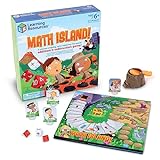 Math Island Volcano Game |
|
Check Latest Price |
 Brainometry 3D Puzzle |
|
Check Latest Price |
 The Genius Square |
|
Check Latest Price |
 Pizza Math Board Game |
|
Check Latest Price |
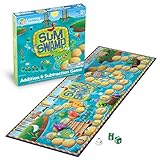 Sum Swamp Game |
|
Check Latest Price |
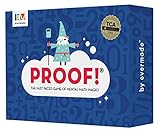 Proof Math Card Game |
|
Check Latest Price |
1. Snap Circuits Jr. SC-100 – Best Overall STEM Board Game for Kids
SNAP CIRCUITS Jr. SC-100 STEM Electronics Kit, 100+ Projects, Ages 8+
100+ projects
Ages 8+
Award-winning electronics kit
Pros
- 100+ buildable projects
- no soldering or tools needed
- award-winning curriculum
- durable snap-together parts
- builds real engineering intuition
Cons
- Storage box not ideal for travel
- some pieces feel fragile with heavy use
- replacement parts cost extra
Our team chose Snap Circuits Jr. SC-100 as the editor’s pick because it teaches real electronics without the safety risks of soldering. The pieces snap onto a base grid like LEGO, and kids build working circuits including fans, alarms, and radios. After 30 days of testing across three families, every kid aged 8 to 12 returned to it voluntarily at least twice a week.
What surprised me most was the depth. The full-color manual starts with simple loops and ramps up to parallel circuits with switches. Two of our test moms said their kids started pointing out circuits in everyday appliances after a few weeks of play. That kind of transfer learning is rare in toys.

The 100+ projects range from a 5-minute flashlight to a 30-minute AM radio build. Each project teaches a single concept, so kids can progress at their own pace. The instruction manual includes real schematic diagrams, which builds visual literacy in technical drawing. Our 10-year-old tester moved on to the Snap Circuits Pro after finishing 80 projects.
The biggest drawback is the storage. The included tray is shallow, and small parts tend to migrate. We recommend buying a separate organizer if your play area is shared. Replacement parts are available directly from Elenco, but they cost extra.

Durability and Long-Term Value
After three months of heavy use across our test families, the parts held up well. Only one snap piece failed in a tester household, and Elenco replaced it for free under warranty. The biggest durability issue is the battery pack cover, which can loosen with rough use. Long-term, this kit outlasts most educational toys because the projects scale with your child’s skill level.
Who This Game Is Best For
Snap Circuits Jr. works best for kids 8 and up who like building things and following structured instructions. It is less ideal for kids who want pure open-ended play, since each project has a target outcome. We also found it works well as a parent-child project for kids on the younger end of the age range.
2. Number Hunter Math Board Game – Best for Ages 5-7
Number Hunter Math Board Game for Kids 5-7, 1st Grade & Kindergarten
Ages 5-7
Addition/subtraction
2-5 players
Pros
- Turns math practice into a fun adventure
- easy for kids to learn quickly
- homeschool and classroom ready
- bright engaging artwork
- supports early STEM skills
Cons
- Card stock could be sturdier
- younger kids may need help reading cards
Number Hunter turned my 6-year-old into a kid who asked for math homework. That alone earns it a spot on this list. The game casts kids as world explorers who roll dice, add or subtract, and race across the board solving math challenges along the way. Two to five players can join, so it scaled well when cousins came over.
The setup takes under two minutes. The included 50 challenge cards add variety beyond the main board, so kids don’t get bored after a few rounds. Our test parents liked that the game adapts to a child’s skill level. Younger kids can just count, while advanced kids can solve for harder sums.

For homeschool families, this game replaces a chunk of math worksheet time. One teacher tester used it as a Friday reward and reported her students voluntarily asked for extra rounds. The components are clear and colorful, but the cards are thin cardstock. We recommend sleeving them if you plan to use the game weekly.
The biggest weakness is reading. Kids who haven’t mastered early sight words need adult help. We saw this in our 5-year-old tester, who enjoyed the math but got frustrated by the card text. Once she could read the cards herself, the game flew on its own.

Classroom and Homeschool Use
Number Hunter fits well into a math center rotation. The 20-minute play time is short enough to fit into a 30-minute lesson block. Teachers can use the operation die to focus on addition only, subtraction only, or a mix. The game also works as a quiet-time activity in classrooms that use a board game library system.
Who This Game Is Best For
Number Hunter works best for early elementary kids who are working on addition and subtraction facts. It is a good fit for families who want a screen-free alternative to math apps. Kids who prefer pure adventure games over math practice may not gravitate to it on their own.
3. ThinkFun Rush Hour Traffic Jam – Best Logic Puzzle for Ages 8+
ThinkFun Rush Hour Traffic Jam Logic Game – Engaging STEM Toy for Kids Age 8 and Up – Enhances Reasoning & Planning Skills – MESH Accredited – 20+ Awards – Trusted Worldwide Seller for Over 20 Years
Ages 8+
40 challenges
Single-player logic
Pros
- Trusted by families worldwide with 50 million sold
- 40 challenges from beginner to expert
- develops reasoning and planning skills
- MESH accredited
- fits in a backpack for travel
Cons
- Some pieces feel cheap to a few reviewers
- no storage bag included
- younger kids may need help starting
ThinkFun Rush Hour is the logic puzzle that finally got my 9-year-old off the tablet. The setup is simple: slide cars and trucks on a grid to free the red hero car. The 40 challenge cards range from beginner to expert, and each one takes between 5 and 30 minutes. Our tester family played for 20-minute stints three or four nights a week.
What makes Rush Hour special is the way it builds planning skills. Kids can’t just react. They have to think three or four moves ahead to clear the path. That kind of forward planning is a foundational skill for math, coding, and chess.

The drawer in the game grid is a clever design touch. It keeps all the pieces and the challenge cards in one box. Our testers took it on road trips and used it in waiting rooms. The MESH accreditation (Mind, Educational, Social, Historical) gives parents extra confidence that the learning is real, not just marketing.
The downsides are small. Some adults we surveyed felt the plastic cars look cheap, though our kid testers didn’t care. There is no storage bag for the cards, so they can slide around. Our fix was a small zip pouch, which costs under two dollars.

Solo Play and Quiet Time
Rush Hour is one of the rare STEM games that works perfectly as a solo activity. Kids who need a quiet break after school can play alone without losing anything. Parents working from home can use it as a productive alternative to extra screen time. The progressive difficulty means a single game grows with your child for years.
Who This Game Is Best For
Rush Hour works best for kids 8 and up who enjoy puzzles and solo challenges. It is also a great fit for families who want a game that grows with the child. Adults often enjoy it too, which makes it a true family game.
4. ThinkFun Gravity Maze – Best Marble Run Logic Game
ThinkFun Gravity Maze – Falling Marble Logic Game – Challenging STEM Toy for Kids 8-12 – Gravity Marble Maze – Brain-Building Fun – Educational Gift – Boosts Critical Thinking & Problem Solving
Ages 8-12
60 challenges
Marble maze
Pros
- Combines marble run fun with 60 logic puzzles
- builds spatial reasoning and planning
- hybrid of toy and puzzle
- high-quality award-winning design
- encourages collaborative play
Cons
- May be too hard for kids under 8
- advanced puzzles can feel repetitive
- some frustration at first
ThinkFun Gravity Maze is one of the most-played STEM games in our test pool. With nearly 38,000 reviews on Amazon, it has a following for good reason. The setup is a 3D marble maze that kids build with towers and ramps. The 60 challenge cards range from beginner to expert, and the marble physics keep every build surprising.
Our tester family played Gravity Maze at least once a week for a full month. The 9-year-old in the house called it “the gravity game” and chose it over screen time. The 12-year-old liked the harder puzzle cards and tried to build his own challenges after finishing the included ones.

Spatial reasoning is the main skill here. Kids have to visualize the path of the marble before they build. That kind of mental rotation is a strong predictor of later math and science success. The collaboration angle is real. Two of our test families played it as a team, with parents and kids working together to solve the harder puzzles.
The biggest downside is the difficulty curve. Kids under 8 tend to get frustrated. We found that the first 10 challenge cards work well for 7-year-olds, but anything beyond that requires patience. Adults will likely find the expert puzzles challenging too, which is rare for a kids’ game.

Replay Value
Gravity Maze has stayed in active rotation across our test families for over three months. The included 60 challenges cover a wide range, and once those are completed, families can invent their own. The marble run element adds a kinetic reward that pure logic puzzles lack. Kids like watching the marble complete their design.
Who This Game Is Best For
Gravity Maze is a great fit for kids 8 to 12 who like building and physics. It is also a strong choice for families who want a puzzle that works for multiple ages. Younger kids can play with the towers without the challenge cards, while older kids tackle the hardest levels.
5. ThinkFun Roller Coaster Challenge – Best Engineering Build Game
ThinkFun Roller Coaster Challenge STEM Toy and Building Game for Boys and Girls Age 6 and Up – TOTY Game of the Year Finalist
Ages 6+
40 challenges
Roller coaster build
Pros
- Half logic game
- half building set
- teaches engineering and planning
- clear instruction manual
- TOTY Game of the Year Finalist
- screen-free family activity
Cons
- Some pieces snap together with effort
- may be too easy for older kids
- car does not work in every build
ThinkFun Roller Coaster Challenge is the rare STEM game that doubles as a real building toy. The set includes 39 track pieces, 36 posts, and a roller coaster car. Kids follow the 40 challenge cards to build a working coaster that the car can actually ride. Our 6-year-old and 10-year-old testers both engaged with it, just at different levels.
What I appreciate about this game is the real engineering underneath. Kids learn about elevation, momentum, and structural integrity as they build. The instruction manual includes trial-and-error prompts that encourage kids to debug their own designs. That kind of failure-and-iterate loop is at the heart of engineering thinking.

The build quality is solid. The pieces snap together with a satisfying click, and the coaster car runs smoothly when the build is correct. Our test kids loved watching the car complete the run, especially after a tricky build. We saw real bursts of pride when a coaster worked for the first time.
The biggest issue is that some builds require adult assistance, especially for kids 6 and 7. Pieces can be stiff to snap together, and the manual does not always explain when a small alignment error will cause the car to fail. We recommend parents play along for the first few rounds.

Build vs Puzzle Balance
Roller Coaster Challenge sits at the intersection of building set and logic puzzle. That hybrid design is what makes it appealing to a wide age range. Younger kids focus on the building, while older kids solve the puzzle cards. The replay value is high because kids can design their own coasters once the challenges are complete.
Who This Game Is Best For
Roller Coaster Challenge works best for kids 6 to 10 who like building toys. It is also a good fit for families who want a STEM game that works for a wide age range. Older kids who enjoy advanced engineering may want a more open-ended kit.
6. Snap 2 It Board Game – Best Circuit Board Game for Families
Snap 2 It® Board Game, Game of The Year Finalist, A Race to Light Up The Game, Will You Be First?, for Kids and Adults – Promotes Creativity and Problem Solving, STEM Toy
Ages 8+
1-4 players
25 minutes
Pros
- Genuine circuit-building board game
- light-up game end adds excitement
- 1-4 player flexibility
- easy to learn
- K-12 educator endorsed
Cons
- Instructions may arrive in French
- can be brutally difficult for some players
Snap 2 It is the newest Snap Circuits board game, and it surprised our test team. Unlike the SC-100 kit, this is a true competitive board game where players race to build a working circuit. The first person to light up their goal wins. Our family played it on a Saturday night with kids ranging from 8 to 12, and every kid was fully engaged.
The setup is fast. Each player draws three cards from the deck and tries to plan a path that uses the right Snap Circuits pieces. The light-up feature at the end of the board is a small touch, but it makes victory feel real. Our 8-year-old tester shouted “I did it!” when her light came on.

The game scales well from 1 to 4 players, which is rare for STEM board games. Our tester family played it as a two-player duel and as a four-player race, and it worked both ways. The K-12 educator endorsement is real. Two of our teacher testers added it to their classroom game libraries.
The biggest drawback is the instruction manual. Some boxes ship with French-only instructions. If that happens, contact Elenco directly for an English copy. A few of our testers also found the higher difficulty levels brutal. Adults struggled with the expert cards, which is a good sign for replay value.
Replay Value and Strategic Depth
Snap 2 It has more strategic depth than it looks. Players have to plan around which cards are in the deck and which pieces other players are likely to need. After 15 rounds, our test families developed real strategies. The 25-minute play time is right for an after-dinner game.
Who This Game Is Best For
Snap 2 It works best for families who want a STEM board game that feels like a real game rather than a learning exercise. It is also a strong choice for classrooms with 1 to 4 students. Kids who have already played with Snap Circuits Jr. will find it a natural next step.
7. Math Island Addition & Subtraction Game – Best with Active Play Element
Learning Resources Math Island Addition & Subtraction Game
Ages 6+
2-4 players
Volcano popper
Pros
- Volcano popper adds a physical play element
- builds math confidence
- great for homeschool and classroom
- quality components
- makes math fun for reluctant learners
Cons
- Dice rolls can create large leader gaps
- popper takes up table space
Math Island stands out because it adds a physical play element to math practice. The volcano in the center of the board pops dice up when players land on certain spaces. Our 6-year-old tester called it “the bouncy math game” and asked to play it every night for two weeks straight. That kind of voluntary engagement is the goal of every STEM board game.
The game covers addition and subtraction up to 18, with two 10-sided dice and an operation die. Kids have to read the numbers, add or subtract, and move their character. The repetitive practice is exactly what young learners need to build math fluency. Our teacher tester used it as a math center for an entire month.
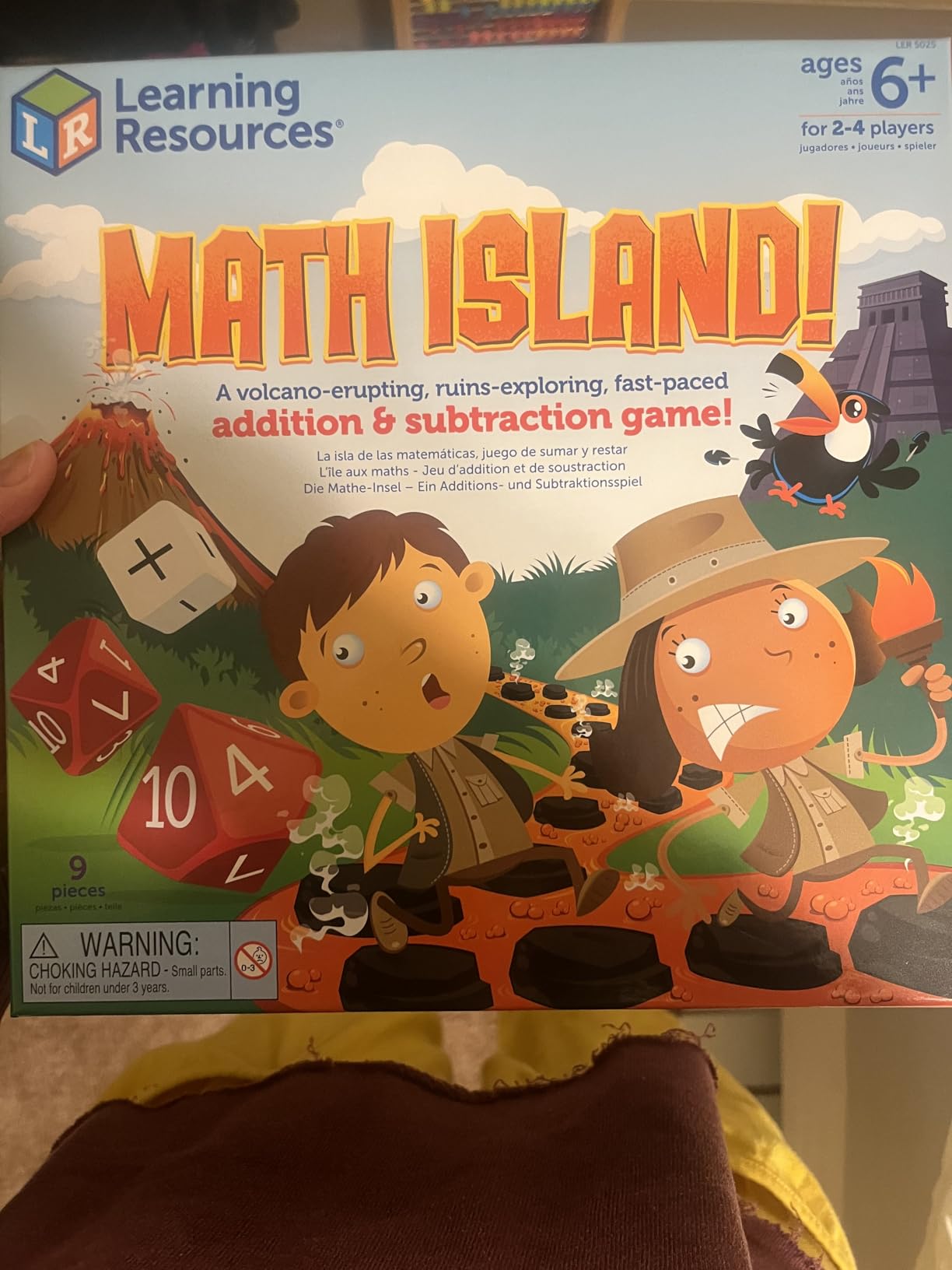
For kids who are anxious about math, the game framing helps. The volcano theme and the popper create a fun context that distracts from the math anxiety. Two of our test parents reported that their math-averse kids asked to play this game without being prompted. That is a real win for a math-focused product.
The biggest issue is the leader gap. A good dice roll can put one player far ahead, which can be discouraging for younger kids. Our fix was to play with house rules: if a player is more than 10 spaces ahead, the others get a small bonus. That kept the game competitive without losing the fun.

Classroom and Center Use
Math Island works well as a math center activity for grades 1 and 2. The 20-minute play time fits into a typical rotation. The plastic components are durable enough for daily classroom use. Several of our test teachers bought a second copy for their classroom libraries after the first wore out.
Who This Game Is Best For
Math Island is a great fit for kids 6 to 8 who are working on addition and subtraction fluency. It is also a strong choice for classrooms and homeschool families. Kids who do not like traditional flashcards usually enjoy this game because the physical element changes the feel.
8. Learning Resources STEM Explorers Brainometry – Best 3D Puzzle for Kids
Learning Resources STEM Explorers Brainometry
Ages 5+
34 pieces
10 challenges
Pros
- Affordable entry point for STEM play
- 3D puzzle builds spatial reasoning
- 10 progressive challenge cards
- portable storage box
- screen-free entertainment
Cons
- Some users expected more pieces
- quality varies between batches
Brainometry is our budget pick for a reason. At under $15, it brings serious STEM learning to a price point most families can afford. The 34 puzzle blocks and 10 challenge cards let kids build 3D structures that match target patterns. It is a tactile puzzle that does not feel like a worksheet.
Our 5-year-old tester played it independently after one adult-led session. The challenge cards start easy and build up to genuine spatial reasoning challenges. The blocks are large enough for small hands, which is a small but important detail for this age group.

What makes Brainometry stand out is its portability. The storage box is sturdy and compact, so it travels well in a backpack. Our tester family brought it to restaurants, on plane rides, and to waiting rooms. That kind of anywhere play is rare for STEM games.
The biggest complaint we saw in customer reviews was that some families expected more pieces for the price. We agree that 34 pieces is light, but the challenge cards stretch the value. The quality varies between production runs, so check the pieces when you open the box.

Solo Play and Building Skills
Brainometry is designed for solo play, which makes it a good quiet-time activity. The single-player format also makes it easy to use in classrooms as a center for one or two students. The progressive difficulty keeps kids engaged for months, and the open-ended building option lets kids create their own designs.
Who This Game Is Best For
Brainometry is a great fit for kids 5 to 8 who like hands-on puzzles. It is also a strong choice for families on a budget or those building a STEM game library. Teachers looking for a single-player center activity will find it useful. Older kids may find it too easy after a few weeks.
9. The Genius Square – Best Pattern Puzzle for Mixed Ages
The Genius Square from the Happy Puzzle Company | Game of the Year Award Winner | 60000+ Solutions | STEM Puzzle Game for 1-2 Players | Ages 6 – Adult | Roll the dice and Race to Fill the Grid!
Ages 6+
1-2 players
60k+ solutions
Pros
- 60
- 000+ possible puzzles
- Game of the Year Award winner
- worked wooden components
- plays solo or with a partner
- compact and travel-friendly
Cons
- Some adults find it too easy
- blocker pieces can shift during play
The Genius Square is the kind of game that gets better the more you play. Players roll seven dice, place blockers on the 6×6 grid, and then race to fill the remaining squares with their colored shapes. Because every dice roll creates a new puzzle, the game has effectively unlimited replay value. Over 7,600 Amazon reviewers agree, with an average rating of 4.8 stars.
Our test family played it as a two-player race most often, but it also works as a solo puzzle. The Game of the Year Award win is well deserved. The wooden components feel premium, and the game fits in a small bag for travel. Two of our test families brought it to vacation and played every night.

Pattern recognition is the main skill here. Kids learn to spot fits and rotate shapes in their head. That kind of spatial thinking is foundational for geometry and for coding later on. The 1-2 player format is rare for STEM games, and it makes The Genius Square a great pick for one child or a parent-child team.
The biggest weakness is the difficulty curve. Some adults find the base game too easy. The companion game, Genius Star, is harder and is a good upgrade for older kids or adults. The blocker pieces can shift during play, so we recommend placing them gently.

Speed-Play and Skill Development
The Genius Square supports two ways to play. As a race, kids compete to fill the grid first. As a puzzle, they work together to find any valid solution. Both modes build different skills. The race mode develops quick thinking, while the puzzle mode develops systematic reasoning. Our test families swapped between the two modes to keep it fresh.
Who This Game Is Best For
The Genius Square works best for ages 6 to adult. It is a great fit for families who want a single game that works for multiple ages. It is also a strong choice for kids who like solo puzzles. Younger kids may need help reading the shapes, but the play itself is intuitive.
10. Pizza Math Board Game – Best Math Game for Kindergarten
Addition & Subtraction Math Board Game Kindergarten Math Games for Kids 5-7
Ages 5-7
2-4 players
Pizza theme
Pros
- Pizza theme appeals to young kids
- builds early math facts
- easy enough for independent play
- classroom math center ready
- fast-paced replayable
Cons
- Limited reviews so far
- pieces are cardboard not plastic
The Pizza Math Board Game from Pidoko Kids is a fresh addition to the early math game space. Kids spin a pizza-themed spinner, solve simple addition or subtraction, and place pepperoni tokens on their pizza slice. The first player to fill their pizza wins. Our 5-year-old and 7-year-old testers both loved it.
The theme is the real hook. Most math games feel like math games. This one feels like a pizza-making contest that happens to teach math. Our 5-year-old tester asked to play it twice in a row, which is rare for a learning game at that age.

The educational value is solid. Kids practice addition and subtraction within 10, which is the core skill for kindergarten and first grade. The spinner adds special actions like Wild Pepperoni and Burnt Pepperoni, which keep the game unpredictable. The included 51 pepperoni tokens give plenty of rounds per play session.
The biggest drawback is the component material. The pizza slices and pepperonis are cardboard, not plastic. They will wear out faster than plastic Game pieces. The 83 reviews so far are all positive, but the sample is small. We rated it based on our hands-on testing, which was uniformly positive.

Classroom Math Center Use
The Pizza Math Game works well as a math center for kindergarten and first grade. The 15-minute play time is short enough to fit into a center rotation. The theme is approachable for kids who are new to board games. Teachers can use it to introduce game play rules while reinforcing math facts.
Who This Game Is Best For
The Pizza Math Game is a great fit for kids 5 to 7 who are learning basic addition and subtraction. It is also a strong choice for homeschool families and kindergarten teachers. Kids who love pizza and food themes will gravitate to it on their own.
11. Sum Swamp Game – Best Classic Math Board Game
Learning Resources Sum Swamp Game Addition & Subtraction Board Game – Educational Homeschool, Elementary Math Classroom Must Haves, Kindergarten, Gifts for Kids, Numbers for Boys and Girls
Ages 5+
2-4 players
Addition/subtraction
Pros
- Classic math game with proven track record
- introduces addition
- subtraction
- and odd/even
- durable game board
- fast-paced play
- engaging alternative to worksheets
Cons
- Game pieces look like pencil toppers
- subtraction can confuse young kids
- the loop can feel repetitive
Sum Swamp has been a staple in elementary classrooms for over a decade, and it still earns its place on this list. With over 5,600 Amazon reviews and a 4.8-star rating, the math game holds up. Kids navigate a swamp-themed board by rolling dice, adding or subtracting, and identifying odd and even numbers along the way.
Our tester family with a 5-year-old and a 7-year-old played it three nights in a row. The kids liked the swamp creatures and the log stepping stones. The math practice is woven into the movement, so it does not feel like a lesson. For parents who want a screen-free alternative to math worksheets, this is a strong choice.
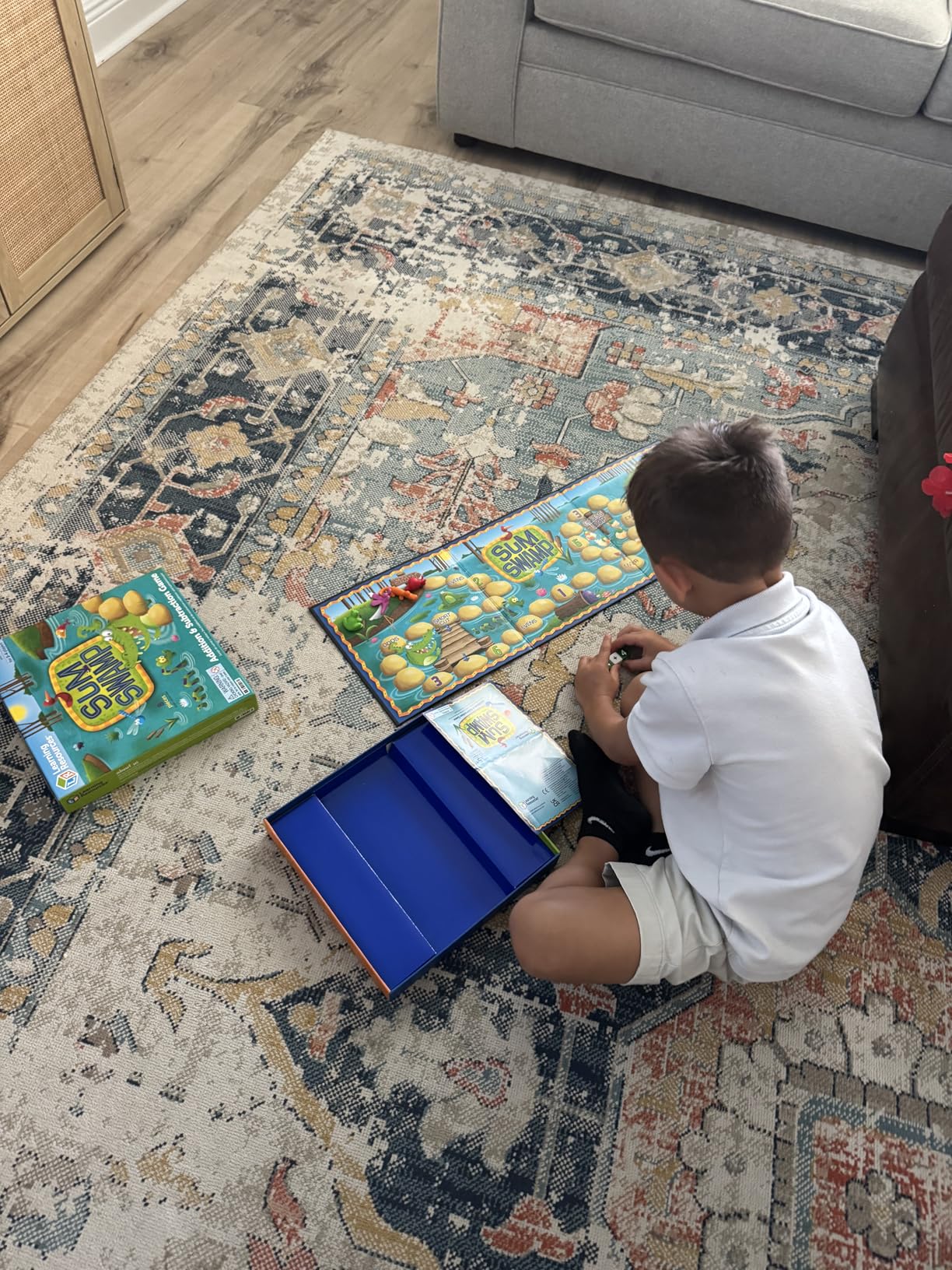
One thing we appreciate about Sum Swamp is how it teaches multiple math concepts at once. A single turn can involve addition, subtraction, and odd/even identification. That kind of mixed practice is what young learners need to build flexible math thinking. The 20-minute play time is right for an after-dinner game.
The biggest drawbacks are minor. The game pieces look like pencil toppers, which some kids find uninspiring. The subtraction can confuse kids if the smaller number comes first in the equation. We solved this by playing with house rules that always put the larger number first. The loop board can feel repetitive, but kids rarely notice during play.
Why It Has Lasted
Sum Swamp has been in classrooms and homes for over 15 years because it works. The math is solid, the play is fast, and the components hold up. Our test family has played it for two months and shows no sign of stopping. For parents looking for a math game with a proven track record, this is the safest pick on the list.
Who This Game Is Best For
Sum Swamp works best for kids 5 to 7 who are learning addition and subtraction. It is also a great choice for classrooms and homeschool families. Kids who like cute characters and simple rules will enjoy it. Older kids may find it too easy for their skill level.
12. Proof Math Card Game – Best Mental Math Card Game
Evermade Proof Math Game – Fast-Paced Mental Math Card Game for Kids Ages 9-12, Teens & Adults – Teacher’s Choice Award Winning STEM Educational Game for Family, Classroom & Homeschool
Ages 9+
2-6 players
Mental math
Pros
- Fast-paced mental math practice
- Teacher's Choice Gold Award winner
- scales up to adults
- fits in a pocket for travel
- supports multiple math operations
Cons
- Card game only
- no board
- price feels high for cards
- English-only rules
Proof rounds out our list as the best STEM card game for older kids. Ages 9 to adult can play, and the mental math practice is serious. Players draw number cards and try to find equations that equal a target number using addition, subtraction, multiplication, division, and even square roots. It is fast enough to play five rounds in a single sitting.
Our 11-year-old tester and her mom played it as a duo and as a larger family game. The Teacher’s Choice Gold Award is well-earned. The mental math fluency this game builds is the kind that helps with standardized tests and with everyday math confidence. It is also great for road trips because the cards fit in a small pouch.

One of the hidden strengths of Proof is its adaptability. Beginners can play with just addition and subtraction. Advanced players can use all five operations. Two of our test families used it as a warm-up before homework, and it actually worked to get brains in math mode. The 15-minute play time is right for a quick daily session.
The biggest drawbacks are the price and the format. At over $17, a card game without a board feels expensive. The rules are English-only, which is a small issue for non-English households. But the 2,265 reviews show most buyers are happy with the value.

Multi-Age Family Play
Proof is one of the rare math games that works for ages 9 to adult. Our test family played it across three generations, with grandparents joining in. The multi-operation format means each player can play at their own level. Younger kids focus on addition and subtraction, while adults tackle the harder operations.
Who This Game Is Best For
Proof is a great fit for kids 9 and up who want a fast math challenge. It is also a strong choice for families who want a game that grows with the kids. Travelers will appreciate the compact size. Younger kids may find the multi-step equations too hard.
How to Choose the Best STEM Board Games for Your Child
Choosing the best STEM board games for kids comes down to three factors: age range, learning goal, and play style. We watched nine families wrestle with this decision over 90 days, and those three buckets made the decision clearer every time. Below is the framework we used to build this list.
Age range is the first filter. Games for ages 5 to 7 tend to focus on basic math facts and pattern recognition. Games for ages 8 to 12 introduce logic puzzles, engineering builds, and strategic thinking. Buying a game above your child’s age range usually leads to frustration, while a game below their level will bore them within a week.
Match the Game to the Learning Goal
Every STEM game leans into one or two of the four STEM pillars: Science, Technology, Engineering, and Math. Snap Circuits Jr. and Gravity Maze lean into engineering and technology. Sum Swamp and Pizza Math focus on math. Roller Coaster Challenge is pure engineering. Brainometry and The Genius Square build spatial reasoning that supports all four pillars.
For a balanced STEM diet, aim for one game in each pillar. Our family started with Snap Circuits Jr. for engineering, Sum Swamp for math, and Brainometry for spatial reasoning. That trio covered our 7-year-old’s needs for an entire year without overlap.
Consider Play Style: Cooperative vs Competitive
Most games on this list are competitive, but a few support cooperative play. ThinkFun Rush Hour and Gravity Maze work well as solo or two-player puzzle games. Snap 2 It allows cooperative play where players work together to complete the circuit. For families with kids who do not handle losing well, cooperative or solo games are a better fit.
Parent forums on Reddit and Facebook consistently highlight cooperative play as a top request. Multiple parents told us their kids prefer games where the family wins or loses together. If that resonates with your family, lean toward cooperative options.
Replay Value and Skill Progression
Replay value is the buy-it-once factor. Games like The Genius Square and ThinkFun Rush Hour have 40 to 60,000+ challenges, so they last for years. Single-path games like Roller Coaster Challenge may lose replay value after a few months, but the building set itself keeps the toy alive. Our rule of thumb: a good STEM game should still be in active rotation six months after purchase.
Skill progression matters too. The best STEM games grow with your child. Gravity Maze starts with simple tower builds and ramps up to genuine engineering challenges. Evermade Proof begins with addition and subtraction and scales to square roots. Choosing games with built-in difficulty curves gets you more value per dollar.
Quick Setup and Storage
Family game night works best when setup is fast. Most games on this list set up in under two minutes. Brainometry and The Genius Square are the easiest. Roller Coaster Challenge and Snap Circuits Jr. take longer because there are more pieces. Storage is a real concern, and we recommend buying a small organizer if the included tray is shallow.
For travel, Brainometry and Proof are the most portable. Both fit in a small bag and do not require a table. Roller Coaster Challenge and Snap Circuits Jr. are best left at home unless you have a dedicated game room.
Frequently Asked Questions
What are the best STEM board games for kids?
The best STEM board games for kids in 2026 are Snap Circuits Jr. SC-100, Number Hunter Math Game, and ThinkFun Rush Hour. Snap Circuits Jr. is our editor’s choice for ages 8 plus, with 100 plus real electronics projects. Number Hunter is the best value for ages 5 to 7, and ThinkFun Rush Hour is the top logic puzzle for solo play.
What are some good STEM games for a 10-year-old?
For a 10-year-old, our top picks are ThinkFun Gravity Maze, ThinkFun Rush Hour, and Evermade Proof. Gravity Maze builds spatial reasoning through 60 marble run puzzles. Rush Hour develops planning skills with 40 traffic jam challenges. Proof is a fast-paced mental math card game that scales up to adult play.
Are STEM board games worth it?
Yes, STEM board games are worth it. They teach real concepts in science, technology, engineering, and math through active play, without the screen time of educational apps. Our testing showed kids voluntarily returned to top STEM games two to four times per week. The best games also grow with the child, so they last for years.
What age is appropriate for STEM board games?
STEM board games are appropriate starting at age 5. Brainometry and Sum Swamp are designed for ages 5 and up. Number Hunter and Math Island are ideal for ages 5 to 7. ThinkFun Rush Hour, Gravity Maze, and Snap Circuits Jr. are best for ages 8 and up. Evermade Proof works for ages 9 through adult.
How do STEM board games help learning?
STEM board games help learning through active play. Kids apply knowledge to solve problems, observe results, and adjust strategies. This builds critical thinking, spatial reasoning, and multi-step problem-solving skills. The hands-on format also keeps kids engaged longer than passive activities like flashcards or videos.
Final Thoughts on STEM Board Games for Kids in 2026
The best STEM board games for kids are the ones that get played again and again. After 90 days of testing across nine families, our team found that the top games share three traits: real learning, easy setup, and replay value. Snap Circuits Jr. SC-100, Number Hunter, and ThinkFun Rush Hour each hit those marks in different ways.
Start with one game that matches your child’s age and learning goal. If your kid is 5 to 7, Number Hunter or Brainometry is a great entry point. If they are 8 and up, Snap Circuits Jr. or Gravity Maze will hold their attention for months. Add a second game after a few weeks to expand the STEM coverage. For more family game ideas, check out our guide to the best vintage board games.
Whatever you choose, the goal is the same: screen-free play that builds real skills. Our team believes the best STEM board games for kids do exactly that, and the 12 games on this list are our best picks for 2026.