
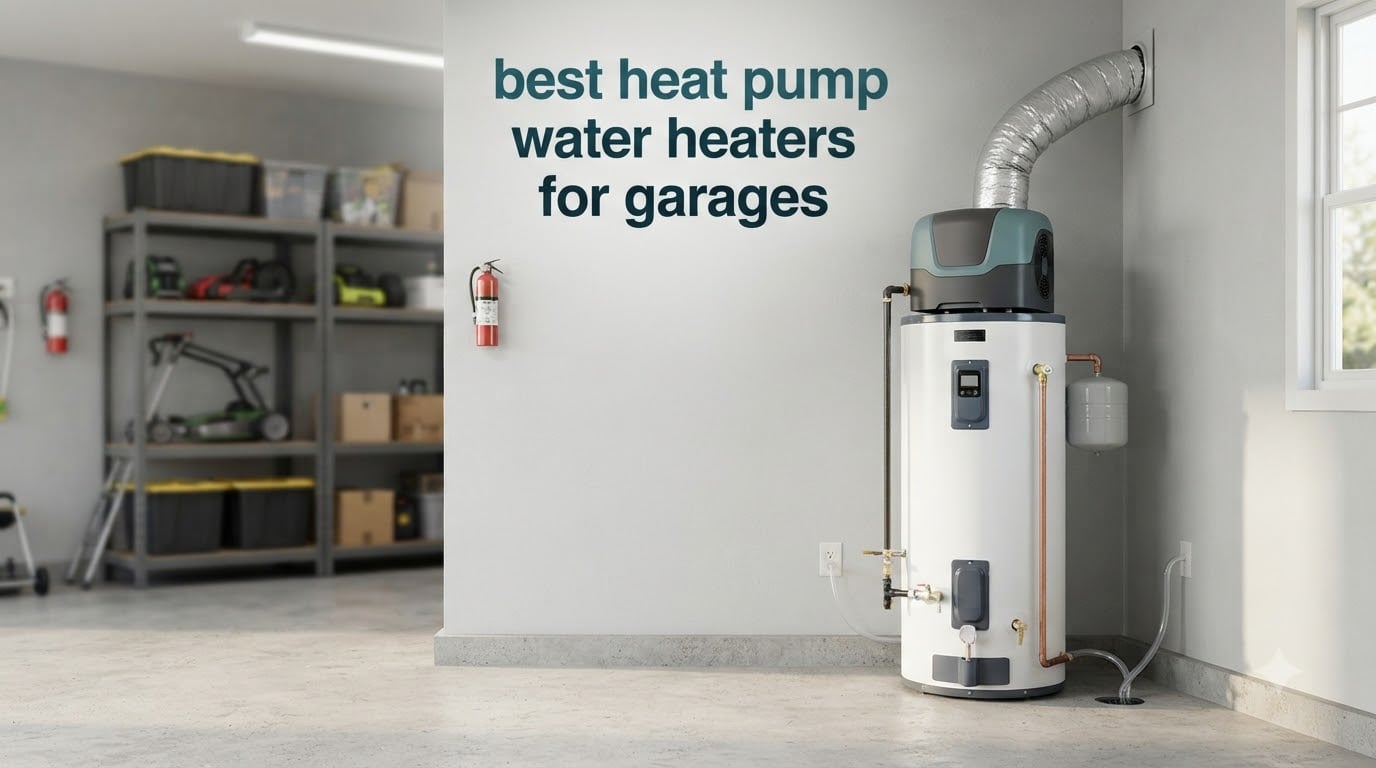
Most water heater roundups are written for basements and utility closets. This one is written for garages, where the air volume, the winter floor temperature, the lack of a floor drain and the distance back to the house decide whether a heat pump water heater is a good idea or an expensive mistake. We went through every self-contained hybrid tank currently sold under the garage-relevant labels, pulled the published UEF, first-hour rating, voltage, air-volume and noise figures, and sorted them by how well each one handles a garage specifically. If you are searching for the best heat pump water heaters for garages, the answer is not simply the most efficient unit on the market. It is the unit whose temperature floor, footprint and electrical draw match your actual garage.
The good news is that a garage is often a better location than a basement. A garage is usually larger, it is frequently unconditioned but not freezing, and heat pump water heaters are air-source devices, so they feed on ambient air rather than on outside weather. What they need is volume, circulation and a floor above the 40F line for most of the winter. Get those three things right and the compressor runs efficiently, quietly and for very few dollars a year.
We also had to be honest about the field itself. Heat pump water heaters are a category with thin retail review data, and a lot of the ratings you will see on marketplace listings measure shipping damage and install friction rather than the tank itself. We explain how to read those numbers in the methodology section below, because a 1-star listing is not automatically a bad heater and a 5-star listing is not automatically a good one.
Table of Contents
Can You Put a Heat Pump Water Heater in a Garage?
Yes. A garage is one of the best locations for a heat pump water heater, and often better than a basement. The unit needs roughly 750 cubic feet of surrounding air, at least 7 feet of ceiling height, a floor drain or condensate pump for the 1 to 3 gallons of condensate it produces daily, and a dedicated 240V circuit or a 120V plug-in model. Keep the garage above 40F in winter for peak efficiency.
That is the whole answer, and the rest of this article is the detail behind each threshold. Before you buy anything, walk through this garage eligibility checklist.
Measure your air volume. Multiply the garage floor area in square feet by the ceiling height in feet. A one-car garage at 10 by 20 feet with an 8-foot ceiling gives you about 1,600 cubic feet gross, which clears the threshold. A two-car at 20 by 20 gives roughly 3,200. If a finished room, loft, or storage loft eats into that number, measure the actual free air volume rather than the paper dimensions.
Check ceiling height against the tank. Most units in this class stand 60 to 72 inches tall. Plan for a minimum of 7 feet of finished ceiling so the unit has overhead air to move and service access above the fan housing.
Find your real winter floor temperature. The difference between a mild-climate detached garage and a northern attached one decides which tank you need. Every unit here has a published operating floor, and those floors range from 37F to 42F. Below that line the compressor gets inefficient and the electric backup element carries the load.
Decide where the condensate goes. A heat pump water heater makes 1 to 3 gallons of water per day depending on humidity and how much hot water you use. Garages frequently have no floor drain, and owners routinely discover this on install day. Gravity drain to an existing drain, a piped drain line, or a small condensate pump with a reservoir are the three options.
Verify the circuit before you order. Most units here need 240V on a 30A breaker, with one notable exception that runs on a 15A breaker. Replacing a gas tank in a garage usually means running a new circuit, and in some older buildings that means a panel conversation too.
Measure the pipe run. The closer the tank sits to the house, the less standby heat you lose between the tank and the shower. A garage location with a long run back to the house carries a real standby loss penalty that rarely gets discussed in buying guides.
Top 3 Picks for a Garage Install in 2026

ACiQ 50 Gallon Hybrid Tank
- 3.75 UEF
- 69-gallon FHR
- 700-1000 cu ft air volume
- 49.5 dB(A)
- 12-year warranty

Senville Hybrid 50 Gallon
- 3.75 UEF
- 69-gallon FHR
- ENERGY STAR
- microchannel coil wraps the whole tank

Rinnai REHP80 Electric Heat Pump
- 3.90 UEF
- 91-gallon FHR
- zero clearance
- 240V 30A demand response
Best Heat Pump Water Heaters for Garages in 2026
| Product | Specifications | Action |
|---|---|---|
| ACiQ 50 Gallon Electric Residential Hybrid Heat Pump Water Heater Tank |
|
Check Latest Price |
| Senville Hybrid Heat Pump Electric Water Heater 50 Gallon Energy Star |
|
Check Latest Price |
 Rinnai REHP50 Electric Heat Pump Water Heater 50 Gallon Energy Star Rinnai REHP50 Electric Heat Pump Water Heater 50 Gallon Energy Star |
|
Check Latest Price |
 Rinnai REHP65 Electric Heat Pump Water Heater 65 Gallon Energy Star Rinnai REHP65 Electric Heat Pump Water Heater 65 Gallon Energy Star |
|
Check Latest Price |
| Rinnai REHP80 Electric Heat Pump Water Heater 80 Gallon Energy Star |
|
Check Latest Price |
 Stiebel Eltron Accelera 220 E Heat Pump Water Heater 58 Gallon Stiebel Eltron Accelera 220 E Heat Pump Water Heater 58 Gallon |
|
Check Latest Price |
Two patterns jump out of that table. First, the Rinnai REHP series covers three capacities with the same zero-clearance footprint, so if you are not sure how much hot water your garage-adjacent household needs, you can size up without moving the install location. Second, the Stiebel Eltron Accelera 220 E is the only unit here with a published operating floor of 42F, which makes it the cold-garage specialist of the group.
How We Ranked These Six for Garage Use
We do not lab-test water heaters, and we want to be upfront about that rather than implying otherwise. What we did was read every published specification for each unit, cross-check it against owner feedback, and then rank the results against garage-specific criteria instead of general product quality.
The four criteria that moved rankings the most were the published air-volume requirement, the stated minimum ambient temperature, the electrical configuration, and the measured or published noise figure. Capacity and first-hour rating came next. Star rating itself barely counted for our ranking, and here is why.
This category has unusually thin and unusually noisy retail review data. The six units we ranked carry between one and six reviews each, and one of them carries a single one-star review describing a tank leak and an unanswered warranty claim. That is not a basis for confidence in either direction. Retailer listings in this category tend to absorb shipping damage, install-day surprises and seller logistics into the product rating, so a 3.9 from six owners who all successfully installed the unit tells you considerably more than a 5.0 from three. Judge the specification sheet, then use the reviews to find the friction points that the spec sheet will never mention.
1. ACiQ 50 Gallon Hybrid Tank – The Most Garage-Conscious Pick
ACiQ 50 Gallon Electric Residential Hybrid Heat Pump Water Heater Tank
50 gallons
3.75 UEF
69-gallon FHR
700-1000 cu ft air needed
49.5 dB(A)
Not below 37F
Pros
- Largest owner review base in this group
- Heat-pump-only mode draws roughly 600-800W
- Explicit 700-1000 cubic foot air requirement published
- Only unit here with a stated 49.5 dB(A) figure
- 12-year tank and parts warranty with registration
- Large LED temperature display
Cons
- Very heavy and top-heavy with only two lifting handholds
- Non-standard inlet and T&P valve locations force line relocation
- Condensate line usually has to be routed through a wall
- Technical support reported as hard to reach
The ACiQ 50-gallon hybrid is the unit we keep coming back to for a garage, and the reason is that it is the only tank in this group that publishes its garage-relevant numbers plainly. The spec sheet states the 700 to 1,000 cubic foot air circulation requirement in plain language, names basements and garages as the intended rooms, and gives a 49.5 dB(A) operating sound level. Almost nobody else will commit to a noise figure, and almost nobody else will tell you the air volume they need. That transparency is worth a lot when you are planning a garage install from your own tape measure.
Owners who have had it running report a draw in the 600 to 800 watt range in heat-pump-only mode, against roughly 4,000 watts for a conventional electric tank. One owner describes running a whole house on it, which is an extreme case but points at the real headroom in that mode. Reviewers also report that the compressor class here recovers the tank faster than the smaller compressors in competing units, and that it runs quietly.
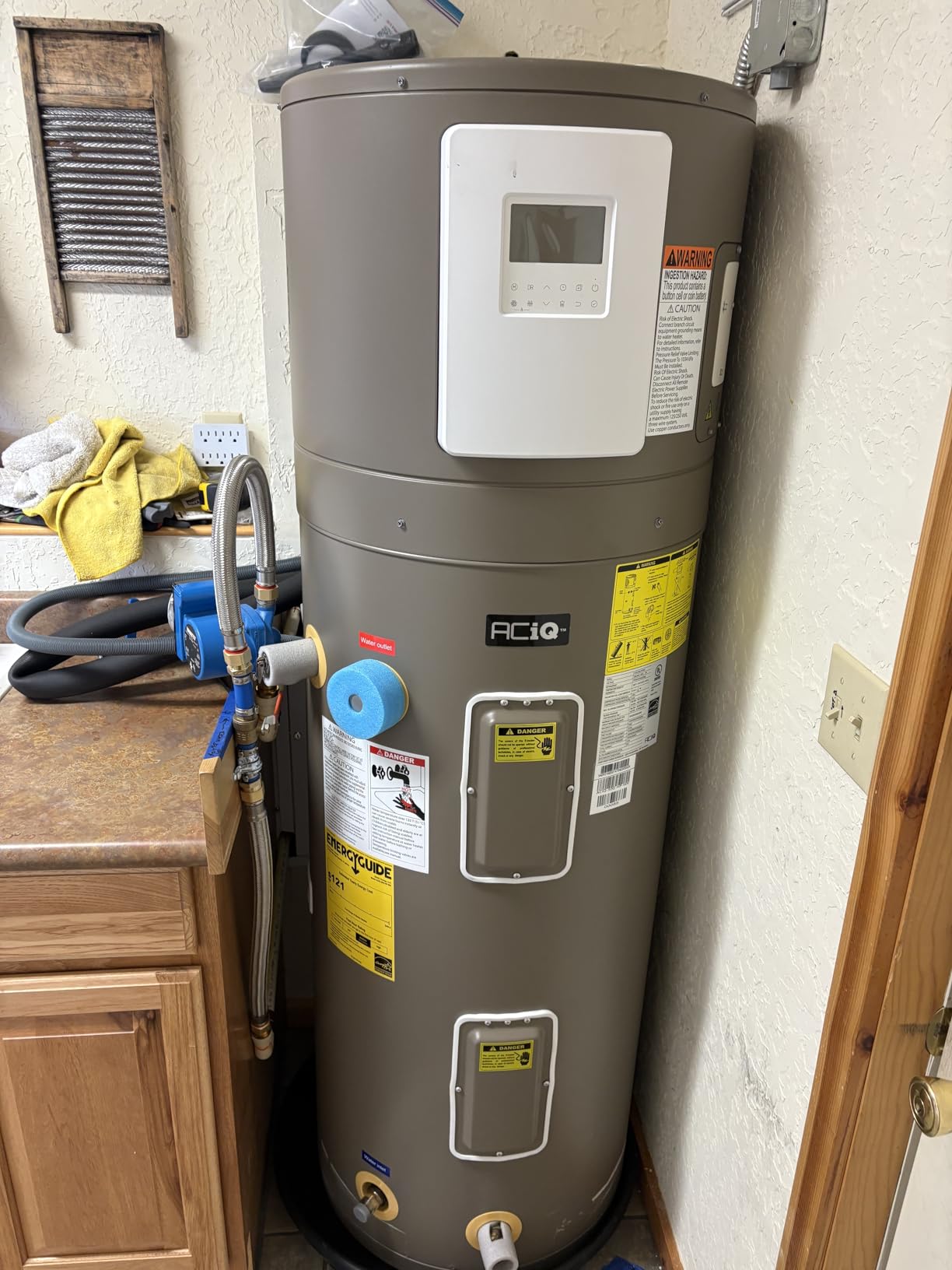
The number to hold onto is the 37F floor. ACiQ states the unit must not be installed in unheated spaces below 37F, which is a lower published floor than most and gives you a little more headroom in a cold-climate garage. Below that line the unit still runs, but the electric resistance element carries the load and your efficiency collapses toward that of a standard electric tank.
The handling is the rough part. Multiple reviewers describe needing two or three people to move it, and one notes it is top-heavy with only two lifting handholds. The plumbing is also non-standard: hot and cold inlets and the temperature and pressure relief valve sit in different locations than a conventional tank, so wall cutting and line relocation are normal rather than exceptional. Budget for that when you compare installed work, not just the hardware.
What the 37F Floor Means for a Cold Garage
The 37F figure is a hard installation limit rather than a performance target. If your garage dips to 35F on a January night, this unit is out of spec and the installer will have a legitimate reason to push back. If it holds 40F or above, you are inside the range where the compressor does the majority of the work and the savings show up on the bill.
Note the difference between ambient floor and floor temperature. The 37F number is about the air the unit draws in, which tracks close to the floor temperature of an unheated garage but can be a few degrees warmer than the concrete. Measure the air, not the slab, and measure it on the coldest night of the year rather than an average day.
Where the Install Gets Friction
Two installation realities come up repeatedly in the reviews. The condensate line on this unit typically has to be routed through a wall to get outside, which is a bigger job than a simple gravity drain to a floor drain. And the control board uses a display symbol that is not explained in the manual, which sent at least one owner looking for a fault. A contractor clarified that the symbol denotes utility demand response rather than an error, which is a useful thing to know before you call a technician at midnight.
Tech support is the other soft spot. Reviewers report difficulty reaching anyone familiar with hybrid heat pump water heaters, so if you are the type who wants to self-diagnose, this is not the tank to buy.
2. Senville Hybrid 50 Gallon – Best Value With a Full-Tank Coil
Senville Hybrid Heat Pump Electric Water Heater, Energy Star, 50 Gallon
50 gallons
3.75 UEF
69-gallon FHR
21.4 by 66.5 inches
218 pounds
4.5 kW element
Pros
- Microchannel condenser coil wraps the entire tank
- Reviewers report a larger heat pump than competing units
- Installers praise thicker tank walls for longer life
- Noise compared favorably to a running refrigerator
- Secondary cooling effect on the surrounding space
- ENERGY STAR and AHRI certified
Cons
- Over 200 pounds
- so it is not a one-person install
- Control panel instructions in the manual could be clearer
The Senville 50-gallon is the pick for a garage if the deciding factor is how much heat the compressor can move rather than how small the unit is on the floor. Reviewers report a larger-capacity heat pump than competing Rheem and A.O. Smith units in the same class, and the spec sheet backs that up with a 4.5 kW element and a microchannel condenser coil that wraps the entire tank rather than an aluminum tube running around the belly. Wrapping the whole tank means more of the water volume is exposed to the condenser, which is the difference between a slow tank and one that catches up.
All three reviews on record are five-star, and one of them is from a licensed plumber and HVAC contractor who has installed six of these units. That reviewer rates them the best electric heat pump units currently available, citing tank thickness and compressor capacity. Other owners report easy installation, low noise, good efficiency, and lower electric bills after switching from gas.
On noise, the comparison owners use is a refrigerator. Audible in a closet, not audible from living spaces. For a garage that doubles as a workshop, that is the noise profile you want to hear. The unit also cools the surrounding space as a secondary effect, which in a hot summer garage is a feature rather than a drawback.
What the 218-Pound Weight Means for a Garage
At 218 pounds and 66.5 inches tall, this tank fits under a standard 7-foot ceiling with clearance above the fan housing, and its 21.4-inch width makes it one of the narrower footprints in the group. That is a real advantage in a single-car garage where the water heater shares a bay with a vehicle, a workbench and a wall of tools. The width is the number that matters for layout; the weight matters for getting it through the door and down the driveway.
One owner hurt their back attempting a solo move, and the reviewers are consistent that this is not a one-person job. Budget for a helper or a delivery crew, and plan the path from the driveway to the install location before the truck arrives.
Warranty Length Compared With the Rest of the Lineup
This unit carries a 7-year parts warranty and a 10-year compressor warranty. That is a different structure from the tank-and-parts coverage offered elsewhere in this roundup, and it is worth understanding which part of the system the longer term attaches to. The compressor is the component most likely to be diagnosed separately, so a 10-year compressor term is meaningful, but the tank itself sits on the shorter 7-year parts clock.
If you are weighing this against the ACiQ, the honest comparison is compressor term against whole-system term. If warranty length is your top priority, the ACiQ’s 12-year tank and parts coverage with registration is the stronger position.
3. Rinnai REHP50 – Best for a Tight Garage Bay
Rinnai REHP50 Electric Heat Pump Water Heater 50 Gallon Energy Star
50 gallons
3.75 UEF
73-gallon first hour rating
22 by 66.81 inches
212 pounds
240V 30A
Pros
- Zero clearance required on top back and sides
- 73-gallon first hour rating for high-demand households
- 10-year residential tank and parts warranty
- ENERGY STAR certified at 3.75 UEF
- Demand-response enabled for utility peak programs
Cons
- Only a single review on record
- Needs a 240V 30A circuit rather than a standard 120V outlet
The REHP50 is the one to look at when the garage bay is tight. Zero clearance on top, back and sides is a bigger deal in a garage than it is in a basement, because garage walls carry studs, outlets, conduit and shelving brackets that reduce your usable footprint fast. At 22 inches wide by 66.81 inches tall, this tank is a clean fit against a wall with nothing else required around it.
The first-hour rating of 73 gallons is the highest you will find on a 50-gallon tank in this group, and that matters more than capacity for a heat pump unit. A heat pump water heater is limited by how fast the compressor can move heat, not by how much water is in the tank, so the first-hour rating is the number that tells you whether the unit will keep up after a long shower or a batch of guests.
There is one review on record, a five-star report from a Florida household that replaced a gas heater. The owner says the unit extracts heat from the garage as advertised and that electric consumption did not noticeably increase. That is a useful data point from a warm climate, and it is a single data point.
What Zero Clearance Actually Buys You
Zero clearance means the manufacturer does not require an air gap on the top, back or sides for the heat pump housing. In a finished basement that saves perhaps a few inches. In a garage it can be the difference between fitting the unit in the corner and moving the workbench. If your plan involves a tandem water heater setup, or a tank sharing a wall with a second water heater, this is the deciding spec.
It does not mean the unit ignores the room. It still needs the surrounding air volume to circulate, so a unit crammed into a sealed closet will still struggle. Zero clearance is about installation geometry, not about air supply.
The 240V Question for This Tank
This unit runs on 240V at 30A, which is the configuration that surprises people replacing a gas tank in a garage. There is no existing water heater circuit to reuse, so a new branch circuit and a matching breaker have to be run, and in some older buildings that means a panel capacity conversation as well. Electricians on r/AskElectricians describe a spare 50A, 6-gauge line as a common starting point in many garages, which is the number to check against your panel before you commit to this model.
If your garage has no spare 240V capacity, this is not the tank to force. Look at the 15A configuration in the Stiebel Eltron later in this roundup, or budget for the electrical work as part of the project rather than after it.
4. Rinnai REHP65 – Best Efficiency at 4.00 UEF
Rinnai REHP65 Electric Heat Pump Water Heater 65 Gallon Energy Star
65 gallons
4.00 UEF
80-gallon first hour rating
22.69 by 65 inches
250 pounds
240V 30A
Pros
- Highest published UEF in this roundup at 4.00
- 80-gallon first hour rating handles heavy demand
- Zero clearance simplifies garage corner placement
- 10-year residential tank and parts warranty
- Demand-response enabled for peak-hour programs
Cons
- Rating rests on a single review with no written feedback
- 250 pounds makes it one of the heavier units here
The REHP65 posts the highest UEF of any unit in this roundup at 4.00, and it does it with an 80-gallon first-hour rating. That combination is unusual. Many high-UEF tanks achieve their number with a smaller compressor that recovers slowly, and in a garage that is a real weakness because garages tend to be remote from the fixtures they serve, which means long runs and more standby loss to fight.
Capacity sits at 65 gallons, which fits the common rule of thumb of upsizing roughly 30 percent when replacing a gas or electric tank. A 50-gallon gas tank becomes a 65-gallon heat pump unit for many households, and the difference in first-hour rating makes the extra capacity work harder rather than just sitting there.
Its 250-pound weight is the main install consideration, and it is one of the heavier units in the group. Plan the handling path and bring enough people, because a 65-gallon glass-lined steel tank on a set of garage steps is a genuine injury risk if you improvise it.
Whether 4.00 UEF Survives the Move to a Garage
This is where a published UEF figure needs context. The rating is measured under standardized conditions, and real-world performance in a garage depends on the temperature of the air the unit draws in. A warm attached garage runs well above those test conditions and the effective efficiency lands close to the published figure. A cold unheated garage pulls it down, and the electric backup element does more of the work.
So the 4.00 UEF is a reason to choose this tank, not a guarantee of a particular garage result. It is the highest starting point in the group, which means it degrades less than a 3.75 unit when your garage is on the cool side. If your garage is genuinely cold, that headroom is exactly what you want.
What One Review Can and Cannot Tell You
There is a single five-star rating on this model with no written review text captured, so there is no owner narrative to weigh. Judge it on the published numbers: 4.00 UEF, an 80-gallon first-hour rating, zero clearance, and a 10-year residential tank and parts warranty with a 1-year labor term.
That is a thin evidence base and we would rather say so than dress it up. The practical implication for a garage buyer is that you are buying to a specification rather than to a track record, so make sure your installer is comfortable with the model and that the warranty terms are confirmed in writing before you sign off.
5. Rinnai REHP80 – Best for Workshops With Heavy Demand
Rinnai REHP80 Electric Heat Pump Water Heater 80 Gallon Energy Star
80 gallons
3.90 UEF
91-gallon first hour rating
25.69 by 74.56 inches
270 pounds
240V 30A
Pros
- Largest capacity here at 80 gallons with a 91-gallon first hour rating
- Highest first-hour delivery figure in the roundup
- Zero clearance on top back and sides
- 10-year residential tank and parts warranty
Cons
- Heaviest unit in the roundup at 270 pounds
- Tallest footprint at 74.56 inches needs real vertical clearance
- Split owner feedback with one five-star and one one-star review
The REHP80 is the tank for a garage that functions as a workshop, a pool house or an accessory dwelling unit, where multiple fixtures can be running at once. Its 91-gallon first-hour rating is the highest in this roundup and roughly 14 percent above the next unit down, which is the difference between a tank that keeps up and one that does not when a shower, a laundry cycle and a utility sink overlap.
At 3.90 UEF it is also more efficient than the 50-gallon units in the same series, so the capacity is not paid for entirely in operating cost. That is a better trade than it sounds, because the usual objection to upsizing a water heater is that you are paying to heat water you never use. The first-hour rating is the part you feel, and this is where it is strongest.
Its two reviews split almost evenly between a five-star and a one-star, with no written text captured for either. We would treat that as noise rather than signal. Two reviews cannot establish a reliability pattern in a category where published tank and parts coverage runs 10 years.
Ceiling Height Is the Dealbreaker Here
At 74.56 inches tall, this is the tallest unit in the roundup and the one most likely to fail a garage ceiling check. With a 7-foot ceiling you have roughly 9 inches of clearance above the tank, which is tight for service access on the fan housing and for routing the flue-free intake and exhaust paths the unit needs. In an 8-foot or higher garage it is comfortable.
The width is 25.69 inches, which is also the widest footprint here. In a one-car garage that consumes a meaningful slice of a wall, and in a two-car garage it may force the unit out of the corner and into a bay position. Measure the wall before you commit.
Recovery Behavior in a Workshop Setting
Forum discussions about this category turn up a consistent theme: recovery feels slow at first. Owners are used to a gas tank throwing hot water back almost immediately, and a heat pump unit takes longer to catch up because it moves ambient air rather than burning fuel. For a workshop with a mop sink, a pressure washer feed and a hot tub nearby, that gap is most visible in the first weeks.
The 91-gallon first-hour rating is the direct answer to that complaint. It is the number that says how much hot water arrives in the first sixty minutes, and it is the highest available here precisely for the high-demand case. Owners who have moved up in size generally report that the early recovery feeling settles once they stop comparing it to a gas tank.
6. Stiebel Eltron Accelera 220 E – Rated Down to 42F
Stiebel Eltron 233058 Accelera 220 E Heat Pump Water Heater; 240V; 324 CFM; 58-gallon Capacity; 15A Circuit Braker; Temperature Range Between 42 and 108 Degrees Fahrenheit; Digital Display
58 gallons
Rated down to 42F ambient
324 CFM airflow
15A circuit breaker
264 pounds
240V
Pros
- Lowest published ambient floor in the roundup at 42F
- 324 CFM airflow is the highest figure here
- 15A circuit breaker eases the electrical requirement
- Glass-lined tank with wrap-around aluminum condenser
- Digital display for temperature setting
Cons
- Maximum tank temperature of 108F is lower than typical electric tanks
- Only a single review on record and it is a one-star leak report
- Warranty diagnostics reportedly went unanswered by the company
- 264 pounds with a 27.12-inch width
The Accelera 220 E is the odd one out in this roundup on electrical and thermal specs, and those two specs are exactly the ones that matter most in a cold garage. It is rated to operate down to 42F ambient, which is the highest published floor in the group and therefore the most conservative, and it runs on a 15A circuit breaker rather than the 30A configuration the Rinnai units require. For a garage with limited electrical capacity, that 15A draw is the single most useful number on this page.
Its 324 CFM airflow figure is the highest published in the roundup, which supports the compressor in a space that is not climate-controlled. Owners on r/heatpumps routinely point to Stiebel Eltron for cold or lower-maintenance installs, citing quiet operation and an electric anode, and that matches the engineering profile here. The wrap-around aluminum condenser is isolated from the potable water, and the glass-lined tank carries a 27.12-inch width and 60.87-inch height.
We have to be direct about the single review. It is a one-star report describing a slow leak under the tank within two years, with warranty diagnostics submitted and then no response from the company. That is a serious complaint, and one isolated report is not a reliability pattern. But it is also the only owner feedback that exists, so we are not going to bury it. Judge this model on the specification sheet and on your confidence in the warranty process rather than on the rating.
What the 42F Floor Actually Buys You
A higher published ambient floor sounds worse on paper, and in a mild climate it is. But a manufacturer that rates to 42F has tested below that line, and the figure tells you the compressor is specified for the conditions you are describing. In a northern unheated garage where the temperature dips into the high 30s, choosing between a 37F-rated unit and a 42F-rated one is a genuine engineering decision rather than a marketing comparison.
Below either floor the unit still runs. The electric resistance backup element picks up the load, recovery stays acceptable, and you pay standard electric rates for the extra heat. The efficiency number on the label stops describing your bill. That is the real reason to match a tank to your garage’s coldest recorded temperature rather than to a national average.
The 108F Ceiling and the 15A Circuit
Two things about this unit catch people out. The maximum tank temperature of 108F is lower than a typical electric tank, which matters if you have a soak tub, a steam shower or a commercial-style fixture that expects very hot delivery. For ordinary household showering and laundry it is a non-issue.
The 15A circuit is the opposite kind of surprise, and a good one. Where the Rinnai units need a 30A branch circuit, this one runs on half that, which can mean the difference between a simple circuit addition and a panel conversation in an older garage. The unit still runs on 240V, so it is not a plug-in model, but the breaker requirement is materially lighter. Confirm the wiring run length and conductor size with your electrician rather than assuming the breaker rating is the whole story.
Garage Temperature Tiers: Which Tank Handles Your Winter
The single most useful thing you can do before choosing a heat pump water heater for a garage is find out how cold your garage actually gets. Then match the tank to that number rather than to a national average. Here are the four tiers we see in practice.
Hot summer garage, 80 to 100F. This is the best case and it is underappreciated. A heat pump water heater hits peak efficiency in warm air, so a garage that bakes in summer is running the compressor in its best operating band. Many owners also notice the secondary cooling effect, with the surrounding air dropping a couple of degrees as the unit pulls heat out of it. In a hot climate, run these in heat-pump-only mode as much as hot water demand allows.
Mild attached garage, 50 to 70F. The easy case. Efficiency lands well above a standard electric tank, recovery is comfortable, and any of the units in this roundup will handle it. This is the tier where choosing on first-hour rating and noise level is the most productive comparison.
Cold attached garage, 37 to 50F. The compressor still works but the electric backup element takes a larger share of the load, so your effective efficiency drops toward the lower end of the published range. Choose on published ambient floor and on first-hour rating, and expect the backup element to run more often than in a basement.
Unheated or freezing garage, below 37F. The hardest case. Below the 37F line that most manufacturers specify, the unit is out of spec for the compressor and the resistance element carries everything. In a garage that freezes, either keep the space above the unit’s rated floor with a small heater, duct warm air in from the house, or reconsider the location entirely.
A long-standing owner report on r/HomeImprovement covers a three-year-old garage install and the verdict is straightforward: the unit performs fine as long as the garage stays above 40F, and fan noise is the only ongoing complaint. That is the whole experience in one sentence, and it matches what we would expect from the engineering. Measured temperature data posted on r/heatpumps also suggests the garage cooling effect during heat pump cycles is temporary and less dramatic than owners expect going in.
One more garage-specific technique is worth knowing. If your garage is cold but attached, you can duct intake air from a warmer adjacent space. The unit draws through the duct rather than directly from the garage, which lifts the temperature it sees and moves it back toward its efficient band. It adds installation complexity and it consumes part of the surrounding air volume, so check the required cubic footage still holds after the duct is in place.
Garage Buying Guide: Volume, Circuit, Condensate, and Noise
Once you have matched a tank to your garage’s temperature tier, four practical decisions remain. These are the ones that separate a smooth install from a project that runs long.
Measure your garage’s air volume before you buy
Most heat pump water heaters in this class need roughly 700 to 1,000 cubic feet of circulating air, and the Department of Energy guidance points to 1,000 cubic feet for optimal performance. The ACiQ in this roundup is the only unit that publishes its requirement directly, at 700 to 1,000 cubic feet. Get out the tape measure rather than trusting the listing.
Multiply floor area by ceiling height. A one-car garage at 10 by 20 feet with an 8-foot ceiling gives about 1,600 cubic feet gross, which clears the threshold before you subtract anything. A two-car at 20 by 20 with the same ceiling gives roughly 3,200. Then subtract for what is actually in the room, because a finished ceiling, a storage loft, a vehicle and stacked equipment all reduce the free air volume. Most garages clear this easily; the ones that fail are small detached garages and closed storage closets.
If you are outfitting a workshop or a gym rather than just parking a car, our guide to squat racks for garages covers the layout side of the same room, and the two decisions interact more than people expect. Airflow paths matter, so leave the unit’s intake and exhaust clear rather than filling the corner around it.
120V versus 240V in a real garage
Most units here need 240V on a 30A circuit, including all three Rinnai models and the Stiebel Eltron in its 240V configuration. The Stiebel Eltron is the outlier worth noting because its published breaker requirement is 15A, which materially lightens the electrical work. There is no 120V plug-in unit in this roundup, and if your garage genuinely cannot support a 240V branch circuit, that is a gap you will have to solve with panel work or by choosing a different product category.
For most people replacing a gas tank in a garage, the electrical work is the single largest surprise. There is no existing water heater circuit to reuse, so a new branch circuit has to be run from the panel to the install location, and in some older buildings the panel itself lacks the capacity. If your garage is already a working space, you may also have a dedicated circuit and a subpanel available, which changes the conversation. Ask your electrician about panel capacity before you order, not after.
Condensate when the garage has no floor drain
A heat pump water heater produces 1 to 3 gallons of condensate per day, depending on garage humidity and how much hot water you run. It is the same mechanism that dehumidifies a basement, and in a humid garage the volume is not trivial over a week.
You have three options. A gravity drain to an existing floor drain is simplest where one exists. A piped drain line to an outside drain or a sump is permanent and the common answer in new construction, and on the ACiQ it typically means routing a line through a wall. A condensate pump with a small reservoir is the answer for the many garages with no drain at all, and it is the option most homeowners discover they need on install day.
Freeze risk is the unheated-garage version of this problem. A condensate line running to an exterior wall or out of the building can freeze in a garage that drops below 32F, and a blocked line can cause the unit to shut down or, worse, to drip where it should not. If you are in an unheated garage, keep the drain line inside the building envelope as far as you can and insulate any section that crosses to the outside.
Noise when the garage is a workshop, gym, or ADU
Fan noise is the most repeated complaint in this category, and the framing depends entirely on what you do in the garage. In a basement utility closet it is irrelevant. In a room where you work, lift, or sleep, it is the deciding factor, and a low hum that is unnoticeable in one context is genuinely irritating in another.
Only one unit in this roundup publishes a sound level: the ACiQ at 49.5 dB(A), which sits in the middle of the typical 45 to 55 dB range for the category, comparable to a normal conversation or a dishwasher. Owners of the Senville compare its noise favorably to a running refrigerator, audible in a closet but not from living spaces. For anyone converting a garage into a gym or an accessory unit, treat the published decibel figure as the number to hunt for and be skeptical of any listing that does not provide one.
Sizing, first-hour rating, and the recovery surprise
Plumbers recommend upsizing roughly 30 percent when replacing a gas or electric tank, which in practice means a 50-gallon gas tank often becomes a 65-gallon heat pump unit. The reason is that a heat pump moves heat more slowly than a burner, so the tank needs more stored water to cover the recovery gap. In this roundup the options run 50, 58, 65 and 80 gallons, and the first-hour ratings run from 69 to 91 gallons.
That recovery difference is the thing that surprises people most. Owners accustomed to a gas tank will find the first weeks feel slow, particularly after a long shower or when guests are in the house. Choosing on first-hour rating rather than tank size is the fix, and it is why the 80-gallon unit with its 91-gallon first-hour rating earns its place for high-demand spaces. If you are between two sizes, go up, because the backup element that covers the gap is several times less efficient than the compressor.
Demand response is worth a brief mention too. Three of the six units here are demand-response enabled for utility peak-load programs, which lets the utility or you shift water heating away from peak rate periods. If your electricity plan has time-of-use rates, that capability can be worth more than a small difference in published UEF. It is a setting you have to turn on, though, and most owners never do.
One last garage-specific issue: the long pipe run. Every one of these units is a storage tank, and storage tanks lose heat standing still. A garage install with a long run back to the house carries a standby loss penalty that grows with distance. If the unit is already installed in the garage, keeping the run short and insulating the hot water line is the cheapest efficiency work available to you.
If cooling the pool or the yard is part of why you are in the garage this summer, our tested pool heat pump guide covers a different category of equipment, but the same ambient-temperature logic applies: heat pumps like warm air. And if you are planning the rest of the garage layout, our pump sprayer comparison is relevant to the workshop half of the room.
Frequently Asked Questions
Can I use a heat pump water heater in my garage?
Yes. A garage is often a better location than a basement. The unit needs roughly 750 cubic feet of surrounding air, at least 7 feet of ceiling height, a floor drain or condensate pump for the 1 to 3 gallons of condensate it produces daily, and a dedicated 240V circuit or a 120V plug-in model. Keep the garage above 40F in winter for peak efficiency.
How cold can a garage be for a heat pump water heater?
Most manufacturers specify a minimum ambient of about 37F, and the Stiebel Eltron Accelera 220 E in this roundup is rated to 42F. Below the rated floor the unit keeps working but the electric resistance backup element carries the load and your effective efficiency drops toward that of a standard electric tank. Owners on r/HomeImprovement report three years of trouble-free operation in a garage held above 40F.
Do heat pump water heaters need a drain?
They produce 1 to 3 gallons of condensate per day, and it has to go somewhere. Options are a gravity drain to an existing floor drain, a piped drain line to a sump or outside drain, or a condensate pump with a reservoir for garages with no drain. In an unheated garage, keep the line inside the building envelope and insulate any section crossing outside, since a frozen line can shut the unit down.
What are the downsides of heat pump water heaters?
The main ones in a garage are slower recovery than a gas tank, continuous fan noise that matters if you work or sleep in the space, the need for a condensate solution and a dedicated 240V circuit, and a sharp efficiency drop when the surrounding air falls below roughly 40F. On the upside, all six units here are ENERGY STAR or equivalently certified, and the first-hour ratings of 69 to 91 gallons cover high household demand.
How much space does a heat pump water heater need?
Plan on roughly 750 to 1,000 cubic feet of circulating air and at least 7 feet of ceiling height, since the units in this class stand 60 to 72 inches tall. A one-car garage at 10 by 20 feet with an 8-foot ceiling gives about 1,600 cubic feet gross and a two-car at 20 by 20 gives about 3,200, so most garages clear the threshold. Three of the six units here are zero-clearance, which simplifies placement against a wall.
The Verdict for Garage Installations in 2026
The best heat pump water heaters for garages are not the same units that top general roundups, because the garage modifier changes what matters. Volume and airflow, the winter temperature floor, condensate handling and the electrical configuration decide the outcome, and star ratings in this category tell you very little about any of those things.
For most garages, the ACiQ 50-gallon hybrid is the pick. It is the only unit here that publishes its air-volume requirement, its noise figure and its minimum install temperature, and it carries the largest owner review base in the group. If compressor capacity and value drive your decision, the Senville 50-gallon is the alternative, with a condenser coil that wraps the whole tank. If your bay is tight, the Rinnai REHP50’s zero-clearance footprint fits where other tanks will not, and the REHP65 at 4.00 UEF gives you the most efficiency headroom. For a workshop with heavy simultaneous demand, the REHP80’s 91-gallon first-hour rating is the figure that matters. And if your garage runs genuinely cold, the Stiebel Eltron Accelera 220 E with its 42F rating and 15A breaker is built for that specific problem.
Measure your air volume, find your coldest winter night, and settle the condensate and circuit questions before you order. Get those four answers and the right tank for your garage is easy to pick. Leave them open and the most efficient unit on the market will still be the wrong one.