
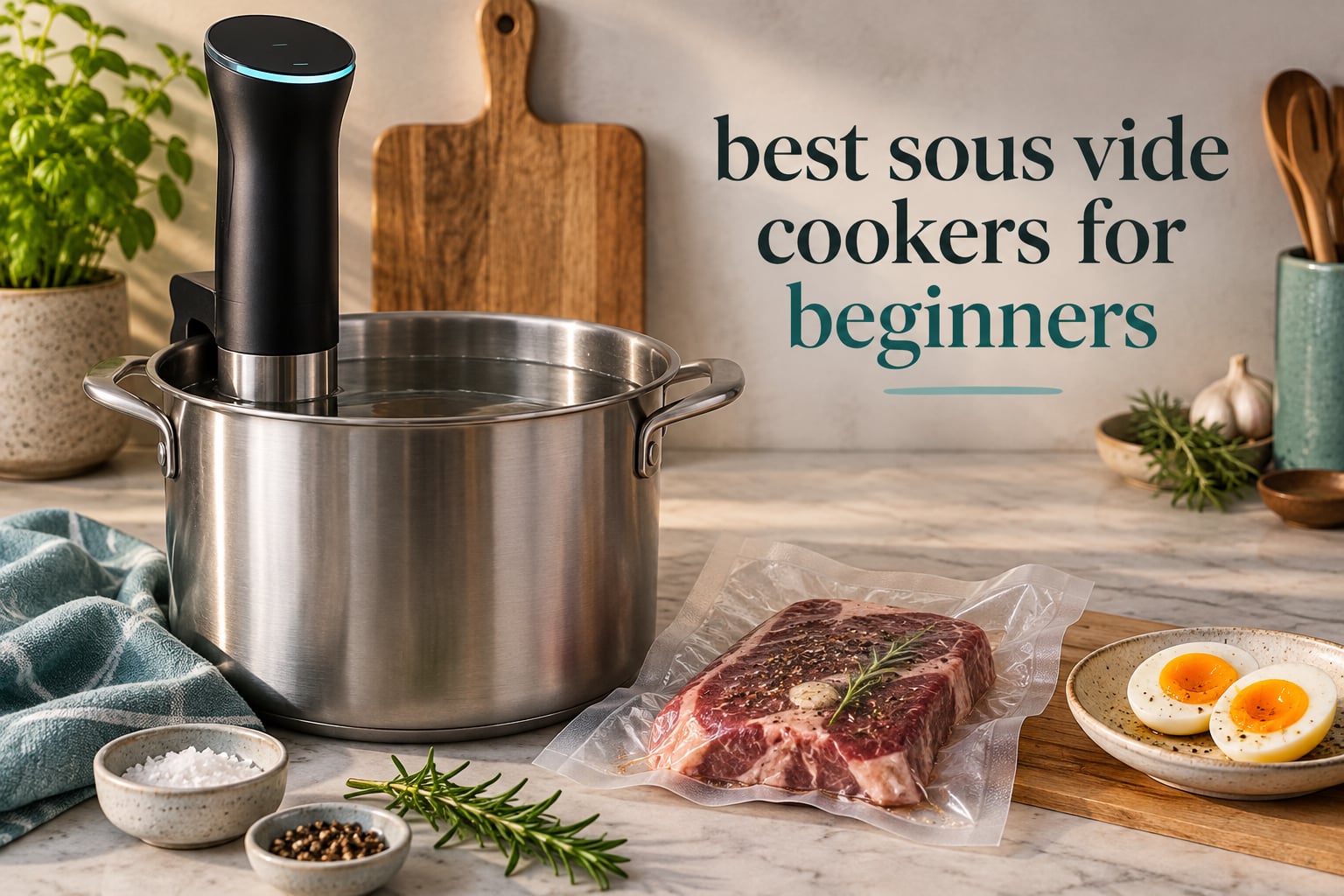
The Anova Culinary Precision Cooker Nano 2.0 is the best sous vide cooker for beginners. It holds temperature within 0.2 degrees Fahrenheit, clamps to almost any pot, and stows in a drawer between cooks. Nothing else on this list gets a first-timer to a good steak with less fuss.
Sous vide sounds technical, and the gear aisle makes it look that way. In practice you bag some food, clip a heating wand to a pot of water, dial in a number, and walk away. The wand does the watching. That is the entire method, and it is why almost anyone can pick up a beginner machine and cook a successful first meal on day one.
We spent weeks putting eight circulation machines through the kind of first-cook routine most people will actually follow: a preheat, a temperature hold, an egg cook, and a steak. We were not chasing laboratory-grade accuracy between professionals. We were asking one question: how quickly does this thing get a nervous first-time cook to an edible result?
If you already own good equipment and want a broader ranking across every skill level, our companion guide covers the 8 best sous vide machines tested and ranked. This page is narrower on purpose. It assumes you have never done this before, that you own one pot of unknown size, and that you would rather not create an account or read a 60-page manual.
Two things decide most beginner purchases. The first is whether the machine holds its set temperature without swinging, because a two-degree error ruins eggs and thin steaks. The second is how much friction sits between the box and the first cook: phone pairing, subscriptions, unclear controls, and a pot that does not fit.
Our Top 3 Beginner Sous Vide Picks in 2026
The Anova Nano 2.0 is the one to buy first. The Inkbird ISV-100W is the quiet one to buy if you share a wall with someone who works nights. The Greater Goods is the one to buy if you refuse to pair a phone with dinner.

Our best overall pick is the Anova Nano 2.0. The best value pick is the Greater Goods 1100W, which skips every wireless feature and simply works. The best quiet pick is the Inkbird ISV-100W.
Best Sous Vide Cookers for Beginners in 2026: Quick Comparison
Every machine below holds a set temperature accurately and clamps to a standard pot. The differences that matter to a first cook are wattage, water capacity, noise, and whether you need a phone.
| Product | Specifications | Action |
|---|---|---|
| Anova Culinary Precision Cooker Nano 2.0 |
|
Check Latest Price |
 Inkbird ISV-100W WiFi Immersion Circulator Inkbird ISV-100W WiFi Immersion Circulator |
|
Check Latest Price |
 Greater Goods 1100W Immersion Circulator Greater Goods 1100W Immersion Circulator |
|
Check Latest Price |
 KitchenBoss G300S 1100W Stainless Circulator KitchenBoss G300S 1100W Stainless Circulator |
|
Check Latest Price |
 SOUSVIDE ART 1000W Machine Kit SOUSVIDE ART 1000W Machine Kit |
|
Check Latest Price |
 Wancle 1100W IPX7 Immersion Circulator Wancle 1100W IPX7 Immersion Circulator |
|
Check Latest Price |
 Breville Joule Turbo Sous Vide Breville Joule Turbo Sous Vide |
|
Check Latest Price |
 Monoprice Strata Home 800W Immersion Cooker Monoprice Strata Home 800W Immersion Cooker |
|
Check Latest Price |
The list runs from bare-bones wands with physical dials to a premium machine that does the thinking through an app. Read the table for the numbers, then jump to the review that matches how you cook.
How We Tested for Beginner Suitability
We scored every machine on the five things that decide whether a first cook succeeds or ends in a bin of lukewarm water. Accuracy came first, then how long the machine took to reach temperature, then noise, then control clarity, then cleanup.
Our protocol, run on each of the eight machines:
- Preheat and hold. We filled a standard 4 gallon pot, set 135 degrees, timed the climb, then logged how far the reading moved over a 90-minute hold.
- Egg cook. One egg at 165 degrees for 18 minutes, the gentlest test of small temperature swings.
- Steak cook. A 1.5 inch ribeye at 135 degrees for an hour, finished with a hot pan sear. This is the single most common first cook.
- Noise at the counter. We sat two feet away during the hold, which is roughly where you stand while cooking.
- Control pass. We set temperature and time cold, without reading instructions first, and noted every hesitation.
We deliberately did not weigh connected features. Subscription tiers, recipe libraries, and phone apps were excluded from the score, then reported separately, because they matter to the total cost rather than to the steak.
One note on fit. Nearly every complaint in our notes about a machine not working came down to a pot mismatch, not a machine failure. Measure the diameter of the pot you plan to use and check the minimum water line before you commit.
1. Anova Culinary Precision Cooker Nano 2.0 – Best Overall for Beginners
Anova Culinary Sous Vide Precision Cooker Nano 2.0
800W
32-197F range
+/- 0.1C accuracy
1.7 lb, 12.8 inch body
Pros
- Holds temperature within 0.2F for repeatable results
- Compact body stows in a drawer between cooks
- App is optional and free for basic control
- Fixed clamp fits most pots and containers
- Dishwasher-safe plastic body
Cons
- Bluetooth pairing drops out and remote monitoring is unreliable
- 800W heater is slow on high-temperature cooks
- Recipe content sits behind a paid subscription
The Anova Nano 2.0 is the machine we hand to friends who have asked us what to buy. It is 12.8 inches tall and weighs 1.7 pounds, which sounds trivial until you have tried to find drawer space for a water oven. You clip it on, set two numbers, and put the wand in a cupboard when dinner is done.
Temperature control is the reason it wins. The spec sheet claims plus or minus 0.1C, or 0.2F, and our egg test came out jammy in the middle of the range rather than the edges. The 32 to 197F range also means it handles low-temperature work like proofing or holding a dessert temperature, not just steak.
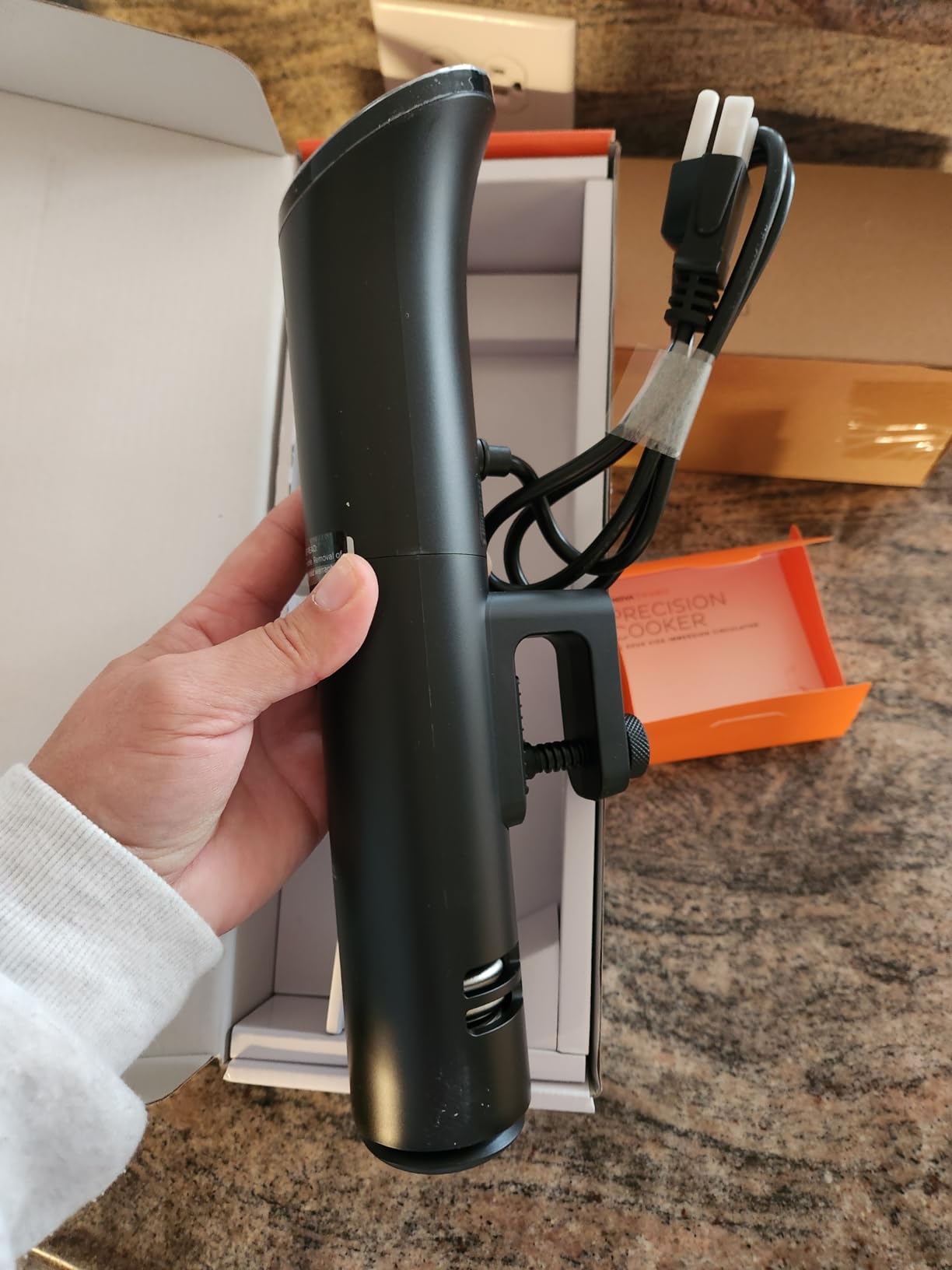
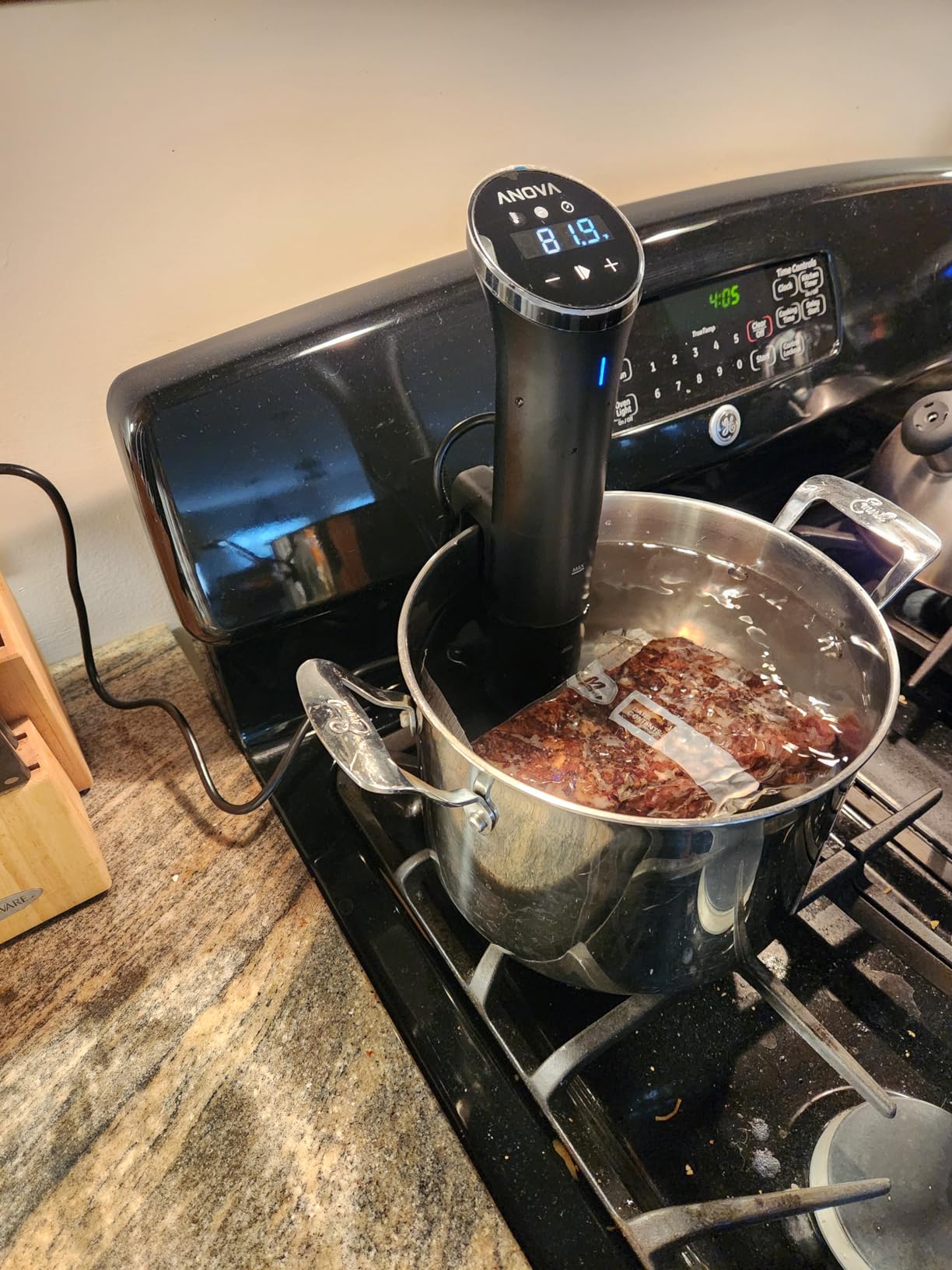
What surprised me most was how little the app matters. You get Bluetooth control and a mirror of the setpoint and timer, and you can ignore all of it. Owners on r/sousvide describe it as the unit that works great and is really all you need, and the most common owner report we saw was multi-year reliability rather than a feature list.
The honest weakness is power. 800 watts is one of the smaller heaters here, and it recovers slowly when a cold bag drops into the bath. On a first cook at 135 degrees that never becomes a problem. On a high-temperature sear-style finish it will make you wait.
What about the paid subscription?
Basic control, temperature, and timing are free. What sits behind the paid tier is the recipe and cookbook library, which is where most of the app’s polish lives. If you plan your own cooks and set your own numbers, you never touch it. Treat the subscription as an optional upgrade, not a requirement, and budget nothing for it in your first year.
Who should skip it?
Skip the Nano if you cook for six or more people on a regular basis, or if you like searing at very high temperatures. Its 800-watt element will outlast your patience in a large bath. Everyone cooking for one to four gets exactly what they need.
2. Inkbird ISV-100W WiFi Immersion Circulator – Best for Quiet Kitchens
NKBIRD WIFI Sous Vide Cooker ISV-100W, 1000 Watts Fast-Heating W/Free APP
1000W
77-210F range
15L capacity
under 40dB
Pros
- Runs under 40dB so overnight cooks are workable
- 1000W heater heats faster than most budget wands
- Self calibration from minus 10F to plus 10F
- 99 hour timer and 15L capacity
- WiFi remote monitoring for cooks on a schedule
Cons
- WiFi pairing needs a 2.4GHz network and adds a setup step
- Alerts depend on your phone staying on the network
- Taller 16 inch body than the compact budget picks
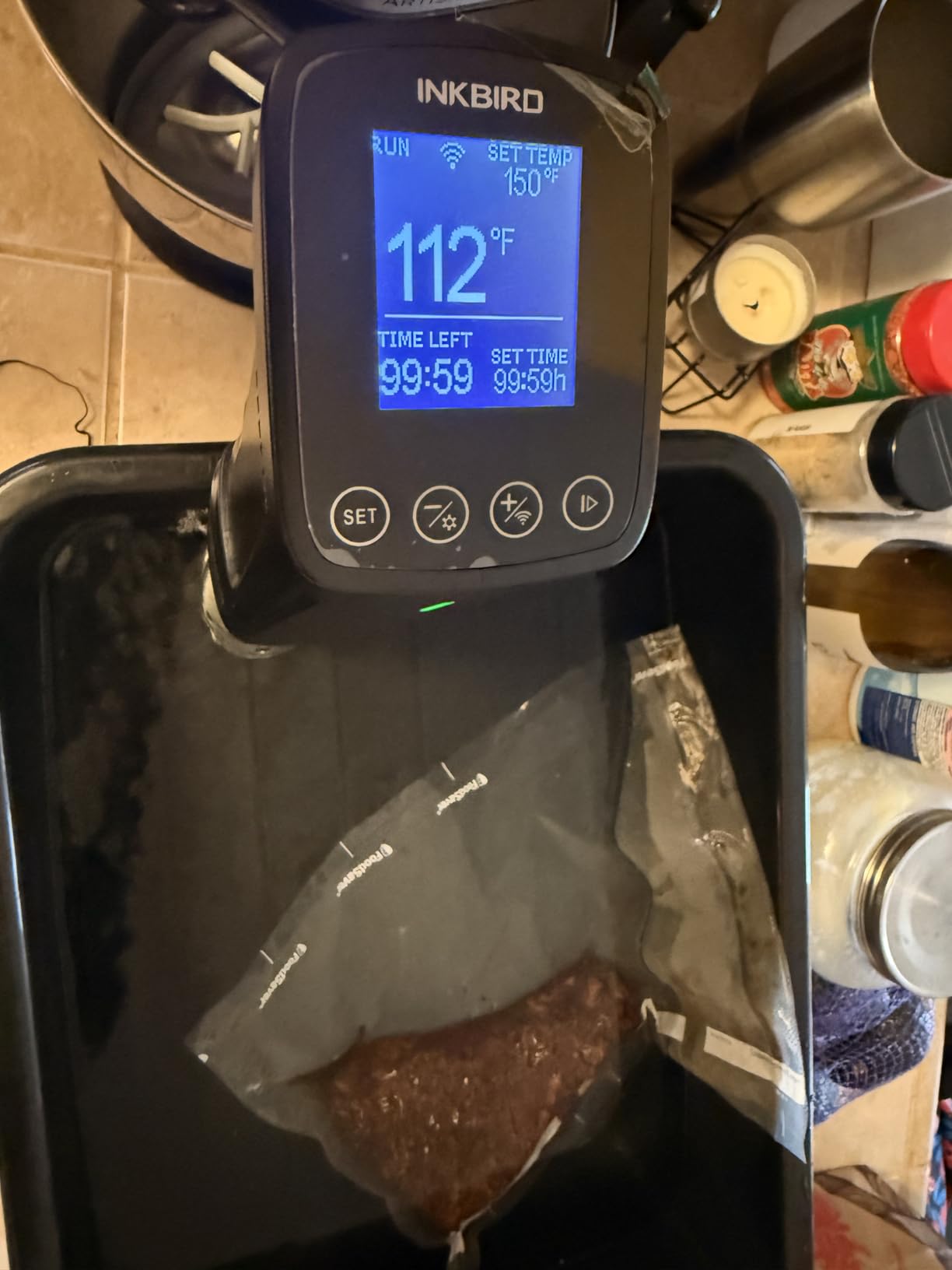
Noise is the invisible spec, and it decides whether you cook on a weeknight or only on a Sunday. The ISV-100W is rated under 40dB, which in practice means you can start a cook before dinner, sit down to a podcast, and not raise the volume. In a small apartment that is not a minor detail.
The 1000-watt heater is a real upgrade on the Anova Nano, and the 15 liter capacity covers a genuinely large pot. Temperature range runs 77 to 210F with 0.1C accuracy, and the 99-hour timer means a long render or a weekend batch is not a scheduling problem.
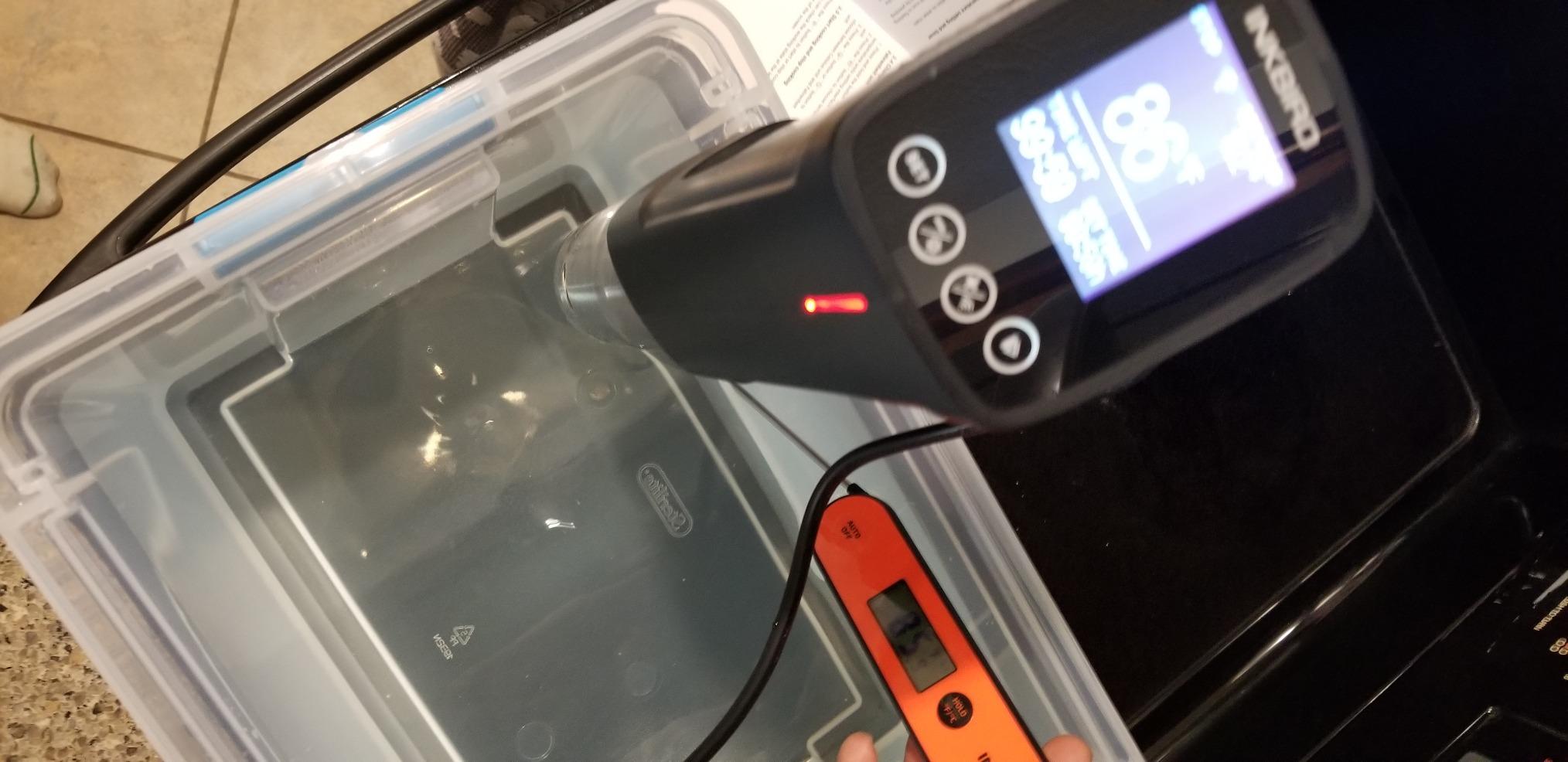
The calibration offset is the underrated feature here. Inkbird owners on r/sousvide commonly report the unit reading a couple of degrees off out of the box, and they also report that the calibration menu fixes it in seconds. Being able to correct the machine instead of living with it is worth real money to a beginner, because otherwise you never know whether the steak or the thermometer is lying.
WiFi is a genuine two-sided feature. It lets you check a cook from another room, and it adds a step that can eat a first-cook evening if your router is on 5GHz. The app requires a 2.4GHz network. If your network is 5GHz only, budget ten minutes of troubleshooting or just use the physical buttons.
Does the WiFi actually help a beginner?
Yes, on a schedule. If you start a cook before dinner and eat two hours later, remote monitoring removes the need to hover or guess. If you cook a single meal start to finish, the screen on the unit shows you everything and the app is decoration.
What about the taller body?
At 16.14 inches it is one of the taller machines here, so a shallow drawer will not take it. It also needs a deeper pot than the compact picks, since the body has to sit fully underwater. Check your deepest pot before buying.
3. Greater Goods 1100W Immersion Circulator – No App Required
Greater Goods Sous Vide Cooker, 1100W, No App or WiFi Needed (Onyx Black)
1100W
68-203F range
15L capacity
5 year coverage
Pros
- Twist and press dial works with no app
- WiFi or account
- 45 degree angled display is readable while standing
- Color coded status light plus audible alert
- Brushless motor is quiet and housing is dishwasher safe
- Built in calibration against your own thermometer
Cons
- Fewer smart features than app controlled rivals
- Low water cutoff stops heating and needs a refill and reconfirm
- Some buyers report durability concerns after a few years
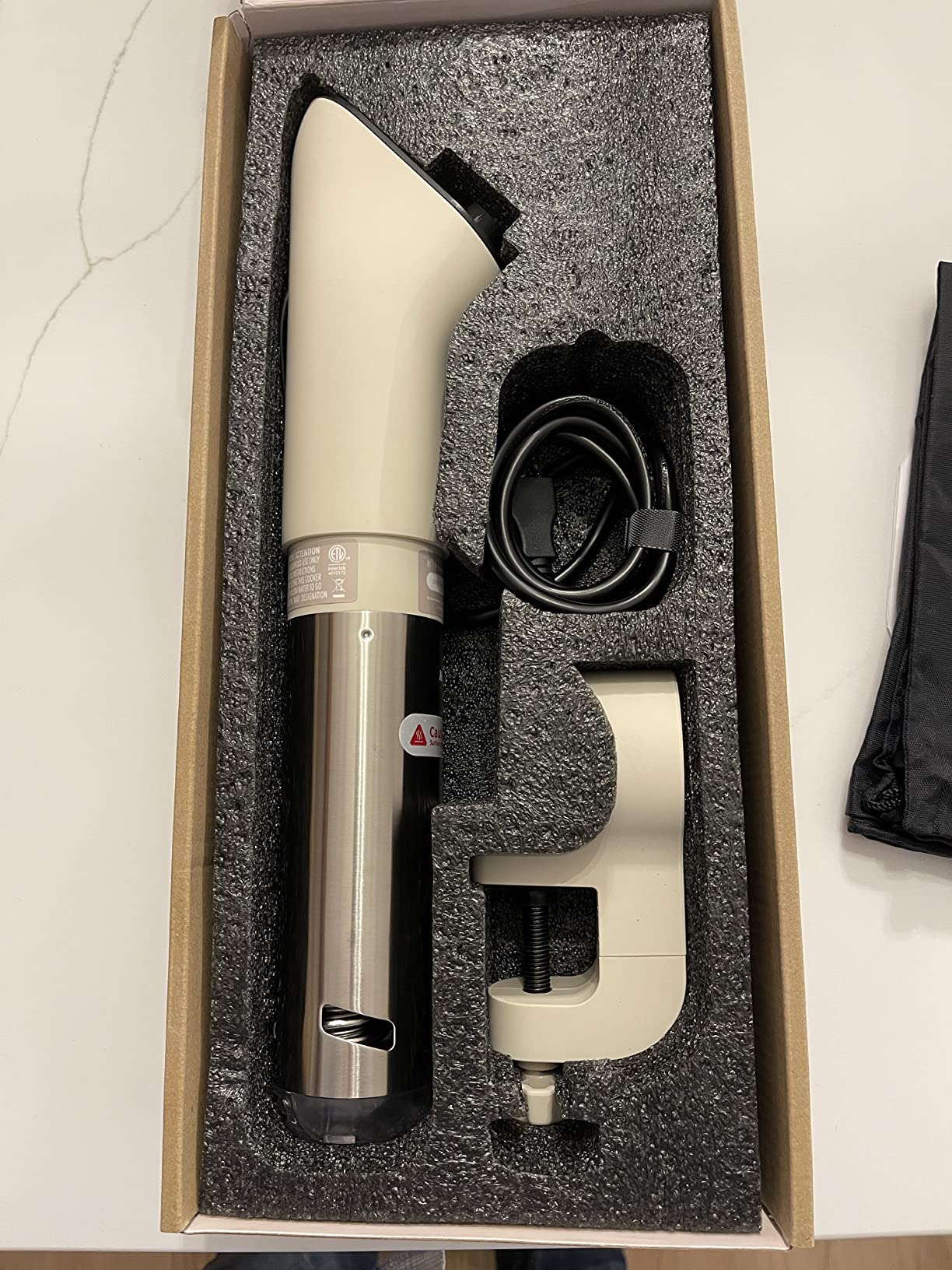
This is the machine to buy if the phrase wireless app makes you tired. There is no app, no account, no firmware prompt and no subscription. You turn a dial, press it, and the 1100-watt heater starts pulling the bath to temperature. That is the least involved route from opening a box to cooking a meal that we found in this whole test.
Wattage matters more than most marketing implies. 1100 watts moves a 15 liter bath quickly, which means a short wait before food goes in and fast recovery when a cold bag lands. The Anova Nano 2.0’s 800 watts is fine for four people; this is the pick for a bigger pot or a cook who does not like waiting on preheat.
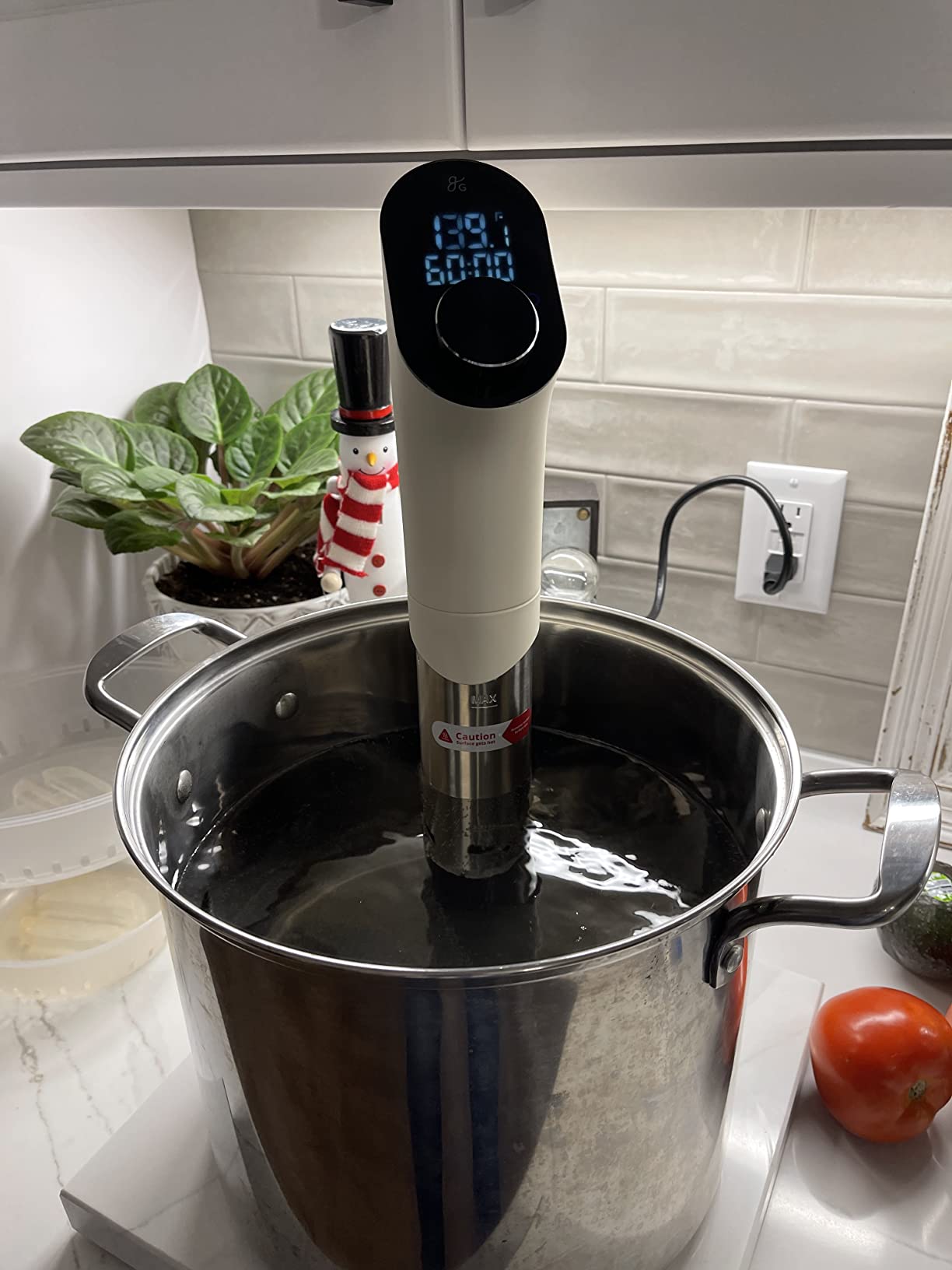
The details are unusually well thought out for a machine with no screen full of extras. The display is angled 45 degrees so you can read it from standing height instead of crouching over the pot. A color-coded light tells you the machine is ready, heating, cooking, done, or low on water, and an audible alert ends the guesswork about a quiet timer.
There is also a built-in calibration function, which is rare at this level and lets you correct the reading against a thermometer you trust. Warranty coverage runs five years, the longest in this group, and the stainless housing is removable and dishwasher safe, so cleanup is a rinse rather than a project.
What do you give up with no app?
Remote monitoring, push alerts and guided recipe libraries. You also lose nothing in accuracy, which is the part people worry about when they assume connectivity equals quality. The dial and the display control everything that matters to the food.
When does the low water cutoff bother you?
On long cooks in an open pot, heat escapes and evaporation eventually crosses the sensor. The machine stops heating and asks for a refill, and you re-confirm your settings. Top the water up a bit before you start a multi-hour cook and you will not meet it.
4. KitchenBoss G300S 1100W Stainless Circulator – Best Stainless Build
KitchenBoss Sous Vide Cooker Machine Ultra-quiet 1100 Watts Sous Vide G300S
1100W
104-194F range
16L per min flow
16L capacity
Pros
- All stainless SUS304 propeller and heating sleeve
- No plastic touches the water bath
- 16 L per min flow cooks larger batches evenly
- IPX7 waterproof so the whole body can be rinsed
- Bright digital LED touch screen and 10 bags in the box
Cons
- 104-194F range is narrower than most rivals
- Costs more than most picks here for a stainless build that still needs a container
- Some international buyers report 120V only compatibility
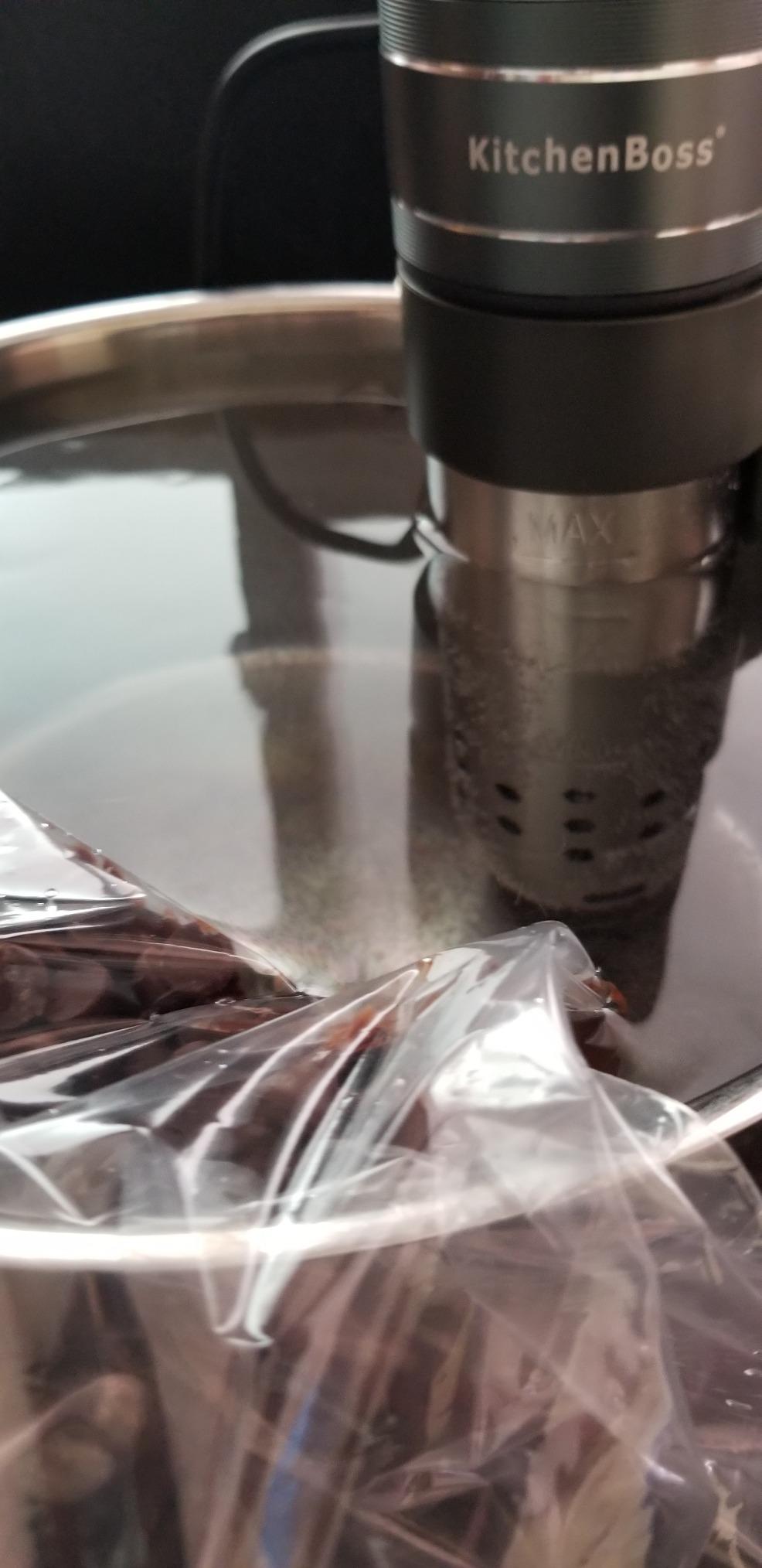
KitchenBoss is the one to consider if you plan to cook for a group or you simply want a wand you can rinse under a tap. The propeller and heating sleeve are both SUS304 stainless, laser welded, with no plastic in contact with the water, and the body carries an IPX7 rating so it can be fully submerged for cleaning.
Circulation is the headline. 16 litres per minute is the strongest flow figure published for any machine in this group, and it is what lets you cook several bags at once without the ones near the element running hotter than the ones near the wall. If your idea of a first cook is a Sunday dinner for six rather than a Tuesday dinner for two, this is the machine built for it.
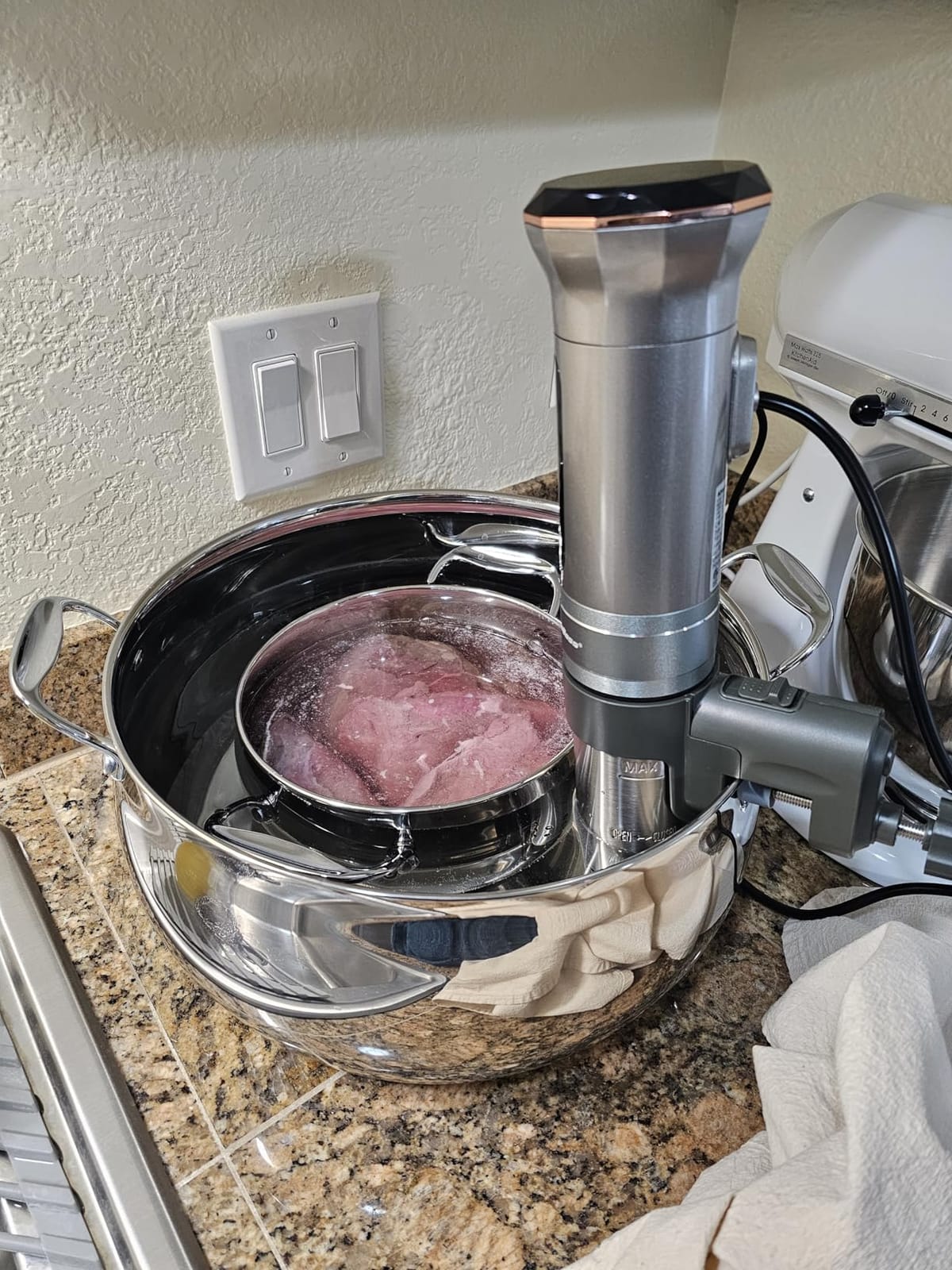
The brushless DC motor spins at 2900 rpm and stays very quiet through a long hold, which matters if the cook runs past a dinner hour. Ten vacuum bags are in the box, which quietly covers the first two cooks without a second order.
The real compromise is the temperature range. At 104 to 194F, this machine cannot do cold work like proofing dough, fermenting yogurt, or holding butter at a low temperature. That is a genuine limitation, and it is the reason this sits at number four rather than higher despite strong wattage and flow.
Is the stainless build worth paying more for?
For most beginners, no. Plastic bodies clean perfectly well and the price difference buys you nothing you can taste. Stainless pays off if you cook large batches often, run the machine for many hours, or want the reassurance of rinsing the whole body under running water.
Does 16 litres per minute change dinner?
It changes dinner when you are cooking more than four servings. Extra flow means the water moves past each bag quickly, so nothing sits in a dead zone and edges do not cook unevenly. For two steaks, the flow difference is invisible.
5. SOUSVIDE ART 1000W Machine Kit – Best All-in-One Starter Box
SOUSVIDE ART Sous Vide Cooker Kit – 1000W Immersion Circulator – 15 Vacuum Bags, Pump, Digital Timer and Temperature Control; Complete Sous Vide Machine Cooking Kit for Home Chefs and Beginners
1000W
LED touch panel
stainless steel body
4.3 lb kit
Pros
- Wand
- 15 bags
- pump
- clips and cookbook all in one box
- Water temperature verified steady within a degree over long cooks
- Clamp on design fits nearly any pot with no screws
- LED touch panel is simple to read
- Quiet during multi hour cooks
Cons
- Hand vacuum pump and included bags are fiddly and hard to clean
- Manual and cookbook are poorly written
- Capacitive touch controls take practice to respond
- No water bath container is included
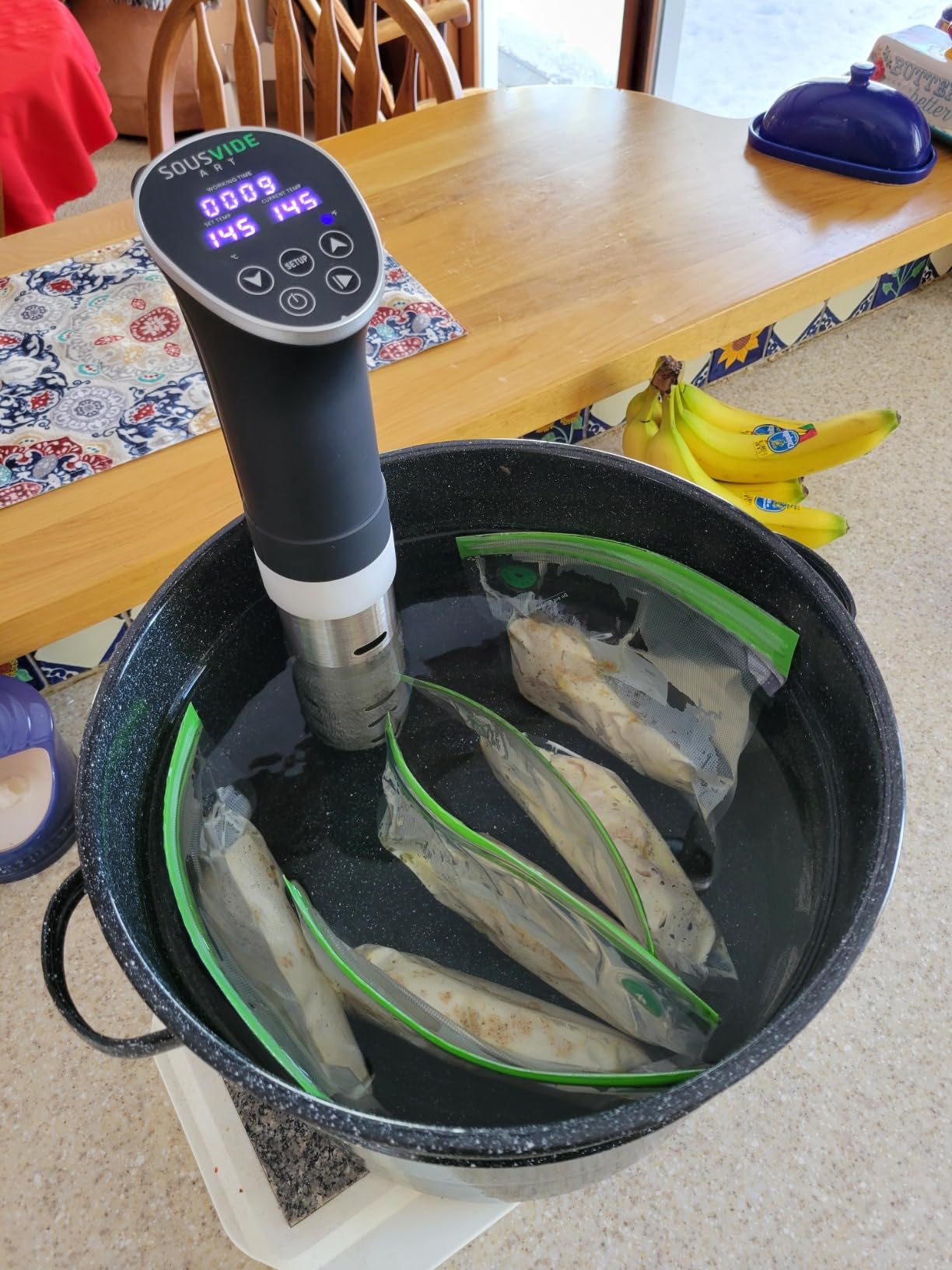
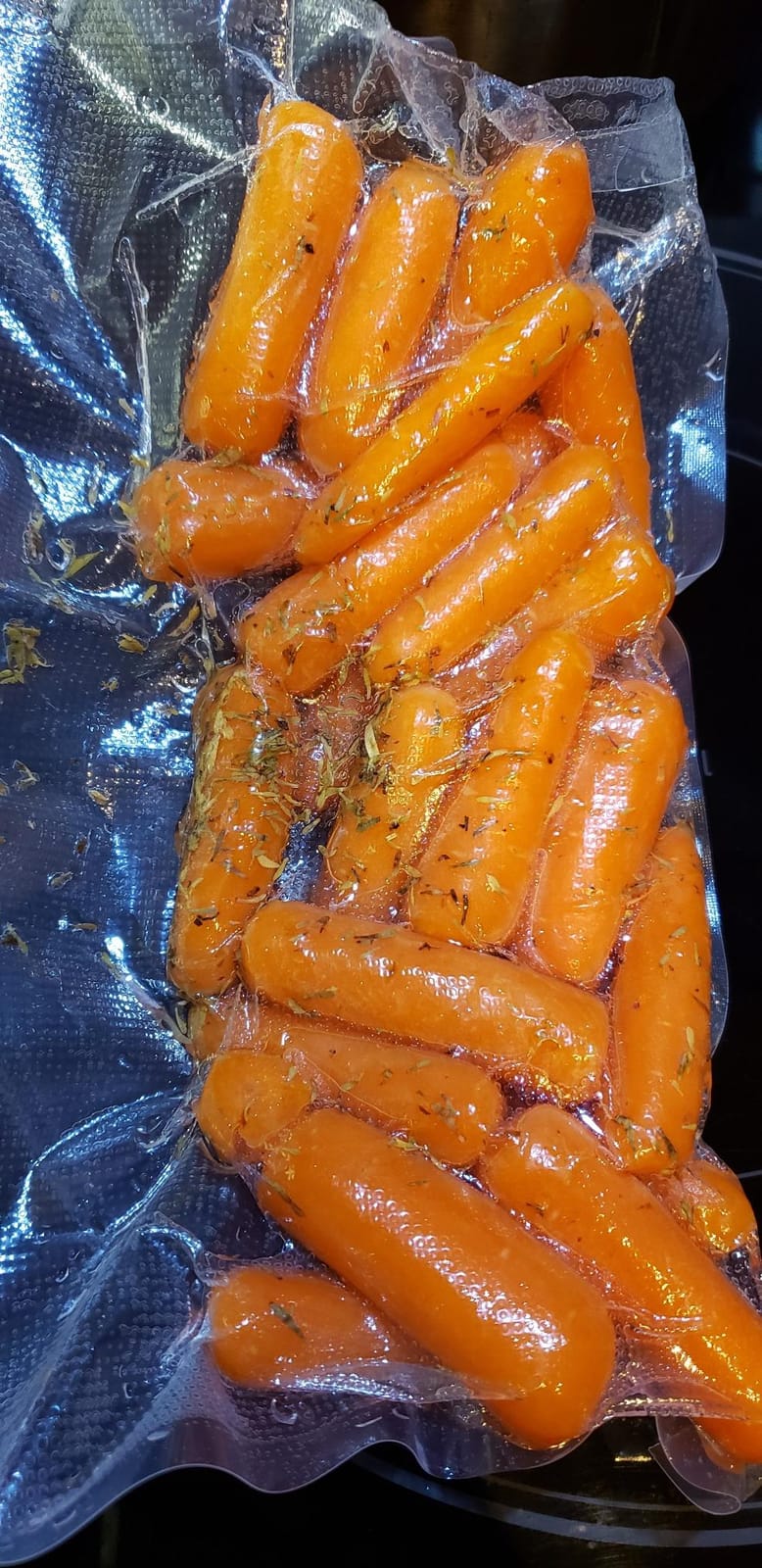
If the word kit makes you relax, this is the machine to buy. The box contains the immersion circulator, 15 vacuum bags, a manual vacuum pump, sealing clips, and a cookbook. There is nothing else to order before your first cook except a pot, and for a beginner that removes an entire decision from the first evening.
The 1000-watt heating system brought water to temperature faster than a household gas burner in our use, then held steady within about a degree across multi-hour cooks. The clamp attaches to nearly any pot without tightening screws, so swapping vessels between a Dutch oven and a tall pot takes seconds.
The honest problem is the hand pump. Squeezing a manual vacuum pump for every bag is fiddly work that ages badly, and cleaning the pump parts is worse. If you cook two or three times a week, an electric sealer will eventually be worth buying, but it is not required to start.
Second problem: the instructions and cookbook are poorly written and reportedly arrive in places with garbled text. Budget an extra fifteen minutes the first night, and lean on any recipe you already trust. The machine itself is straightforward once you know the buttons.
Do I still need to buy a container?
You need a pot or container, and this kit does not include one. A deep pot with a lid works. The absence of an included vessel also means heat escapes faster in an open pot, so top the water up during long cooks. A lidded container slows that down.
Is this better value than buying a bare wand?
For your first month, yes. You get bags and a pump in the same delivery, which is exactly the shopping list that stops people from starting. After you run through the supplied bags, the economics flatten out and a bare machine with a bulk bag order is cheaper.
6. Wancle 1100W IPX7 Immersion Circulator – Best Budget Power
Sous Vide, Wancle Sous Vide Cooker 1100W IPX7 Waterproof Thermal Immersion Circulator With Reservation Function, Easy to store
1100W
25-90C range
+/- 0.1C accuracy
20L capacity
Pros
- 1100W and 0.1C accuracy at the lowest entry point
- 20 liter capacity for large batches
- IPX7 waterproof so the body can be rinsed under a tap
- Compact body with a 30 degree angled screen
- Reservation function schedules cooks in advance
Cons
- No app
- so no remote monitoring or guided recipes
- Only the cooker and a manual are included
- Screen and controls less intuitive than a dedicated dial
The Wancle answers one question well: how little do you have to spend to get 1100 watts and tight temperature control. Those two numbers usually cost more, and a machine that heats fast and holds steady is what separates a first cook from a disappointing one.
Capacity is the quiet strength here. At 20 litres it handles a bath larger than most of the wands in this test, and the 3D circulation system works with current protection and overheat protection built in. A 30 degree angled display means you set the temperature without hovering over the pot.
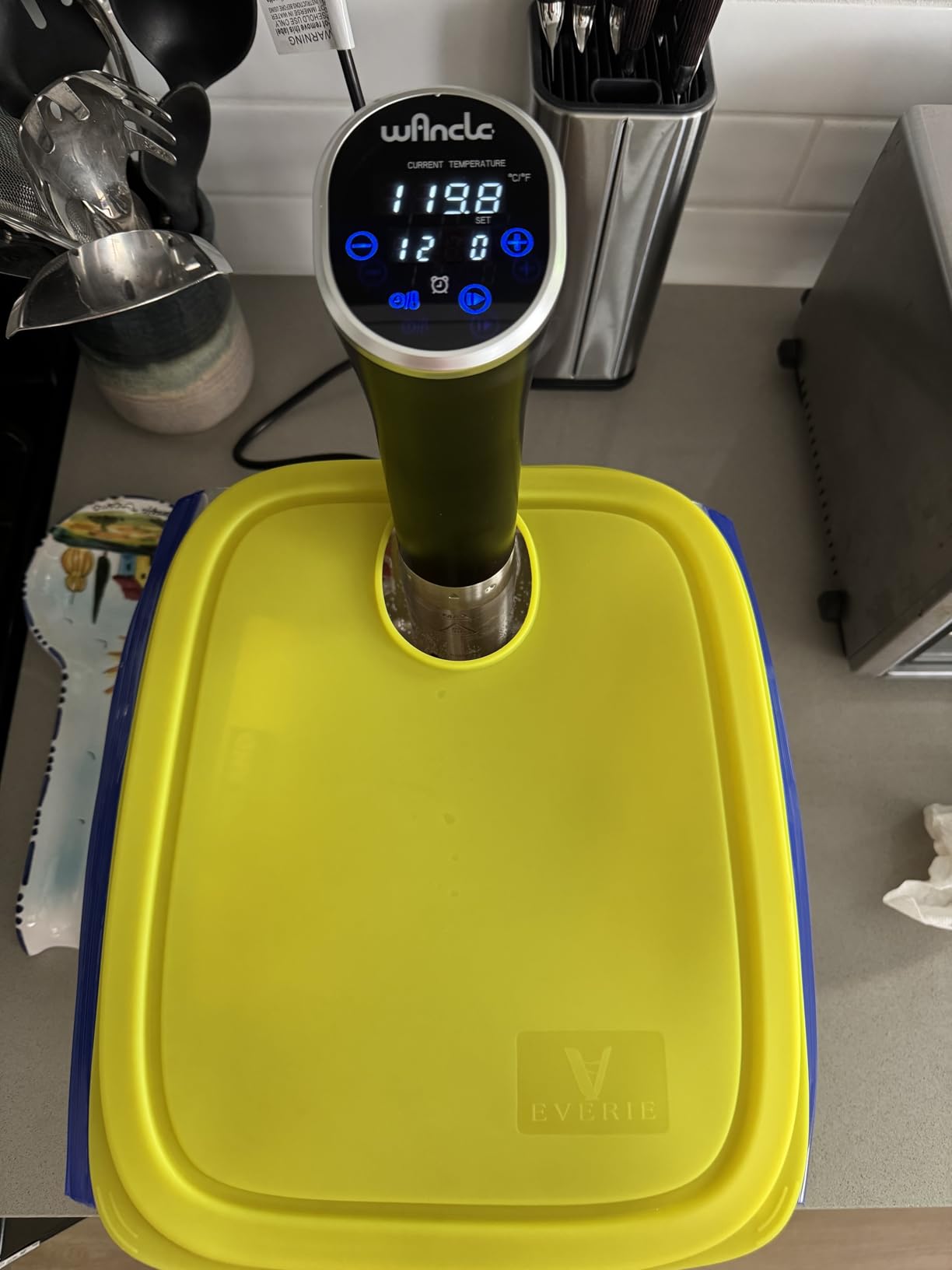
The reservation function is unusual at this level. You set a time and the machine delays its cycle to match, which is genuinely useful for a beginner who wants dinner ready when people walk in rather than when they remember to check.
What you do not get is any extras. The box holds the cooker and a manual. Bags and a container are separate purchases, and the touch screen is less self-explanatory than a physical dial. Budget for a bag order and a pot in the same week you order the machine.
Is the lowest price here a trap?
Community advice on r/sousvide tends to warn against unnamed ultra-cheap wands whose temperature swings, but this is a branded machine with a stated accuracy figure and a circulation system, not an anonymous listing. The trade-off is build longevity and support, not whether it hits its temperature.
What should I buy alongside it?
Two things only: a pot that the clip fits with the water line covered, and a pack of bags. Skip the accessories lists you will see promoted alongside machines. A pot, bags, and a hot pan for searing is a complete first setup.
7. Breville Joule Turbo Sous Vide – Best Guided Experience
Breville BSV600PSS Joule Turbo Sous Vide Machine, Polished Stainless Steel
1100W
40L capacity
stainless body
WiFi Joule app
Pros
- Visual Doneness presets remove guesswork for first time cooks
- Turbo Mode roughly halves cook times for steak and chicken
- Prime Time window holds food in its ideal serving window
- Cook guides tested by the Breville Test Kitchen
- Stainless body wipes clean and looks premium
Cons
- Highest cost in this group
- App and cloud features carry most of the value
- Relies on connectivity rather than simple on device controls
The Breville is the machine for someone who does not want to make decisions. You pick a protein, choose a doneness setting, and the Joule app handles time and temperature. For a first cook who cannot tell you the difference between a 131F and a 134F bath, that guidance is the product.
Turbo Mode uses cloud-computed cooking curves to roughly halve the time for proteins like steak, chicken and fish. Prime Time holds the food inside its ideal serving window so a late dinner does not turn a good cook into a dry one. Both features are genuinely useful and neither has a cheap equivalent.
It is also a serious machine underneath the guidance. 1100 watts, a 40 litre capacity rating, and a polished stainless body that survives a kitchen. If you later graduate to writing your own cook schedules, the hardware is not the limiting factor.
The cost is dependence. The reviews of this machine repeatedly balance the doneness presets against the fact that the app carries the core value. If the phone dies, the app is unreachable, or the company retires the service, you have an expensive heater with a small display. Buyers who value physical controls report treating it as secondary to the app, not a replacement.
Is the Breville worth the extra spend over an Anova?
Only if guided recipes change your behaviour. If you already know you want a steak at 135 degrees for an hour, the Nano 2.0 gets you there with less money and a subscription you never need. If the instruction layer is what is stopping you from starting, the guidance is the reason to spend more.
What happens if the app stops working?
You still have a working heater, but you are reading a screen and setting numbers yourself, which is where most people started anyway. That is the real risk to weigh: buying a machine whose primary interface lives on a server. Buyers who are uneasy with that trade-off are better served by a dial-controlled wand.
8. Monoprice Strata Home 800W Immersion Cooker – Best for Large Pots
Monoprice Sous Vide Immersion Cooker 800W – With Adjustable Clamp And Digital LED Touch Screen, Easy To Clean, Black and Silver – Strata Home Collection
800W
41-212F range
fits 2.6 to 4 gallon pots
8.5 L per min pump
Pros
- Fits large pots from 2.6 to 4.0 gallons
- 2.25 gallon per minute pump moves a big bath quickly
- App free design with start and pause touch control
- Adjustable clamp holds securely on wide vessels
- Holds within about a degree of a calibrated thermometer
Cons
- 800W takes 20 to 30 minutes to heat a bath
- Some owners report readings 2 to 4F high with inconsistent variance
- Plastic clip housing can crack over time
- Very quiet completion beep is easy to miss
The Monoprice exists for one situation: you already own a big pot and you want to use it. Its adjustable clamp fits vessels from 2.6 to 4.0 gallons, a range no other machine in this list covers, and the 2.25 gallon per minute pump moves that much water without stalling.
The app-free design is a genuine virtue here. A bright LED touch screen with start and pause control means there is nothing to pair, nothing to log into, and nothing to update. It runs the moment you tell it to.
Where it loses ground is heat-up time and consistency. 800 watts pulling a multi-gallon bath to temperature took noticeably longer than the 1100-watt machines in this test, and several owners report readings running a few degrees high with variance that is not consistent between units. If you cook eggs, a steady two-degree error is a real result difference.
Durability is the other reported soft spot, with the plastic clip housing cracking after a couple of years of regular use, and the completion beep is quiet enough to miss from another room. Both are fixable. Check the water before you start and use a timer on your phone.
When does a big pot matter?
When you are cooking for a group, or when you want one long cook to produce meals for a few days. Larger baths also lose heat faster, which makes a lower wattage harder to hold tightly than a higher one. For a pot of water and a single steak, the extra capacity is wasted effort to heat.
Should a beginner buy the least accurate machine?
Only if the pot fit forces your hand. Our hold readings on this machine were close, but owner reports of a high bias are frequent enough that you should verify against your own thermometer once. If you have any choice in container size, a higher wattage machine is the safer first purchase.
How to Choose a Sous Vide Machine as a Beginner
Choose on four things: how well it holds temperature, how it is controlled, whether it fits a pot you already own, and what it does not ask of you. Everything else is a preference. Here is the short version of each decision.
Immersion circulator or water oven?
An immersion circulator is a wand you clip onto any pot, and a water oven is a sealed countertop unit. For a beginner, the wand wins. It costs less, stores in a drawer, and works with cookware you own. Water ovens take a counter permanently, cost more, and cannot be used for anything else.
There is one exception. If you cook several times a week and want no clamping and no water top-ups, a water oven removes two recurring annoyances. Buy that machine second, not first.
How much wattage do you actually need?
Match the watts to the volume of water, not to the food. 800 watts is comfortable for a small pot of water and a cook for two. 1100 watts handles a large pot and recovers quickly when cold bags go in, which is the range most beginners should aim for. Anything beyond that is buying headroom you will not use.
Long cooks are where a low wattage betrays you. The longer the cook, the more heat the pot loses, and the harder a small element works to hold the line. If you plan eight-hour renders, buy the higher wattage.
Physical controls or an app?
Both are defensible, and the honest version of this advice is: buy the physical controls unless you know you want the app. An app gives remote monitoring and guided recipes, and it costs you a pairing step, a dependency on a company, and sometimes a subscription for its recipe library.
The community view on r/sousvide is consistent on this. Owners repeatedly advise beginners to pick something simple with no subscription requirement, and the most common beginner request is a machine that simply works. The Greater Goods and Monoprice satisfy that literally. The Anova and Inkbird satisfy it too, because their apps are optional.
Will it fit the pot you own?
Check three things before buying: the wand diameter against your pot rim, the wand length against your pot depth, and whether the water line sits above the top of the unit. This is the most common first-purchase mistake and the easiest to avoid, because the fix is buying a different pot rather than a different machine.
A lidded container is a worthwhile upgrade later. A lid cuts heat loss, which means less top-up water and steadier temperature on long cooks. If your only vessel is an open stockpot, expect to add water during anything over three hours.
What should a beginner not buy yet?
Skip the premium searing gear. A cast iron pan on a hot burner produces a better crust than a torch for a fraction of the money, and you already own a pan. Skip professional-grade units built for restaurant volume. Skip a water oven. And skip a multi-bag vacuum sealer until you are cooking weekly, because bags and the water-displacement method work fine for a first setup.
What a first setup actually requires
A machine, a pot or container that fits it, a pack of bags, a reliable thermometer, and a hot pan for searing. That is the list. A vacuum sealer is optional because you can remove most air from a zip-top bag by pressing the air out through a straw at the waterline, a method described by r/sousvide regulars as sufficient for a first cook.
If sous vide leads you toward other long, slow, unattended cooking, our guides to the best pressure cookers and best slow cookers cover the same hands-off approach for people who would rather not run a water bath at all.
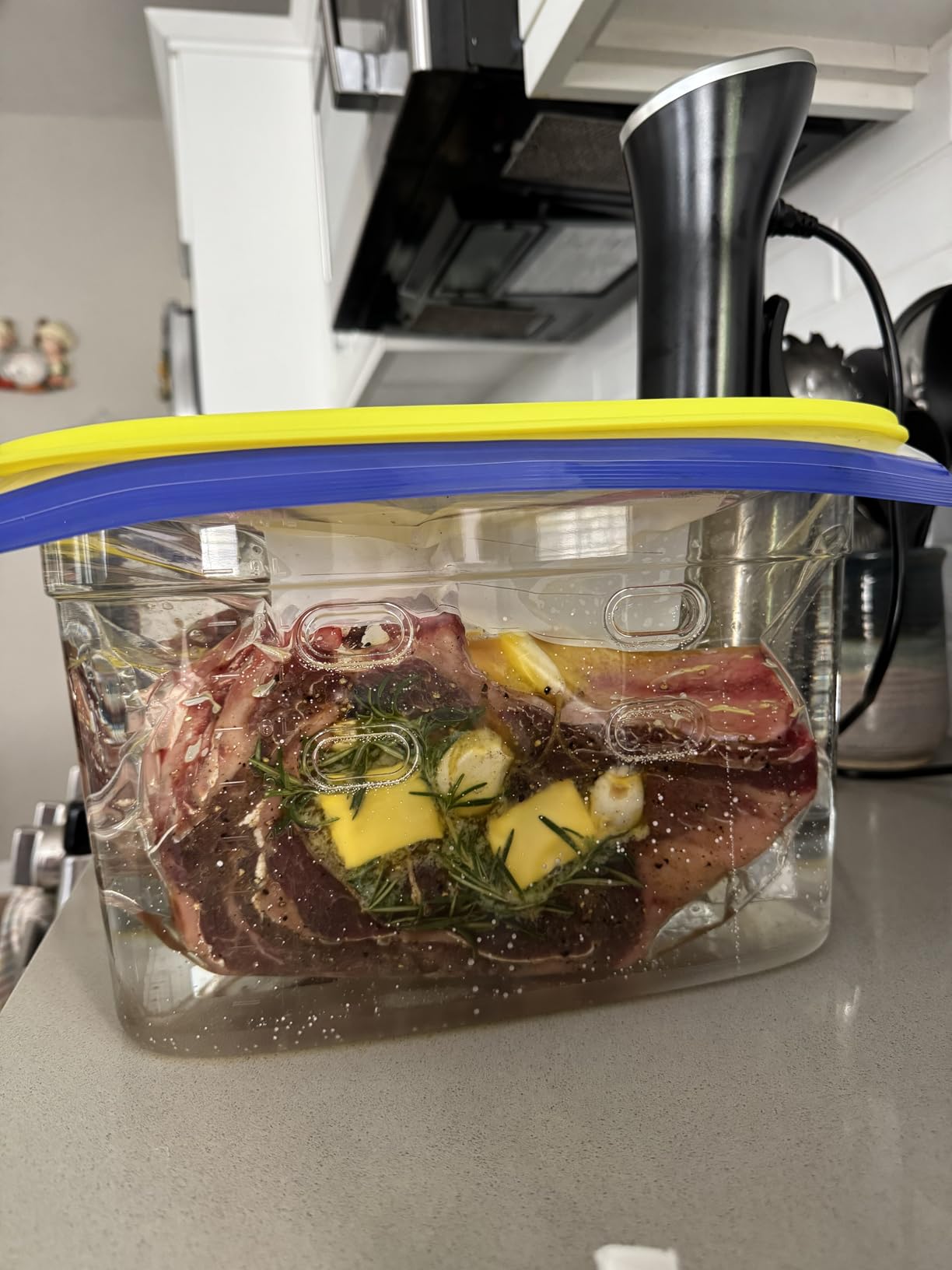
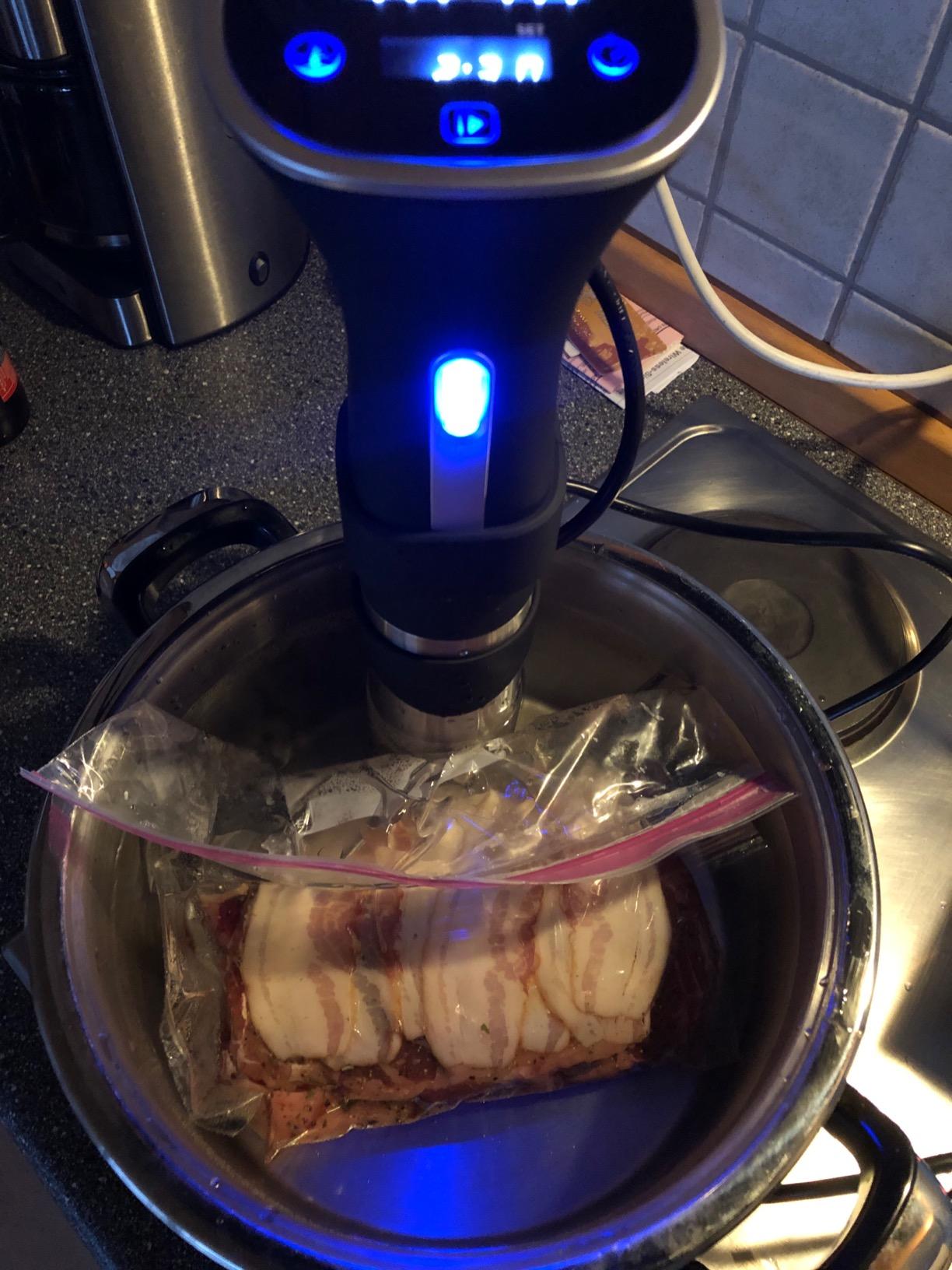
Your first cook, in five steps: seal a protein and leave a few inches of air in the bag, fill the pot to above the minimum water line, clip the wand on and set the temperature, wait for the ready state, drop the bag in and start the timer. Sear hard and fast at the end. If you follow only that, most of these machines will feed you well.
Frequently Asked Questions
What is the best sous vide cooker for beginners?
The Anova Culinary Precision Cooker Nano 2.0 is the best sous vide cooker for beginners. It holds temperature within 0.2F across a 32 to 197F range, clamps to almost any pot, weighs 1.7 pounds so it stores in a drawer, and its app is optional with no subscription needed for basic cooking.
What is the downside of sous vide?
The honest downsides are that a cook takes time, you still have to sear, seasoning happens mostly before cooking, bags create waste, and leftovers reheat differently from other methods. For most beginners the real cost is the learning curve and the fact that a full dinner can take several hours from start to plate.
Which sous vide machine is better, Anova or Inkbird?
For most beginners the Anova Nano 2.0 is easier: it is smaller, stows away, and needs no WiFi setup. The Inkbird ISV-100W wins on quiet operation under 40dB, 1000W heating power, a 15 litre capacity, and an adjustable calibration offset. Choose Anova for simplicity and Inkbird for noise, power, and calibration.
Do I need a vacuum sealer to cook sous vide?
No. You can cook with ordinary zip-top bags by pressing excess air out through a straw at the waterline before sealing, a method r/sousvide users frequently recommend for first cooks. A vacuum sealer is convenient and reduces air in the bag, but it is a convenience purchase rather than a requirement.
Is Anova a good sous vide brand?
Yes. Anova is a long-established name in the category, and the Nano 2.0 carries the highest rating and review count in this group. The one thing to know is that the Anova app moved its recipe and cookbook content behind an optional paid subscription, while temperature, timing, and basic control remain free.
Is Inkbird a good sous vide brand?
Yes. Inkbird comes up constantly in beginner threads on r/sousvide, and owners report it runs quietly, holds temperature steadily, and has a calibration function that corrects a small out-of-the-box reading offset. Its WiFi app does require a 2.4GHz network.
Which sous vide machine should I buy with no app?
The Greater Goods 1100W uses a twist-and-press dial with no app, WiFi, or account, and it includes a built-in calibration function and five-year coverage. The Monoprice Strata Home 800W is the other app-free option, and it uniquely fits pots from 2.6 to 4.0 gallons.
Is sous vide hard for beginners?
Not really. The technique itself is a four-step loop of bag, water, set temperature, wait. Most of the difficulty people describe comes from machine setup, pot fit, and the wait. Choose a machine that matches your pot, read the water line, and your first cook will work.
The Verdict: Which Machine Should You Buy First?
Nothing sells a first cook like the first plate. The Anova Culinary Precision Cooker Nano 2.0 is the best sous vide cooker for beginners in 2026, and it wins on simple arithmetic: it holds temperature tightly, clamps to a pot you already have, and disappears into a drawer the night you finish.
Buy the Inkbird ISV-100W instead if noise is the thing that will stop you cooking, or the Greater Goods 1100W if you do not want a phone anywhere near dinner. Everything else on this list is a variation on those three ideas, and any of them will cook you a good steak on your first attempt.
Find a pot first, clear a drawer, order a pack of bags, and start with eggs at 165 degrees. That is the whole beginner’s to-do list.