
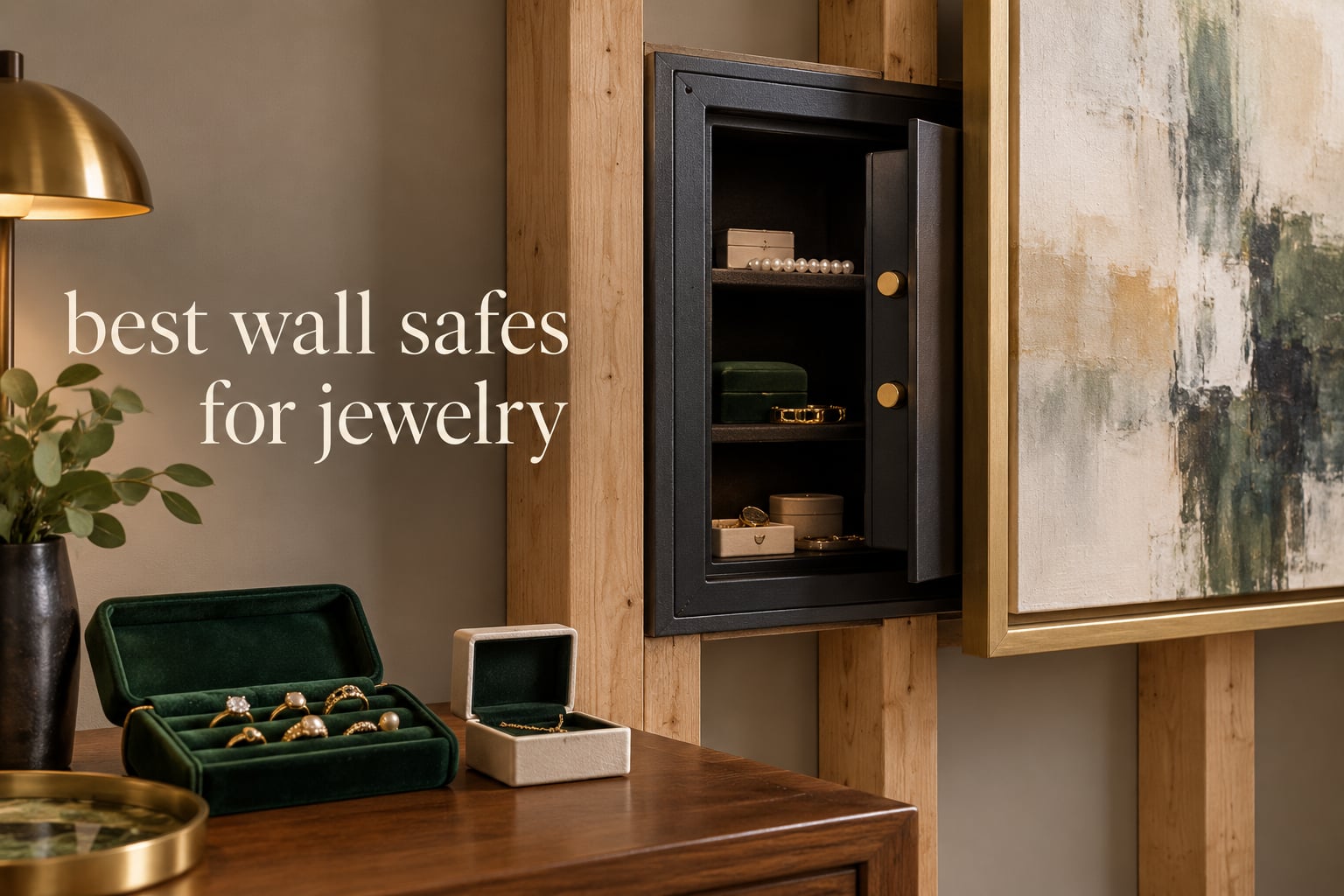
Most wall safes sold online are not safes at all. They are steel boxes with a latch that can be defeated in a few seconds, and the top thread on r/Safes opens with exactly that complaint: every time someone picks one out, they find out it can be opened in 3 seconds. That is the honest starting point for this roundup, because a wall safe only earns its drywall cut if it is anchored to framing and rated for something real.
For most people storing jewelry at home, the Paragon In-Wall Safe with Keypad is the best wall safe for jewelry overall: 0.83 cubic feet of interior, a programmable keypad, two manual override keys, and an anti-theft alarm that locks you out after repeated bad codes. The Viking VS-52BLX is the pick if you want fingerprint entry, and the Protex PWS-1814E is the pick if velvet lining matters more to you than capacity.
This guide covers ten genuine in-wall safes that recess between standard framing, and every one of them lists its exact exterior width and depth so you can check the fit before you cut drywall. Nothing here carries a published UL burglary listing, so we say so plainly rather than repeating marketing language. If you want the freestanding alternative, our picks on the best jewelry safes cover that ground separately.
Last updated: October 2026. Our team compared manufacturer specifications, verified review counts and installation constraints across ten models, and cross-checked fit questions against recurring threads on r/Safes, r/Gold and garagejournal.com. We do not claim any product here is fireproof or burglary-proof, because no safe is either.
Top 3 Picks: Best Wall Safes for Jewelry in 2026
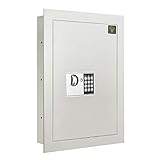
Paragon In-Wall Safe with Keypad
- 0.83 cubic feet
- Keypad plus two override keys
- Anti-theft alarm
- Fits 16 inch studs
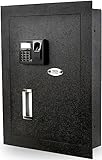
Viking VS-52BLX Biometric Wall Safe
- Fingerprint PIN and key
- 970 cubic inches
- Interior LED
- Two 20mm steel bolts
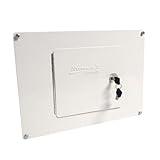
Homak Between the Studs Wall Safe
- Tubular key lock
- 480 cubic inches
- 4 pound body
- Fits 16 inch studs
Quick Overview: Best Wall Safes for Jewelry in 2026
The table below lists all ten picks with their exterior dimensions. Width is the number that decides whether a model drops between 16 inch on-center studs, and depth is the number that decides whether it fits your wall cavity at all.
| Product | Specifications | Action |
|---|---|---|
| Paragon In-Wall Safe with Keypad |
|
Check Latest Price |
| Viking Security VS-52BLX Biometric Safe |
|
Check Latest Price |
| Homak First Watch Between the Studs Safe |
|
Check Latest Price |
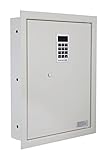 Protex PWS-1814E Keypad Wall Safe Protex PWS-1814E Keypad Wall Safe |
|
Check Latest Price |
 Nebakne 25.6 Inch Tall Between-Studs Wall Safe Nebakne 25.6 Inch Tall Between-Studs Wall Safe |
|
Check Latest Price |
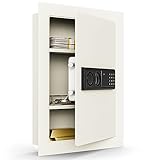 Giantex Electronic Hidden Wall Safe Giantex Electronic Hidden Wall Safe |
|
Check Latest Price |
 Grimtron Wall Safe for 16 and 24 Inch Studs Grimtron Wall Safe for 16 and 24 Inch Studs |
|
Check Latest Price |
 Langger Biometric Wall Safe Langger Biometric Wall Safe |
|
Check Latest Price |
 Langger WS021X Biometric Wall Safe Langger WS021X Biometric Wall Safe |
|
Check Latest Price |
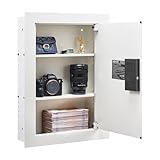 VEVOR 22 Inch Three-Tier Wall Safe VEVOR 22 Inch Three-Tier Wall Safe |
|
Check Latest Price |
1. Paragon In-Wall Safe with Keypad: The Best Overall Pick for Jewelry
Paragon Safes In Wall Safe with Keypad and 2 Manual Override Keys, White
0.83 cubic feet
Alloy steel
4 inch deep
39 lbs
Keypad plus 2 override keys
Pros
- Fits between 16 inch on-center studs without trimming
- Solid alloy steel feel for its size
- Simple master and guest code programming
- Flush face lets artwork conceal it
- Anchor bolts included
Cons
- Center lock takes a large slice of the middle shelf
- Keypad beeps on every press with no disable
- Included lag bolts are weak and some buyers replace them
This is the safe we keep coming back to, and the reason is unglamorous: it has the widest base of real installations behind it. Owners describe the same experience of sliding it into a 16 inch cavity, bolting it to the studs and hanging a canvas over the finished frame. The 0.83 cubic feet of interior is enough for a jewelry box, a stack of documents and a handful of small pieces without the safe feeling empty.
Exterior dimensions are 16.25 inches long by 4 inches wide by 22 inches high, and the interior measures 16.25 by 3.8 by 20.25 inches. That 4 inch depth matters, because it is about the ceiling in a standard 2×4 framed wall once you account for the drywall thickness on each side. The safe comes with 4 AA batteries and anchor bolts, and it weighs 39 pounds, which is heavy enough to feel like a real object rather than a panel.
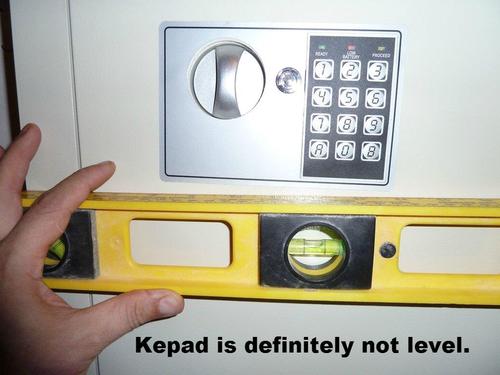
The electronic keypad takes programmable master and guest passcodes of 3 to 8 digits, and two manual override keys are included. That combination is the reason this model ranks so high among collectors who carry pieces to and from work: the two-key override means a dead keypad is not a lockout event. The anti-theft alarm triggers 20 seconds after 3 incorrect entries and 5 minutes after 6.
We want to be straight about the design trade-off, because it is the same one you will find in most slim in-wall safes. The center locking mechanism occupies a large portion of the middle shelf, so a long jewelry box that would fit in a freestanding safe may not clear it here. Reviewers also note that the keypad beeps on every button press and that there is no disable option, which matters if the safe sits in a hallway rather than a closet.
How to check the fit before you cut
Measure the distance between two stud centers before you buy. At 16 inches on center, the 16.25 inch exterior length is what makes this model drop in between studs without trimming, and buyers confirm that it does. If your studs sit 24 inches on center, this is the wrong safe and no amount of careful drywall work will change that.
Then check your cavity depth with a tape measure pushed into an unfinished opening, not a finished wall. Anything close to 4 inches of clearance and this body works, and less than that means a shallower body or a surface-mounted option instead.
When the included hardware is not enough
The box includes anchor bolts, and several reviewers report that those lag bolts are of low quality and they substituted their own. On r/Safes the consensus is consistent: a wall safe is only as good as its anchor point, and an unanchored in-wall safe can simply be carried out of the wall and worked on somewhere with better light.
For that reason, buy lag bolts rated for the framing and drive them into the studs on all four corners rather than relying on the supplied set. Doing it properly takes an extra ten minutes and it is the difference between a real barrier and a box in a wall.
2. Viking Security VS-52BLX: The Best Biometric Wall Safe for Jewelry
Viking Security Safe VS-52BLX Hidden Wall Biometric Safe
970 cubic inches
Alloy steel
4 inch deep
39 lbs
Fingerprint, PIN and key
Pros
- Fingerprint reader reads worn prints instantly
- Three ways in: fingerprint
- PIN and two keys
- Interior LED with three adjustable shelves
- Two 20mm steel bolts and a motorized deadbolt
Cons
- Large central lock box eats interior space
- Metal shelf tabs are thin and bend during install
- Fits 16 inch studs only
If you open and close a jewelry safe several times a day, the fingerprint reader is the feature that actually changes your routine. A turn dial or a keypad makes you stop and think every time. This model stores up to 32 fingerprints plus a PIN code, and reviewers with years of ownership describe the reader as reading worn or slightly damp prints without a retry.
The body is alloy steel at 4 inches deep by 14 inches wide by 19.3 inches high, and the 970 cubic inch interior is the largest in this group. The lock is a motorized 20mm deadbolt with two 20mm solid steel locking bolts, and the door is a 5mm laser-cut panel. Mounting bolts, an Allen wrench, two backup keys and 6 AA batteries are included in the box.
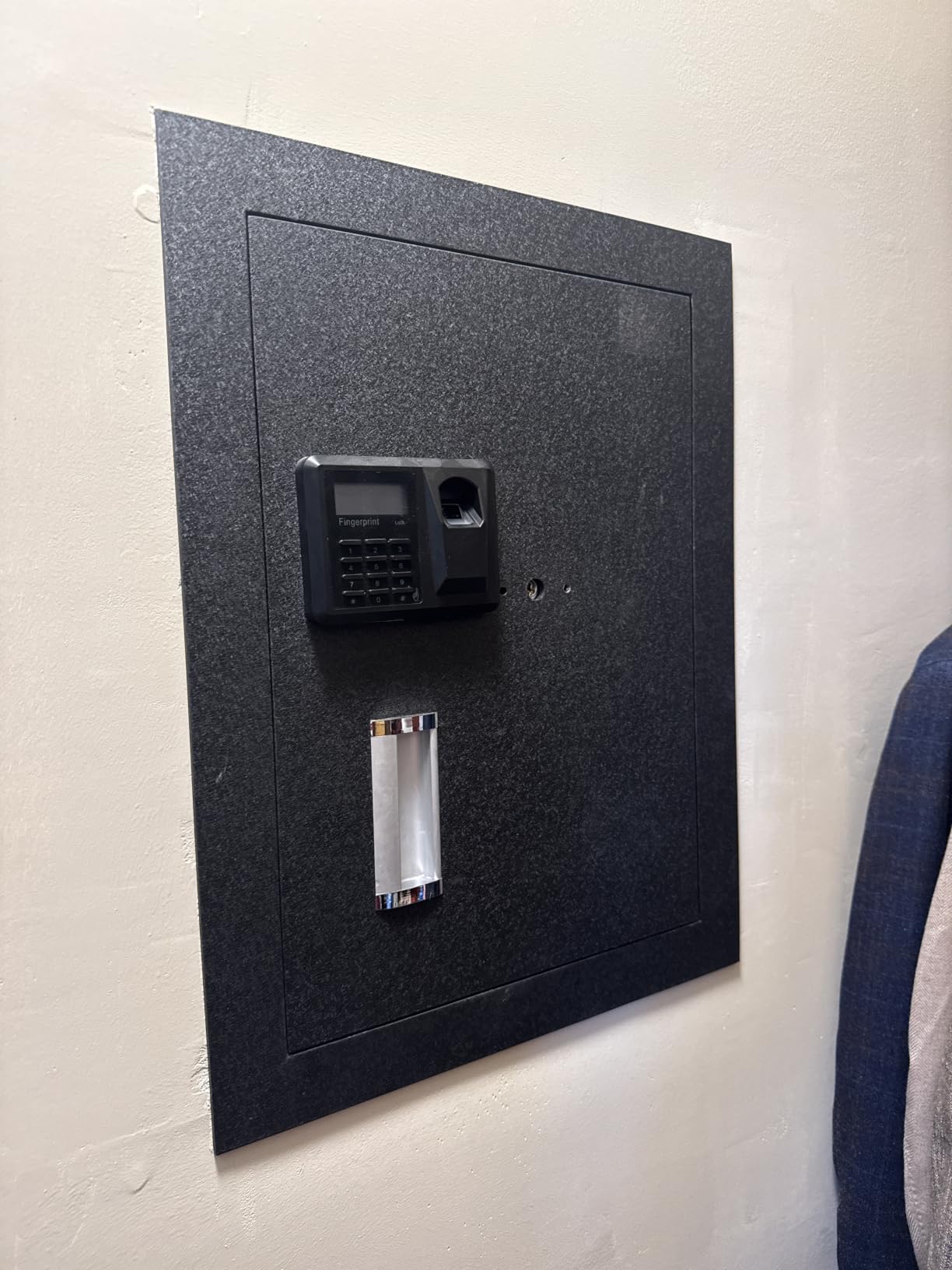
Two details separate this from the other fingerprint models here. First, the all-carpeted interior has a built-in LED light, three fully adjustable shelves and key hooks, which is the arrangement jewelry actually needs. Second, the fingerprint memory is retained even if the batteries are removed, so a battery swap does not mean re-enrolling your prints.
There is a sound on and off toggle, and the safe beeps if you leave the door unlocked. That is genuinely useful for jewelry, where a forgotten open door is the most common real-world failure. Two backup keys are included as a third route in, so a dead electronic lock is not the end of the story.
What the shelf and lock layout costs you
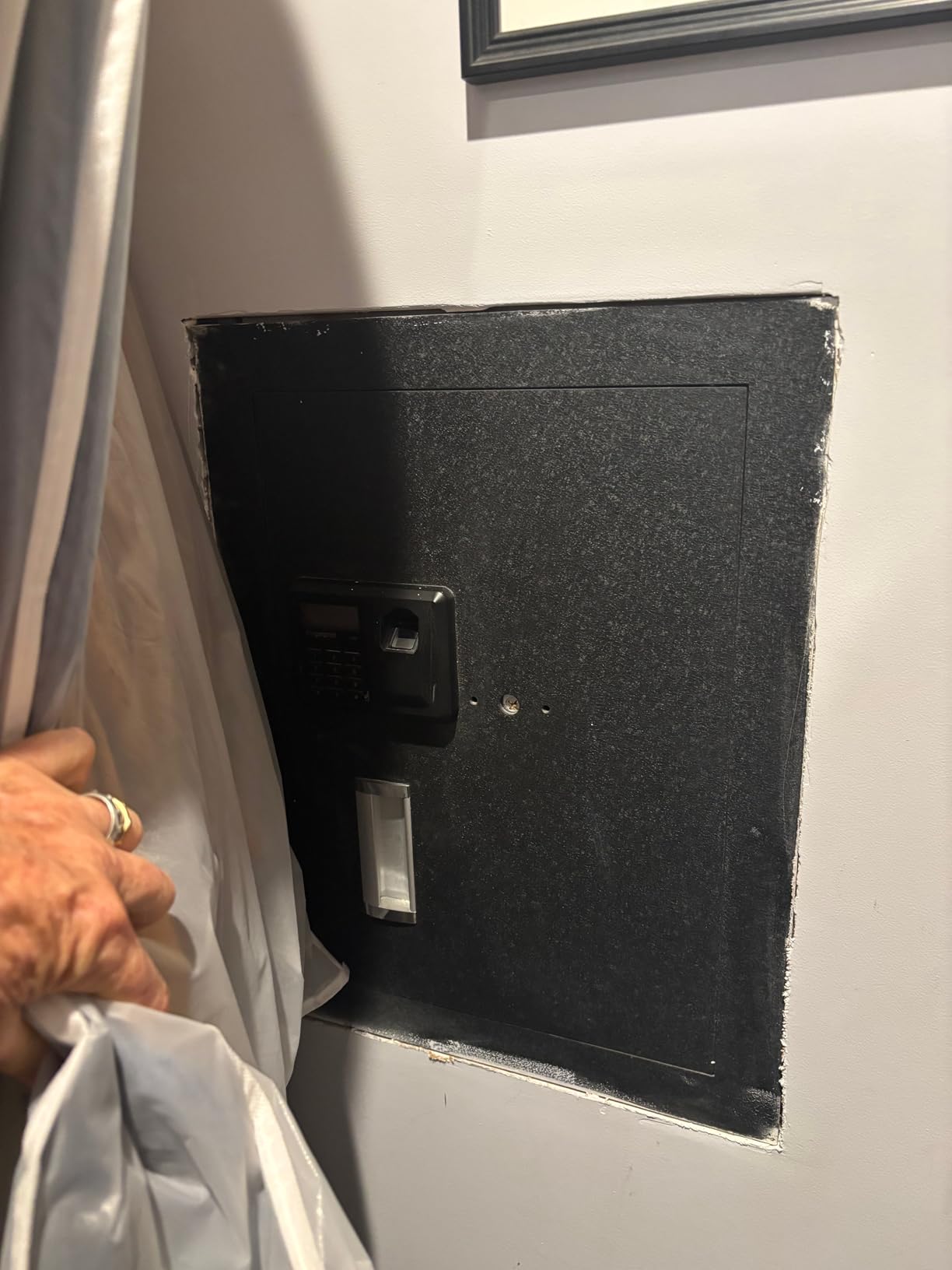
The central lock box is large and removes a meaningful chunk of the usable interior, which is the recurring complaint in reviews. Shelves are positioned around it rather than through it, so a single long jewelry box that would slide in on a flat-floored safe will not fit here. Plan your storage around two shorter pieces per shelf rather than one long one.
The metal shelf tabs are also thin and can bend while you are forcing them into place inside a wall cavity. Support the shelf with one hand while you seat the tab. It is a small step that avoids a bent tab and a crooked shelf later.
When this model is the wrong buy
This safe fits 16 inch on-center studs only. If your framing is 24 inches on center, or if you are in an older home with irregular spacing, you need the spacer approach instead. Buyers who need flexibility across two spacings should read the Grimtron section below.
It is also a 39 pound unit, so have a second person for the lift. And if your priority is a soft interior that will not scratch metal watch bracelets, the carpeted lining is functional but not as kind to jewelry as the velvet option later in this list.
3. Homak First Watch Between the Studs: The Budget Pick Wall Safe
Homak First Watch Between The Studs High Security Steel Wall Safe, White
480 cubic inches
Alloy steel
4 inch deep
4 lbs
Tubular key with 2 keys
Pros
- Low-cost concealed storage entry point
- Fits neatly between 16 inch studs
- Ten minute installs reported by buyers
- Flush mount hides behind a mirror or picture
Cons
- No rim or lip around the door makes it easier to pry
- Door steel is thinner than buyers expect
- Shallow interior with no shelf or hooks included
This is the honest budget answer, and we would rather recommend it plainly than pretend it is something it is not. At 4 pounds it installs in about ten minutes according to multiple buyers, and it sits flush in a 16 inch cavity behind a mirror, a picture frame or closet contents. If the goal is a lockable compartment that a houseguest never thinks to look for, it does that job well.
The interior is 480 cubic inches in a body that measures 4 inches deep by 17.12 inches wide by 11.75 inches high. The lock is a high security tubular system with two keys, and the door attaches on a full-length piano hinge rather than a small concealed hinge. Black foam interior lining is included, and the body is listed as water resistant.
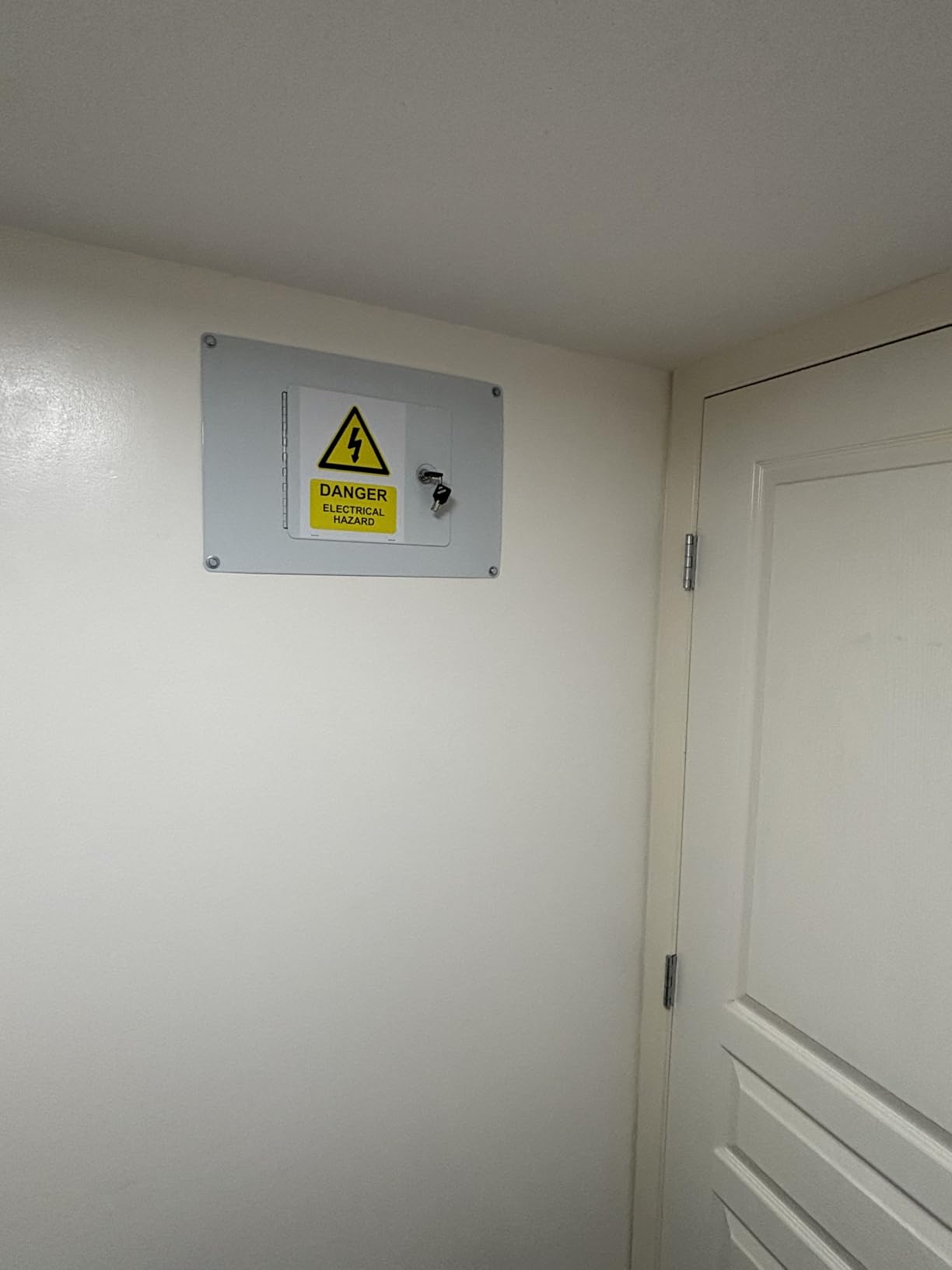
The honest limitation is the door. Reviewers note there is no rim or lip around the door opening, which means a pry bar has a straight line to the door edge instead of having to work around a folded lip. Several also describe the door material as softer than they expected. This is a deterrent against casual access, not a resistance to a determined person with tools.
That framing is consistent with how owners talk about it. The common summary in reviews is a low-cost concealment box, useful for a second set of costume jewelry, spare keys and travel documents, rather than a place for a graded coin or a family stone.
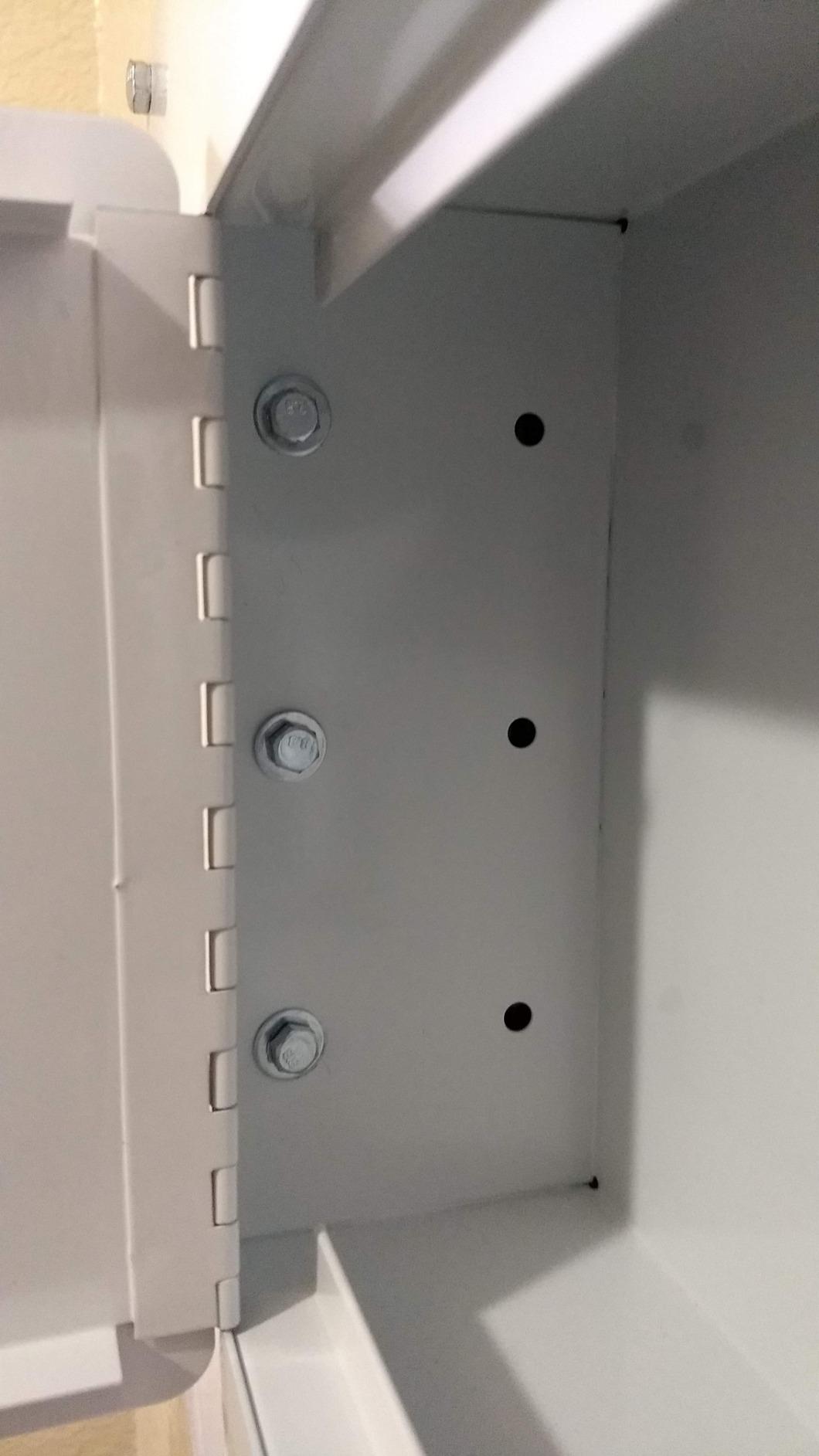
What you can realistically store inside
The interior is shallow, roughly the thickness of a stud, and it ships with no shelf and no hooks. That means rings, earrings, a slim watch and a folded document or two. If your collection includes necklaces with any length to them, plan on adding a roll of hook-and-loop cable ties or a small fabric roll rather than expecting hanging storage.
For a secondary layer of protection, owners sometimes place a small fire-resistant document case inside a larger safe. A garagejournal.com thread made that point about a mixed collection of jewelry, cash and firearms, and the same logic applies here at a smaller scale: a safe inside a safe improves the outcome in a fire.
How to bolt this one properly
Because it weighs 4 pounds, this is the easiest model here to carry off intact, which makes anchoring non-negotiable. The keyhole sits in the center of the door face, so plan the concealment piece to cover the whole front rather than a small area.
Use lag bolts into the studs on at least two opposite corners and keep the head shallow enough that the door closes without binding. Then hang the artwork or mirror on standoff clips so the panel can be removed without prying at the safe frame.
4. Protex PWS-1814E: The Best Wall Safe for a Velvet Jewelry Interior
Protex Safe Electronic Keypad Wall Safe (PWS-1814E), Burglary Resistant wall safe, digital electronic locking system, velvet interior, automatic door opening, 2 Removable shelves
0.44 cubic feet
Heavy gauge steel
3 inch deep
28 lbs
Keypad auto-open door
Pros
- Motorized auto-open door with interior LED
- Velvet lining on walls and shelves
- External battery contact plus override key
- Dual live motorized chrome bolts
Cons
- Instructions are confusing and easy to misread
- Only 0.44 cubic feet of interior
- Keypad beep can only be removed by desoldering
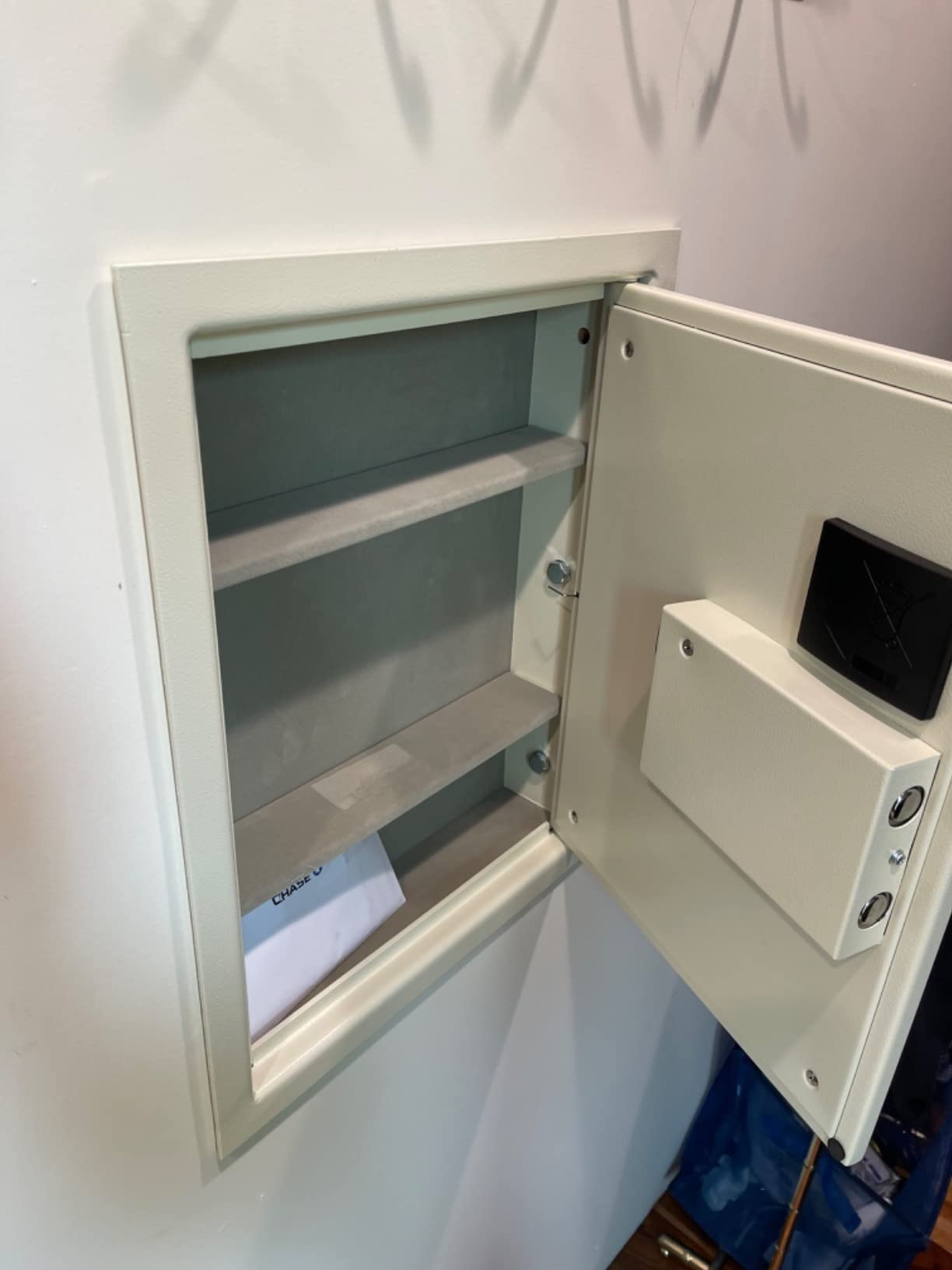
This is the one to buy if your jewelry is soft metal. A velvet and felt lining on the walls and the shelves is the single most jewelry-specific feature in this entire roundup, because bare steel shelves will put fine scratches on a polished bracelet or a gold chain the first time you set it down. The interior LED means you are not craning into a dark wall cavity to find what you stored.
The body is heavy duty gauge steel at 3 inches deep by 14 inches wide by 18 inches high, giving 0.44 cubic feet of interior. It is designed to install between 16 inch on-center studs, and the manufacturer lists a rough opening of roughly 18-1/8 by 14-1/8 by 3-3/4 inches. Two removable shelves come in the box along with a physical override key.
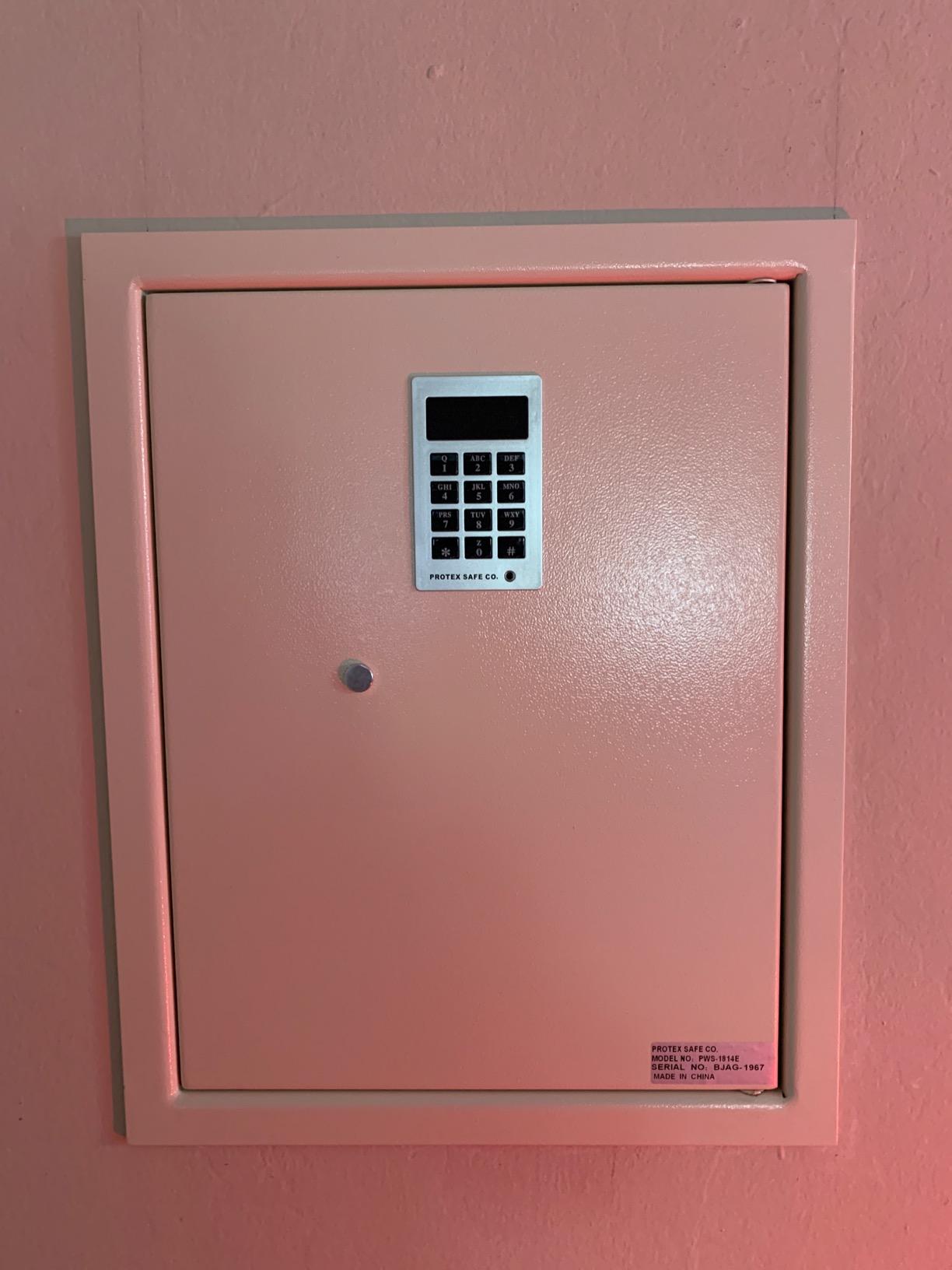
Access is layered in a way we like. A motorized bolt system springs the door open automatically once the code is accepted, two user codes plus a master code are programmable, and there is an external battery contact so a power pack can bring the keypad back from a dead battery without cutting the wall. Dual live motorized chrome bolts at three-quarter inch diameter back the lock.
The catch is capacity. At 0.44 cubic feet, this is roughly half the interior of several rivals, and the motorized lock housing does not help. If your jewelry lives in one case plus a few loose pieces, that is a real constraint worth weighing before you cut the opening.
Read the manual before you trust the keypad
Multiple reviews single out the instructions as poorly written and easy to misread, and that complaint is about setup rather than daily use. Program the master code first, test it with the door open, and only then mount the safe. The motorized door is spring-loaded enough that testing it with the door closed can leave you guessing whether the code took.
One reviewer also reported the auto-open mechanism failing to spring the door open, so when the safe is installed, test the open cycle several times from a seated position before you trust it with heirloom pieces.
What the 3 inch depth means for your wall
This is one of the shallower bodies in the roundup, and shallow is a virtue in older construction. Three inches of depth plus drywall is a comfortable fit in a tight 2×4 cavity where a 4 inch model would need the wall opening widened. If you live in a home with old plaster or a wall you suspect is shallow, this profile is safer to install.
Two shelves are included, and the thin shelf material is another recurring note in reviews. Load jewelry boxes rather than loose heavy items, and you will not see the shelves bow over time.
5. Nebakne 25.6 Inch Tall Wall Safe: The Best Fit for Tall Jewelry Boxes
25.6″ Tall Fireproof Wall Safe Between Studs 16″ Centers | Hidden Wall Safe
25.6 inch tall exterior
Alloy steel
3.93 inch deep
28.7 lbs
Code plus emergency key
Pros
- Tall interior fits jewelry boxes other safes cannot
- Heavy 4cm steel door with 2.2cm bolts
- Code and emergency key give flexible access
- Flush mount hides behind framed artwork
Cons
- Lock hardware takes part of the middle section
- Listing family covers many sizes and finishes
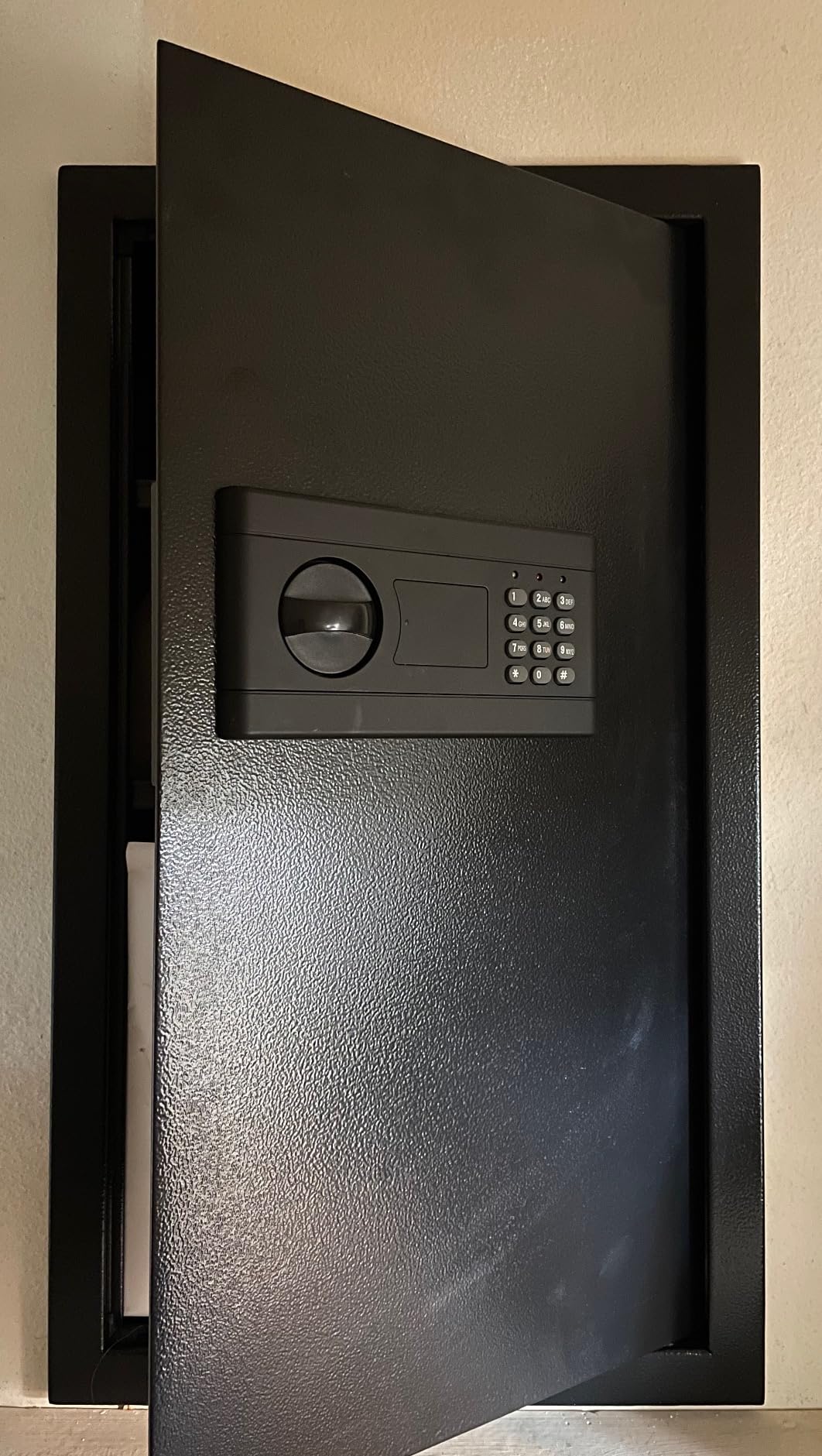
Height is the feature here. At 25.6 inches of exterior height, this is the tallest unit in the roundup, and reviewers single out the extra vertical room as the reason it holds jewelry boxes and taller pieces that shorter between-studs safes simply cannot take. The body measures 3.93 inches deep by 14.56 inches wide, and it weighs 28.7 pounds.
Access is an electronic combination lock that accepts 3 to 8 digit codes, plus two emergency keys and a manual knob. That third method matters on a recessed unit, because a dead keypad inside a wall is a genuinely stressful problem. A hidden lower compartment adds a second layer of storage beneath the main chamber, which is a nice place for spare keys and travel cases.
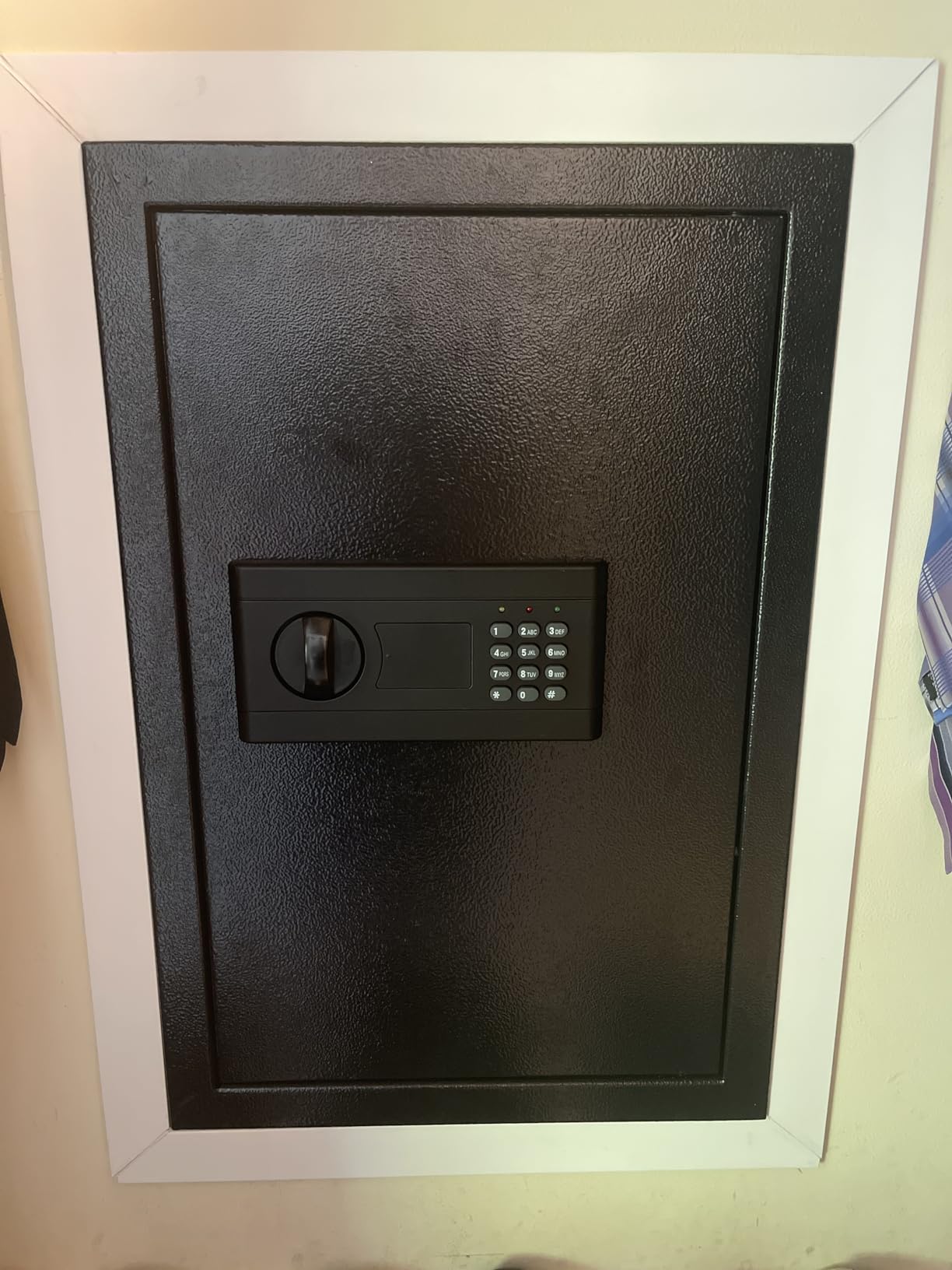
The door is 4cm thick steel with two solid bolts at 2.2cm and an all-metal door panel, which is beefier on paper than several other bodies here. The safe is designed to fit standard 16 inch on-center stud spacing and mount flush so a framed picture covers it completely.
One thing to flag: the listing markets this model as fireproof without stating a UL or ETL listing or a tested duration. We are not going to repeat that as a rating. If fire performance is part of your decision, treat it as unverified marketing and assume you have no tested fire protection, then check the listing yourself for a certification mark before you rely on it.
What 25.6 inches of height buys you
Most of the other safes in this roundup top out around 19 to 22 inches. That difference decides whether a full-height jewelry case stands upright inside or has to lie flat, and for someone storing a presentation case for an heirloom set, standing room matters more than an extra shelf.
The lower compartment is separate from the main cavity, so you can keep everyday-carry items somewhere separate from the pieces that only come out for an occasion. Buyers like that split, and it also gives you a spot for the spare safe key.
What to check before you commit
The lock hardware occupies part of the middle section, so the usable interior is a tall space with a narrower band through the center. Measure your tallest jewelry box and confirm it clears before you order.
Also note the listing family covers several heights and finishes, which reviewers mention as a source of confusion when the box arrives. Match the model number on the listing against the label inside the door before you start cutting. Contents include the safe, two emergency keys, mounting screws and a manual.
6. Giantex Electronic Hidden Wall Safe: The Best Heavy Steel on a Budget
Giantex Electronic Wall Hidden Safe Security Box, Built-In Wall Electronic Flat Security Safety Cabinet (White)
0.83 cubic feet
Alloy steel
4.17 inch deep
31.6 lbs
Keypad plus override key
Pros
- More heft than its specification suggests
- Reliable keypad with a simple override key
- Build quality rivals safes twice its size
- Easy to hide behind a picture or door
Cons
- Keypad face has a cheap rubber feel
- Battery compartment is inside the safe
- Included screws are poor quality
The recurring line in reviews is that this looks and feels more substantial than its specifications suggest. At 31.6 pounds of alloy steel with 0.83 cubic feet of interior, that impression is not unreasonable. The exterior is 22 inches high by 16 inches wide by 4 and 1/7 inches deep, and the interior measures 19 by 13.8 by 3.75 inches, so it fits a 16 inch cavity with clearance to spare.
You get two ways in: an electronic code or a backup key. A lockout timeout engages after three incorrect combination attempts, which is a shorter fuse than some rivals but appropriate for jewelry that a curious teenager might try to open. The flush flat profile means a piece of furniture or a door panel sits in front of it naturally.
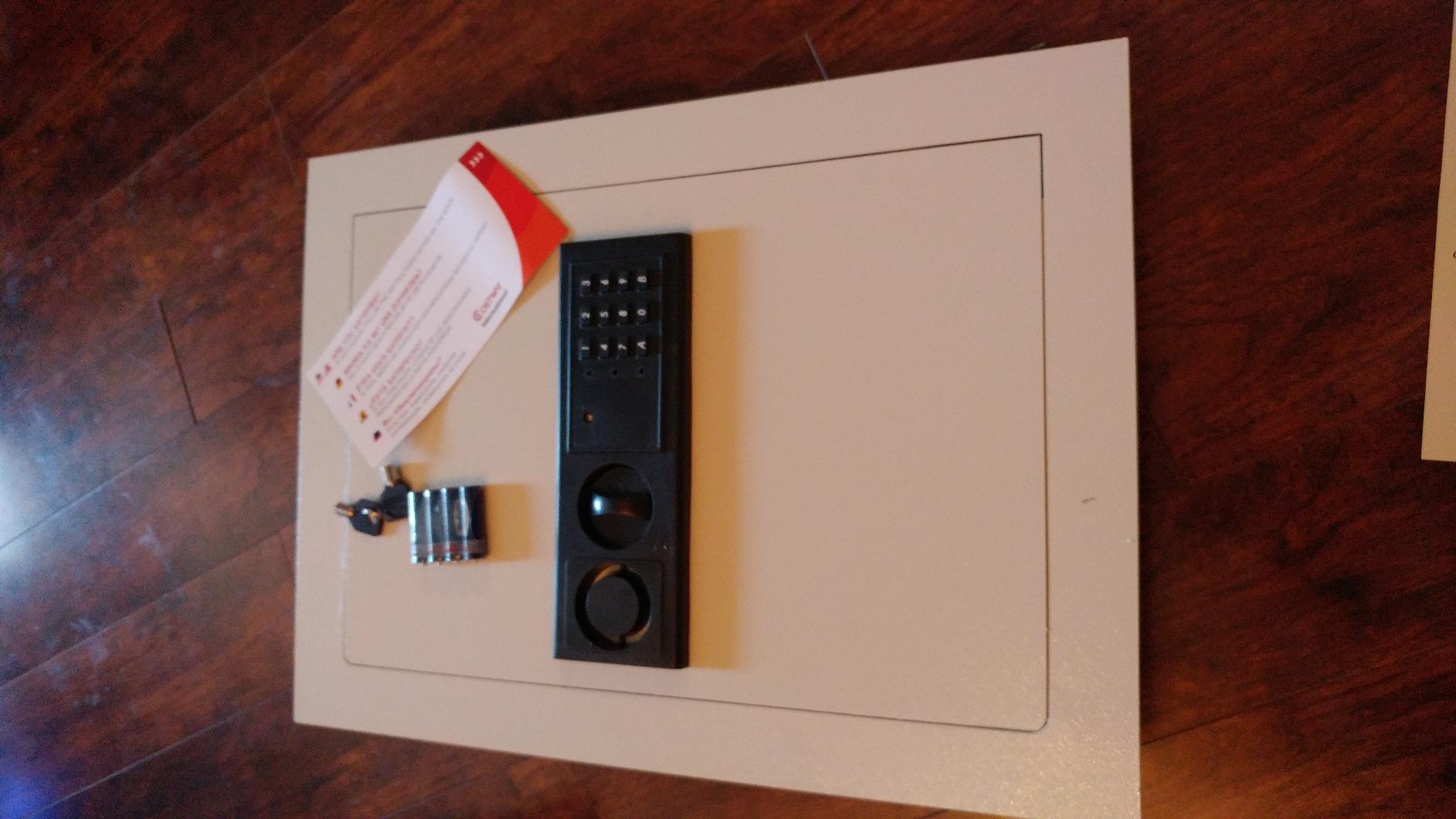
The one design detail that catches people is the battery location. The compartment is inside the safe, so when the batteries die, the code does not work and you need the override key to open the door and get to them. That is fine if your key is somewhere sensible and annoying if the key is stored inside the safe. Keep the key in a different room, a lockbox, or with someone you trust.
Sound quality is the other recurring note. The keypad face has a cheap rubber feel according to several reviewers, which is a cosmetic complaint rather than a mechanical one.
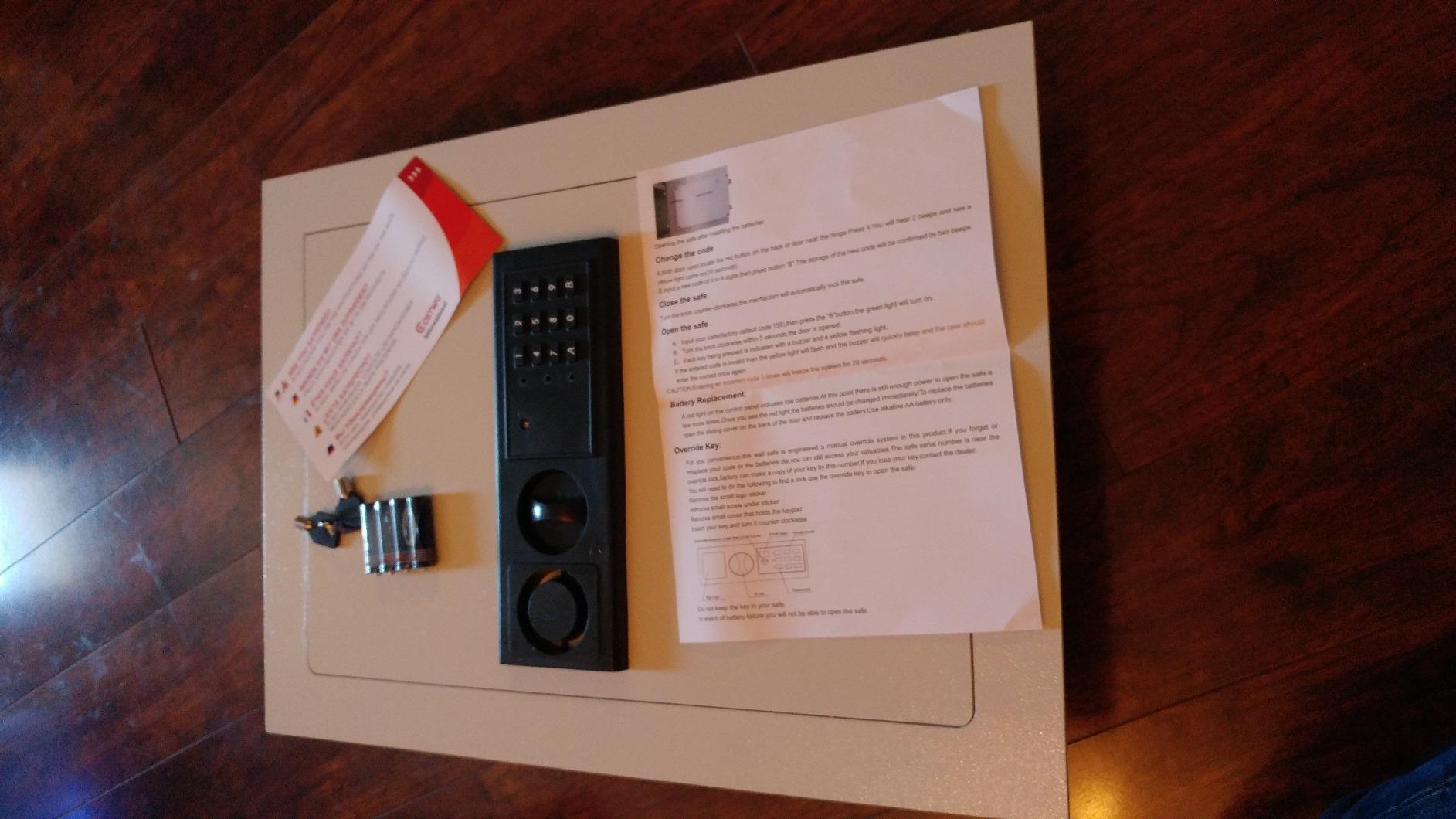
How the keypad behaves day to day
Owners describe the keypad as reliable across daily use, and the three-attempt timeout is short enough that casual code fishing is not a realistic path in. The beep on each press is present, and like the other models here it is not adjustable, so install this one in a closet rather than a hallway if noise matters.
Because the safe is deep at just over 4 inches, confirm your cavity clearance before cutting. In a standard 2×4 wall this is at the upper limit once both drywall faces are accounted for, and a shallow cavity is the most common reason a remodel of this type goes wrong.
Why the included screws are not the answer
Reviews flag the included screws and the keyhole cover screw as poor quality. On a 31.6 pound body that is being recessed into a wall, cheap fasteners are the weakest link in an otherwise solid package. Replace them with structural lag bolts driven into the studs on all four corners before the concealment panel goes up.
Finehomebuilding.com threads make a related point about mounting to framing rather than just to studs, which lets a larger safe sit properly. On a budget model, at minimum get four quality lag bolts into the framing and check that the safe cannot rock by hand once tightened.
7. Grimtron Wall Safe for 16 and 24 Inch Studs: The Best Fit for Wider Framing
Grimtron Electronic Wall Safe Between 16″ & 24″ Studs with Shelves & Hooks
0.76 cubic feet
Steel body
3.86 inch deep
25.8 lbs
Fits 16 and 24 inch studs
Pros
- Spacer kit bridges 16 inch and 24 inch stud spacing
- Lock does not take over the center shelf
- Silent mode works for discreet access
- Two shelves plus hooks and a pegboard
Cons
- Not fire resistant
- Screws are weak and strip easily
- Keypad beeps unless silent mode is on
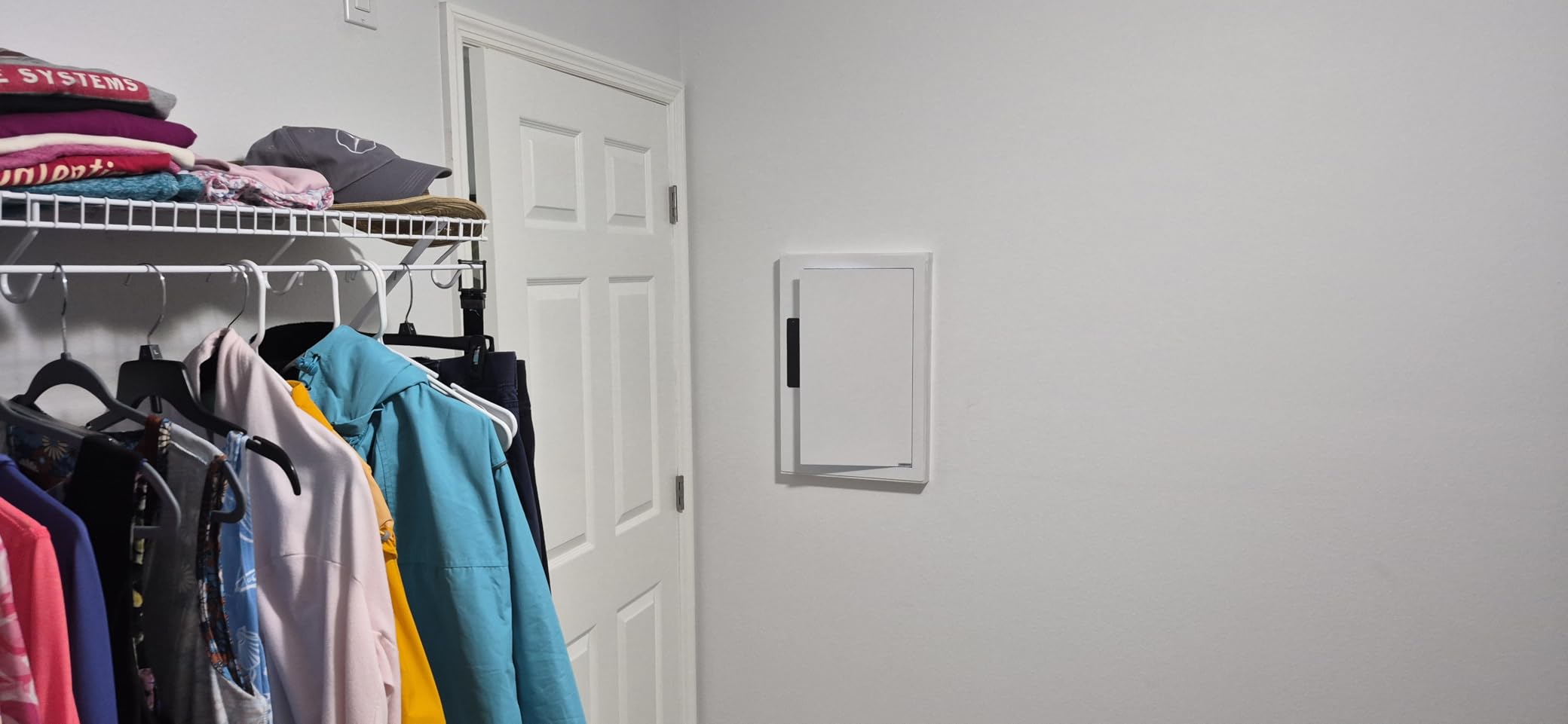
Stud spacing is the number one technical worry in the r/Safes threads, and this model answers it more completely than anything else in the roundup. A spacer kit bridges the gaps so the same body fits both 16 inch and 24 inch on-center framing. If you do not know which spacing you have, this is the safe that forgives the guess.
The body measures 3.86 inches deep by 14.57 inches wide by 19.68 inches high at 25.8 pounds, with 0.76 cubic feet of interior. Access is a touchpad electronic lock with an auto-open door, interior LED and a silent mode that reviewers confirm genuinely works rather than merely muting the beeps.
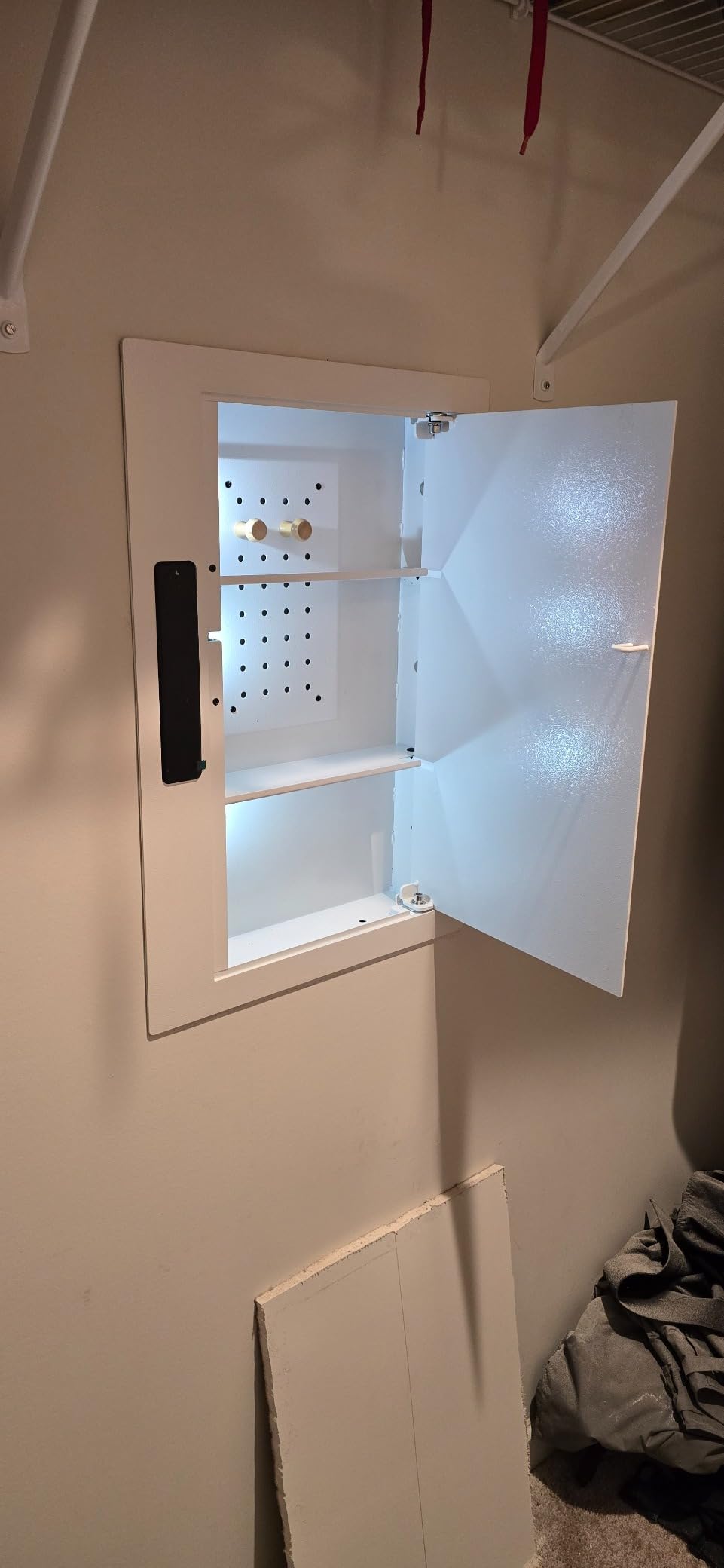
Two removable shelves, two removable hooks and a removable pegboard are included, along with a key, 4 wall screws and anchors. Two emergency keys come in the box, and there is an emergency USB port that provides temporary keypad power when the internal batteries die. That single feature removes the most common complaint about electronic in-wall safes, where a dead battery means a locked safe in a wall.
A second thing reviewers like is the interior layout. Because the lock is not mounted in the middle of the cavity the way it is on several competitors, you get continuous usable vertical space rather than two short sections.
What the emergency USB port really solves
Lock-out risk is the failure mode that scares people off electronic wall safes, and this model handles it cleanly. When the batteries die, you run a USB power source into the port from outside the safe and enter your code normally, then change the batteries once the door is open. No cutting, no calling a locksmith, no pry bar.
Check the port before you install, and keep a small USB battery pack with the manual in the same room. If you are installing this in a closet, keep the pack inside the closet rather than at the front door.
What the spacers do and do not solve
The spacer kit bridges the gap for 24 inch on-center framing, which is uncommon in modern residential construction but shows up in older homes, some renovations and multi-family buildings. It solves horizontal spacing. It does not solve depth, and 3.86 inches still needs a cavity to match.
This model is not fire resistant, and the listing does not claim otherwise, so treat it as theft concealment only. If both fire and theft protection matter to you, the roundup has no model with a verified fire listing, and that is a limitation of what is available in this category rather than a gap we can fill with marketing.
8. Langger Biometric Wall Safe: The Best for Large Fingerprint Storage
Langger Biometric Wall Safe Between Studs, Hidden Fingerprint In‑wall Safe
Carbon steel body
4 inch deep
32.3 lbs
100 prints
PIN and key backup
Pros
- Fast fingerprint access for everyday jewelry
- Recessed door and deadbolt bars feel solid
- Silent mode for quiet access
- White finish blends with closet trim
Cons
- Lock assembly reduces interior space
- Some units arrived with welds that broke in install
- Instructions need careful rereading before the reader works
Where the Viking stores 32 fingerprints, this one stores up to 100, which matters if you are enrolling everyone in the household or coordinating access with a partner or family member. Add a PIN code and emergency keys and you have three routes in, with the fingerprint scanner as the fast path for daily use.
The body is heavy duty carbon steel with two motorized deadbolt locks, and the door is recessed from the frame so a pry tool slides past the gap rather than catching. It weighs 32.3 pounds and measures 4 inches deep by 15.1 inches wide by 21.8 inches high, with a rough opening of 21 by 13.75 by 4 inches. The right-opening door is fixed, not reversible.
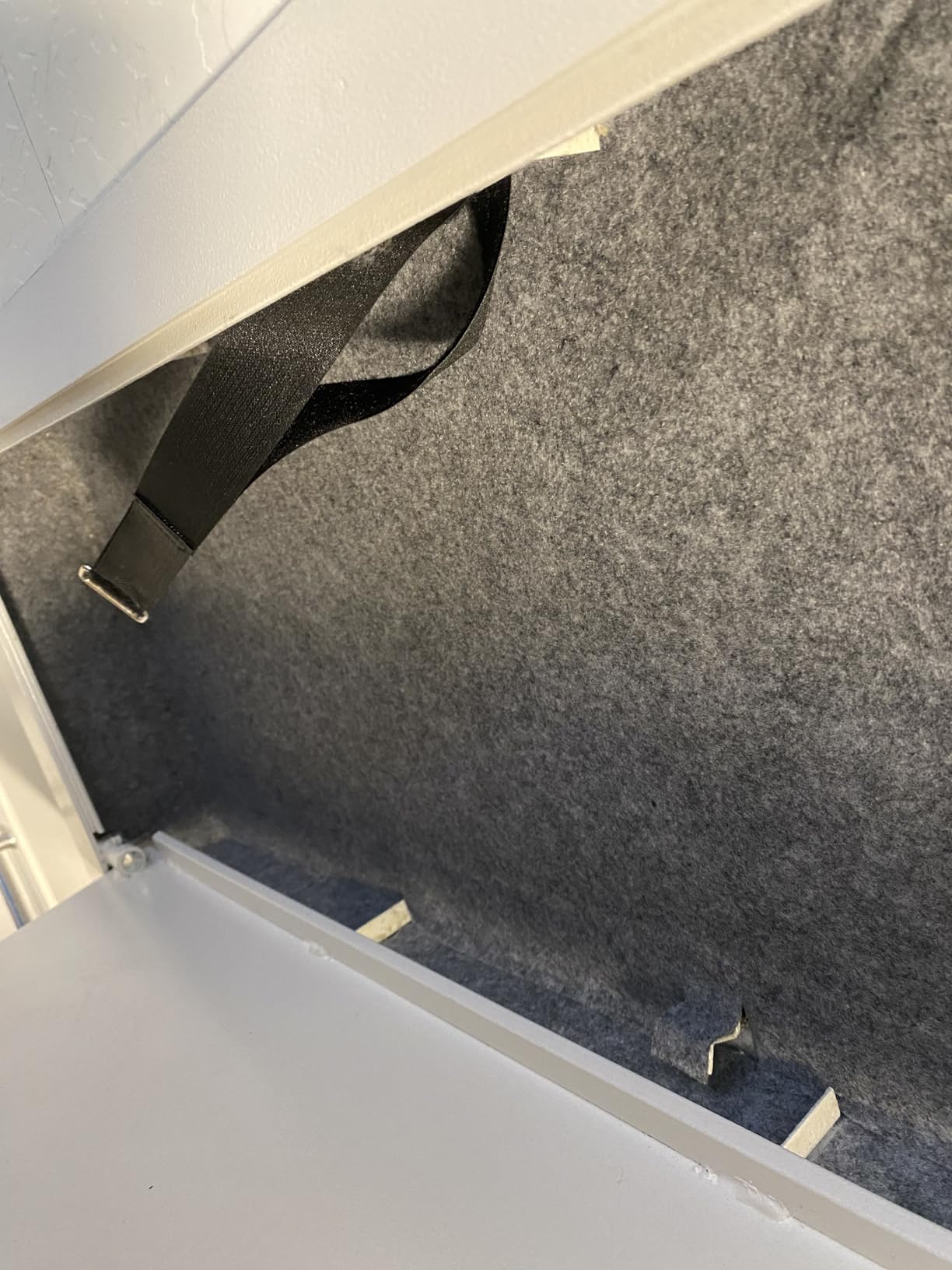
There is a beep-off silent mode, and the white finish is designed to blend with traditional closet trim, which helps if the safe is installed in a walk-in closet rather than hidden behind artwork. A shelf and mounting bolts are included with the safe and a key.
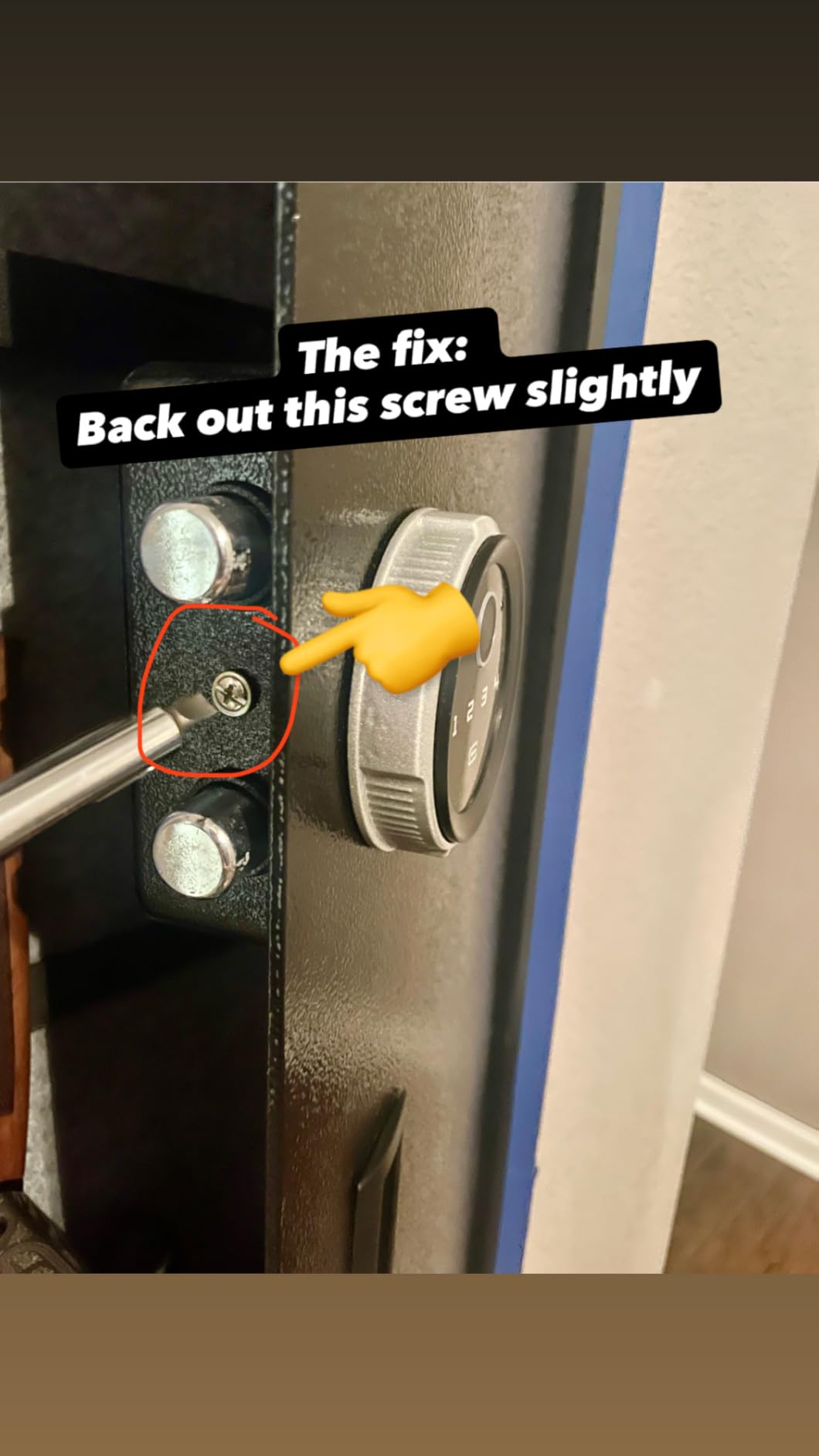
Quality control is the story in the reviews. Several buyers are very happy with biometric speed and quiet operation, while others received units with spot welds that broke during installation or deadbolts that would not drop until a center screw was loosened. If you buy this one, test the deadbolts before the drywall goes up.
How to handle the fingerprint reader
The reader works, but the setup is less intuitive than it should be. Owners report needing to reread the instructions carefully before the scanner behaves as expected, so program your prints with the door open and the safe in hand. Enroll a finger rather than a whole hand, and test it from a few angles.
For a household that wants no fuss at all, compare the workflow with the keypad models in this roundup. A keypad has nothing to calibrate, and several of them include a mute switch you actually control.
What to inspect before the wall closes
Rig the deadbolts by hand and confirm all of them extend and retract smoothly. Then pull on the door while the bolts are thrown, and while they are not, to feel for play in the frame. Any unit that needs a screw loosened or has a weld that flexes should be returned rather than grouted into a wall.
Because the door is right-opening and fixed, decide the swing direction now, not after the cut. The safe belongs on the side where the concealed artwork or cabinet swings away from you when you stand in front of it.
9. Langger WS021X Biometric Wall Safe: The Best for Thick Door Gauge
Wall Safe, Hidden Fingerprint Security wall Safe, In Wall Safe Between Studs, Upgraded Biometric/Keypad/Key Access, Secure Handgun, Documents, Jewelry, Valuables (Biometric Fingerprint)
11 gauge steel door
4 inch deep
23.8 lbs
Biometric, keypad and key
Pros
- Three ways in: fingerprint
- PIN and key
- Backlit 6 button keypad beats 4 button models
- 11 gauge steel door resists prying
- Two removable shelves plus USB emergency port
Cons
- Locking hardware reduces usable interior depth
- Needs an accurate rough opening measurement
Door gauge is the number most listings bury, and this one leads with it. The door is 11 gauge steel with a double-layer carbon steel body and thick metal hinges, welded as a single piece with pre-drilled mounting holes. On a biometric safe at this level, that is a meaningful upgrade over thinner pressed doors, because a biometric lock is only as good as the door it releases.
Access is a semiconductor fingerprint scanner paired with a backlit 6 button keypad, plus two keys. A 6 button keypad gives you far more possible combinations than a 4 button panel, which slows down anyone trying codes by hand. The box includes the safe, two removable shelves, two keys and a manual.
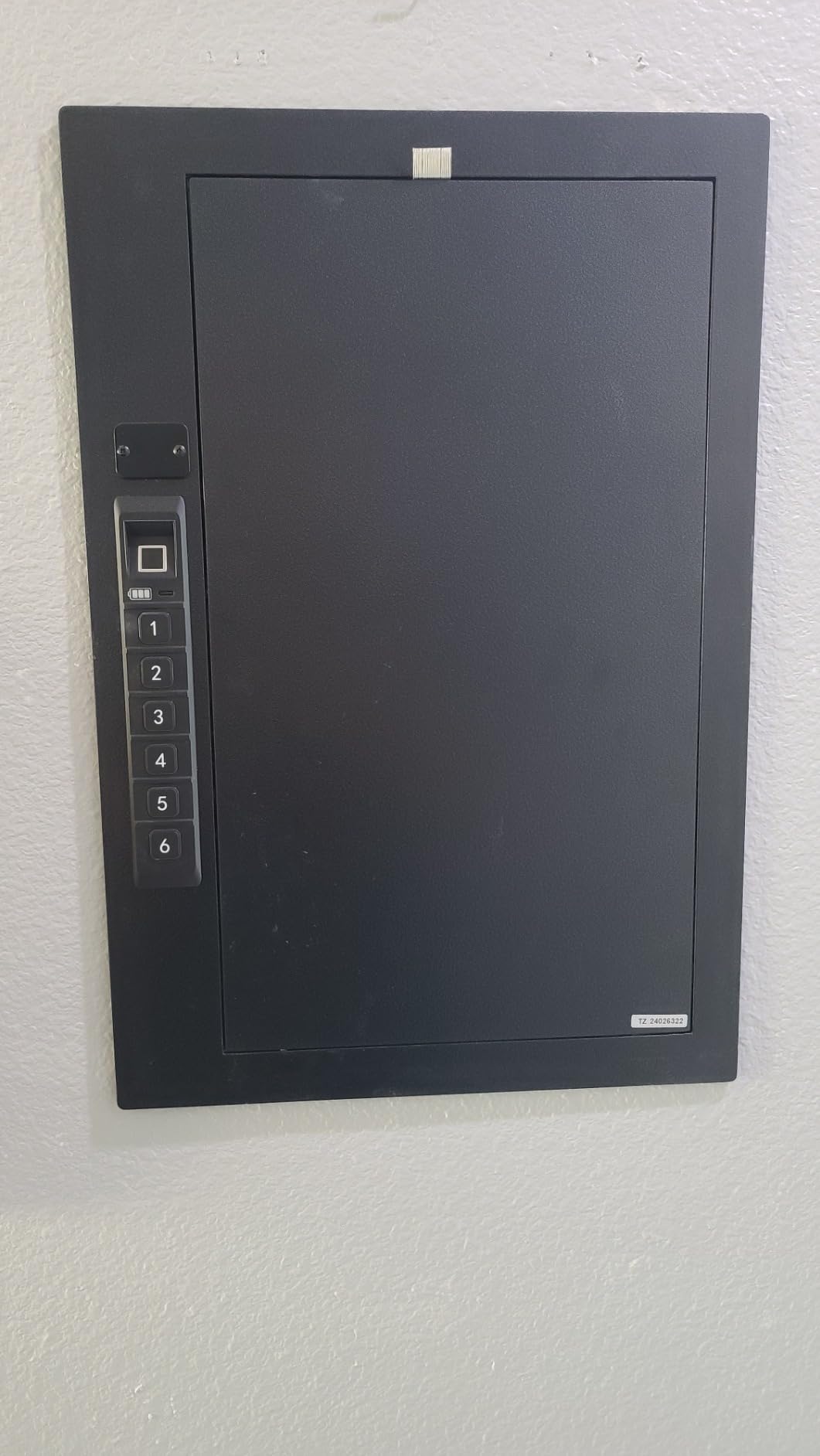
There is a USB emergency port that powers the fingerprint and keypad entry if the internal battery dies, which is the same lock-out insurance the Grimtron offers. Two removable shelves give you flexibility for a jewelry box and a document folder, and the body is alloy and carbon steel at 23.8 pounds, measuring 4 inches deep by 15 inches wide by 22 inches high.
The rough opening is listed at 20.9 by 13.8 by 4 inches and the door is right-opening. Reviews note that the locking hardware reduces usable interior depth, so the effective shelf space is a little less than the outside dimensions suggest.
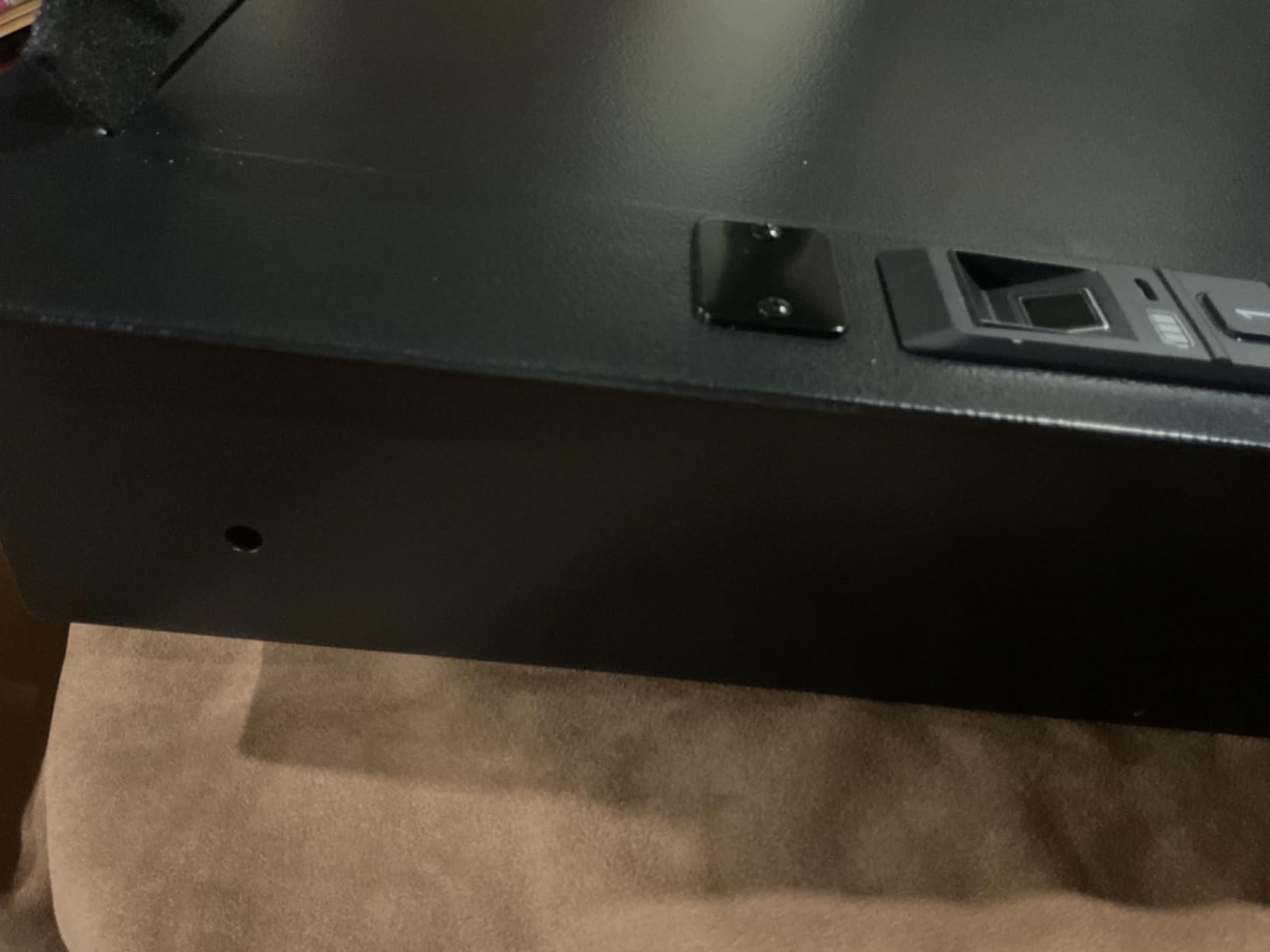
Why an accurate cutout matters here
This is a flush mount, and the pre-drilled holes are already positioned for a standard install. Measure the opening twice, because a cutout that is even a quarter inch small will leave the safe proud of the wall and spoil the concealment. Use the listed rough opening numbers rather than the exterior body dimensions.
Check the wall for wiring and plumbing with a detector before the saw touches anything. On a renovation you did not build, that check is the difference between a two-hour project and a repair bill.
How the keypad compares to the fingerprint reader
Use the fingerprint for daily access and the keypad when a print is cold, wet or cut. The backlit buttons are visible in an unlit closet, which matters more than it sounds at 6 in the morning. Both keys remain as the physical fallback.
If you are choosing between this and the Viking earlier in the list, the deciding factors are fingerprint capacity and interior volume rather than build quality. This one has the heavier door gauge; the Viking has the larger interior, more shelves and a longer review history.
10. VEVOR 22 Inch Three-Tier Wall Safe: The Best for Multi-Tier Shelving
VEVOR 22″ High Wall Safe, 3-Tier Hidden Wall Safe with Password, Key & Turning Knob, Q235 Cold-Rolled Steel In-Wall Box with Adjustable Shelves & Mounting Holes for Money, Jewelry, Passport, White
2.35mm cold-rolled steel
4 inch deep
20.3 lbs
Password, key, knob and RFID
Pros
- Three tiers of adjustable shelving use space well
- Felt pads keep jewelry from scratching
- External power box for emergency unlocking
- Manageable 20.3 lb weight for a solo install
Cons
- Thin 2.35mm steel gives limited pry resistance
- Lowest rating in the group
- Electronic lock depends on the external power box as backup
Three tiers is the reason to look at this one. Most safes in this roundup give you two shelves; the detachable adjustable shelving here creates three levels across an interior of 3.86 by 15.16 by 20.75 inches, which is more usable space for a collection of smaller boxes. Soft felt pads are built in to stop jewelry and documents from scratching against bare metal.
Access covers more ground than most. You can open it with a password, a key, the turning knob or one of three included RFID cards, and an external power box is included specifically for emergency unlocking if the internal battery dies. The body is Q235 cold-rolled steel at 2.35mm thickness, weighing 20.3 pounds, and measures 4 inches deep by 16.25 inches wide by 22 inches high.
Be clear-eyed about the steel. At 2.35mm, this is the thinnest material in the roundup, and the rating reflects that. Reviews call out limited pry resistance, and this model carries the lowest average rating and the highest share of one-star feedback of everything we reviewed. It is a storage box with a lock, not a defensive barrier.
It is also lighter than the other full-size bodies here, at 20.3 pounds, which buyers note makes it installable without a second person. The included hardware is more complete than most, with an external power box, three RFID cards, three reset pins, four expansion bolts and eight shelf clips.
Who this model actually suits
It suits a renter-adjacent situation, a storage unit, a garage wall or a first safe for costume jewelry, spare cash and travel documents. The three shelf tiers genuinely help when you are organizing many small boxes rather than a few large ones, and the RFID cards mean you do not have to remember a code at all.
It does not suit a graded coin collection, a family heirloom set or anything you cannot replace. For those, spend up and move to the Paragon or the Viking.
What to check before the drywall goes up
Test all four access methods with the door open: password, key, knob and each RFID card. Then pull the external power box and confirm the emergency unlock procedure works exactly as the manual describes, because you will not discover a failure later when the battery is flat.
Expansion bolts are supplied, but use structural lag bolts into the studs anyway. A 20 pound safe that is easy to lift is exactly the size that gets carried away, and the anchoring is what changes that outcome.
Best Wall Safes That Fit Between Studs: How to Check in Five Minutes
The fastest way to know whether a wall safe will fit is to measure the distance between two stud centers before anything else. Standard residential framing is 16 inches on center, and a safe with an exterior width under about 14.5 inches will drop in cleanly. If your studs measure 24 inches on center, you need a purpose-built unit or a spacer kit, and a standard between-studs body will not work.
Second, measure the cavity depth with a tape measure pushed into an unfinished opening or a removed baseboard. A 2×4 framed wall gives you roughly 3.5 inches of cavity, and a 2×6 wall gives you roughly 5.5 inches. The models in this roundup run from 3 inches to 4.17 inches deep, which is why fit anxiety is the most common regret in the forum threads we read.
Third, check the width at the tightest point rather than at the studs. The rough opening is usually a little larger than the exterior body, and if you are measuring in a finished wall the drywall thickness reduces usable depth. Nobody wants to discover a 4 inch body does not clear after the first cut.
Fourth, run a wire and pipe detector across the entire area before you saw. Renovation fear is a real theme on r/Safes, and hitting a cable in a finished wall turns a two-hour job into a repair. If you own a home you did not build, this step is not optional.
Fifth, confirm there is framing to bolt into on all four corners. Where there is not, use a toggle or Molly anchor rated for the drywall weight plus the safe, and check that the mounting holes in the safe body line up before you finish the cut. A safe with no solid fastener path behind it is decoration.
Fire Ratings Explained: UL Class 350 vs Class 125
No safe in this roundup carries a verified fire listing, and we want that stated before anything else. A fire-resistant safe is rated for a specific interior temperature and a specific duration, and none of the ten models here publishes a tested figure from UL or ETL. If fire protection is your priority, buy from a manufacturer who prints the certification number on the label, and treat marketing claims without that number as unverified.
UL Class 350 means the interior stays below 350 degrees Fahrenheit for the rated duration. That is the standard relevant to paper, documents and jewelry, because most gemstones and metals are comfortable well below that ceiling. Class 125 holds the interior under 125 degrees with humidity below 80 percent, and it is the rating you need for anything digital such as USB drives, SD cards or hard drives.
That distinction matters for jewelry safes specifically. A class of collection keeps watches, chains and stones on a velvet shelf, but plenty of owners also tuck in a spare drive or a memory card with family photographs. A Class 350 safe can cook that storage, and heat plus humidity is exactly what damages both drives and adhesives in a presentation box.
What not to store in any wall safe: medications that need controlled temperature, magnetic media, solvents and anything you would describe as irreplaceable without a second copy somewhere else. A safe is one layer of protection, not the only layer.
Burglary Ratings Explained: RSC, TL-15 and Dollar Value of Contents
A burglary rating tells you how long a safe resists a well-equipped attacker using hand tools, power tools and cutting tools. A UL Residential Security Container rating means roughly five minutes of net attack time with common tools, tested to UL 1037. TL-15 means fifteen minutes against higher-powered drills, saws and carbide tools, and TL-30 means thirty minutes, which is retail and ATM grade.
Net attack time is the number that sounds harsh and is not. The clock stops whenever testers switch tools or reposition the safe, so five minutes represents sustained, realistic effort rather than five minutes of hopeless prying. That is why published breach times in minutes are more useful to you than any steel gauge number.
Burglary ratings also map to value. A TL-15 safe is commonly cited as protecting contents up to 100000 dollars without a monitored alarm and up to 200000 dollars with one, which is why alarm monitoring changes the equation rather than the safe. None of the ten models here publishes a UL RSC or TL listing, so read the certification section of any product page with skepticism.
Insurers respond to ratings too. Many homeowner’s policies tie jewelry coverage limits to the rating of the safe the items are stored in, and a rated safe can qualify for a lower premium. Ask your insurer specifically what limit they will apply to items held in an unrated in-wall safe before you decide where the collection lives.
Lock Types Compared: Dial, Key, Keypad and Biometric
Mechanical dial locks never fail, because there is no battery and no electronics. They are the right choice for heirlooms you access a few times a year, and the wrong choice for anything you open daily, because a turn dial is a deliberate act. Key locks are simpler still and need a key stored somewhere other than the safe.
Electronic keypads are the most common in-wall option and the most convenient. Look for a beep mute and for an override method, because a recessed unit with no external power contact is a real lock-out risk. The Grimtron and VEVOR in this roundup both include an external power option, and several others include a physical override key.
Biometric scanners trade a small amount of security for a large amount of convenience, and for jewelry used daily that trade is usually worth it. Check the storage capacity against your household. Thirty-two prints covers a couple; one hundred covers a shared plan. Always keep a key or PIN as a backup, and enroll a finger rather than a whole hand.
Dual authentication, where a fingerprint and a PIN are both required, is available on some of the biometric models here and is the sensible setting for a collection you would rather nobody access casually. It adds a step every time you open the safe, so it works best on pieces that live in storage rather than pieces you wear daily.
How to Install a Wall Safe and Anchor It Properly
Plan the door swing and the keypad position before the saw comes out. Stand where you will stand when you open the safe, confirm the concealed panel or cabinet swings away from you, and make sure the keypad is not on the side that faces the wall. Decide this on paper, because changing it later means opening the wall again.
Cut the rough opening to the manufacturer’s listed numbers rather than to the exterior body dimensions, and use a stud finder plus a wire detector in the same pass. Leave the cut slightly undersized and trim the drywall to fit, because a hole that is too large leaves gaps that defeat the entire point of concealment.
Anchor to the framing with structural lag bolts, not the small screws in the box. Several reviews in this roundup specifically call out weak included hardware, and forum consensus is blunt that the anchor point is the entire security model. A wall safe that can be lifted out and worked on in better light is not protecting anything.
On whether to hire a professional: if you have never cut drywall before, or if the wall is a load-bearing interior wall, the cost of a professional install is usually cheaper than the cost of patching a wall you have already cut wrong. Forum anecdotes put professional installation in the low hundreds depending on wall type, which is a fair comparison against the value of a collection you cannot replace.
One last note that shows up repeatedly: check whether the manufacturer requires professional mounting to keep the warranty valid. Some do, and mounting it yourself with the included screws is the most common reason a warranty claim gets refused.
How to Hide a Wall Safe in Plain Sight
Concealment works on the assumption that a burglar looks where burglars look, and that is the master bedroom closet and the dresser. For jewelry, a closet safe is dramatically better than a wall safe in a hallway, because the hallway is a place people naturally scan. This is consistent with published testing advice that treats bedroom closets as a poor hiding place for documents, and it is the opposite of what jewelry storage usually does.
The classic method is framed artwork on standoff clips, sized so the frame covers the finished safe face with an inch of overlap on each side. Mount the art so it lifts off without prying, and keep the spacing tight enough that the frame cannot be pushed inward to reveal the door edge.
A mirror mounted on a French cleat, a full-length leaning mirror, or a tall cabinet door all work. The advantage of the cabinet is that it also gives you somewhere to put things you do not want locked up, which makes the safe less conspicuous. The disadvantage is that cabinets sit in obvious places.
Two methods to avoid: a hollowed-out book on a shelf, which a thorough search finds and which can block ventilation, and a low baseboard outlet cover, which is fine for a Homak-sized box and wrong for a 39 pound body. Also avoid labeling the artwork or hanging it in a spot that only makes sense if a safe is behind it.
If you want a broader look at how the rest of a jewelry storage setup is organized, our guides on jewelry armoires and hanging jewelry organizers cover the cases where a lockable compartment is not the bottleneck.
When NOT to Buy a Wall Safe
Do not buy an in-wall safe if you rent. The cut is not reversible, the deposit is not the issue, and no landlord will accept a new hole in a bedroom wall. For a rental, a portable safe anchored to a floor joist or a heavy dresser, or a good fire-resistant document case, covers the realistic risk profile better.
Skip it if your walls are shallow and you cannot verify cavity depth before ordering. Discovering a 4 inch body will not clear after the drywall is already open is the most expensive mistake in this entire category, and it is entirely avoidable with a tape measure and an unfinished opening or an outlet plate to check behind.
Do not buy one for a collection you could replace easily. A fire-resistant portable safe plus a homeowner’s policy is enough under roughly 10000 dollars of jewelry, and the honest answer to should you put your jewelry in a safe every time you leave the house is no, not the pieces you wear daily. Store the everyday set in a drawer and reserve the safe for what you would actually miss.
Finally, do not buy one expecting it to stop a determined thief with tools, because none of the models in this roundup publishes a burglary rating that supports that claim. The realistic benefit of a wall safe is that it removes the safe from the list of places anyone thinks to look, and that it slows down someone who finds it by accident. Both are worth having. Neither is a vault.
Frequently Asked Questions
What is the best wall safe for jewelry?
The best wall safe for jewelry is the Paragon In-Wall Safe with Keypad, which gives you 0.83 cubic feet of interior, a programmable keypad with two manual override keys, and an anti-theft alarm that triggers after repeated bad codes. It fits between 16 inch on-center studs, sits flush so artwork can conceal it, and includes anchor bolts. The Viking VS-52BLX is the alternative if fingerprint entry matters more to you than capacity.
What is the best wall safe to mount between studs?
Any safe with an exterior width under about 14.5 inches mounts between standard 16 inch on-center studs. In this roundup the Protex, Grimtron and Langger models are the narrowest at 14 to 14.57 inches, while the Grimtron also includes a spacer kit that bridges 24 inch on-center framing. Measure the cavity depth before you order, since bodies run from 3 to 4.17 inches deep.
What are the disadvantages of wall safes?
The main disadvantages are that installation is permanent and can damage a finished wall, most consumer models have no published burglary or fire rating, an unanchored unit can be carried away and opened elsewhere, and a recessed electronic lock with no external power contact can lock you out of a safe in a wall. A 2×4 framed wall also caps cavity depth at roughly 3.5 inches, which rules out many larger bodies.
What is the most effective way to hide a wall safe?
The most effective method is framed artwork mounted on standoff clips, sized to cover the finished safe face with an inch of overlap on every side, and located outside the master bedroom closet where a burglar naturally looks. A full-length mirror on a French cleat or a full cabinet door also works. Avoid hollowed-out books and avoid labeling or positioning the artwork in a way that hints at a safe behind it.
Which wall safe is best for fire resistance?
None of the ten models reviewed here carries a verified UL or ETL fire listing, so we cannot rank them on fire performance and we advise against treating unverified fireproof marketing as a rating. For fire protection, buy from a manufacturer that prints a certification number and a tested duration on the label, and note that jewelry needs a UL Class 350 rating while any digital media stored alongside it needs a UL Class 125 rating.
Conclusion
By collection size, the picks are straightforward. Under 1000 dollars of jewelry that you could replace, a fire-resistant portable safe and a homeowner’s policy are enough, and cutting a wall is not worth it. Between roughly 1000 and 10000 dollars, a concealed between-studs unit bolted to the framing is the right answer, and the Paragon In-Wall Safe with Keypad is our pick of the best wall safes for jewelry because of its interior volume, its two-key override and the depth of real installations behind it.
For a household that opens the safe several times a day, the Viking VS-52BLX buys you fingerprint entry, a larger interior and three ways in, at the cost of a bulky center lock box. For fine metal that scratches easily, the Protex PWS-1814E’s velvet lining is the feature that matters, and you accept a smaller cavity for it. For wider or older framing, the Grimtron’s spacer kit removes the stud-spacing gamble.
Whatever you choose, measure the cavity before you order, buy structural lag bolts instead of trusting the included screws, and confirm the safe has a key or an external power contact so a dead battery never becomes a locked wall. Those three steps do more for your jewelry than any rating printed on a box.