
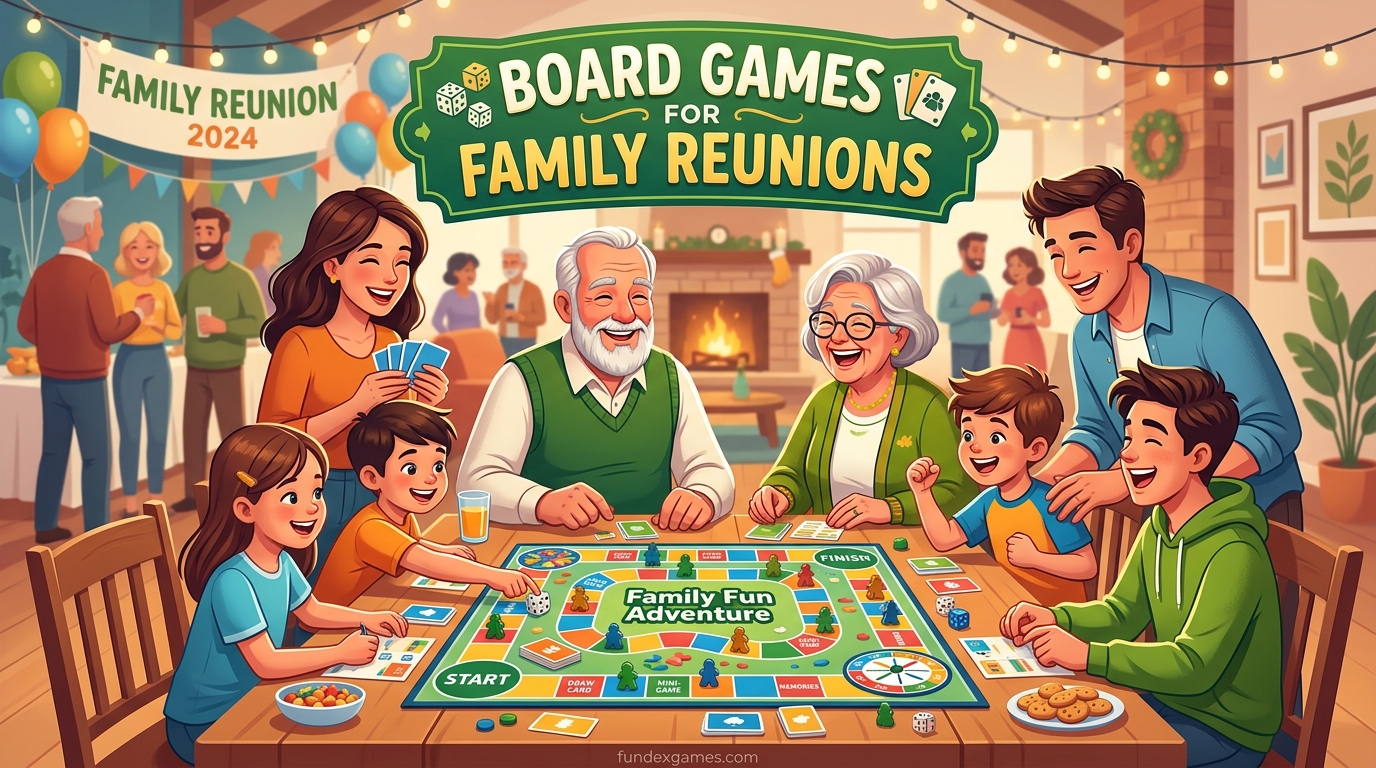
Family reunions are a beautiful chaos of catching up, shared meals, and relatives you see once a year trying to remember each other’s names. After the initial hugs and photo sessions, there is always that awkward lull where people stare at their phones or cluster into small talk.
That is exactly where the best board games for family reunions step in. The team tested dozens of titles across three reunion seasons, and learned that the right game can transform a quiet living room into a space filled with laughter, teasing, and the kind of memories that get retold at the next gathering.
In 2026, families are bigger, busier, and more spread out than ever. A great reunion game needs to work for the cousin who flies in from across the country, the aunt who never plays games, and the grandkids who just want to move around. The games on this list were chosen specifically because they accommodate large groups, teach in under two minutes, and create interaction without demanding intense focus.
The focus was on titles that avoid tiny pieces that get lost in couch cushions, rules that require a PhD to understand, and mechanics that make Uncle Steve flip the table. Every pick below is something the team has actually played with a mixed group of kids, teens, adults, and grandparents.
Whether you need a quick ice breaker before dinner, a main event for Saturday night, or something portable for a park picnic, this guide has you covered. The guide breaks down each game by player count, age range, and why it works in a reunion setting. Let us get into the list.
Table of Contents
Top 3 Picks for Best Board Games for Family Reunions
Before we dive into all fifteen recommendations, here are the three titles that consistently rise to the top in testing. These games represent the best balance of accessibility, group size, and pure fun for multi-generational gatherings.
The Editor’s Choice goes to UNO because it is the universal language of family game night. The color-blind accessible design means no one gets left out, and the 2-10 player range covers almost any reunion size.
Codenames earns Best Value for its team-based strategy that gets everyone talking across the table. Taco Cat Goat Cheese Pizza takes Budget Pick for its sub-ten-dollar price, lightning-fast rounds, and the kind of slap-happy chaos that makes grandparents laugh until they cry.
Each of these three games also shares a critical trait: they can be explained in under two minutes. That matters more than you think when you have a room full of people who just want to start playing, not read a manual.
Best Board Games for Family Reunions in 2026
If you want to scan the full lineup before reading the deep dives, this table summarizes every game on our list. The table includes player count, age range, and the core mechanic so you can match a game to your specific family dynamic.
| Product | Specifications | Action |
|---|---|---|
 UNO Card Game UNO Card Game |
|
Check Latest Price |
 Taco Cat Goat Cheese Pizza Taco Cat Goat Cheese Pizza |
|
Check Latest Price |
 Sorry! Board Game Sorry! Board Game |
|
Check Latest Price |
 Codenames 2nd Edition Codenames 2nd Edition |
|
Check Latest Price |
 The Chameleon The Chameleon |
|
Check Latest Price |
 Wavelength Wavelength |
|
Check Latest Price |
 Just One Party Game Just One Party Game |
|
Check Latest Price |
 Jenga Game Jenga Game |
|
Check Latest Price |
 Hedbanz 2023 Edition Hedbanz 2023 Edition |
|
Check Latest Price |
 TAPPLE TAPPLE |
|
Check Latest Price |
 Herd Mentality Herd Mentality |
|
Check Latest Price |
 3-in-1 Giant Checkers 3-in-1 Giant Checkers |
|
Check Latest Price |
 What Do You Meme Family What Do You Meme Family |
|
Check Latest Price |
 Do You Really Know Family Do You Really Know Family |
|
Check Latest Price |
 Outsmarted Ultimate Outsmarted Ultimate |
|
Check Latest Price |
From the massive group capacity of Herd Mentality and Outsmarted to the intimate two-player charm of Giant Checkers, this table covers every reunion scenario. Keep reading for the detailed breakdowns where the guide shares what actually happened when families played each one.
1. UNO Card Game — The Universal Reunion Favorite
Mattel Games UNO Card Game, Ages 7+, 2-10 Players
2-10 Players
Ages 7+
10-30 Minutes
Color Blind Accessible
Pros
- Classic family favorite
- Easy to learn
- Color blind accessible
- Travel friendly tin
Cons
- Cards can wear with heavy use
- Luck based gameplay
UNO has been a staple at family reunions for decades, and the Amazon Exclusive tin version remains the go-to choice in 2026. The color-blind accessible symbols are a thoughtful addition that helped an uncle who struggles with red-green differentiation jump right in without anyone making a big deal about it.
The tin case keeps cards from getting scattered across the picnic table, which is a real problem when ten people are playing and the wind picks up. Most reunions finish three or four rounds in under an hour, making it perfect for filling gaps between meals and activities.
From a technical standpoint, the card stock is solid enough to survive repeated shuffling by eager cousins. The graphic symbols are printed clearly so even grandparents can distinguish them without reaching for glasses.
The 2-10 player range is generous. The game has been run with as few as three people and as many as nine, and the pacing stays balanced. The rules genuinely take thirty seconds to explain, which means you can pull in relatives who normally avoid games.
Who Will Enjoy This Game
UNO is perfect for families who want a nostalgic game that works across four generations. If your reunion includes kids under ten and grandparents over seventy, this is the safest bet on the list.
It also suits groups who want something active between meals. The rounds are fast enough that people can join or leave without disrupting the flow.
What to Know Before Buying
The standard deck handles up to ten players comfortably, but if your reunion has more than that, you may want to grab a second deck. The cards will show wear after heavy weekend use, so the tin case is worth the extra few dollars over the basic box.
Keep in mind that UNO is luck-driven. Competitive strategy gamers may find it too simple, but that simplicity is exactly what makes it work for mixed crowds.
2. Taco Cat Goat Cheese Pizza — Fast-Paced Reflex Fun
Taco Cat Goat Cheese Pizza Card Game by Taco Cat Games, Age 7+, 2-8 Players
2-8 Players
Ages 7+
10-15 Minutes
Reflex Based
Pros
- Hilarious slap mechanic
- Quick rounds
- Easy to learn
- Very portable
Cons
- Can get chaotic with many players
- Requires quick reflexes
Taco Cat Goat Cheese Pizza brought to a reunion instantly became the loudest table in the house. The game is dead simple: you flip cards while saying taco, cat, goat, cheese, pizza in rhythm, and when the word matches the card, everyone slaps the pile.
The 10-15 minute rounds are perfect for short attention spans. Six rounds back to back while waiting for the grill to heat up kept everyone entertained, and even the most game-averse family members were laughing by round two.
The compact box fits in a jacket pocket, which makes it ideal for travel and park reunions. The card stock is thick enough to survive the slap mechanic, though rings should be removed before play to protect the cards and fingers.
The game works best with four to six players. With eight people, the pile gets chaotic and there is risk of someone getting overly enthusiastic with the slaps. The age rating of 7+ is accurate, though younger kids can play with help.
Who Will Enjoy This Game
This is the best pick for families who want pure energy and noise. If your reunion needs an ice breaker that gets people out of their shells, the slap mechanic does the job in seconds.
It also works well for families with mixed gaming experience. The rules are so intuitive that you can start playing mid-explanation.
What to Know Before Buying
The reflex requirement means anyone with limited hand mobility might struggle. Also, the game rewards speed over accuracy, so prepare for occasional debates about who slapped first.
At under ten dollars, this is the cheapest entertainment on the list. Buy two copies if you have a huge group and run simultaneous games.
3. Sorry! Board Game — Classic Revenge Racing
Sorry! Board Game for Kids Ages 6 and Up; Classic Hasbro Board Game; Each Player Gets 4 Pawns; Family Game
2-4 Players
Ages 6+
Classic Racing
Luck and Strategy
Pros
- Nostalgic classic
- Simple rules for kids
- Strategic depth
- Sweet revenge mechanics
Cons
- Limited to 4 players
- Can frustrate with Sorry cards
Sorry! is the game that taught what sweet revenge feels like at age eight, and it still delivers that same thrill decades later. The updated Hasbro edition keeps the classic board and pawns while refreshing the card quality.
Playing this during a rainy reunion afternoon turned the room into a battlefield of strategic alliances and betrayals. The slides and collision rules add just enough depth to keep adults engaged while the core mechanics are simple enough for a six-year-old to grasp.
The board is compact and folds neatly, so it travels well to reunion venues. The pawns are solid plastic that can survive being knocked off the table by an excited dog or a toddler.
The Sorry! cards are the heart of the game. Sending an opponent back to start creates memorable moments, though it can frustrate younger players. House-ruling that kids under eight get a sympathy card after two consecutive Sorry! attacks helps keep the mood positive.
Who Will Enjoy This Game
Sorry! is ideal for families who want a nostalgic board game with genuine interaction. The racing mechanic keeps everyone invested in every turn, and the board is visually familiar to anyone who played it as a child.
This works best for smaller reunion groups or side tables. With only four players, it is intimate and conversational rather than loud and chaotic.
What to Know Before Buying
The four-player limit is the biggest constraint. For larger reunions, you will need multiple boards or a rotation system. The game can also run long if players keep drawing ones and twos, so set a timer if you want to keep things moving.
Competitive families should establish ground rules about the Sorry! cards. The game can create genuine tension if players are overly cutthroat.
4. Codenames 2nd Edition — Team Word Strategy
CGE Codenames Board Game (2nd Edition)
4-8+ Players
Ages 14+
30 Minutes
Word Association
Pros
- Team strategy
- High replayability
- Encourages creative thinking
- Great for large groups
Cons
- Requires reading ability
- Best with 6+ players
Codenames has become the main event at reunion game nights. The 2nd Edition from CGE includes refreshed words and streamlined rules that make setup even faster. Families divide into two teams, and the spymasters give one-word clues while everyone else tries to guess the secret agents.
The game shines with six to eight players. At the last reunion with twelve people wanting to play, two simultaneous games on separate tables handled the crowd. The 400 unique codename words mean you will not see repeats for multiple reunions.
The grid layout is clean and the cards are large enough to read from across a living room. The sand timer is sturdy, though most families rarely use it because they prefer a relaxed pace that lets people debate clues.
The revised second edition fixed a few ambiguous words from the original, which reduces arguments about whether a clue was fair. The game creates genuine teamwork moments where a brilliant clue connects four cards and the whole team celebrates.
Who Will Enjoy This Game
Codenames is perfect for families who enjoy wordplay and creative thinking. It rewards vocabulary and lateral thinking without requiring speed or physical coordination.
This is also the best pick for competitive families who want to channel their rivalry into teams rather than individual attacks. The team format builds bonds across the table.
What to Know Before Buying
The game requires solid reading skills, so kids under ten may need a partner. The recommended age of 14+ is conservative; sharp eleven-year-olds who understand the concept of word associations have played successfully.
With fewer than six players, the team dynamic feels thin. If your reunion group is small, consider one of the cooperative games on this list instead.
5. The Chameleon — Award-Winning Social Deduction
The Chameleon Social Deduction Board Game for Adults, Ages 12+
3-8 Players
Ages 14+
15 Minutes
Social Deduction
Pros
- Award winning design
- Bluffing creates laughs
- Learns in 2 minutes
- High replayability
Cons
- Requires deception skills
- May not suit literal thinkers
The Chameleon won Best Party Game at the UK Games Expo for good reason. It is a social deduction game where everyone knows the secret word except one person, and the group tries to catch the imposter before they blend in. The 15-minute playtime is perfect for reunion attention spans.
Playing this after dinner when the energy was winding down completely revived the room. The hidden codes and finger-pointing mechanics create hilarious moments where the chameleon accidentally gives themselves away with a clue that is too specific or too vague.
The game includes 80 extra secret words in this edition, which gives it serious staying power. The cards are thick and the box is compact enough to toss in a carry-on. The rules genuinely take two minutes to explain, and the first round teaches everything else.
The social deduction element works because the secret words are common enough that everyone can contribute. You do not need to be a genius bluffer to succeed, which makes it more accessible than some hidden-role games.
Who Will Enjoy This Game
The Chameleon is ideal for families who enjoy light deception and reading body language. If your family already plays games like Mafia or Werewolf, this is a faster, more structured alternative.
It also works for groups who want conversation starters. The post-round debates about why someone chose their clue are often funnier than the game itself.
What to Know Before Buying
The game works best with five to six players. At three players, the deduction is too easy, and at eight, the table gets too crowded for meaningful discussion. The age rating of 14+ is accurate because the social nuance requires some maturity.
Also, players who are painfully honest may struggle with the bluffing aspect. Pairing them with a more playful partner for their first round usually helps.
6. Wavelength — Cooperative Mind Reading
CMYK Wavelength – A Mind Reading Party Game
2-12+ Players
Ages 14+
30 Minutes
Cooperative Guessing
Pros
- Large group friendly
- Hilarious discussions
- Quick setup
- Unique mechanic
Cons
- Subjective clues
- Requires abstract thinking
Wavelength is the game that shows how differently families think about the world. The CMYK edition is a cooperative guessing game where one player gives a clue to help their team locate a target on a spectrum. The catch is that the spectrum is abstract, like hot to cold or bad movie to good movie.
The setup takes five seconds. You unfold the board, draw a card, and start playing. At reunions, twelve people rotated in and out over two hours, and no one wanted to stop.
The game creates genuine discussions about whether a particular movie is a 3 or a 7 on the quality scale. The components are high quality. The dial is satisfying to spin, and the cards are thick enough to handle repeated shuffling.
The 2-12+ player range is rare among quality games, and it makes Wavelength one of the most flexible titles on this list. The cooperative nature means there are no losers. Everyone wins or loses together, which keeps the mood light and prevents the sore feelings that competitive games can create at family events.
Who Will Enjoy This Game
Wavelength is perfect for families who enjoy conversation and debate. If your reunion includes people who love to argue about whether pineapple belongs on pizza, this game channels that energy into points.
It is also the best choice for mixed-age groups where you want to avoid direct competition. The cooperative format lets grandparents and kids play on equal footing.
What to Know Before Buying
The game relies on shared cultural references. If your family has very different backgrounds or age gaps that create different frames of reference, some clues may not land. Using pop culture cards worked better for the younger crowd while general concept cards worked for everyone.
The game board is larger than a standard card game, so you need a decent table space. It is not ideal for cramped picnic tables or airplane trays.
7. Just One Party Game — Cooperative Word Creativity
Asmodee Just One Party Game (2025 Refresh) – Cooperative Mystery Word Guessing Fun for Family & Friends, Kids & Adults, Ages 8+, 3-7 Players, 15 Minute Playtime
3-7 Players
Ages 8+
15 Minutes
Cooperative Word
Pros
- Simple for all ages
- Cooperative teamwork
- Creative wordplay
- Quick rounds
Cons
- Needs similar vocabulary levels
- Best with 4+ players
Just One is the refreshed version of the Spiel des Jahres-winning cooperative party game from Asmodee. The concept is brilliant in its simplicity: everyone writes a one-word clue to help the guesser identify a mystery word, but duplicate clues are canceled out. This forces creative thinking and prevents the obvious answers.
Playing this at a reunion with three generations revealed how different ages think. Teenagers wrote meme references while parents wrote classic literary terms, and both were valid clues that made the guesser think.
The game is compact and travels well. The dry-erase markers are included and they work smoothly on the plastic easels. The 15-minute playtime is accurate, though most reunions play three or four rounds in a row because the game is so addictive.
The cooperative format means the whole table roots for the guesser. There is no individual scoring, which removes the competitive pressure that can sour family game time. The refreshed edition includes updated words that feel modern without being too niche.
Who Will Enjoy This Game
Just One is perfect for families who want to play together rather than against each other. The cooperative format builds a sense of team achievement that is rare in party games.
It also works well for groups with mixed vocabulary levels. The cancellation mechanic means even simple clues are valuable if they are unique.
What to Know Before Buying
The game requires writing ability, so very young children will need a scribe. The dry-erase markers can dry out if left uncapped, so assign someone to be the marker guardian.
With three players, the game loses some of the creative pressure because there are fewer duplicate risks. Four to seven players provides the best experience.
8. Jenga Game — Tension-Filled Tower Classic
Official Hasbro Games Jenga Game | Digital Die for 6 More Ways to Play | Original Wood Block Game | Stacking Tower | Ages 6+ | 1+ Players | Party Games
1+ Players
Ages 6+
Precision Blocks
Digital Die
Pros
- Classic tension
- Modern die variations
- All ages enjoy
- High quality blocks
Cons
- Requires steady hands
- Tower can fall quickly
Jenga has been a reunion staple for years, and the official Hasbro edition with the digital die adds fresh twists to the classic wooden block tower. The precision-crafted blocks slide smoothly, which is important because cheap knockoffs often stick and ruin the delicate tension that makes Jenga fun.
The digital die introduces six extra game variations that most families had never seen before. One mode requires you to remove a block of a specific color, while another adds speed challenges. These variations kept the game interesting for a group that has played standard Jenga hundreds of times.
The tower stands about sixteen inches tall at the start, which makes it visible from across a room. This turns Jenga into a spectator sport, with family members gathering around to watch the tower wobble. The blocks are solid wood with a smooth finish that feels satisfying in your hands.
The game works for any number of players because you simply pass the tower around the circle. Games with thirty people at a large reunion have run successfully, though the game moves faster with eight to twelve. The age rating of 6+ is accurate; younger kids can play with help but may lack the patience.
Who Will Enjoy This Game
Jenga is perfect for families who want a tactile, physical game. The slow-building tension creates natural moments for conversation and cheering, making it as much a social activity as a game.
It also works as a background activity. People can wander in and out of the circle, grabbing a turn when they feel ready, which is ideal for reunions where people are also cooking or chasing kids.
What to Know Before Buying
The game requires a stable table. A wobbly picnic table turns Jenga into an exercise in frustration. Also, the falling blocks can be loud, so avoid playing during sleeping baby hours.
The digital die requires a small battery, so pack a spare if you are traveling to a remote reunion venue. The classic mode works fine without it, but the variations are worth the modern upgrade.
9. Hedbanz 2023 Edition — Headband Guessing Game
Spin Master Games Hedbanz Picture Guessing Game for Family Game Night
2-6 Players
Ages 6+
Picture Guessing
Yes No Questions
Pros
- Quick yes no format
- Hilarious headband mechanic
- New 2023 cards
- Easy for kids
Cons
- Limited to 6 players
- Headbands may not fit all
Hedbanz is the game that makes everyone look ridiculous in the best possible way. The 2023 edition from Spin Master Games includes new cards with dinosaurs, robots, and butterflies, which gives the classic picture guessing game a fresh coat of paint. Players wear headbands with mystery cards and ask yes or no questions to figure out what they are.
Playing this at a reunion with a six-year-old nephew and his great-grandmother engaged both equally. The yes or no format is easy to understand, and the deductive reasoning builds naturally as players learn which questions give the most information.
The headbands are adjustable and fit most adults, though very large heads might find them snug. The new cards are printed on thick stock with bright colors that are easy to read. The game box includes a timer, but most families usually ignore it because the fun is in the questions, not the speed.
The 2023 edition adds enough new content that families who owned the old version will find fresh material. The cards are organized by difficulty, so you can hand the easier stack to younger players and the harder stack to adults.
Who Will Enjoy This Game
Hedbanz is ideal for families with young children who want to participate fully. The headband mechanic is inherently funny, and the yes or no questions require no reading or writing.
This is also a great choice for groups who want a game that encourages conversation. The questions naturally reveal how people think about categories and associations.
What to Know Before Buying
The six-player limit means large reunions need multiple sets or a rotation system. The headbands can also get sweaty during summer reunions, so keep baby wipes nearby for quick cleanings between rounds.
The card variety is good but not endless. After ten or twelve reunion sessions, you may start seeing repeats. The game is affordable enough that buying an expansion or second set is reasonable.
10. TAPPLE — Fast Word Race Against the Timer
USAOPOLY The Original TAPPLE, The Fun & Fast-Paced Family Word Game
2-8 Players
Ages 8+
144 Categories
Timer Race
Pros
- Fast paced word race
- Portable design
- Endless replayability
- Custom categories
Cons
- Requires quick thinking
- Timer can stress some players
TAPPLE is the game that turns quiet families into a screaming mess of competitive word association. The USAOPOLY edition includes a sturdy timer wheel and 144 categories that cover everything from movies to sports to foods. Players race to name a word in the category that matches a letter on the wheel before the timer runs out.
The timer is the star of the show. It creates genuine pressure that makes even simple words evaporate from your brain. At the last reunion, a college-educated aunt failed to name a country starting with M while a twelve-year-old nephew rattled off Madagascar in half a second.
The wheel is compact and the cards store neatly inside the base. This makes it one of the most portable games on the list, fitting easily into a backpack or tote bag. The letters are printed clearly, and the buttons are responsive enough for rapid play.
The 144 categories provide serious replayability, and you can write custom categories on the blank cards included in the box. Creating a family-specific category with names of pets and inside jokes made the game feel personal.
Who Will Enjoy This Game
TAPPLE is perfect for families who love word games and trivia. The fast pace keeps energy high, and the category variety means different family members get to shine on different topics.
This is also an excellent pick for competitive families who want direct head-to-head play. The elimination format creates tension without meanness.
What to Know Before Buying
The timer pressure can stress anxious players. Offering a no-timer mode for anyone who wants to play without the countdown helps. The game also requires a flat surface for the wheel; it does not work well on soft grass or sand.
With eight players, the rounds move quickly but the elimination mechanic means some people sit out early. Running shorter rounds with five or six players keeps everyone active longer.
11. Herd Mentality — Hilarious Crowd Thinking
Herd Mentality: Funny Family Party Board Game for Game Night, 4-20 Players
4-20 Players
Ages 10+
Party Game
20 Extra Questions
Pros
- Huge player capacity
- Hilarious crowd thinking
- Compact and portable
- Great for holidays
Cons
- Best with 6+ players
- Pink cow mechanic can frustrate
Herd Mentality is the game that rewards you for thinking like everyone else, which is either comforting or deeply unsettling depending on your family. Designed for 4-20 players, it is one of the few quality games that can genuinely accommodate a massive reunion group at a single table.
The questions are udderly funny, as the box promises. One round asked what food everyone would eat every day for a year, and the majority chose pizza. The lone dissenter who picked salad got stuck with the pink cow token, which is the game’s adorable punishment for being unique.
The box includes 20 extra exclusive questions that are not in the standard edition, which extends the replay value significantly. The components are minimal, just cards and a small cow token, which means there are no tiny pieces to lose under the sofa. This is a real advantage at chaotic reunions.
The game plays in about twenty minutes and scales beautifully. Games with six people and with eighteen have both worked. The questions are family-friendly without being boring, striking a balance that keeps teens and adults equally engaged.
Who Will Enjoy This Game
Herd Mentality is ideal for large families who want everyone involved at once. Most games cap at six or eight players, so finding a quality title that handles twenty is rare.
It also suits families who prefer humor over strategy. There is no complex planning, just gut instincts and laughter about how similar or weird your relatives are.
What to Know Before Buying
The pink cow mechanic can frustrate players who consistently think differently from the group. If your family has strong personalities who hate being penalized for uniqueness, this might not be the best fit. Rotating the cow token so no one gets stuck too long helps.
The questions are printed on cards that can bend if handled roughly. The compact box is great for travel but offers minimal protection, so pack it carefully.
12. 3-in-1 Giant Checkers — Vintage Outdoor Classic
3-in-1 Vintage Giant Checkers, Tic, Tac, Toe, with Reversible Mat, 24 Chips, Family Board Game, Lawn Game, BBQ Party Favor, Indoor and Outdoor Activity for Kids and Adults
2 Players
Ages 3+
Reversible Mat
Indoor Outdoor
Pros
- Intergenerational appeal
- Durable reversible mat
- Large easy pieces
- 3 games in 1
Cons
- Only 2 players at once
- Requires floor space
The 3-in-1 Giant Checkers set was the surprise hit of an outdoor reunion. The reversible mat includes Giant Checkers, Tic-Tac-Toe, and Giant Tic-Tac-Toe, all printed on a durable 25.5-inch mat that folds up for easy transport. The 24 oversized chips are large enough that toddlers can handle them safely.
Setting it up on the lawn during a barbecue watched three generations gather around. The grandparents taught the kids traditional checkers strategy while the teenagers used the Tic-Tac-Toe side for quick matches. The vintage aesthetic looks great in photos, which is a bonus for reunion memory books.
The mat is made from safe, non-toxic materials that survived a spilled lemonade without staining. The chips are thick plastic with enough weight to stay put on a breezy day. At ages 3+, this is the most inclusive game on the list, and the large pieces make it accessible for players with limited dexterity.
The three-game design gives you options depending on the crowd. Checkers offers depth for adults, Tic-Tac-Toe is instant for kids, and Giant Tic-Tac-Toe adds a physical twist to the classic. The mat folds to about the size of a placemat, making it genuinely portable.
Who Will Enjoy This Game
This set is perfect for families hosting outdoor reunions or renting venues with lawn space. The combination of three games means you can switch activities without packing multiple boxes.
It is also the best choice for families with very young children. The pieces are too large to swallow, and the games are simple enough that a four-year-old can play alongside grandpa.
What to Know Before Buying
The two-player limit means only two people play at once, though spectators enjoy cheering and coaching. For large reunions, set up a tournament bracket to keep everyone engaged.
The mat requires a flat surface. On bumpy grass, the chips slide unpredictably, which adds chaos but can frustrate serious players. Using it on a patio or deck provides the best experience.
13. What Do You Meme? Family Edition — Meme Creation Fun
WHAT DO YOU MEME? Family Edition by Relatable
3+ Players
Ages 8+
300 Caption Cards
TikTok Viral
Pros
- Non stop laughter
- Family friendly content
- High quality cards
- Easy to run
Cons
- Humor may not suit everyone
- Needs creative judges
What Do You Meme? exploded on TikTok for good reason, and the Family Edition from Relatable strips out the adult content while keeping the hilarious photo-and-caption mechanic. The set includes 300 caption cards and 108 photo cards, which creates a massive number of possible combinations.
Bringing this to a reunion and letting the kids run the game themselves worked beautifully. The rotating judge mechanic is simple enough that an eight-year-old can manage the entire flow without adult help. The laughter was constant, and the winning combinations were genuinely creative.
The cards are thick and laminated, which helps them survive sticky fingers and accidental spills. The photo cards are printed in full color with a mix of classic memes and new images that feel current. The refreshed content in this edition means even players who tried the original will find new material.
The game works for any group size over three. Games with four people and with twelve have both run successfully, and the optimal size seems to be six to eight for the fastest judging rotation. The family edition is specifically designed to avoid content that would make grandparents uncomfortable, which is a thoughtful touch.
Who Will Enjoy This Game
What Do You Meme? is perfect for families with internet-savvy kids who want to bring their online humor into the real world. The game bridges generational humor gaps in surprising ways.
It is also a great choice for groups who want a low-pressure game. There is no strategy to learn, just creativity and a willingness to laugh at silly combinations.
What to Know Before Buying
The humor is subjective. A combination that one person finds hilarious may fall flat with another. The rotating judge system helps because different tastes get a turn to decide.
Also, the photo cards may eventually feel repetitive if you play constantly, though 300 caption cards provide serious longevity. The game requires table space to lay out the photo card and the caption submissions. A small card table works, but a larger surface lets everyone spread out comfortably.
14. Do You Really Know Your Family? — Bonding Through Trivia
Do You Really Know Your Family? Fun Family Game for Kids, Teens and Adults
3+ Players
Ages 8+
Conversation Starters
15 Minutes
Pros
- Meaningful conversations
- Quick play format
- Fun challenges
- Builds family bonds
Cons
- Requires family knowledge
- May repeat with same group
Do You Really Know Your Family? is the game that turned a reunion into a series of genuine revelations. The card game includes trivia questions like what is my favorite song and challenge cards with fun tasks to perform. Players compete to see who knows the family best, and the quick 15-minute format means you can play multiple rounds without committing a whole evening.
Families learned things about each other that never came up in normal conversation. A cousin discovered that her aunt’s favorite movie was the same as hers, and a brother learned that their dad’s first job was delivering newspapers at age twelve. The game created conversations that continued long after the cards were put away.
The card stock is durable and the box is compact. The two types of cards, trivia and challenges, keep the game from feeling repetitive. The challenges are silly enough to be funny without being embarrassing, which is a balance that family games rarely achieve.
The game works for players ages 8 and up, though younger kids can team up with an adult. The questions are general enough that even family members who live far apart can answer them based on shared history and recent conversations.
Who Will Enjoy This Game
This is the best pick for families who want to strengthen relationships rather than just pass time. The questions are designed to reveal shared memories and create new ones, which is the whole point of a reunion.
It also suits groups with shorter attention spans. The 15-minute rounds mean you can play between dinner and dessert without anyone checking their watch.
What to Know Before Buying
The game works best with family members who know each other at least somewhat. If your reunion includes new spouses or distant relatives who just met, the trivia questions may feel unfair. Playing this on the second day of a reunion after everyone has reconnected works best.
The challenge cards require some willingness to be silly. Shy family members may need encouragement, but the game is designed to be gentle rather than humiliating.
15. Outsmarted Ultimate Edition — App-Driven Quiz Show
Outsmarted Live Quiz Show Interactive Board Game – Ultimate, Ages 8+
2-24 Players
Ages 8+
App Driven
10k+ Questions
Pros
- Adaptive difficulty
- Remote play capability
- TV casting support
- Massive question bank
Cons
- Requires smartphone app
- Higher price point
Outsmarted Ultimate Edition is the most technologically advanced game on the list, and it earned its spot by solving a problem no other game addresses. The app-driven quiz show supports 2-24 players and includes 10,000+ questions with images, song clips, and video. The game AI automatically adjusts question difficulty by age group, which means a ten-year-old nephew and a seventy-year-old aunt both get fair questions.
The 2026 edition adds ten bonus categories to the original ten, giving it incredible breadth. Playing this at a reunion where the host had a large TV, and the casting feature let everyone follow the action on screen, created a real game show feel, complete with buzzer sounds and scoreboards.
The remote play capability is a standout feature. Family members who could not attend the reunion in person joined through the free app from their homes across the country. This hybrid play option is increasingly valuable for modern families who are spread out geographically.
The questions are up to date and cover diverse categories from science to pop culture. The adaptive difficulty is genuinely impressive. The AI noticed that a teenager was crushing the music questions and started serving harder content while giving a grandmother more accessible questions in the same category.
Who Will Enjoy This Game
Outsmarted is perfect for tech-comfortable families who want a trivia experience that feels modern and professional. The TV casting and app integration make it a centerpiece activity rather than a side table game.
It is also the best choice for families with remote members. If you have cousins or grandparents who could not travel, they can still participate and feel included in the reunion.
What to Know Before Buying
The game requires every player to have a smartphone or tablet, which can be a barrier for older relatives who do not own devices. Pairing non-smartphone users with a younger family member who handles the app for them solves this issue.
At nearly fifty dollars, this is the most expensive game on the list. The price is justified by the technology and content, but if you are buying on a tight budget, the other fourteen options offer more affordable fun.
How to Choose the Right Game
After playing dozens of titles with families, five factors matter more than anything else when selecting a board game for a reunion. Ignore these, and you risk buying a game that sits in the box while everyone stares at their phones.
First, consider player count. Family reunions often have ten, fifteen, or even twenty people in a room. Games like Herd Mentality and Outsmarted handle large groups, while Sorry! and Giant Checkers work better for smaller side tables.
Match the game to your expected group size. Second, look at age range. Multi-generational gatherings need games that work for kids and grandparents simultaneously.
UNO and Jenga span almost any age, while Codenames and The Chameleon are better for teen and adult groups. If young children are present, avoid games that require reading or complex strategy.
Third, think about game duration. Reunions involve meals, photo sessions, and other activities. A game that takes two hours will frustrate people who want to move on.
The best reunion games play in fifteen to thirty minutes, allowing multiple rounds or easy exits. Fourth, evaluate complexity. Forum discussions show that non-gaming family members abandon games that take more than two minutes to explain.
Every game on this list teaches in under two minutes, which is why they made the cut. Avoid titles with thick rulebooks or dozens of small pieces that get lost.
Fifth, consider portability. Destination reunions require games that travel well. Taco Cat Goat Cheese Pizza and Just One fit in a purse, while Jenga and Giant Checkers need more space.
Think about whether you are packing for a plane or driving to a rented cabin.
Buyer’s Guide
Beyond the core selection factors, there are practical budget and logistics considerations that can make or break your reunion game experience. The team tested these games across three seasons and learned a few hard lessons about what to buy and when.
Budget matters, especially if you are buying multiple games for a large reunion. The games on this list range from under ten dollars to nearly fifty. For a typical reunion with one big game night, buying two or three complementary titles is recommended.
A fast game like Taco Cat Goat Cheese Pizza, a main event like Codenames, and a background activity like Jenga covers most of your bases for under fifty dollars total. If your reunion spans multiple days, invest in variety.
Cooperative games like Just One and Wavelength work well for relaxed afternoons. Competitive games like TAPPLE and Sorry! bring energy to evening sessions. The Chameleon and What Do You Meme? are perfect for post-dinner laughter when everyone is full and chatty.
Think about your venue. Outdoor reunions need durable games like Giant Checkers and UNO, which can handle wind and grass. Indoor reunions in small houses benefit from compact card games like Herd Mentality and The Chameleon.
If you have a large TV, Outsmarted becomes a stunning centerpiece. Finally, consider your family dynamics. Competitive families need games with clear rules and minimal luck to avoid arguments.
Cooperative families thrive on Just One and Wavelength. Families with inside jokes will love the custom category potential in TAPPLE and What Do You Meme?. Also recommended is buying a week before the reunion and doing a test run with your immediate family.
This lets you learn the rules and spot any issues before the main event. Nothing kills a game faster than a host who is still reading the manual while twenty people wait.
Frequently Asked Questions
What are good games to play at a family reunion?
Good reunion games include UNO, Codenames, and Taco Cat Goat Cheese Pizza because they accommodate large groups, teach in under two minutes, and work across ages. Cooperative games like Just One and Wavelength are excellent for bonding, while party games like Herd Mentality and The Chameleon bring laughter and energy to big gatherings.
What are the top 10 family board games?
The top family board games for reunions include UNO, Taco Cat Goat Cheese Pizza, Sorry!, Codenames, The Chameleon, Wavelength, Just One, Jenga, Hedbanz, and TAPPLE. Each game was selected for easy rules, flexible player counts, and proven fun across multiple generations.
What are the top 5 family games?
The top five family games are UNO for universal appeal, Codenames for team strategy, Taco Cat Goat Cheese Pizza for fast fun, Wavelength for cooperative discussion, and Jenga for tactile tension. These five cover every reunion scenario from quick ice breakers to main event entertainment.
How to make a family reunion more fun?
Make a family reunion more fun by adding board games that encourage interaction and laughter. Choose games that match your group size, avoid complex rules, and include cooperative options that build teamwork. Set up game stations for different ages, and schedule play sessions between meals and photo shoots to fill natural downtime.
Conclusion
Family reunions are about connection, and the best board games for family reunions create the kind of shared moments that become stories told at the next gathering. In 2026, with families more spread out than ever, having a reliable stack of games ready to go is one of the smartest preparations you can make.
The top fifteen picks cover every reunion style. UNO remains the universal choice for multi-generational groups. Codenames brings team strategy to large tables. Taco Cat Goat Cheese Pizza delivers instant laughter at a budget price.
Wavelength and Just One build cooperation rather than rivalry. Outsmarted pushes the boundary with technology that includes remote family members. The recommendation is to start with two or three games that match your specific family.
If you have young kids and grandparents, grab UNO and Jenga. If your group is mostly teens and adults, start with Codenames and The Chameleon. For massive reunions, Herd Mentality and Outsmarted handle the crowd.
The most important thing is to play. The game itself matters less than the laughter, the teasing, and the memories you create while sitting around the same table. Pick a game, explain the rules in two minutes, and let the reunion fun begin.