
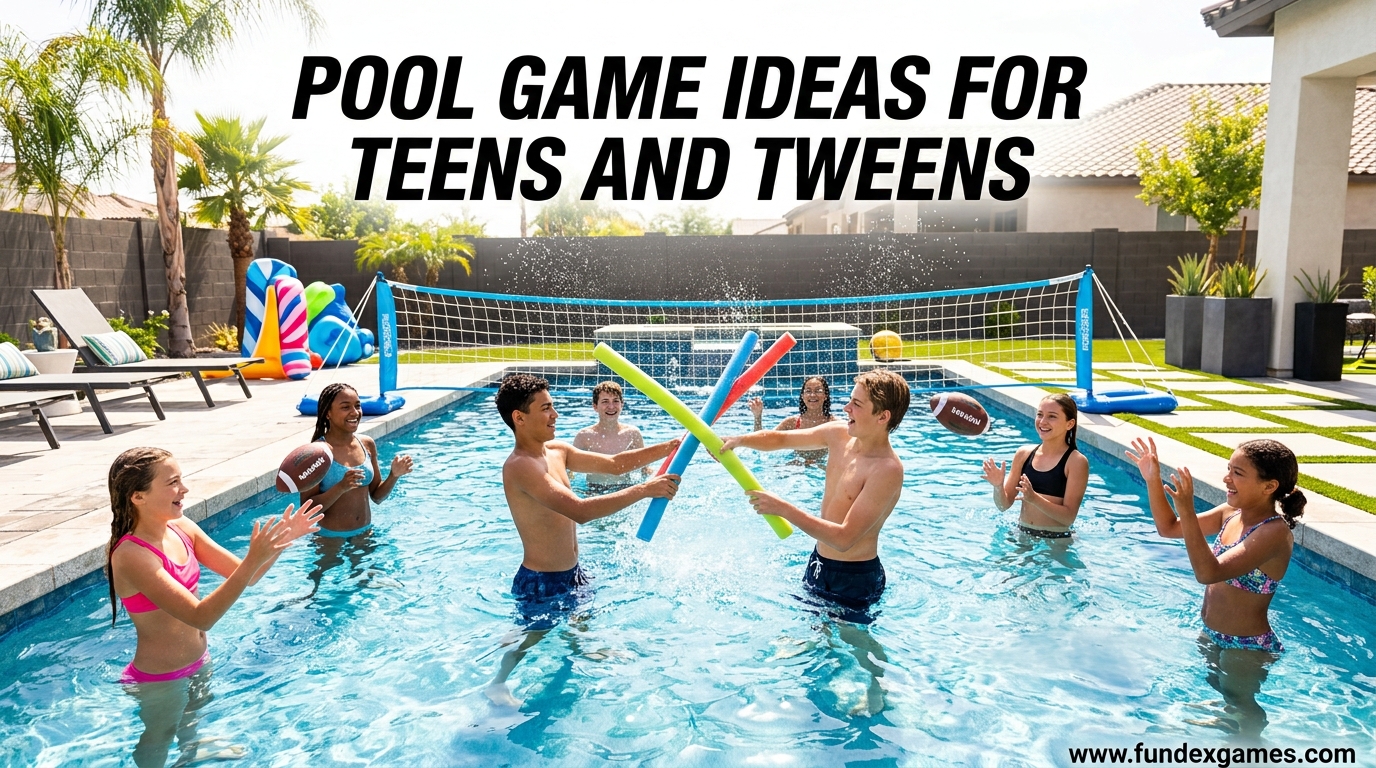
Summer means longer days, sunshine, and one of the best ways for teens and tweens to beat the heat: pool time. Whether you are planning a birthday bash, a camp activity, or just a way to keep the kids entertained on a hot afternoon, having a solid list of pool game ideas for teens and tweens makes all the difference. This guide covers everything from classic games that never get old to creative variations that will have everyone talking about your pool party long after the summer ends.
The tween and teen years (ages 10 to 14) are when kids want games that feel more mature than what they played when they were younger. They crave competition, teamwork, and activities that look good on social media. The good news is you do not need expensive equipment or complicated setups to keep this age group entertained. You just need the right game ideas. By the time you finish reading, you will have enough pool game options to fill an entire summer without repeating the same activity twice.
Table of Contents
Pool Safety Rules Every Teen and Tween Should Know
Before any pool game begins, safety has to come first. This is especially important for teens and tweens who may feel like they have outgrown basic pool rules. A quick safety refresher keeps everyone responsible and ensures the fun does not get interrupted by accidents.
First, establish a clear swimming boundary. Younger teens and tweens should know where the shallow end ends and the deep end begins. If your group includes kids with different swimming abilities, designate a visible line that non-swimmers cannot cross during games. Second, set a rule about running on the pool deck. Slippery surfaces plus excitement equals falls, and falls around concrete and tile can be serious. Third, mandate rest breaks every 30 to 40 minutes. Even strong swimmers get exhausted, and fatigue is when drownings most often occur.
One more critical rule: never play breath-holding games alone. Teens sometimes challenge each other to see who can hold their breath the longest. This is dangerous and should always be prohibited. Keep a charged phone nearby in case of emergencies, and make sure at least one adult knows the group is in the pool. These rules are not meant to kill the fun. They exist so everyone survives the afternoon to play another day.
Classic Pool Games That Never Get Old
Some games have been around for generations because they work. The following classics are easy to set up, require zero equipment, and scale well for groups of different sizes. Our team has seen these games entertain everything from small families to large camps, and they consistently deliver.
Marco Polo Variations
Marco Polo remains one of the most recognizable pool games for good reason. One person closes their eyes and calls out “Marco,” while the others respond “Polo.” The person with their eyes closed tries to tag someone by following their voice. What many people do not realize is that this game has evolved into several variations worth trying.
In Marco Polo Freeze, anyone who gets tagged becomes frozen in place until another player crawls under their legs to “thaw” them. In Marco Polo Poison, the person who is “it” becomes poison if they tag you, and you have to make it to the other side of the pool without getting tagged. These variations keep the classic fresh while adding new strategic elements that teens find engaging.
To make Marco Polo more challenging for older teens, try playing in the deep end where participants cannot touch the bottom. This forces everyone to tread water while playing, which dramatically increases the difficulty and the workout. The result is a game that challenges both coordination and stamina.
Sharks and Minnows
Sharks and Minnows is the ultimate tag game for pools. One person starts as the shark, and everyone else is a minnow. When the shark says “Shark in the water,” the minnows have to get from one side of the pool to the other without getting tagged. Anyone tagged becomes a shark in the next round. The game continues until only one minnow remains, who becomes the winner.
What our team loves about this game is how it scales. With a small group of 5 or 6 players, you can play a continuous game. With a larger group of 15 or more, split into two pools or play in shifts to keep everyone involved. For teens who want more intensity, add a rule that sharks can tag with a splash, meaning if they splash water at a minnow and it hits their face, they are tagged. This requires minnows to keep their eyes on the shark at all times.
Forum discussions confirm that sharks and minnows remains universally popular across age groups. Reddit users consistently recommend it as a go-to game when groups ask what to play beyond Marco Polo. The reason is simple: it requires no equipment, adapts to any pool size, and creates natural drama as the number of sharks grows.
Relay Races and Competitive Games
If your teens crave competition, relay races deliver that adrenaline rush. These games work especially well at parties where you want to split into teams and keep score. Most relay races use basic equipment you probably already have around the house, and they can accommodate both small and large groups.
Pool Noodle Relay Races
Pool noodles are inexpensive, abundant, and incredibly versatile for relay races. For a basic noodle relay, divide players into teams of 4 to 6. Each team member holds a noodle in front of them while swimming from one end of the pool to the other. The next person cannot start until the previous person touches the wall.
To increase difficulty, try the noodle limbo variation. Set up a floating noodle at chest height across the pool. Each player must swim under the noodle without touching it. Anyone who touches it is out for that round. Lower the noodle after each round to make it progressively harder. This game tests swimming skill while adding a limbo element that teens find hilarious.
Another popular variation is the noodle balance race. Players balance a beach ball on top of their noodle while swimming. If the ball falls, they have to stop, retrieve the ball, and get back in position before continuing. The visual comedy of people chasing floating beach balls while trying to stay balanced makes this a hit at parties.
Beach Ball Challenges
Beach balls bring endless possibilities to pool games. For Beach Ball Keep Away, the group tries to keep the ball in the air for as long as possible without using their hands. Only heads, feet, and noodles can touch the ball. Set a timer and see how long your group can keep it floating. For competitive play, split into two teams and see which team can keep the ball over their side of the net for longer.
Beach Ball Volleyball works well for groups without a proper volleyball net. Simply draw a line in the pool (or use a floating noodle as a net) and play volleyball using the beach ball. The soft ball moves faster than a regular volleyball and creates chaotic, fun rallies that work well for mixed skill levels.
Our team tested the Beach Ball Relay last summer with a group of 12-year-olds. The setup was simple: pass a beach ball down the line underwater. Players had to swim underwater to pass the ball, which meant holding their breath and working together. The kids loved it because it felt like a secret mission, and they kept asking to play again.
Treasure Hunt Games
Drop sinking objects like dive sticks, coins, or small pool toys into the pool and challenge players to retrieve them. Set a time limit and award points based on the difficulty of each item. Colored dive sticks sunk to different depths create natural point tiers. Red sticks at the bottom might be worth 10 points, while yellow sticks near the surface earn 3 points.
To make treasure hunts more engaging for teens, turn it into a puzzle. Leave clues around the pool deck that lead to different zones where items are hidden. Teams earn points by collecting items and solving the final puzzle. This works especially well for themed parties where you can tie the puzzle into a mystery or adventure narrative.
Team Games for Large Groups
When you have 10 or more kids, individual games stop working. You need team activities that get everyone involved at once. The following games scale well and create that exciting team atmosphere that teens love.
Pool Volleyball Variations
Pool volleyball is a classic for good reason. You do not need a professional net. A floating noodle or a rope with a net attached works perfectly for casual play. For smaller groups, try 2-on-2 or 3-on-3 volleyball. For larger groups, expand to 5-on-5 with positions.
One variation our team recommends is Water Polo Lite. Divide into two teams of 5 to 7 players. Use a soft ball or beach ball and two floating goals (laundry baskets work well). Players cannot touch the bottom of the pool, which means everyone treads water the entire time. The goal is to pass the ball and throw it into the opponent’s basket. This game provides an incredible workout while teaching teamwork and strategy.
For mixed age groups, adjust the rules so younger tweens can play alongside older teens. Give younger players a “safe zone” where they can touch the bottom, or assign them lighter scoring tasks like retrieving the ball when it goes out of bounds.
Human Chain Games
Have players form a human chain by holding hands while swimming across the pool. The challenge is keeping the chain intact while navigating around obstacles. If the chain breaks, everyone has to restart. This game builds trust and cooperation while providing a physical challenge.
For a competitive twist, time the groups and have them race. Add obstacles like noodles floating in the water that the chain must navigate around. This adds strategy because teams have to communicate quickly to redirect the chain.
Games by Age Group: Teens vs Tweens
Not every game works for every age. Tweens (ages 10-12) often want games that feel more grown-up than what they played as kids, but they still appreciate clear rules and structure. Teens (ages 13-14) push for more independence, competition, and social elements. Here is how to match the right game to the right age.
Best Games for Tweens (Ages 10-12)
Tweens generally respond well to games with clear structure, visual scoring, and plenty of action. The following games tend to work especially well for this age group.
Pool Noodle Bocce Ball is perfect for tweens. Float multiple beach balls or pool noodles across the pool as targets. Players throw dive sticks or small coins and try to land them closest to the target. This game teaches precision while keeping everyone moving.
Cannonball Contests never fail with this age. Have kids jump in from different heights (pool edge, ladder, diving board if available) and score points based on splash size. Judge creativity and style alongside splash impact. This game works well as a group activity because everyone participates at once and there are no elimination rounds.
Pool Trivia combines learning with fun. Float a foam board in the pool with trivia questions attached using waterproof markers or laminated cards. Players swim to the board, answer a question, and swim back. For tween-appropriate content, include questions about science facts, movie trivia, or pop culture that this age group enjoys.
Best Games for Teens (Ages 13-14)
Teens want games that feel more sophisticated and that they can share on social media. They also appreciate competitive elements with real stakes, even if the stakes are just bragging rights.
Synchronized Swimming Challenges appeal to teens who enjoy performance and creativity. Have teams create short routines set to music that they perform for the group. Include moves like underwater flips, handstands, and coordinated floating patterns. This activity works well because it combines swimming skill with creativity and performance.
Social Media Challenges are perfect for teens who want content. Challenge them to create the most creative TikTok-style video while in the pool. This might include a synchronized dance, a comedy skit, or an underwater camera trick. Give prizes for the most creative, funniest, and most liked videos.
The Dibble Game comes from forum discussions and deserves more attention. Players fill water bottles with pool water, cap them, and then throw the caps over their shoulder into the pool. Others try to catch the caps or guess where they will land. The randomness creates humor and engagement that teens find entertaining.
No-Equipment Pool Games
Sometimes you do not have time to run to the store, or you want games that cost nothing. These no-equipment games use only the pool and imagination. They work especially well for spontaneous pool days or when you have a mixed group with different comfort levels in the water.
The Torpedo Game is a forum favorite. One kid floats on their back acting as the “torpedo transport,” while another kid dives underneath and acts as the torpedo. The diver holds onto the transport player’s legs and is carried across the pool. At a signal, the diver releases and “launches” underwater. Other players have to spot the torpedo and avoid intersection. It sounds simple, but the stealth and surprise elements create genuine excitement.
Freeze Tag works like regular freeze tag but in the water. One person is “it” and tries to tag others while they swim. When someone is tagged, they freeze in place with arms raised. Other players can swim to frozen players and “thaw” them by swimming under their raised arms. The game continues until a set time limit, and the team with the most thawed players wins.
Underwater Limbo replaces the traditional barLimbo with a floating noodle. Players must swim under the noodle without touching it. After each round, lower the noodle closer to the water surface. Anyone who touches the noodle is out. This works best in the shallow end where players can touch the bottom if needed for support.
Currency Exchange is a simple game using only your body. One player swims underwater and touches another player’s foot. That player then becomes the “currency” and must swim underwater to tag someone else. The challenge is holding your breath while playing, and the game naturally creates groups of players egging each other on to hold on longer.
Glow-in-the-Dark Pool Games for Nighttime
Night swimming transforms the pool into something new and exciting. With the right glow elements, you can create an entirely different atmosphere that teens find irresistible. These games work best during evening parties when the sun has gone down but there is still plenty of ambient light.
Glow Stick Tag uses inexpensive glow sticks available at most dollar stores. Give each player a glow stick necklace or bracelet. One person is “it” and tries to tag others. The tagged player freezes and holds their glow stick above the water until another player swims over to “release” them by tagging. The visual effect of glowing sticks floating in the dark pool creates an atmosphere that regular daytime games cannot match.
Underwater Light Hunt works by placing waterproof flashlights or glowing objects on the pool bottom. Turn off all other lights and let players dive to collect the items. Award points for each item retrieved within a time limit. This game creates genuine adventure because players cannot see the objects until they are close to them.
Flashlight limbo uses a waterproof flashlight beam as the limbo bar. One player shines the beam across the pool at water level, and others swim under it. The beam is easier to judge than a physical noodle, and the moving light adds unpredictability. Play music in the background and treat it like a party activity.
Glow Bowling sets up plastic bottles or containers as pins in the pool. Players use a waterproof flashlight as the “ball” and try to knock down the pins by pushing them with the light. This works best in the shallow end and creates a fun social atmosphere that teens enjoy.
Teen Pool Party Activities
Pool parties for teens need activities that keep energy high and give guests something to do between swimming sessions. The following ideas work for birthday parties, end-of-school celebrations, or any teen gathering by the water.
Pool Party Olympics creates a tournament atmosphere that teens love. Set up multiple stations around the pool with different challenges: relay races, accuracy contests, endurance challenges, and trivia rounds. Teams rotate through stations, and points accumulate. Award prizes at the end for winning teams and fun categories like “most enthusiastic cheerleader.”
Backyard Movie Night combines the pool with cinema. Set up a projector and screen near the pool and play family-friendly movies while kids swim. Turn down the volume and let the movie create background atmosphere. This works especially well for parties that go into the evening hours.
Musical Pool Float combines musical chairs with pool floats. Players float on pool floats while music plays. When the music stops, everyone must get off their float and swim to a different one. The last person without a float is out. This game works best with enough floats for most but not all players.
Pool Photo Booth creates social media content opportunities. Set up a station near the pool with fun props like pool noodles, goggles, and beach balls. Designate someone to take photos, or let kids take turns with a waterproof camera. Print the photos as party favors at the end of the night.
Competitive Tournament Formats
Teens love competition with real stakes. Setting up a tournament structure takes your pool games to the next level and gives kids something to train for over multiple sessions. Here is how our team recommends organizing pool game tournaments.
Start with a Round Robin format for smaller groups of 6 to 10 players. Everyone plays against everyone else in a series of matches. Award points for wins and losses. At the end of the round robin, the top point-earners compete in a final bracket. This format ensures every player gets multiple games and prevents early eliminations.
For larger groups of 12 or more, use a Tournament Bracket system. Set up a bracket with random matchups. Players compete in single-elimination rounds until a champion emerges. Between rounds, schedule “losers bracket” games so eliminated players still have something to play for.
Keep score visible on a whiteboard near the pool. Teens respond to visible progress and enjoy watching rankings change throughout the party. Assign a scorekeeper who is not playing to maintain objectivity and keep the tournament moving.
Add prize categories beyond just winning. Award points for sportsmanship, creativity, and enthusiasm. This prevents sore feelings from eliminations and gives everyone a reason to participate fully. Prizes do not need to be expensive. Extra screen time, choosing the next game, or a special snack work well for teens.
Pool Game Ideas for Teens and Tweens: FAQ
What are some fun games to play at a pool party?
Classic options include Marco Polo, Sharks and Minnows, relay races, and pool volleyball. For more variety, try pool noodle games, treasure hunts, or team competitions like water polo. Glow-in-the-dark games work great for evening parties.
What are some good games for 12 year olds?
Tweens this age enjoy pool trivia, cannonball contests, pool noodle bocce, and competitive relay races. Games with clear structure and scoring appeal to this age group. They also enjoy synchronized swimming challenges and social media-friendly activities.
What to do at a teen pool party?
Host a Pool Party Olympics with multiple game stations, set up a tournament bracket for competitive play, create a glow-in-the-dark evening session, or organize a synchronized swimming competition. Social media challenges and photo booth stations also work well for teen parties.
What are some unique swimming pool game variations?
Try Marco Polo Freeze where tagged players become frozen, or Sharks and Minnows Splash where sharks tag by splashing water. The Dibble game uses water bottle caps thrown over the shoulder. For night games, glow stick tag and underwater light hunts create unique experiences.
Final Thoughts on Pool Game Ideas for Teens and Tweens
The best pool game ideas for teens and tweens share a few common elements. They create energy, encourage teamwork, and give participants something to talk about afterward. They do not require expensive equipment or complicated setups. They adapt to different group sizes and skill levels. And most importantly, they make pool time feel exciting rather than routine.
Whether you are planning a backyard birthday party, a summer camp activity, or just a way to keep the kids entertained on a hot afternoon, this guide gives you enough ideas to fill an entire summer without repeating the same game twice. Start with the classics like Marco Polo and Sharks and Minnows. Add variety with relay races and team competitions. When you want to mix things up, try the no-equipment games that use only the pool and imagination. For evening events, glow-in-the-dark games transform your pool into something completely new.
The key is to watch your group and adjust. If one game is not landing, move to the next. If your teens want more competition, add a tournament structure. If they want more creativity, try synchronized swimming challenges. Pool game ideas for teens and tweens work best when they evolve with your specific group. Use these ideas as a starting point and make them your own.