

A room light flattens artwork. It bounces off the ceiling and comes down evenly from everywhere, so a canvas looks like a poster and a framed photograph looks like a thumbnail. A picture light fixes that with a narrow wash of directed light, and choosing the right one comes down to three things most buyers never think about: where the power comes from, how warm the light reads, and whether the fixture matches the art in size.
That first question is why so much of this category is confusing. There are battery-operated units, rechargeable units, plug-in fixtures and hardwired ones, and they are not interchangeable. Renters and anyone whose art wall has no nearby outlet usually end up with a cordless model, whether they planned to or not. Households with an accessible outlet get more output and zero charging from a plug-in. Homeowners about to redecorate often choose hardwired because it is the only version that disappears completely into the wall and works with a smart-home switch.
This roundup covers ten picture lights for wall art across all four of those power types, from compact rechargeable pucks you can stick to a bookcase to a full-metal fixture you can hardwire into the wall. We compared the published specs side by side and read what buyers actually said about runtime, brightness and build quality, and we re-checked the whole list in 2026. Every pick here carries a stated con, because in this category the reviews are where the useful information is.
Before we get into the fixtures, it is worth locking in the frame first. If you have not chosen your wall art yet, start with our wall picture frame buying guide, because the frame’s width is what determines the fixture width.
What we looked at: light output in lumens, stated color temperature, color rendering accuracy, battery capacity and claimed runtime, beam angle, adjustability, mounting method, material, warranty length and real-world buyer complaints. We did not measure lux on a calibrated meter, so every brightness figure here is the manufacturer’s published number rather than our own reading.
Top 3 Picks for Picture Lights for Wall Art in 2026

FULEN 2-Pack Rechargeable Lights
- CRI 95+ at 3000K
- 4500mAh for 15+ hours
- Remote with 3 temps and 5 brightness levels
- Magnetic tool-free no-damage mounting

LYTARA Cordless Gold Light
- 5000mAh for about 10 hours
- 70 LED beads at 350 lumens
- Stepless dimming with 3 color temps
- Full metal finish with pivotable bracket

EZVALO 3-Pack with RGB
- 2000mAh
- full charge in about 2.5 hours
- 3 color temps plus 12 RGB colors
- Timer at 15
- 30 and 60 minutes
Best Picture Lights for Wall Art (October 2026)
Every pick below, with the specs that actually separate them. Width matters more than any other single number, because a fixture that is too narrow leaves the edges of a canvas in shadow.
| Product | Specifications | Action |
|---|---|---|
| FULEN 2-Pack Rechargeable Picture Lights |
|
Check Latest Price |
| LYTARA Cordless Gold Picture Light 14 inch |
|
Check Latest Price |
| EZVALO 3-Pack Rechargeable RGB Lights |
|
Check Latest Price |
 Xuolder Battery Operated 3-Pack Puck Lights Xuolder Battery Operated 3-Pack Puck Lights |
|
Check Latest Price |
 Craftersmark 16-Inch Dimmable Cordless Bar Craftersmark 16-Inch Dimmable Cordless Bar |
|
Check Latest Price |
 Tassuowell 12-Inch Brass Rechargeable Light Tassuowell 12-Inch Brass Rechargeable Light |
|
Check Latest Price |
 Yuichoy 2-Pack 16-Inch Metal Gallery Lights Yuichoy 2-Pack 16-Inch Metal Gallery Lights |
|
Check Latest Price |
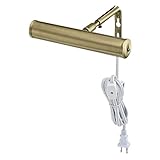 Westinghouse 7-Inch Antique Brass Plug-In Westinghouse 7-Inch Antique Brass Plug-In |
|
Check Latest Price |
 LEONLITE Dimmable CRI90 Picture Light LEONLITE Dimmable CRI90 Picture Light |
|
Check Latest Price |
 Coinmit 24-Inch Telescoping Plug-In Light Coinmit 24-Inch Telescoping Plug-In Light |
|
Check Latest Price |
What Are Picture Lights? Art Lights, Gallery Lights and Frame Lights
A picture light, also called an art light, gallery light or picture frame light, is a narrow wall-mounted sconce that throws focused downward light onto artwork. The distinction is mostly about scale: a picture light lights one frame, while a gallery light is usually wider or used in multiples to cover a whole wall of pieces.
Every fixture in this roundup shares the same basic geometry: a shade or tube, an adjustable arm or pivot, and a source aimed down at roughly a 30-degree angle. What changes between them is the power source, the beam width, the color of the light, and how much of the frame is actually covered.
1. FULEN 2-Pack Rechargeable Picture Lights: Best Picture Lights for Wall Art Overall
FULEN 2 Pack Picture Lights for Wall Rechargeable, Picture Frame Lights
300 lumens at 3000K
CRI 95+
4500mAh, 15+ hours per charge
2 lights, 2 cables and a remote
Pros
- CRI 95+ so artwork colors stay accurate
- 4500mAh battery for over 15 hours per charge
- Remote controls 3 color temperatures and 5 brightness levels
- Magnetic tool-free mount means no holes in the wall
- Slim profile works on bookshelves and mirrors too
Cons
- Light bar must be detached to recharge
- Adhesive base is less secure than screws in busy spots
This is the pair we kept coming back to. The FULEN set ships with two light bars, two USB cables and one remote, and the magnetic base means you can move either light whenever the art changes without touching a drill. For most people deciding on their first picture light, that flexibility is worth more than any single spec.
Color accuracy is where this pair separates itself. A published CRI of 95 means reds, skin tones and earth pigments in a painting render close to how they look in daylight, which is exactly what you want above art. Most competing cordless fixtures in this roundup do not publish a CRI figure at all, so you are often guessing.
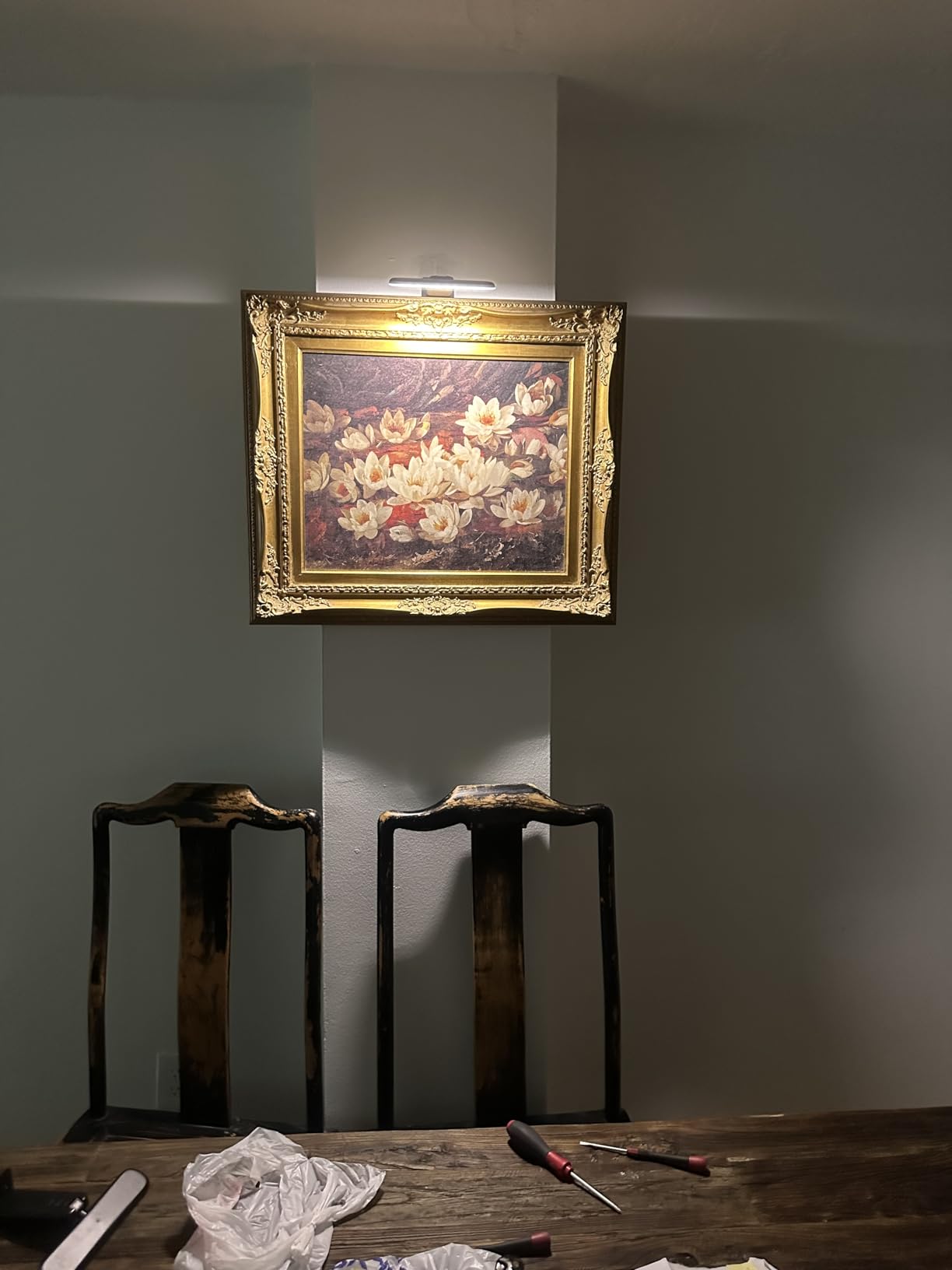
The 4500mAh battery is one of the larger cells in this group and the claimed runtime is over 15 hours of continuous light. In practice, capacity does not translate one-to-one into hours, because brightness setting and color temperature both draw current. Buyers in the reviews most often describe it as lasting through an evening comfortably rather than through a whole week.
Each bar runs 300 lumens from 1.5 watts on a built-in LED, and the remote gives you three color temperatures and five brightness levels. That combination covers the full range of what art needs: 2700K and 3000K for warm gallery tone, and the cooler setting for photography where you want to check color.
Where these two lights earn their keep
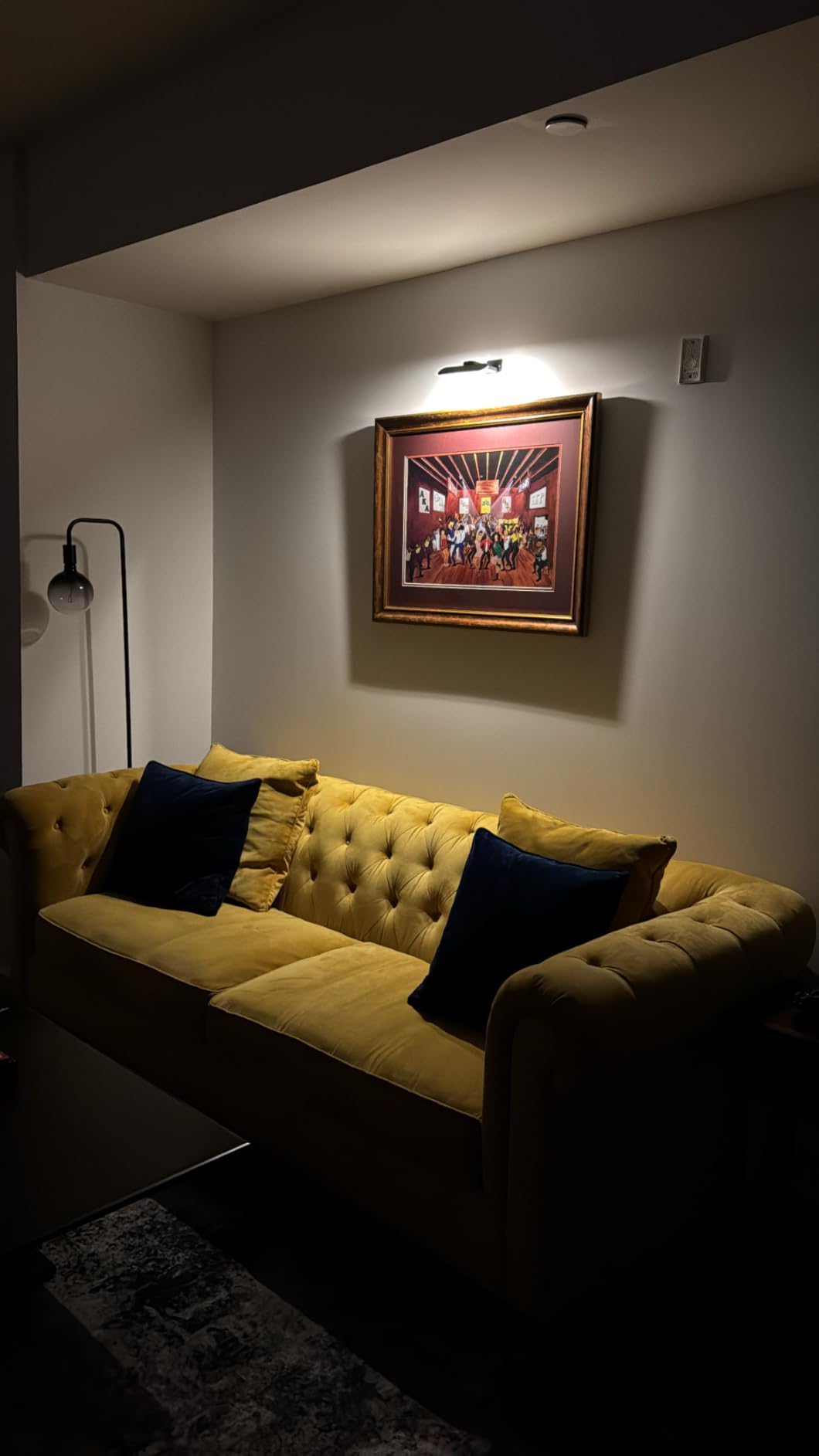
Two lights beat one light for almost any wall with two pieces on it. A single centered fixture over two frames produces a hot spot in the middle and dark corners at the outside edges, which is the most common complaint about one-light setups. A matched pair spreads the wash evenly across the pair.
Because the mount is magnetic and adhesive, this set is also one of the strongest renter options here. Nothing is drilled, and when you move out the base comes off the wall with it. If your art wall is in a bedroom or a hallway with no outlet within reach, this is the realistic answer.
Where they fall short
The magnetic design has one real cost: the bar has to come off the wall to plug into its cable. There is no way to leave a light burning and top it up at the same time, so this is a light you switch on to look at something rather than one you leave on all day.
The second limitation is the adhesive base. On a smooth painted wall it holds well, but in a high-traffic spot or on a textured surface a screw-mounted bracket is simply stronger. Each light also measures under 9 inches wide, which suits smaller frames than a 36-inch canvas.
2. LYTARA Cordless Gold Picture Light with a 5000mAh Battery
LYTARA Dimmable Cordless Picture Light with Controller and Timer, Rechargeable 5000mAh Battery Wall Sconce for Wall Pictures, Gallery Artwork, Paintings, Portraits, Dartboards (Gold)
350 lumens
5000mAh, about 10 hours
14 inch wide, metal gold
Stepless dimming with IR remote
Pros
- Highest average rating in the roundup
- 5000mAh battery for about 10 hours of continuous light
- 70 LED beads spread light evenly across the bar
- Stepless dimming plus 3000K/4000K/6500K selection
- Pivotable bracket and rotating bar for accurate aim
Cons
- Timer caps out at a one-hour auto-off
- Battery needs more frequent charging if left on daily
- Suited to small and medium frames rather than large canvases
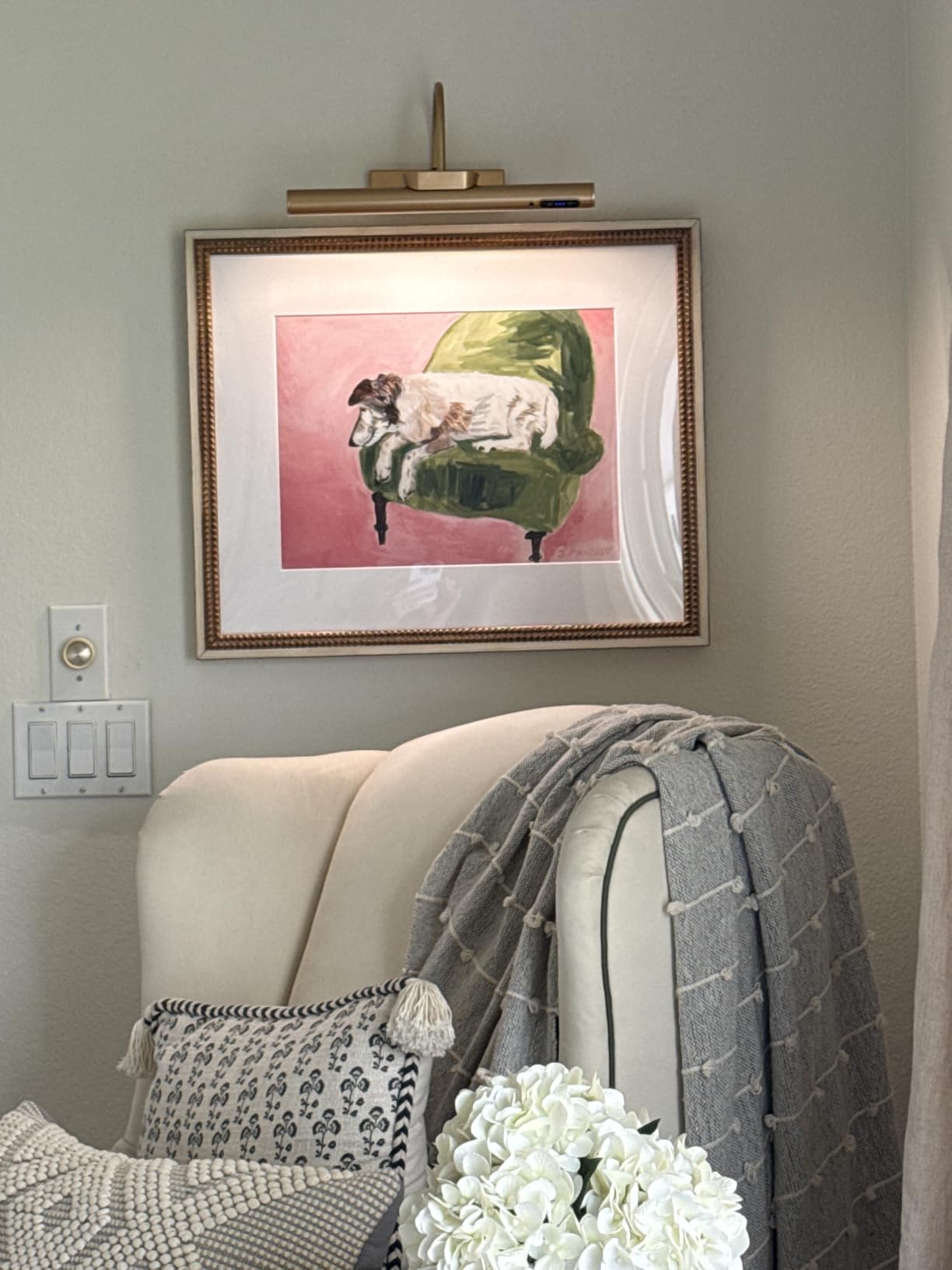
This is the one we would put above a canvas if metal matters to you. The LYTARA body is metal rather than painted plastic, and owners describe the gold finish as classy and museum-like rather than like painted plastic. It carries the highest average rating in the group at 4.6 out of 5 across more than 1700 reviews, which is unusual for a category this full of near-identical listings.
The 5000mAh battery delivers roughly 10 hours of continuous light and recharges over USB-C. The light bar is magnetic, so you lift it off to plug in the same way you would with the FULEN pair. That is a design you will either love or find mildly annoying depending on whether you consider the light decoration or function.
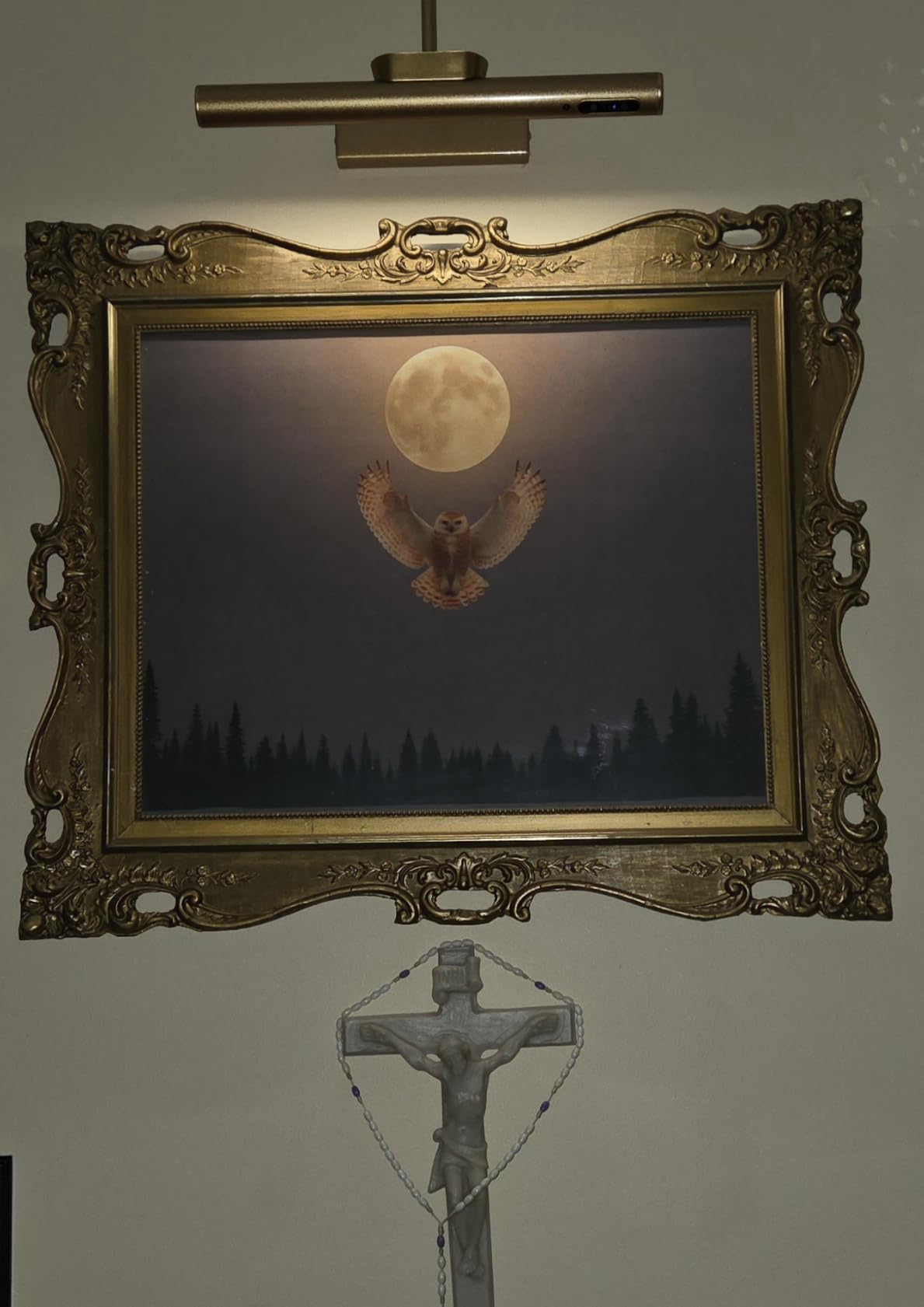
Where this fixture genuinely shines is the light itself. Seventy LED beads across a 14-inch bar produce 350 lumens with very little visible hot spot, and the diffuser spreads that output evenly. For a textured canvas or a woven textile, an even wash matters more than raw brightness, and this is one of the few cordless options that gets close to even.
Aim control is good too. The bracket pivots and the bar rotates, so you can pull the beam forward over a frame that sits proud of the wall or angle it back to avoid glare on glass. Owners using it for dartboards and mirrors report the same flexibility.
Who this light suits
If your art leans warm, this is the safest pick in the roundup. The 3000K warm setting reads like a traditional halogen picture light rather than like an office fixture, which matters when the artwork is oil, wood or leather tones.
It is also the right answer for anyone who has already been disappointed by a plastic cordless light and wants something that looks like hardware. The manufacturer is a lighting factory rather than a general home goods seller, and that shows in the finish and the weight at 15.2 ounces.
Who should skip it
The timer is the first limitation. It tops out at a one-hour auto-off, so you cannot set it to run for three hours while you host dinner. If you want a light that switches itself off after an hour and a half, this one will not do it.
Second, ten hours is a shorter run than the FULEN pair claims, and it needs more frequent charging if you tend to leave art lighting on during the day. At 14 inches it is also on the small side for a large canvas, and the listed color temperature range leans cooler than ideal for traditional work.
3. EZVALO 3-Pack Rechargeable Lights with RGB Modes: Best Value
EZVALO Picture Lights for Wall, 2000mAh Rechargeable Battery Magnetic Poster Lights with 3 Color Temps & 12 RGB, Remote Dimmable Timer Painting Light, Wall Decor Light for Art Display, Frame (3 Pack)
80 lumens
2000mAh, about 2.5 hour charge
USB-C
Three lights and mounting hardware
Pros
- Three lights controlled by one remote
- 2000mAh battery fully charges in about 2.5 hours over USB-C
- 3 color temperatures plus 12 RGB colors with flash and fade modes
- Brightness adjustable from 10% to 100 percent
- Three timer settings at 15
- 30 and 60 minutes
- Tap control on the lampshade as well as remote
Cons
- 80 lumens is modest and suits smaller frames only
- Small round profile does not scale to gallery walls
The RGB option is not a gimmick here, because the use case is real: a row of three small frames, a set of prints, or a hallway with art in three spots. The EZVALO pack includes three mounting brackets and three adhesive tapes alongside a single remote, so all three lights change together.
Charging is fast and the cable is USB-C, which means the same charger as your phone. The 2000mAh cell reaches a full charge in about 2.5 hours according to the manufacturer, so a top-up during a coffee break is realistic. That turnaround matters more than raw capacity for most people.
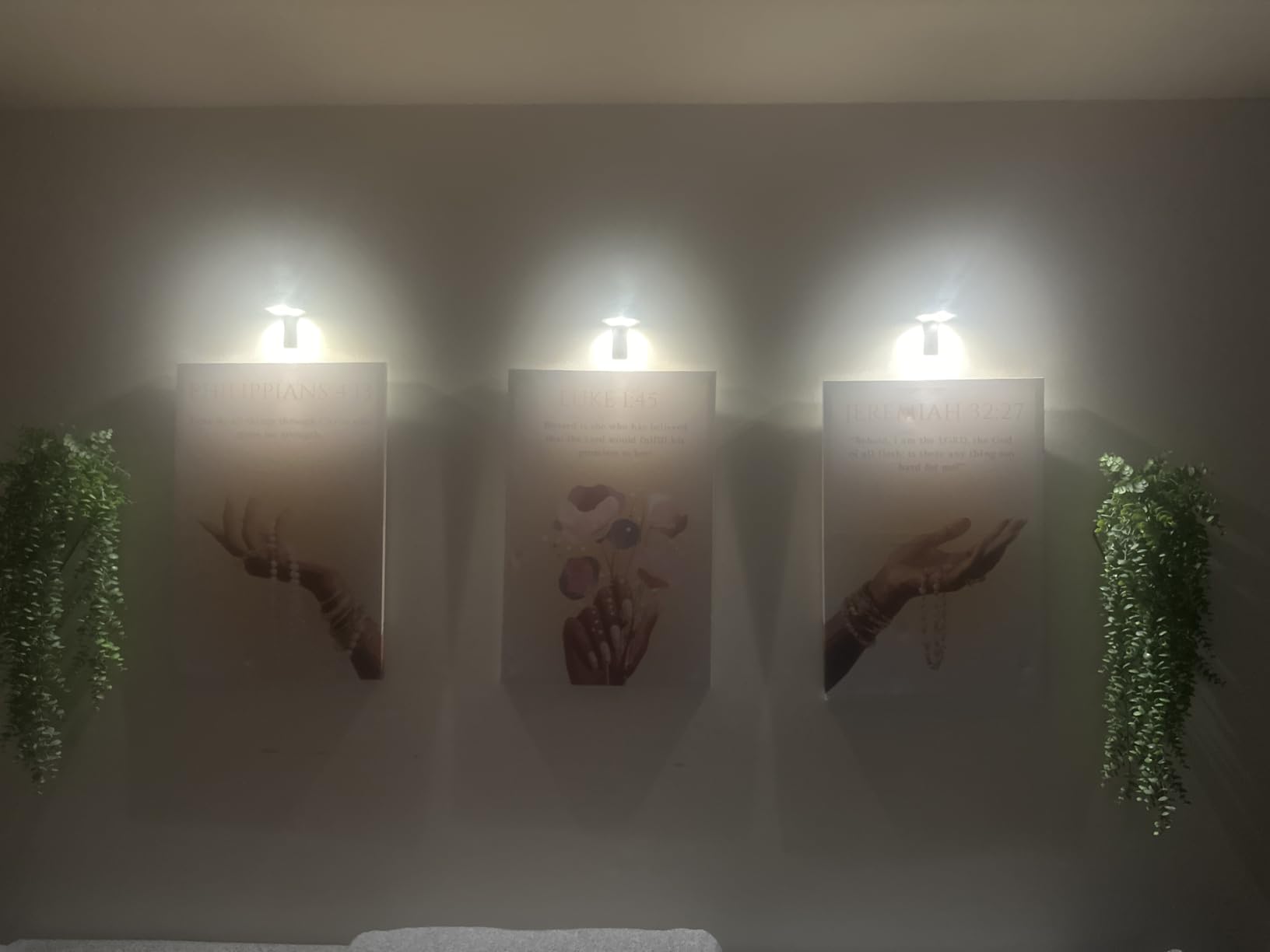
The unusual part is color. Alongside three standard color temperatures you get 12 RGB colors and two dynamic modes, flash and fade. Reviewers consistently name this as the reason they bought it, particularly for holiday displays. It is not something you need for a permanent gallery, but it turns these lights into accent lighting for a party.
Brightness runs from 10% to 100% for each color, and the timer offers 15, 30 and 60 minute settings from the remote. You can also tap the lampshade directly, which is handy when the light is within arm’s reach.
What works about this pack
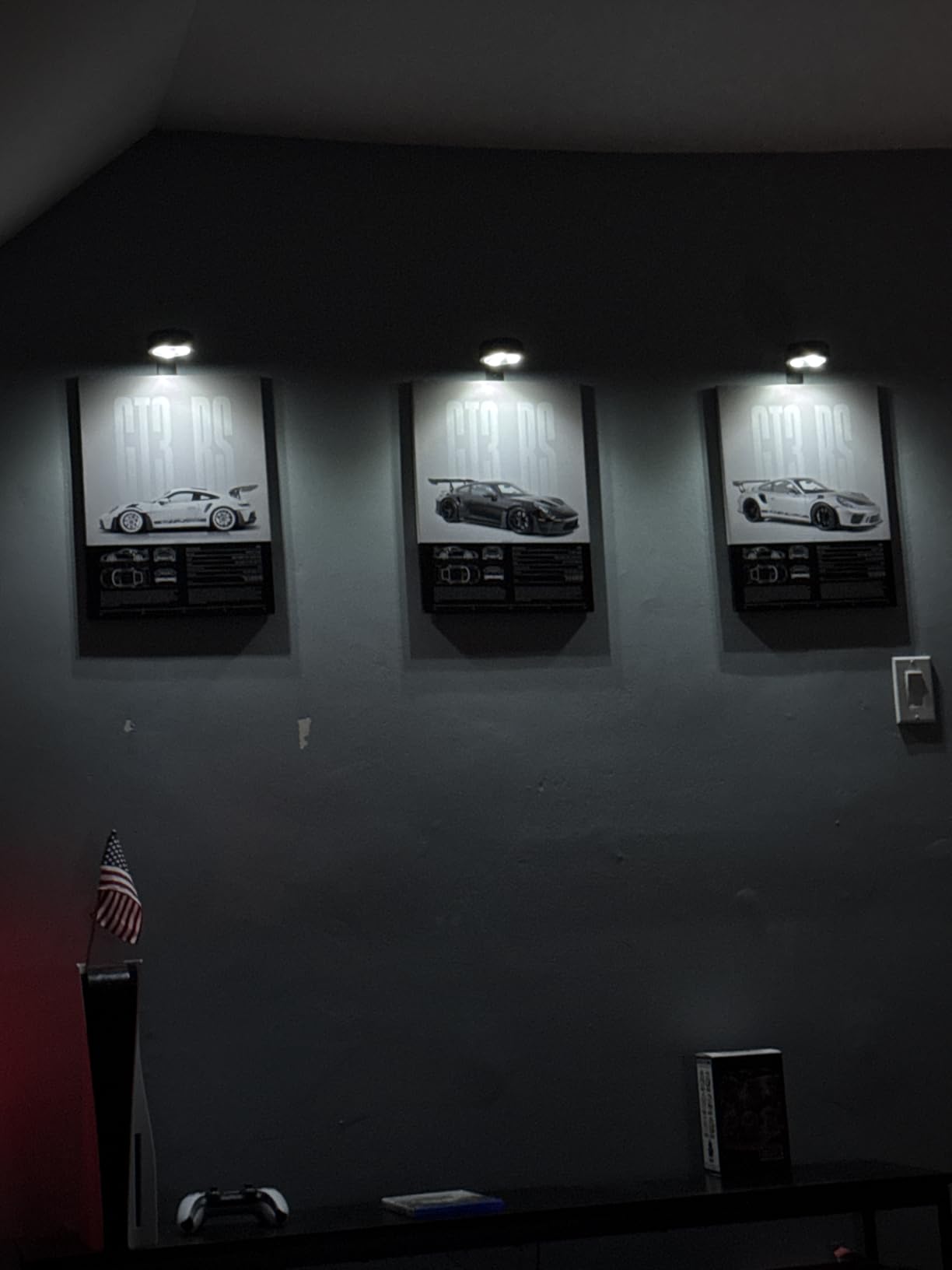
Three lights means a gallery wall is finally possible without a single cable. Spacing them evenly above three frames gives you the even wash that one centered fixture cannot, and because they are all remote-controlled you can dim or switch the whole set with one press.
This is also the strongest choice for a child’s room or a rental. Adhesive and bracket mounting means no holes, and a light you can move to a bookshelf, a mirror or a display cabinet when the art changes keeps one purchase useful for years.
What to know before you buy
Output is the honest drawback at 80 lumens per light. That is bright enough to lift a 4×6 or 8×12 frame off the wall, but it will not carry a large canvas, and reviewers regularly note that the light fades toward the edges of bigger pieces.
The round housing is about 3 inches across, so it reads as a puck rather than a slim bar. That looks intentional on a shelf or in a display case and less so above a substantial frame. If you are lighting large artwork, look at the 16-inch options further down instead.
4. Xuolder Battery Operated 3-Pack: Best Picture Light for Renters
Xuolder Battery Operated Picture Lights Magnetic Paining Light with Remote
300 lumens
3 AA batteries per light
3-pack with magnetic brackets
Small puck, 4.89 inch wide
Pros
- No charging cable to keep track of
- just standard AA batteries
- Three lighting modes set by remote or touch
- Dimmable with timer up to 120 minutes
- Tool-free magnetic bracket mounting
Cons
- AA batteries are not included and need periodic replacement
- Compact format is meant for frames up to about 10x14 inches
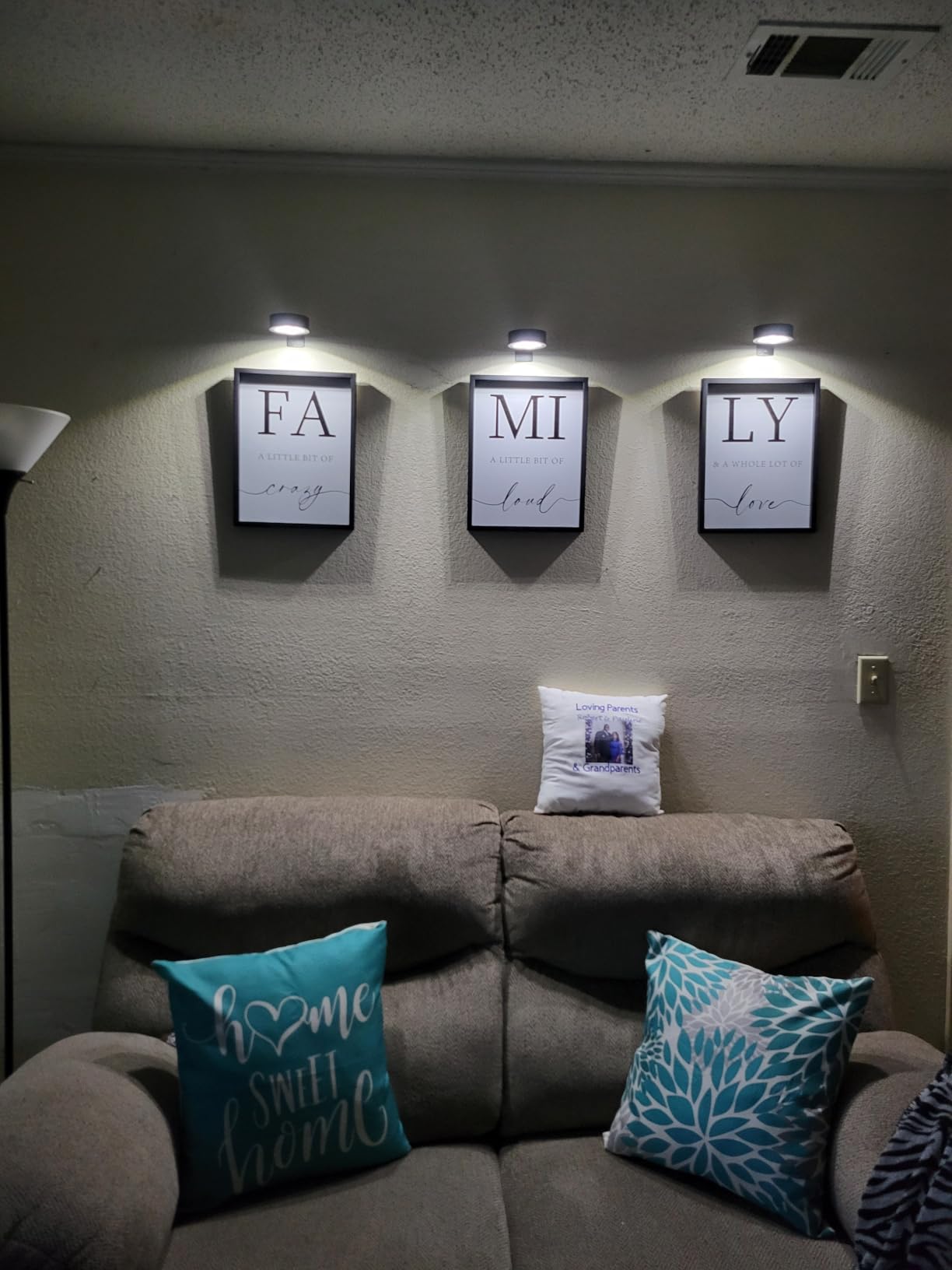
The Xuolder pack exists for one specific situation: you want light over your art and you want nothing to plug in, charge or mount permanently. Each light takes three standard AA batteries, which means there is no recharge cycle at all and no cable to hide.
That has a hidden advantage over rechargeable units. When the batteries get low you swap in a fresh set in under a minute, whereas a cordless fixture has to come off the wall and sit unplugged for a couple of hours. For someone who wants their light available on demand, disposable cells are more reliable than a battery that might be flat.
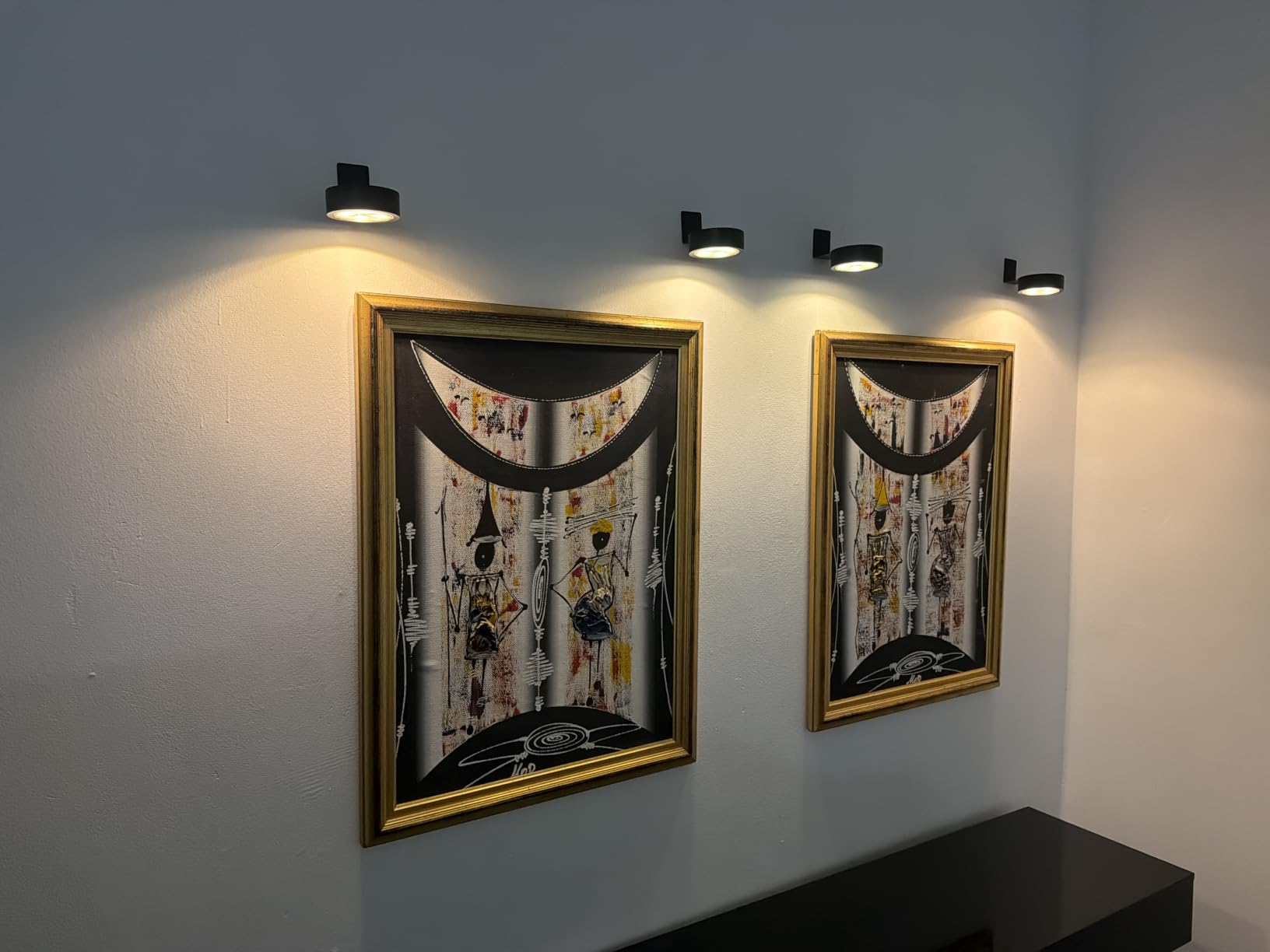
The bracket mounts with an adhesive-backed iron sheet, so it holds the puck off the wall at a slight angle and comes off cleanly when you move. Three lights run off one remote, and each also has touch control on the puck itself. Three lighting modes and a dimmer cover the range most people actually need.
The timer reaches 120 minutes, longer than any other timer among these ten fixtures, so you can set it to shut itself off after two hours and walk away.
Why this still earns a spot
For small frames, small shelves and bookcases, this is genuinely the most sensible pick. Covering three 8×10 frames in a hallway or a reading nook costs less than a single premium fixture, and the pucks tuck into tight spots where a bar would not fit.
It also sidesteps the recurring complaint about blue light in cheap cordless fixtures. Three selectable modes let you sit at the warm end permanently rather than accepting whatever the factory shipped.
Where it falls down
Batteries are not included, and that line in the box matters. Budget for nine cells for the pack, and expect to replace them on a cycle depending on how often you use the lights. Over a year that recurring cost is not nothing.
The other limitation is size. Each puck is under 5 inches across and covers frames up to roughly 10×14 inches. Above anything larger the light simply cannot span the work, and this is the one category of feedback that appears consistently across the reviews.
5. Craftersmark 16-Inch Dimmable Cordless Light Bar: Best for Wide Canvases
Craftersmark Dimmable Cordless Picture Light for Wall 16in, 5000mAh Rechargeable Battery Wall Sconce Art Light, CRI 95+ 350LM Wall Light for Gallery Artwork, Paintings, Photo,Portraits – Black
16 inch bar at 350 lumens
CRI 95+
Timer at 2, 4, 6 or 8 hours
Surface mounted, black finish
Pros
- 16 inch bar covers paintings up to about 40 inches wide
- CRI 95+ for accurate color
- Three color temperatures and three brightness levels at 40/70/100 percent
- Longest timer options we found at up to 8 hours
- One remote controls multiple fixtures at once
- Four finish options including gold copper and white
Cons
- Light bar is painted plastic with a metal hook and backplate
- Battery drains faster at higher brightness settings
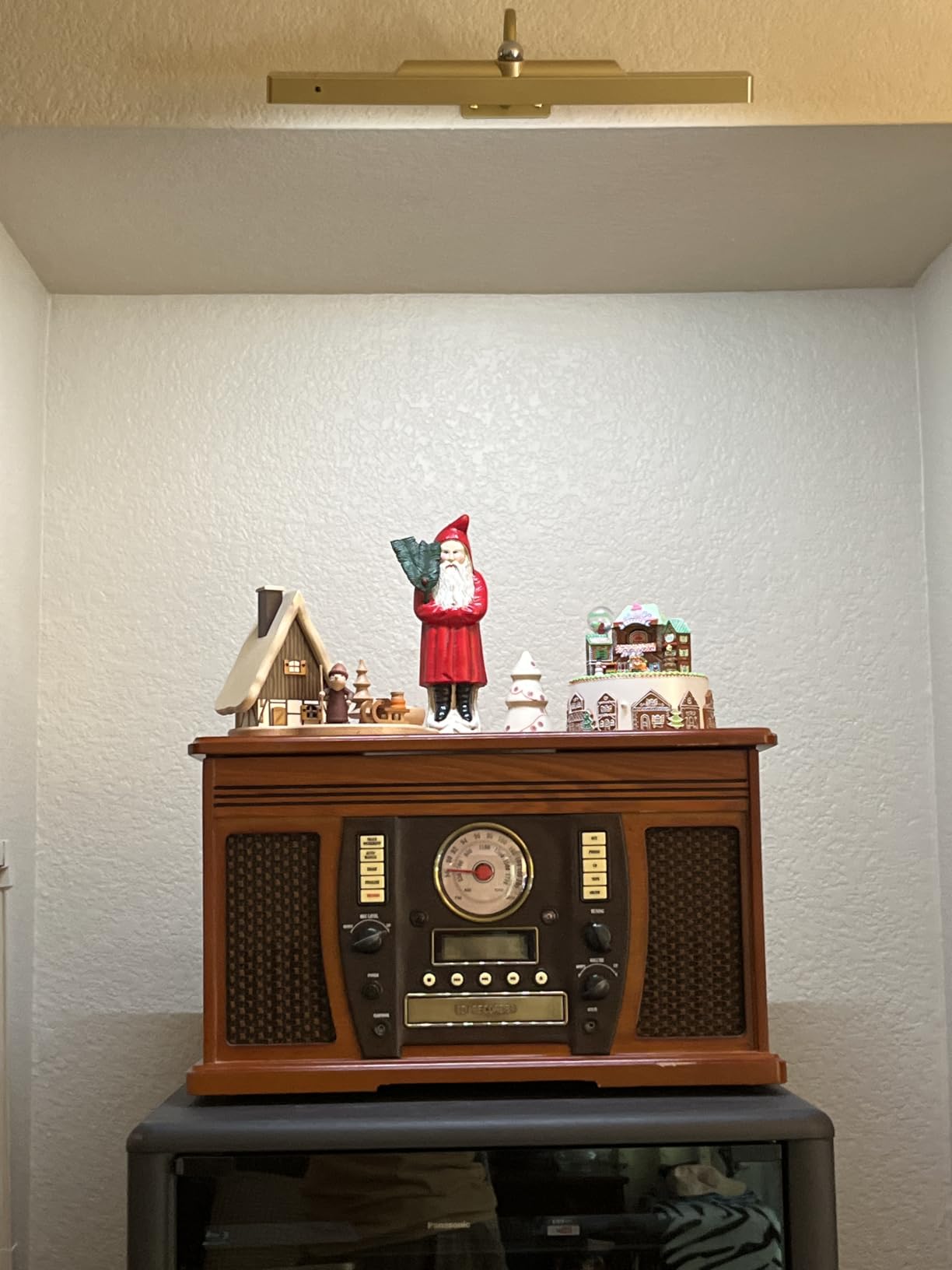
Width is the reason this one is on the list. At 16 inches with 350 lumens it covers paintings up to about 40 inches wide, which puts it among the smaller fixtures here that can properly span a large canvas rather than spot-lighting the center of it.
It also carries the longest timer options among these ten fixtures, with 2, 4, 6 and 8 hour settings from the remote. If you want accent lighting that switches itself off hours later, that is a convenience the shorter timers cannot match.
Color specification is the other strength. A published CRI of 95 plus three selectable color temperatures gives you both accurate rendering and the choice to match the room.
One number helps when comparing output across this group: lumens per watt. This fixture publishes 116.67 lumens per watt at 3 watts, which is why it delivers 350 lumens from a smaller and less expensive cell than most of its size class. Picture lights are deliberately dim by room-lighting standards, since the point is accent light rather than illumination.
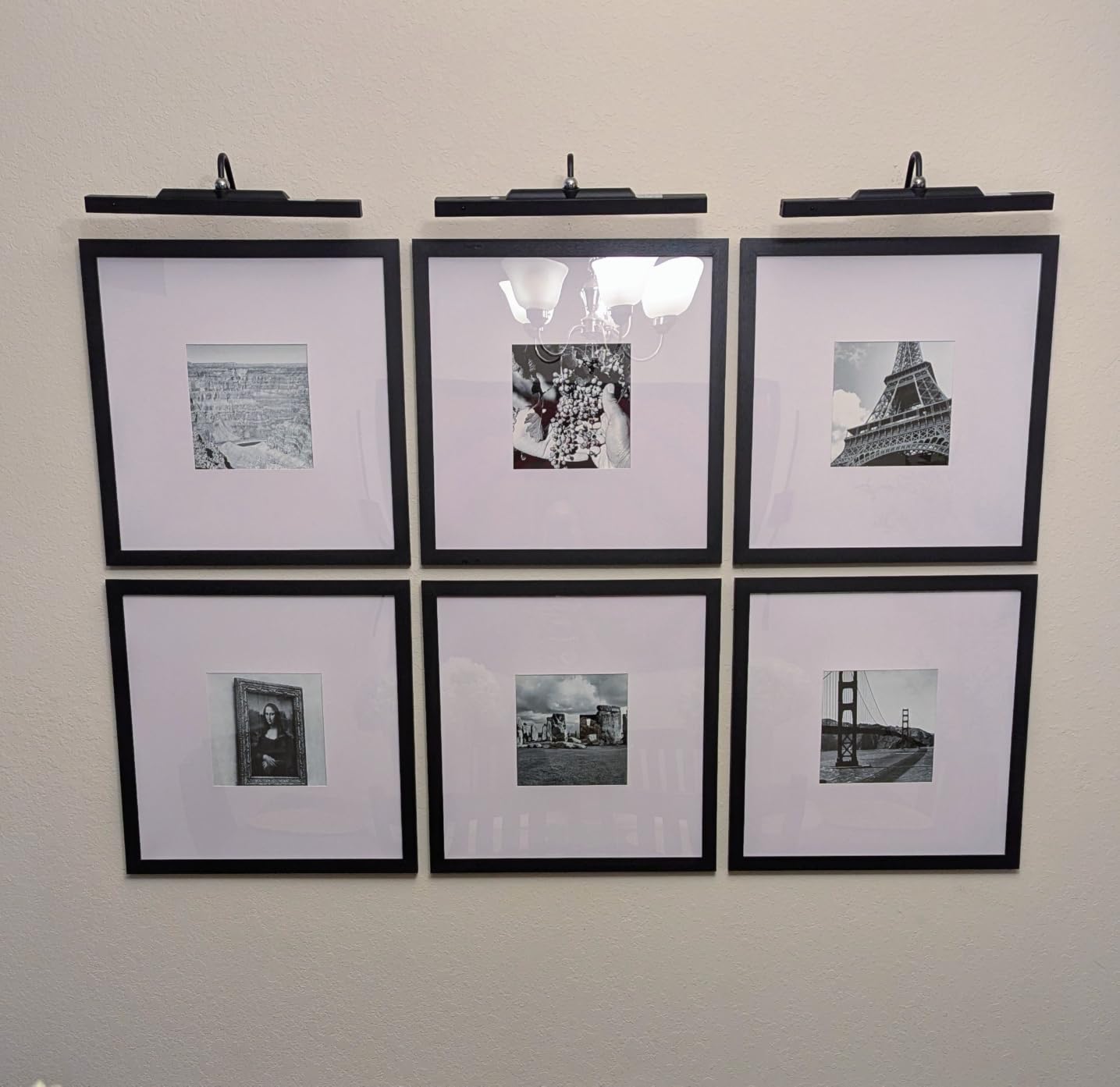
Because the remote can drive several fixtures at once, two of these over a pair of large canvases behaves like a single lighting system. The bar lifts off magnetically for USB-C charging, so you are not uninstalling anything to plug it in.
What this fixture is genuinely good at
Large horizontal work, two pieces side by side, and a wall where you want the light to feel deliberate. At 16 inches and 350 lumens it is the closest cordless option here to the coverage you would get from a plug-in fixture, without needing an outlet anywhere near the art.
Reviewers frequently describe it as looking more expensive than the price suggests, which is a reasonable read for a black bar with a slim profile. If you want metal but are sensitive about buying a unit that shows its plastic at close range, see the Yuichoy pair below instead.
What to be honest about
The bar itself is painted plastic with a metal hook and backplate. From across a room that reads fine, but buyers who expected solid metal based on the product photography mention the discrepancy more than any other con on this model.
Battery drain is also brightness-dependent, and at the higher settings the charge goes faster. If you plan to run it at full output every evening, expect to top it up more often than the spec sheet suggests.
6. Tassuowell 12-Inch Brass Rechargeable Picture Light
Tassuowell Rechargeable Picture Light with Remote Control,12 Inch Brass Finish Adjustable Wireless Art Lighting Fixture,Painting Lights with Timer,3 Color Temperature and Dimmable
12 inch brass fixture
500 lumens at 2700K
5000mAh, 7 to 30 hours
180 degree swing arm
Pros
- Full metal construction with an acrylic shade in an elegant brass finish
- 5000mAh battery charging in 4 hours with 7 hours at top brightness up to 30 hours at the lowest
- 180 degree swing arm and 270 degree rotatable lamp tube for accurate aiming
- Remote adjusts brightness from 10 to 100 percent across three color temperatures
- Two-year after-sales service from the manufacturer
Cons
- Real-world charge holds about 6 to 8 hours at typical settings and needs daily charging
- Recharging at height means taking the fixture down and reaching an outlet
If your decor leans traditional, the Tassuowell is the fixture that will not look out of place. It is a full metal body with an acrylic shade in a brass plating finish, and designers and buyers alike describe it as looking higher end than the price implies. At 12 inches it covers a mid-size frame well.
The output figure is generous for a cordless light at 500 lumens, and the color temperature is a warm 2700K, which is the closest match to traditional halogen picture lighting anywhere in this roundup. That warmth is what keeps oil paintings and sepia photography from going cold.
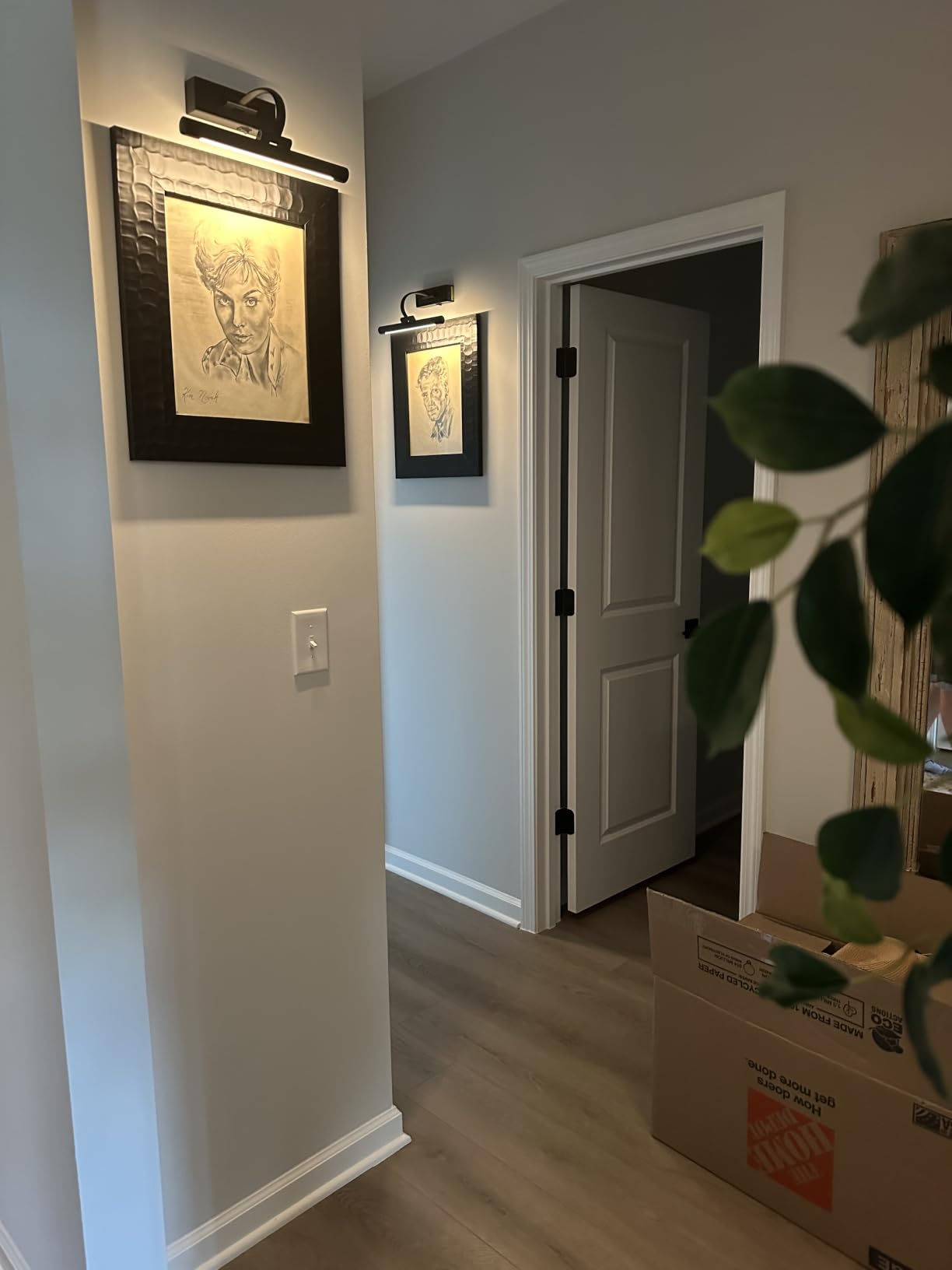
Adjustment is where this one earns its keep. The arm swings 180 degrees and the lamp tube rotates 270 degrees, so you can angle the beam over a frame that sits proud of the wall or dial it back to kill glare on glass. Very few of the cordless fixtures here give you that much freedom of aim.
The remote handles brightness from 10 to 100 percent, three color temperatures and a timer, with memory so the last setting returns after a power cycle.
The case for a brass fixture
Finish is not a small detail in this category. A light that clashes with the room’s hardware reads as an afterthought no matter how well it performs, and a brass fixture with a metal shade disappears into traditional interiors the way white plastic never will.
This is also one of the few cordless options with a two-year service commitment from the manufacturer, which matters more than usual for a fixture with a sealed internal battery.
The honest drawback
Runtime is the weak point, and the reviews are blunt about it. The claim is 7 hours at top brightness rising to 30 at the lowest, but most buyers report closer to 6 to 8 hours at typical settings and describe it as needing a daily charge.
That matters more here than with the other rechargeable units, because this fixture is not magnetic. To charge it you take the whole unit down, which at picture-light height usually means a step ladder and an extension lead. Plan the charging spot before you mount it.
7. Yuichoy 2-Pack of 16-Inch Metal Gallery Lights: Best for Two-Piece Walls
Yuichoy 2 Pack Picture Lights for Wall Battery Operated, 16 inch Wireless Art Lighting for Painting, 6 Colors Picture Frame Lights with Remote, Dimmable 5200mAh Gallery Light, Black
Two 16 inch metal lights
300 lumens each
5200mAh, 10 to 36 hours
Six tones, 2700K to 6500K
Pros
- Two all-metal 16 inch lights cover frames from 35 to 70 inches wide
- 5200mAh battery gives 10 to 36 hours depending on brightness
- Six color tones from 2700K to 6500K with dimming from 20 to 100 percent
- 270 degree rotating head and 180 degree rotating pole for precise aim
- Drilling template and two screws per light included
- Runs at only 3 watts and produces very little heat
Cons
- Coverage is fixed by the stated frame width ranges
- Back piece slides off for charging so the fixture must be reachable
- Only a one-year manufacturer warranty
The Yuichoy pair is the most complete answer to the two-frame gallery wall question in this roundup. Two 16-inch all-metal lights cover frames from about 35 to 70 inches wide, which is the span most people mean when they say they have a gallery wall. One light covers 16 to 32 inches.
Metal matters on this one. Several buyers bought it specifically to avoid painted plastic, and the finish is described as genuinely metallic rather than a coating over something else. At 3 watts with a 5200mAh battery, it also produces very little heat, which matters if you own paper or textile work.
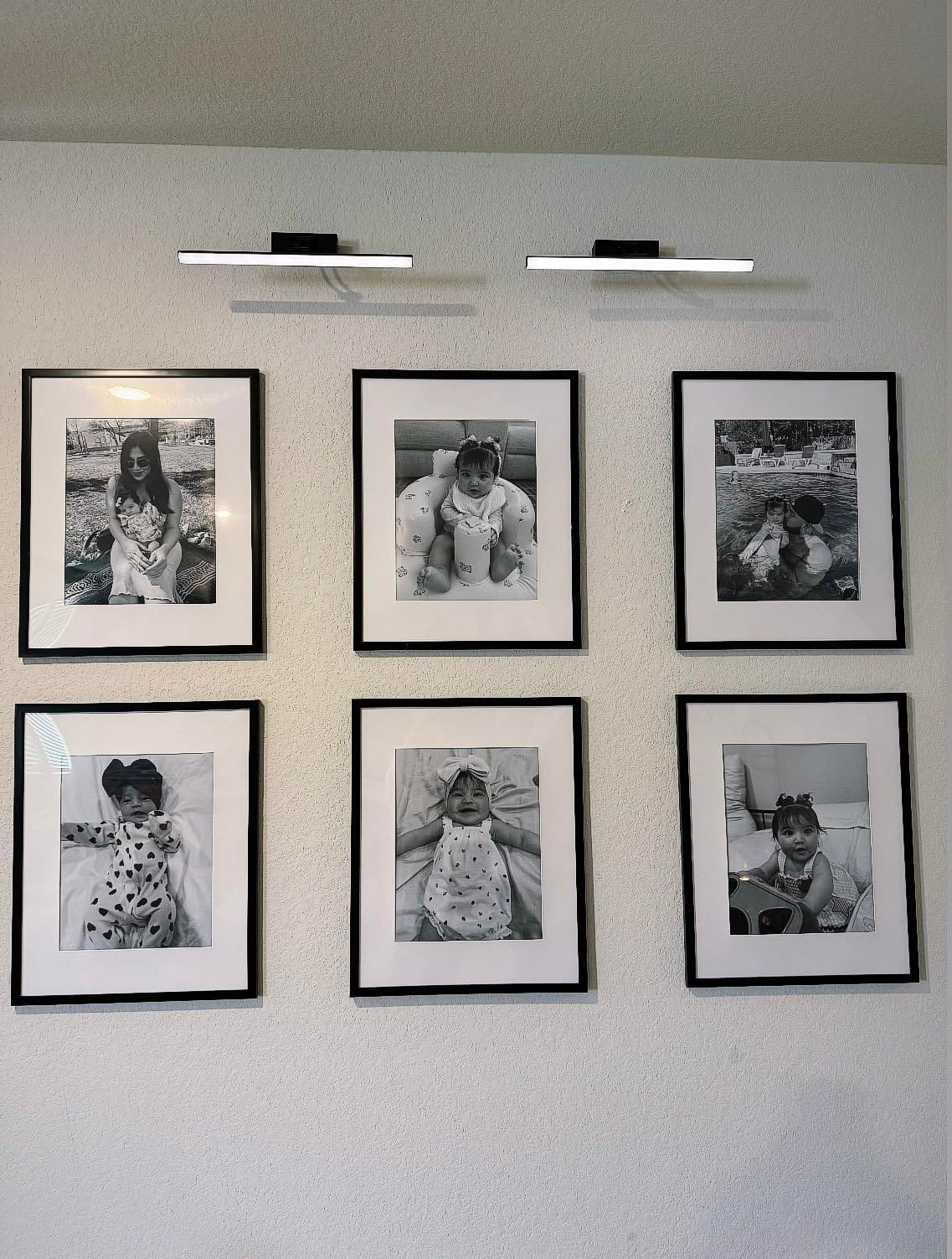
The widest published color range in the roundup is here too. Six tones from 2700K up to 6500K plus dimming from 20 to 100 percent give you fine control, and both an inline switch and a remote work, so you are not dependent on line of sight for basic on/off.
Installation is the most thought-through of the cordless options. A drilling template is included with two screws per light, and a 40-inch USB cable is in the box, which reduces the odds of a light that is mounted higher than the nearest convenient outlet.
Why two lights beat one
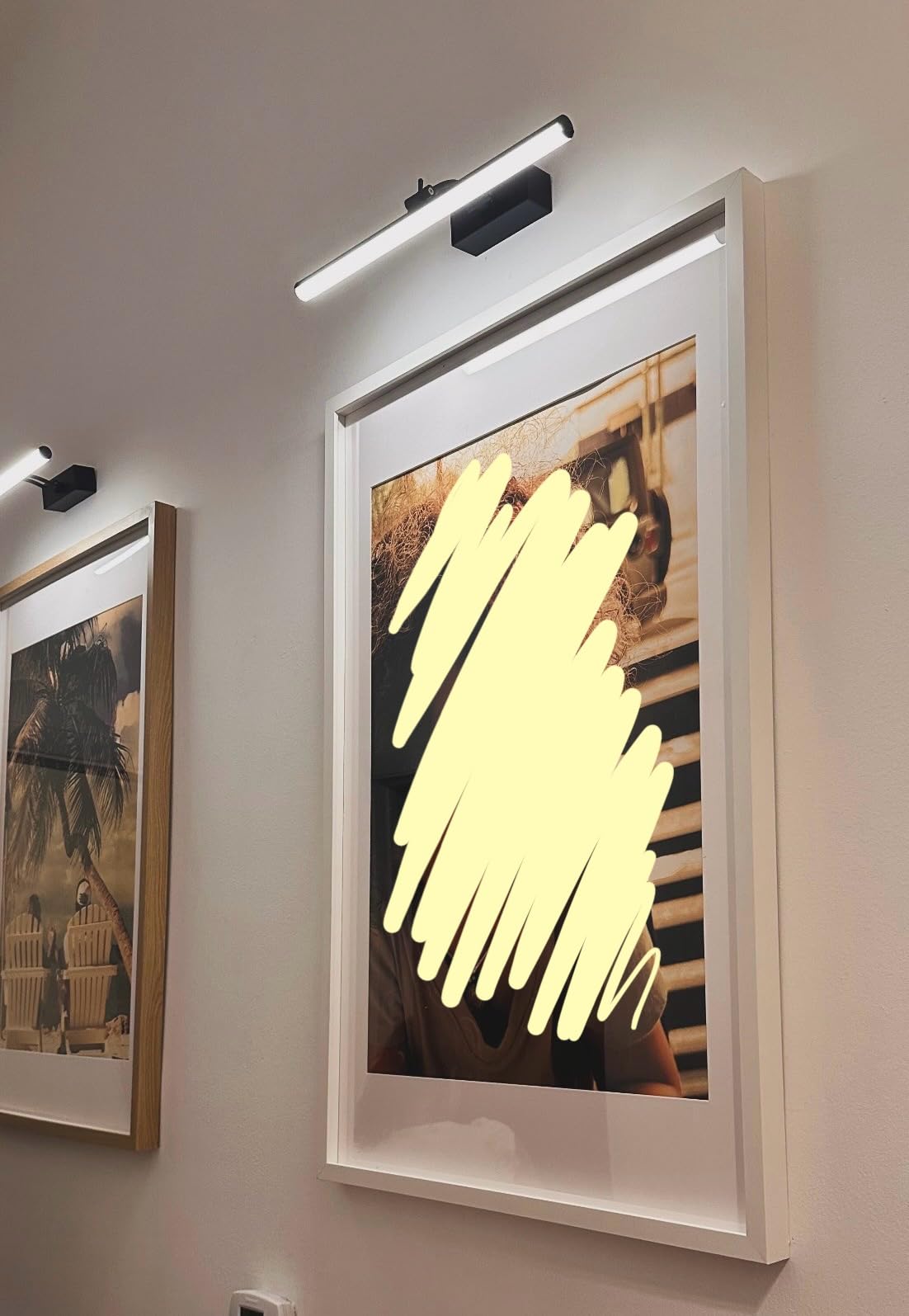
A single fixture centered over two frames creates a bright band across the middle and dark corners at the outside edges. That contrast is what makes artwork look badly lit even when the light is bright enough. Spacing two fixtures to match the frames solves it, and this pair is sized for exactly that job.
It also works as a pair of shelf lights or as two reading lights flanking a bed. Buyers use them over dartboards, mirrors and photo displays in the same way.
What to plan around
Charging requires the back piece to slide off, so the fixture has to be reachable. Mounting it above a tall bookcase or in a vaulted entry means finding somewhere sensible to plug it in, and that is worth checking before you drill.
The one-year warranty is the shortest in the group, which is worth considering against the 5000mAh-plus batteries in the FULEN and LYTARA units. Treat the pair as a medium-term purchase rather than a fixture you expect to hand down.
8. Westinghouse 7-Inch Antique Brass Plug-In Light: Best Vintage Warm Glow
Westinghouse 7505200 Picture Light, 7-Inch, Antique Brass
7 inch brass body
1100 lumens, 15 watt E12 bulb
Plug-in with rocker switch
5 year warranty
Pros
- Plug-in installation with swivel adjustment and no rewiring
- Replaceable 15 watt E12 candelabra bulb included with an in-line rocker switch
- Warm incandescent tone that suits traditional and antique decor
- UL listed brass body with a frosted shade
- Five-year limited manufacturer warranty
Cons
- Only about 10 degrees of vertical tilt so the shade cannot be aimed far downward
- The included incandescent bulb runs hot and some buyers fit a lower wattage
- Best suited to small artwork of roughly 2 by 3 feet
- Bracket does not clamp reliably on every frame style
There is a reason incandescent picture lights have stayed on shelves for decades, and the Westinghouse 7-inch is the cleanest example. The bulb is a standard 15 watt E12 candelabra lamp you can replace at any hardware store, and the warm glow it throws is closer to traditional halogen than any of the LED fixtures in this roundup.
Installation is about as simple as it gets. It plugs into a wall outlet, the switch is in line on the cord, and the swivel bracket mounts over the top of the frame. No charging, no batteries, no adapter to keep track of. It works the moment it is plugged in.
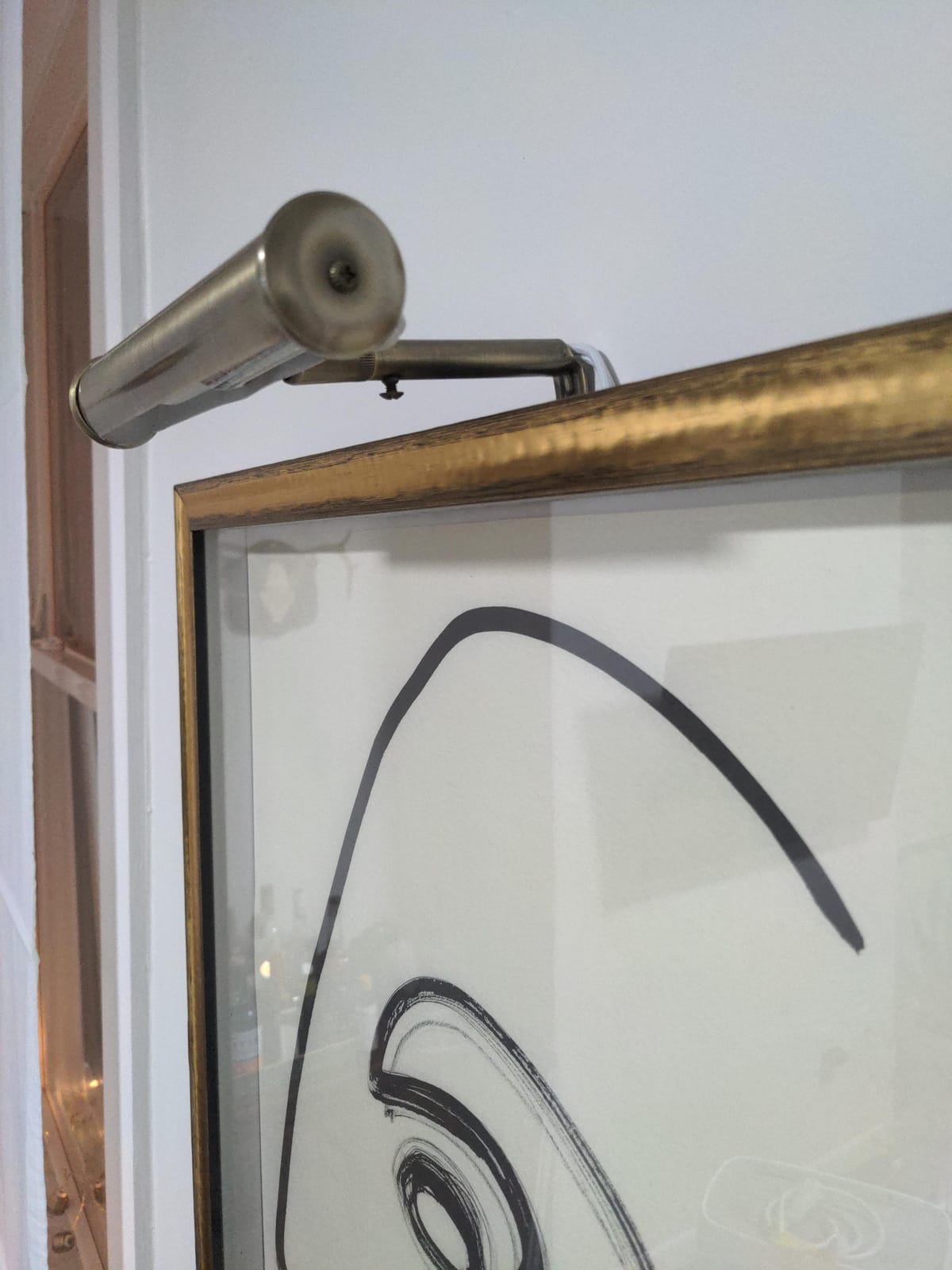
The brass body with a frosted shade gives it a traditional look that LED fixtures struggle to match, and the 1100 lumen figure is the highest published output of any fixture listed here. That matters in a dark hallway or a room with low ambient light.
It also carries a five-year limited manufacturer warranty, which is the longest published warranty among these ten fixtures, and the UL listing is a genuine plus for anyone who is wiring into a finished room.
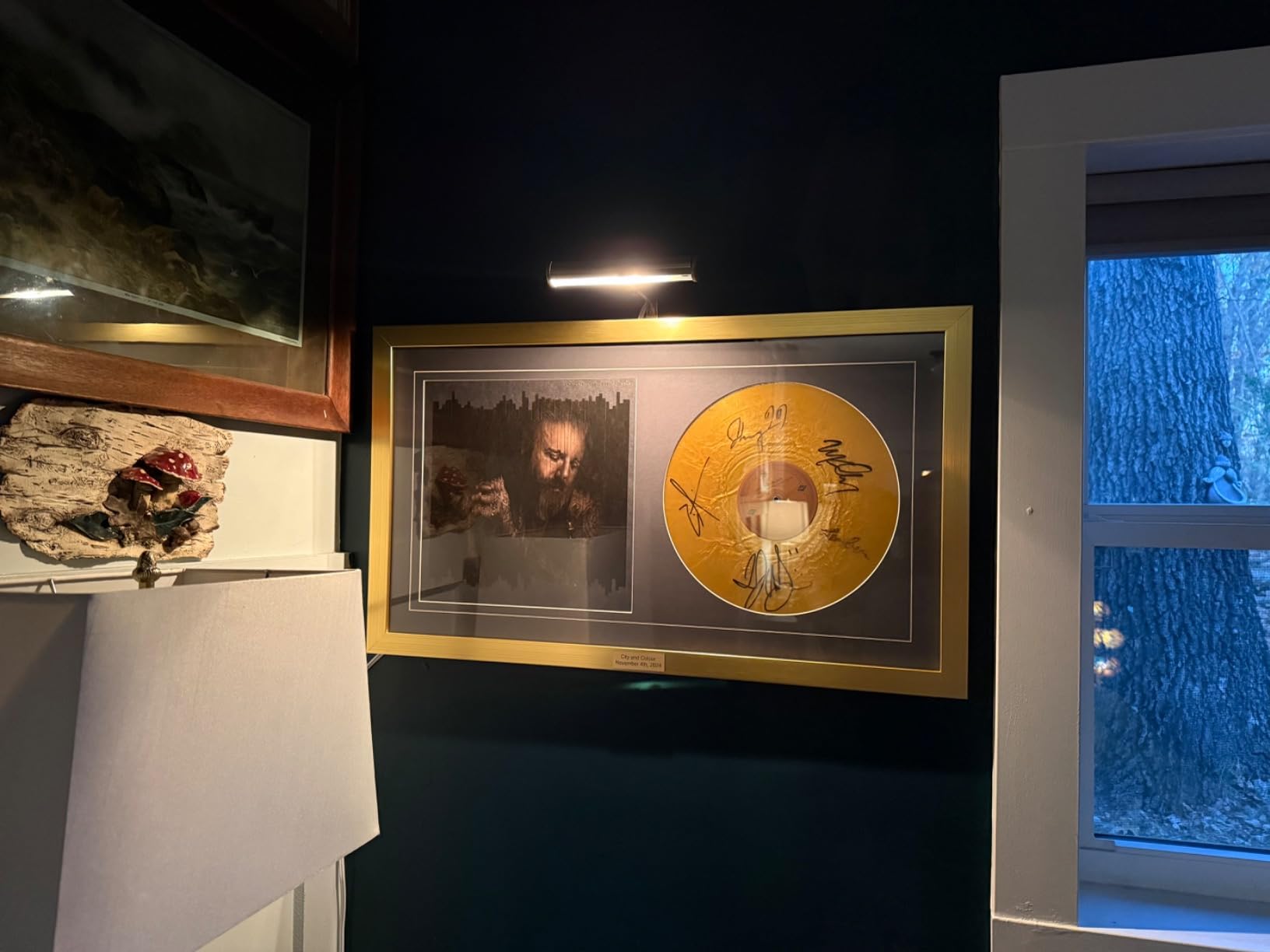
What the incandescent approach still does well
Color rendering is the honest advantage. Incandescent light is a continuous spectrum, so reds, golds and skin tones in a traditional painting look richer than they do under a cheap LED. For an antique oil or a warm-toned print, that difference is visible from across the room.
Replaceability is the other one. When the bulb eventually fails you swap a standard lamp in a minute, forever, rather than sending a fixture with a sealed battery to a manufacturer. Owners with long-term installs value that.
Why we did not put it first
The tilt range is about 10 degrees, which is the real problem. Nearly every installation guide says to aim the fixture 30 to 35 degrees downward, and this one physically cannot get there. On a tall frame the light spills onto the wall above rather than washing the artwork.
The included bulb also runs hot, and several buyers fitted a lower wattage lamp instead. Add the small 7-inch size, which suits artwork only up to about 2 by 3 feet, and it becomes a period-appropriate accent rather than a workhorse.
9. LEONLITE Dimmable CRI90 Light That Works Plug-In or Hardwired
LEONLITE 3CCT Dimmable LED Picture Light, CRI90, Adjustable, Antique Brass
15.75 inch full metal
600 lumens at CRI 90
2700K, 3000K or 4000K
Cord and hardwire kit included
Pros
- 15.75 inch full metal fixture with three selectable color temperatures
- CRI 90 with even light distribution and smooth dimming at 600 lumens
- 270 degree swivel head with a 120 degree beam angle for wide coverage
- Installs as plug-in or hardwired with both cord and wiring in the box
- Low heat emission and a UL listed plug in the box
Cons
- Needs a nearby outlet or electrical work for hardwiring
- Color temperature cannot be switched while the light is off
- Heaviest published weight among these picks at 1.7 pounds
This is the answer for a homeowner who has an outlet today and might redecorate in two years. The LEONLITE ships with both a power cord and a hardwiring kit in the box, so you can plug it in now, enjoy it, and hardwire it later without buying a second fixture.
It is a 15.75-inch full metal body, which makes it a genuinely different object from the cordless bars above. The 1.7-pound weight is what you would expect from solid metal rather than a plastic shell with a metal backplate.
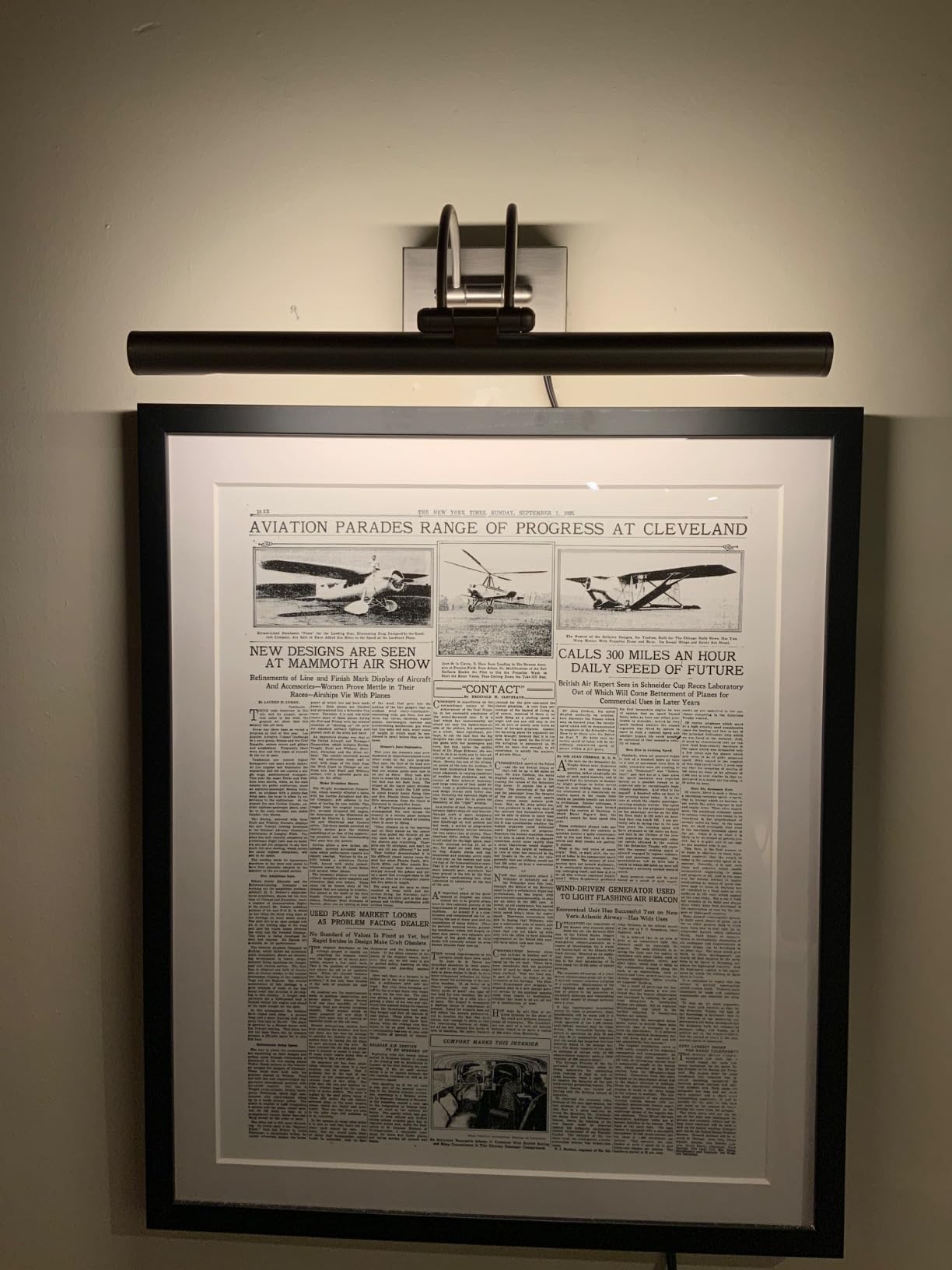
Light quality is specified properly here, which is rare. CRI 90 means colors render accurately, and the three selectable color temperatures cover 2700K, 3000K and 4000K from a single fixture. You can match a warm living room or a cooler hallway without changing bulbs.
The 270-degree swivel head has a 120-degree beam angle, the only wide-beam figure published in this roundup. A wide beam with even distribution is what stops a mid-size painting from having a bright center and dim corners, and that is the single biggest difference between this and the cordless bars.
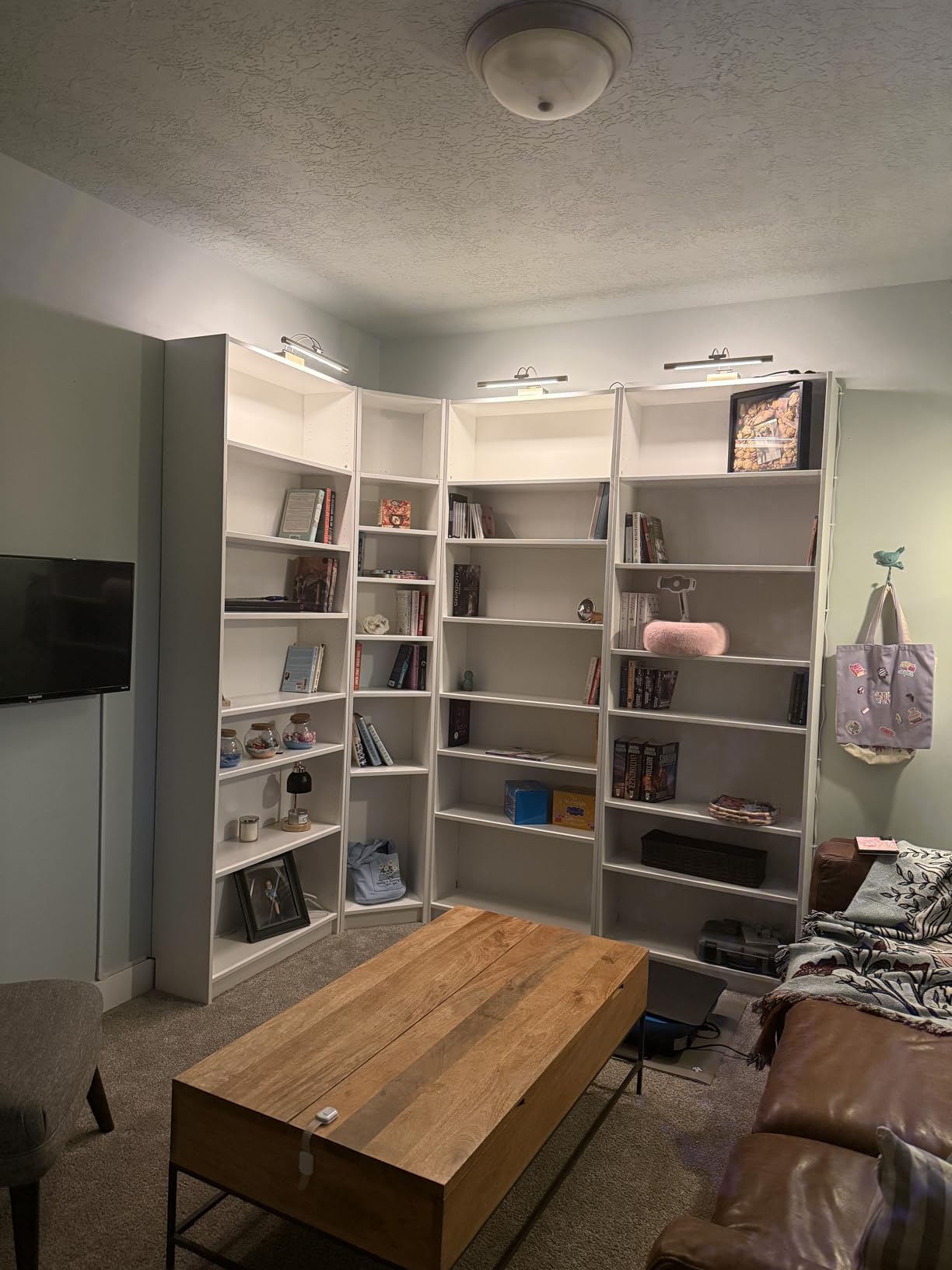
When hardwiring is worth it
Hardwiring removes the cord entirely, which is the only way to get a genuinely clean installation. It is the right call if you are redecorating anyway, if the art wall is in a spot where a visible cord would bother you daily, or if you want to put the fixture on a wall switch or a smart-home hub.
Be clear-eyed about what that involves. If there is no electrical box in the wall where the light goes, someone has to open the wall, and that is an electrician’s job. The fixture itself is a small part of the cost. A renter cannot do this at all.
What is imperfect about it
The color temperature toggle only works while the light is on. In practice that means the setting you choose in the evening is the setting you get in the morning, which is annoying in a bedroom or a hallway you use briefly.
At 1.7 pounds it is also the heaviest fixture whose weight is published in this roundup, so the bracket needs solid studs or appropriate anchors rather than a hollow-wall plug. Plan the screw locations before you drill.
10. Coinmit 24-Inch Telescoping Plug-In Light with Remote: Best for Wide Walls
Coinmit 24″ Plug in Picture Light 9W Gold Art Light with Remote
24 inch telescoping bar, 9 watt LED
Gold metal finish
6.6 foot cord with switch
Remote dimming
Pros
- 24 inch telescoping bar with a 3 year warranty
- Rotates 90 degrees vertically and 360 degrees horizontally for flexible aiming
- Controls on the cord and by remote for on off color temperature brightness and a 1/2/4 hour timer
- Stepless brightness adjustment by holding the remote buttons
- Plug-in power means no charging downtime and a 3 year warranty
Cons
- Remote needs two AAA batteries which are not included
- Cord has to reach a nearby outlet so placement is less flexible than cordless models
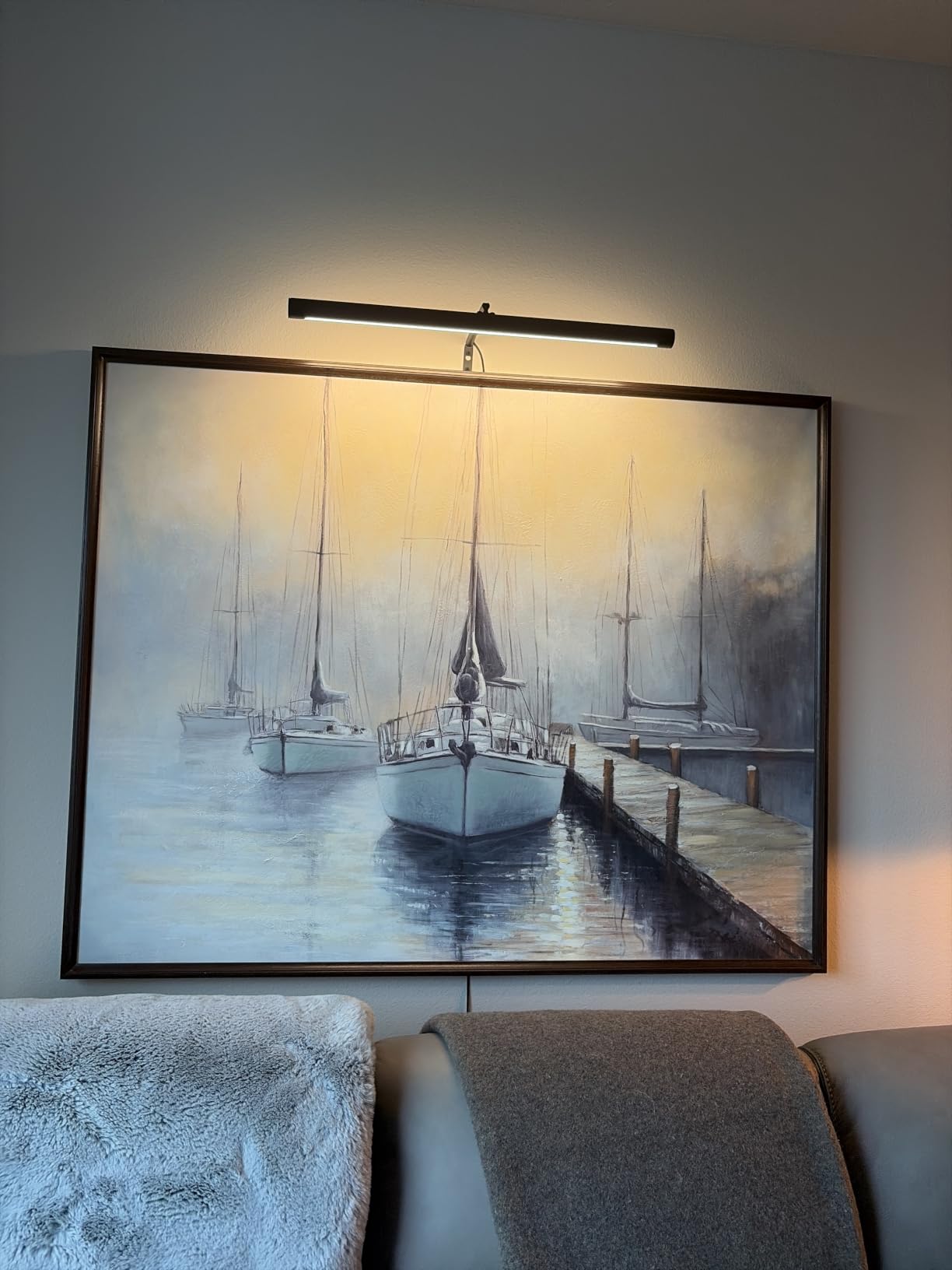
When one fixture has to carry a very wide wall, span is the only answer. The Coinmit bar is 24 inches as supplied with a telescoping section that extends further, so it can cover a large horizontal canvas or a row of smaller frames without the hot spot you get from a narrow light. No other fixture here reaches that span.
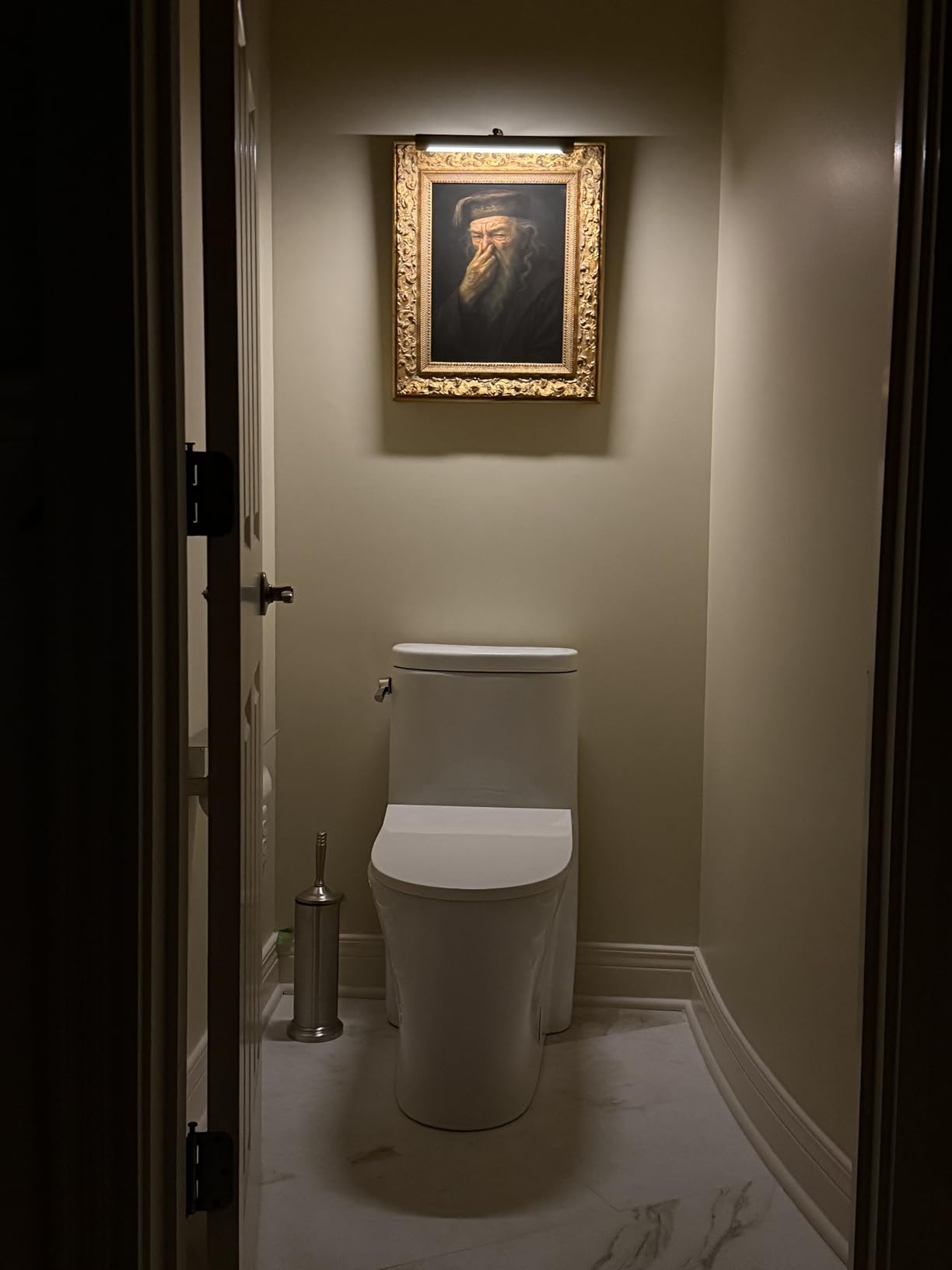
Aim is unusually flexible. The head rotates 90 degrees up and down and a full 360 degrees horizontally, so you can angle the beam to wash a tall wall or pull it forward over glass without a fight. The 9 watt LED is the highest LED wattage in the roundup, which is what makes the reach possible. Stepless dimming works in both directions by holding the plus and minus buttons on the remote, so you can match the light to a room that already has dimmable lighting.
Controls are duplicated on the cord and the remote. The inline switch gives you on, off, color temperature, brightness and 1, 2 and 4 hour auto-off, so you do not need the remote for daily use. The 6.6-foot cord is generous enough to run behind a wide frame.
Where a 24-inch bar wins
Long horizontal pieces, a pair of frames on a wide wall, and hallways where you want one fixture rather than a pair. At this span the light distribution is even enough that the frame edges and the center read at similar brightness, which is the whole point of buying something this long.
Plug-in power also means the fixture never goes dark because of a battery. If you want accent lighting on a schedule, a timer plus a wall outlet is steadier than a rechargeable pack you have to remember to top up.
What to plan around
The cord has to reach an outlet. That is obvious with a plug-in light and it is the reason most people end up choosing cordless, but it is worth measuring before you buy, especially on a long wall.
The remote takes two AAA batteries that are not included, which is a minor irritation given the fixture’s three-year warranty. Cord management is the other job: a cord cover painted to match the wall, or running the cable behind the frame, keeps it from being the first thing a visitor notices.
Battery vs Plug-In vs Hardwired: Which Power Source Fits Your Wall?
If you take one decision from this roundup, make it this one. The power source determines your light output, your cord situation, your flexibility and your true cost more than the finish ever will.
Battery and rechargeable units. Nothing to plug in, nothing to wire, nothing to hide. The trade is runtime. Buyers consistently report 8 to 12 hours of real use from rechargeable packs, which is well short of a week, and rechargeable options are widely distrusted for exactly that reason. If your art wall is in a bedroom, a hallway or a rental with no outlet nearby, this is still the right answer.
Plug-in fixtures. More output, no charging, and a bulb or LED that never goes flat. The cost is a cord, and the cord has to be planned for. A clip-in cord cover painted to match the wall, or routing the cable behind the frame, handles it in most rooms.
Hardwired fixtures. The cleanest look and the only version that works with a wall switch or a smart-home hub. It also requires an electrical box in the wall where the light goes. If there is not one, someone opens the wall, and the electrician is the largest single cost in this entire category by a wide margin. The fixture is a small fraction of what a hardwired install actually involves.
The renter decision is simple. If you cannot drill or cannot alter wiring, your real choices are the adhesive-mounted cordless units above: the FULEN pair, the EZVALO pack and the Xuolder pack all mount without a hole and lift off the wall cleanly when you leave.
What battery runtime actually looks like
Advertised figures and daily reality are different numbers. Capacity in mAh sets the ceiling, brightness and color temperature set the drain, and most buyers describe a full evening rather than multiple days. The 8 to 12 hour figure that comes up repeatedly in forum discussions is realistic for a mid-brightness setting.
Three things extend runtime more than any spec upgrade. Use the timer so the light switches itself off, run it at a lower brightness step, and use fewer fixtures at higher brightness instead of more fixtures at low brightness. A timer is the feature we would not give up, and most of the cordless picks here include one.
How to Choose the Right Picture Light
Six considerations decide whether a picture light works for your wall. Work through them in order and the model choice takes care of itself.
1. Power source. Decided in the section above, but decide it first, because it eliminates half the options before you look at anything else. No outlet nearby means cordless. Outlet nearby means plug-in. Rewiring budget means hardwired.
2. Size relative to the artwork. A fixture should be roughly half to two-thirds the width of the piece below it. A quick lookup: a 24 inch artwork takes a 12 to 16 inch light, a 36 inch canvas takes an 18 to 24 inch bar, and a 48 inch work needs 24 inches or more. Going wider than two-thirds of the art starts to look like a shelf light rather than a picture light.
3. Color temperature. For artwork, 2700K to 3000K is the range that flatters almost everything. Lower numbers are warmer and more forgiving on skin tones, oil paint and wood; higher numbers read clinical and can make a painting look like a product photo. For color-true rendering, look for a published CRI figure of 90 or above, because anything at or below 70 makes artwork look wrong in ways people describe as dull or dingy without being able to say why.
4. Beam angle and glare. A narrow beam spotlights the middle of a frame and leaves the edges dark. A wide beam, around 120 degrees, spreads more evenly. Baffled or frosted shades soften the hot spot, which matters most over glossy glass where reflection is a real problem.
5. Material and finish. Metal bodies read as real hardware at any distance; painted plastic does not, and buyers mention the gap more than any other build complaint in this category. Match the finish to what is already in the room, and be careful with brushed metals that can look cheap if the plating is thin.
6. Controls. A remote matters most for lights mounted high or over a large canvas where a switch is out of reach. A timer matters more than almost anything else for anyone who does not want to remember to turn it off.
If you are still choosing the art itself, our wall art picks guide covers sizing and style by room, and our metal wall art roundup is worth a look if you want something that reads as an industrial piece under a warm brass light.
Installation: Mounting Height, Tilt Angle and the Painter’s Tape Test
Mount the fixture 2 to 6 inches above the top of the frame and tilt it 30 to 35 degrees downward. Those two numbers are the difference between a light that flatters artwork and one that creates a bright stripe on the wall above it.
The tilt is the part people get wrong. At shallow angles the beam travels past the artwork and hits the ceiling or the wall behind, which reads as a glow with no picture underneath it. At steep angles the top of the frame is hot and the bottom falls into shadow. Somewhere near 30 degrees balances the two.
Before you drill anything, tape a full-size paper template of the fixture to the wall and look at it in the evening light. One interior-decorating poster we came across used an AI mockup for the same purpose. Paper tape costs almost nothing and it catches placement mistakes that a drilled hole does not.
Uplight or downlight for a gallery wall?
Downlight is the right default for most walls. It washes the artwork, keeps the beam hidden inside the shade, and reads as deliberate. Uplight bounces off the ceiling, which is flattering to texture but throws a bright patch above the frames and creates glare for anyone standing in front of the wall.
Use uplight only on a dark wall color where the reflected glow reads as ambient light rather than a hotspot. On a gallery wall, space two or three fixtures evenly rather than one wide one, and match the fixture count to the frame count so the wash stays symmetrical. Our wall art sets roundup is a good source of pieces that already share a size, which makes a single fixture easier to aim. If the wall is in a game room or den, our game room wall art picks skew toward larger statement pieces, so budget for the 16-inch bars and the 24-inch option rather than the pucks.
Do Picture Lights Damage Artwork? UV, Heat and Lux
Low-wattage LED picture lights do not generate meaningful heat, and heat was the historic reason people worried about lights above paper and textiles. That concern is largely resolved for modern fixtures: the LED sources in this roundup run between 1.5 and 9 watts.
The live question is UV exposure, and it depends on the work. Paper, watercolor, textiles, dyed leather and some photographs are the materials most vulnerable to light fade. Museum practice references roughly 50 lux as a safe exposure for light-sensitive works, which is far dimmer than any of these fixtures at full output.
If you own anything on that list, the practical advice is simple. Use the dimmest setting that still lets you see the work, do not leave the light on all day, and prefer a fixture with a frosted or baffled shade that filters direct output. Forum users are genuinely split on this, with some arguing LED efficiency and low heat make fading a non-issue, and collectors pointing out that low heat says nothing about UV exposure.
For oil, acrylic and canvas paintings in a normal domestic setting, none of the fixtures here present a real risk at reasonable brightness. Paper and textiles just deserve a dimmer default.
Frequently Asked Questions
What are art lights called?
A picture light is also called an art light, gallery light or picture frame light. It is a narrow wall-mounted sconce aimed downward at a frame. A picture light typically covers one piece, while a gallery light is wider or used in multiples to light a whole wall of work.
What are the key considerations when choosing a picture light?
Six things matter: the power source (battery, plug-in or hardwired), fixture width relative to the artwork (roughly half to two-thirds of the art width), color temperature between 2700K and 3000K, a published CRI of 90 or higher, beam width and glare control, and metal construction rather than painted plastic.
How high should a picture light be mounted?
Mount the fixture 2 to 6 inches above the top of the frame and tilt it 30 to 35 degrees downward. A shallower angle sends light past the artwork onto the ceiling, while a steeper angle leaves the bottom of the frame in shadow.
What size picture light do I need for my art?
The fixture should be roughly half to two-thirds of the width of the artwork below it. A 24 inch work takes a 12 to 16 inch light, a 36 inch canvas takes an 18 to 24 inch bar, and a 48 inch piece needs 24 inches or more.
What are the disadvantages of battery-powered lights?
The main drawbacks are needing regular recharging or battery swaps, generally lower light output than a plug-in fixture, and build quality that often reads as plastic. Real-world rechargeable runtime is commonly 8 to 12 hours, well short of advertised figures.
How long do battery operated art lights last?
Expect 8 to 12 hours of real use from most rechargeable picture lights at a mid brightness setting, and roughly four to eight hours from the highest settings. Units that take disposable AA batteries avoid the recharge cycle entirely and can be swapped in under a minute.
Is a plug-in or hardwired picture light better?
A plug-in fixture gives more output and never needs charging, at the cost of a visible cord. Hardwiring removes the cord entirely and is the only option that works with a wall switch or smart-home hub, but it requires an electrical box in the wall and professional installation if one is not already there.
Do picture lights fade artwork?
Low-wattage LED fixtures produce very little heat, so heat fade is largely a solved problem. UV exposure remains a consideration for paper, watercolor, textiles and photographs, where museum practice references roughly 50 lux. Keep sensitive work at a lower brightness setting and use a frosted or baffled shade.
The Best Picture Lights for Wall Art in 2026: Final Verdict
The FULEN 2-pack is our pick for the best picture lights for wall art because it combines a published CRI of 95, a 4500mAh battery and a magnetic no-damage mount, and it comes as a pair, which is the right format for most walls. If you want metal rather than plastic and you light smaller frames, the LYTARA cordless gold light is the best-rated pick in this roundup at 4.6, with a full metal body.
If you would rather not think about charging at all, the LEONLITE works plug-in today and hardwired later, and its 120-degree beam is the most even coverage we found on this list. Renters should start with the adhesive-mounted cordless picks, and anyone with two frames on the wall should buy a pair rather than one wide light.
Whichever you choose, get the width right first, mount it 2 to 6 inches above the frame, tilt it 30 to 35 degrees, and tape the position on the wall before you drill. Those three details do more for how your art looks than any specification on the box.