
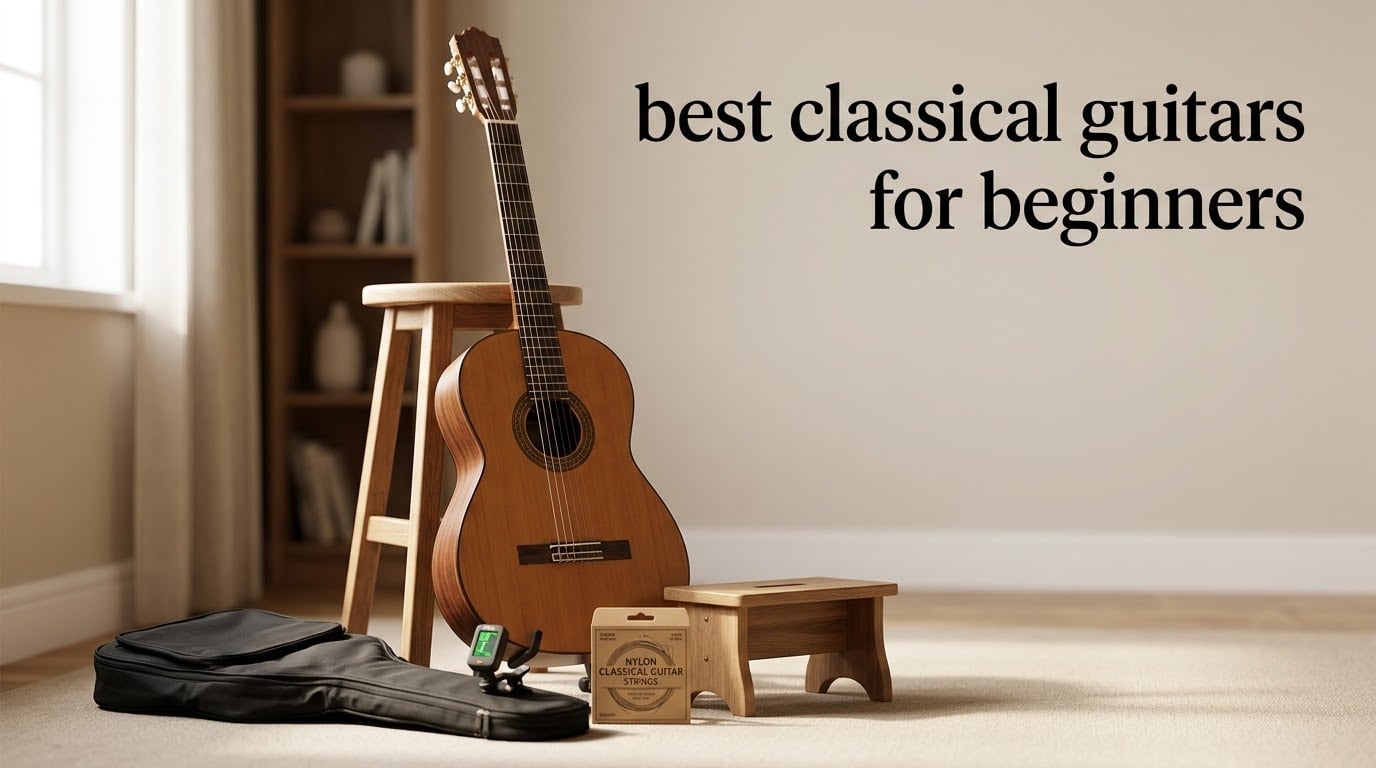
There is a specific moment in every beginner guitarist’s life: the case comes open, the instrument sits on the sofa, and you realise the thing you have been saving for looks less like a guitar and more like a small wooden boat. Choosing well matters more than almost anything else you do in year one, because the best classical guitars for beginners make the first six months feel possible and the wrong one makes you quietly stop practising.
Here is what we learned after going through the specifications, owner reviews and setup reports on twelve beginner classical guitars side by side. Nothing on this list needs a luthier’s eye to enjoy, and every one of them takes nylon strings, the wider fingerboard and the fingerstyle-friendly construction that makes classical technique transferable to everything else you will later play.
What we look for is narrower than most buying guides admit: can a beginner’s hand actually reach around the neck, does the instrument hold a tune without daily babysitting, and does the setup survive a change of season. Tone matters, but it matters less in the first year than most product pages suggest, because a well-set-up laminate guitar teaches technique better than a badly set-up solid top.
If your student is a child rather than an adult, start with the sizing section further down, and you may also want our broader guide to the best kids guitars for every age before committing.
Top 3 Classical Guitar Picks for Beginners (October 2026)
Before the long list, here is the short version. The Yamaha C40II is the one we would put in front of an adult beginner without hesitation, the Yamaha CGS103AII is the smarter buy for anyone with smaller hands, and the Pyle 3/4 kit is the most complete package for a young student.

Yamaha C40II Classical Guitar
- Spruce top
- Meranti back and sides
- Rosewood fingerboard and bridge
- 25-inch scale

Yamaha CGS103AII Classical Guitar
- 3/4 scale
- Spruce top
- Low forgiving action
- Lightweight body

Pyle 3/4 Beginner Classical Kit
- 36-inch 3/4 size
- Nylon strings
- Bundle with bag and tuner
- 18 frets
Best Classical Guitars for Beginners (October 2026)
Every guitar below is a genuine beginner instrument, but they are not interchangeable. Four are small-body models aimed at children, four are full-size instruments with truss rods, and the rest sit in between with a bundle of accessories attached.
| Product | Specifications | Action |
|---|---|---|
| Yamaha C40II Classical Guitar |
|
Check Latest Price |
| Yamaha CGS103AII Classical Guitar |
|
Check Latest Price |
 MasterPlay 30 Inch Kids Classical Guitar MasterPlay 30 Inch Kids Classical Guitar |
|
Check Latest Price |
| Pyle 3/4 Beginner Classical Kit |
|
Check Latest Price |
 Music Alley 34 Inch Junior Classical Guitar Music Alley 34 Inch Junior Classical Guitar |
|
Check Latest Price |
 ADM 30 Inch Classical Guitar Bundle ADM 30 Inch Classical Guitar Bundle |
|
Check Latest Price |
 ADM 39 Inch Full Size Classical Guitar ADM 39 Inch Full Size Classical Guitar |
|
Check Latest Price |
 Winzz 4/4 Beginner Classical Guitar Winzz 4/4 Beginner Classical Guitar |
|
Check Latest Price |
 VEVOR 30 Inch Classical Starter Kit VEVOR 30 Inch Classical Starter Kit |
|
Check Latest Price |
 Fender FA-25N 3/4 Nylon String Fender FA-25N 3/4 Nylon String |
|
Check Latest Price |
 Hola! Music 39 Inch Classical Guitar Hola! Music 39 Inch Classical Guitar |
|
Check Latest Price |
 Vangoa 39 Inch Classical Guitar Bundle Vangoa 39 Inch Classical Guitar Bundle |
|
Check Latest Price |
1. Yamaha C40II Classical Guitar – The Default First Guitar
Yamaha C40II Classical Guitar, Full Size With Rosewood Fingerboard and Bridge, Natural
Spruce top
Meranti back and sides
Rosewood fingerboard and bridge
25 inch scale, 1.5 kg
Pros
- Rich airy tone that suits classical repertoire
- Firm tuning pegs that hold pitch
- Clean gloss finish for this tier
- Wide fingerboard comfortable for arpeggios
Cons
- No truss rod so neck relief cannot be adjusted
- Action can run high out of the box
- Supplied wound strings wear quickly
This is the guitar we keep coming back to. The Yamaha C40II is a full-size instrument with a spruce top, meranti back and sides, and a rosewood fingerboard and bridge, and after 1649 owner reviews it holds a 4.5 average. Owners describe the tone as rich and airy, which is about right for a guitar that will mostly be playing simple arpeggio patterns in your first months.
What makes it the safe pick is consistency rather than any single specification. Yamaha’s quality control on this model is famously even, the tuning pegs are firm enough that the guitar does not drift badly between practice sessions, and the finish looks far better in person than the tier suggests. Many beginners buy this and keep playing it for years, which is exactly what you want from a first instrument.
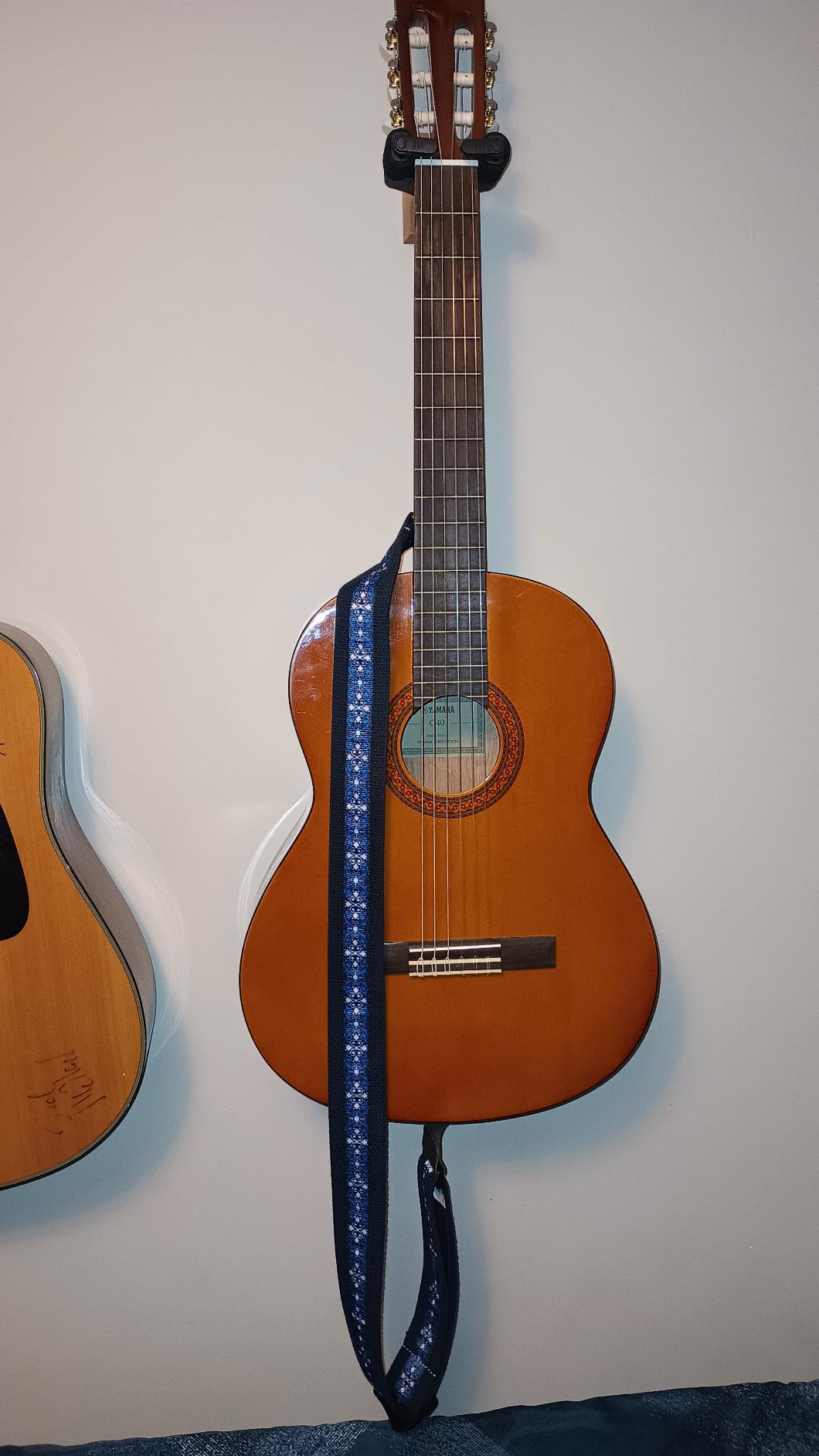
The honest weakness is that there is no truss rod. That means the neck cannot be adjusted if the action creeps up, and the single fret marker at the seventh fret is not much help when you are learning to read position. If you live somewhere with genuinely variable humidity and you cannot get to a luthier easily, this is worth thinking about before you buy.
Action is the other recurring theme in the reviews. Owners report that some examples arrive with a high action that needs saddle work before the guitar feels comfortable, and that the strings supplied are basic wound nylon that most players replace within the first few weeks. Neither issue is a fault of the design, but both are reasons to factor in the cost of a basic setup.
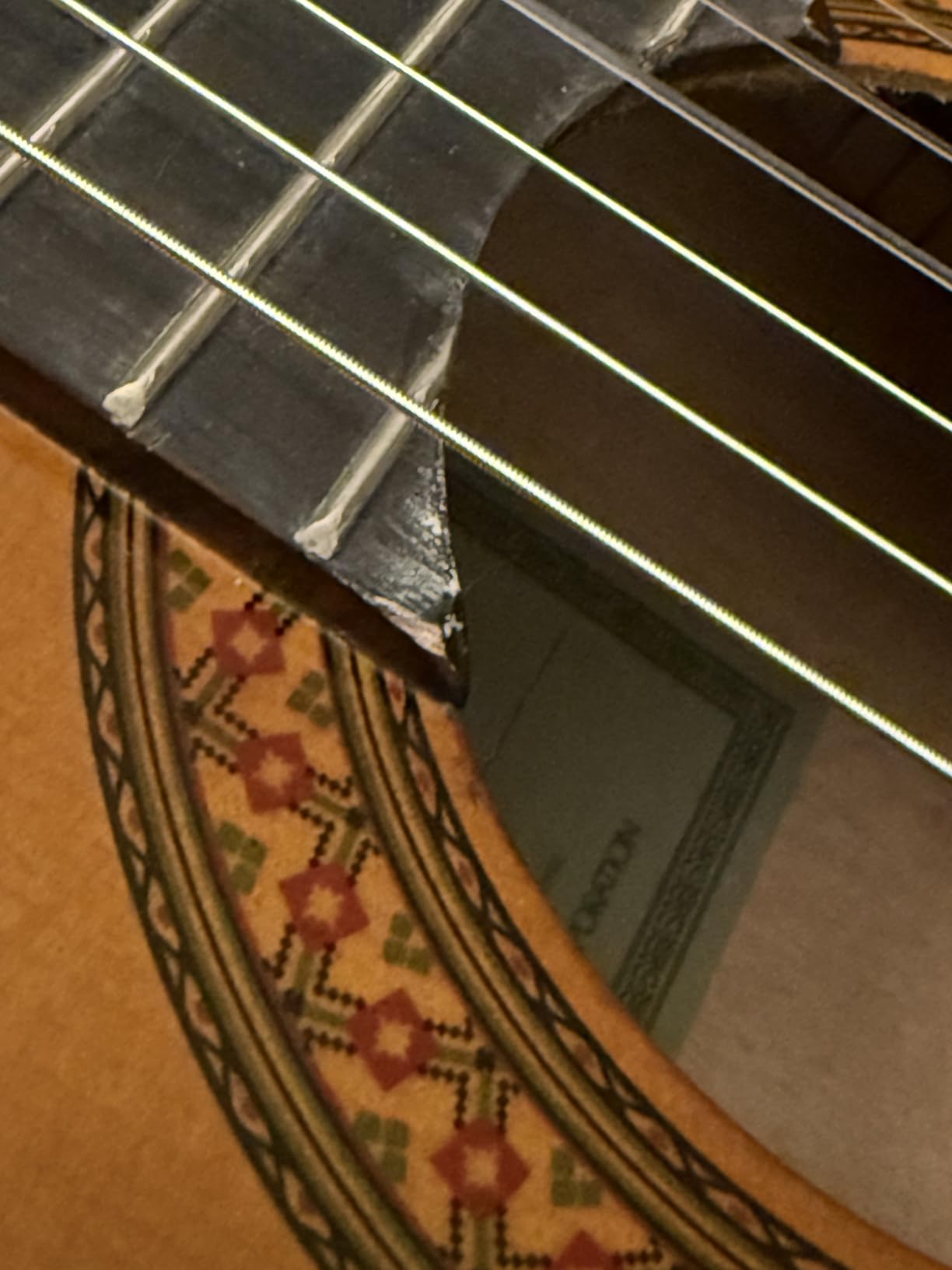
Is the C40II the right size and scale for your hands?
With a 25-inch scale and full-size body, this is a proper adult classical. A child under about ten will struggle to reach the first frets, and players with smaller hands often find the stretch to the third and fourth position uncomfortable for the first few months. Adults of average and above-average hand span will find it immediately comfortable.
The rosewood fingerboard is a genuine advantage over cheaper boards for players who move between positions often, since it balances grip and smoothness. It is also the part of the guitar that ages best, so an instrument bought now will feel the same in three years.
When to skip this guitar
Skip it if your guitarist is a young child, because a full-size body and 52mm-class neck will frustrate rather than encourage. Skip it if you know you will be moving to a warm or humid room with no access to setup help, because the missing truss rod removes your main adjustment. Everything else, this is the model we would hand to a beginner.
2. Yamaha CGS103AII Classical Guitar – Best Fit for Smaller Hands
Yamaha Student Series CGS103AII Classical Guitar, Natural
3/4 scale, 23 inch
Spruce top
Meranti back and sides
16 ounce body
Pros
- Compact 3/4 scale suits children and small adults
- Low forgiving action
- Mellow tone with good intonation
- Lightweight and portable
Cons
- Shorter scale gives a smaller tone
- Action at the twelfth fret can run high
- Finish quality inconsistent on some examples
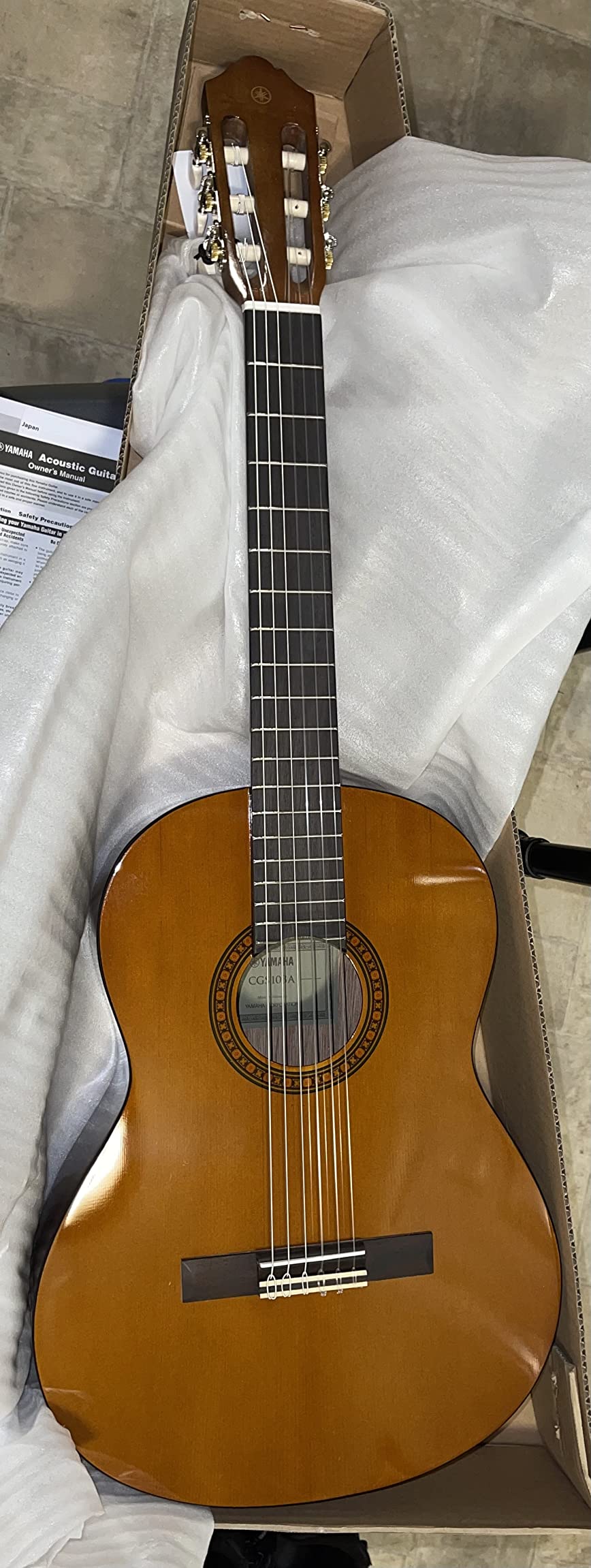
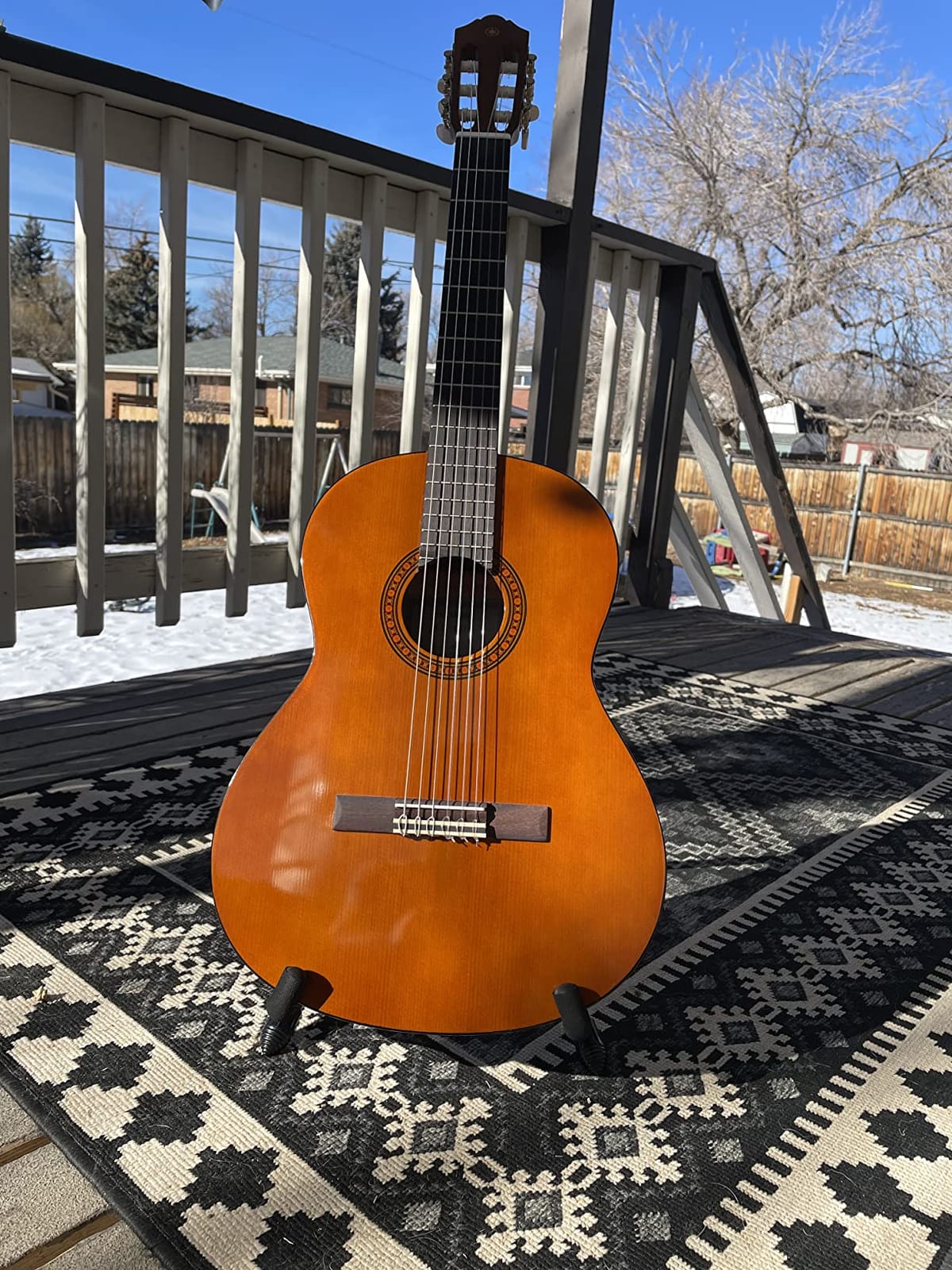
This is the highest-rated guitar in the group at 4.6 across 1151 reviews, and the reason is simple: it fits. The 3/4 scale with a 23-inch scale length and a 16-ounce body is the size most children between about eight and thirteen, and plenty of adults with smaller hands, actually need.
Under the compact frame you still get a spruce top, meranti back and sides, and a rosewood fingerboard and bridge, so the parts that touch your hands are the same quality as on the full-size C40II. Reviewers consistently mention the low, forgiving action and the soft feel of the strings as the reason it is easy to play for long stretches without sore fingertips.
The trade is tone volume. A 23-inch scale simply cannot move as much air as a 25-inch one, so the sound is smaller and less full-bodied. If you are learning in a bedroom rather than a room with other people in it, that matters very little. Owners of full-size instruments who later compare the two usually describe the difference as refinement rather than a night and day change.
Two caveats show up repeatedly. String action at the twelfth fret can run high, which is the same setup note we see across this whole category, and a minority of buyers report cosmetic finish problems such as uneven lacquer near the sound hole or a rough neck joint. Those are finish complaints, not structural ones.
When to size down instead of buying full size
Size down when the player’s hand span cannot comfortably wrap the body, or when they cannot reach the first few frets without contorting the wrist. Our rule of thumb is that if a child can hold a full-size guitar without their elbow sticking out awkwardly, they will grow into it. If the body is wider than their lap, it is time for a 3/4.
Our guide to kids guitars across every age group goes deeper on that decision, and on the game-guitar side of things we also tested a batch of acoustic-style controllers for Xbox 360 that work as a first step for very young children.
How long a 3/4 size stays useful
A 3/4 classical comfortably carries most players into their early teens, and there is no rule that forces an upgrade at a specific birthday. The usual reason to move up is repertoire and ensemble playing, when a fuller sound matters. The Yamaha’s build quality here means a step-up later feels like a choice rather than a repair.
3. MasterPlay 30 Inch Kids Classical Guitar – The First Instrument for a Four Year Old
MasterPlay Kids Guitar, 30” Beginner Classical Wood Guitar For Learners, With starter kit, Bag, Strap, Tuner, Pick, Extra String, Cleaning cloth, Christmas, Birthday Gift for Girls Ages 5-12, Pink
30 inch basswood body
Linden wood top
Three steel three nylon strings
3 pound build
Pros
- Complete bundle with bag tuner strap and spare strings
- Right-sized 30 inch body for small children
- Real wood construction rather than plastic
- Hardware survives rough handling
Cons
- Needs frequent retuning as strings stretch
- Limited uke-like tone that is outgrown quickly
- Nut grooves can be wide causing buzz
- Not right for players over about seven
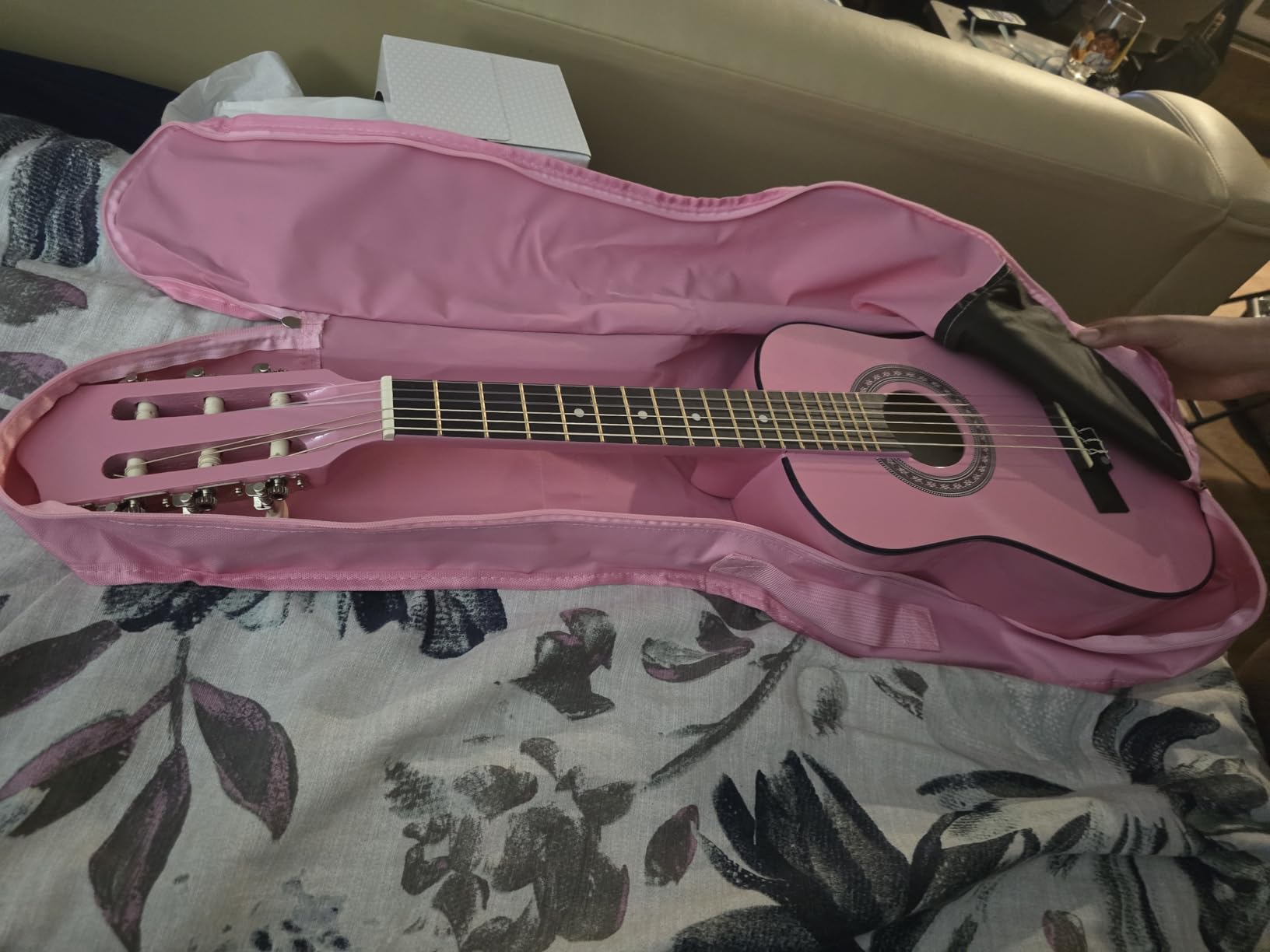
This is not a classical guitar in the purist sense, and we want to be clear about that before anyone buys it expecting more. It is a 30-inch basswood learner guitar with a linden top, three steel and three nylon strings, and a body small enough for a four-year-old to actually hold against their chest and fret with both hands.
What it does well is survive. Across 9572 reviews the consensus is that parents of young children are happy with the durability, the included accessories and the fact that a real child can play it rather than fighting a body that is too large. The gig bag, tuner, strap, spare strings, picks, cloth and capo all arrive in the box, which removes the first round of shopping entirely.

Where it runs out of road is tone. The short string length gives a thin, uke-like voice, and reviews note the strings going flat quickly in the early weeks. The nut grooves are also described as sometimes too wide, which causes buzzing on the top two strings. None of that is a problem for a six-year-old learning the difference between one string and the next.
It is a problem by about age eight, which is when most owners and reviewers start advising an upgrade. Think of it as eighteen months to two years of play rather than a guitar to keep. Buying this with that expectation set costs a lot less frustration than buying it hoping it will last.
Is a learner kit enough for a first guitar?
For ages four to seven, yes, because the alternatives at that size are mostly plastic toys with no neck. Real wood and six tuning pegs teach the correct physical motion, and the included tuner means an adult can help a child tune without any extra equipment. For any player past the age where a child can hold a real 3/4 classical, choose the Yamaha instead.
One practical warning: because it is a hybrid steel and nylon instrument, do not assume it will accept standard classical strings. Check what the maker specifies before replacing the set, and expect a break-in period either way.
When to move up and what to move up to
The signal to move up is simple: your child has learned their first chords and their hands have outgrown the neck width. The most direct next step is a 3/4 classical such as the Yamaha CGS103AII on this list, which keeps the nylon-only string set and gives a real spruce top. You can also read our full kids guitar guide for the wider comparison.
4. Pyle 3/4 Beginner Classical Guitar Kit – The Most Complete Package for a Young Student
Pyle 36-Inch Beginner Classical Acoustic Guitar Kit, 3/4 Size Junior Nylon String Guitar for Kids and Adults, Includes Gig Bag, Strap, Spare Strings, Picks, Cleaning Cloth, 18 Frets, Natural, Gloss
36 inch 3/4 size
Linden wood body
22.8 inch scale and 18 frets
1.97 inch nut width
Pros
- Warm clear tone good for lessons and practice
- Comfortable junior scale with low action
- Gig bag strap strings picks and cloth included
- High gloss finish looks sharp out of the box
Cons
- Arrives out of tune and needs several days of settling
- Build quality varies between examples
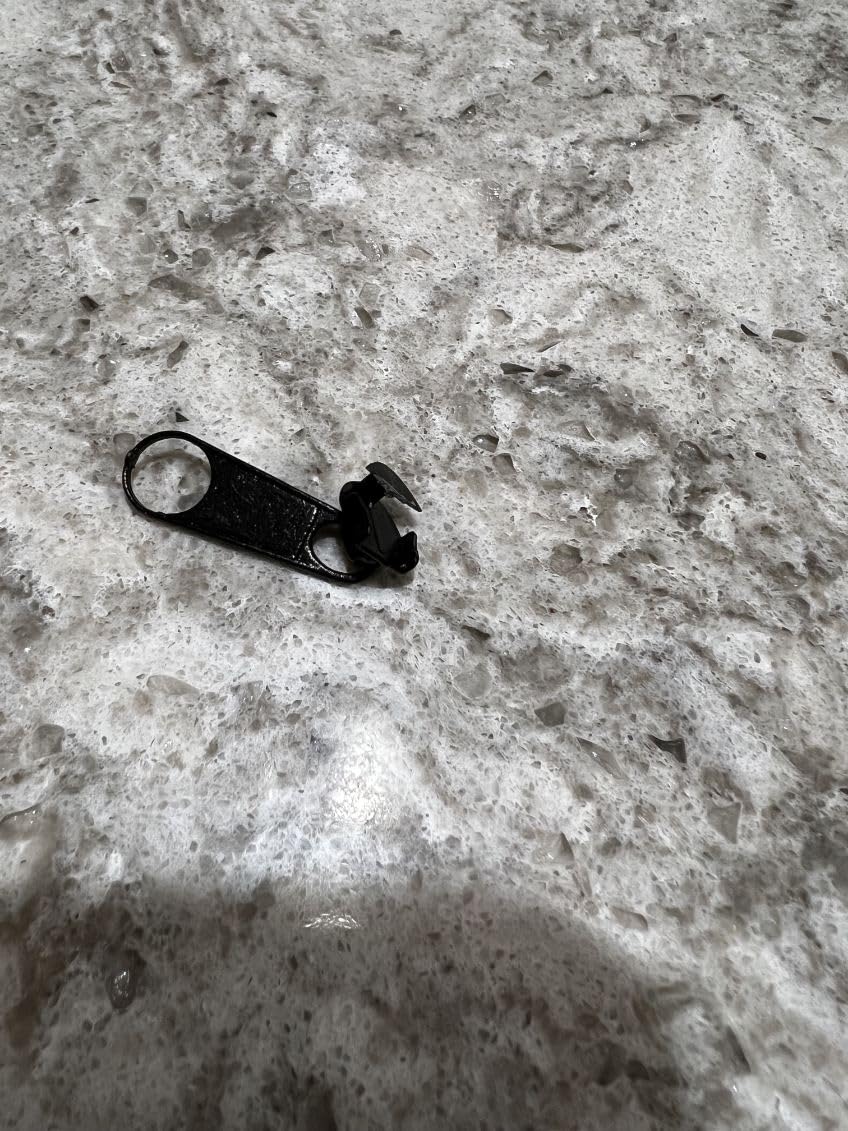
- Gig bag zipper is a repeated failure point
- No fret position markers
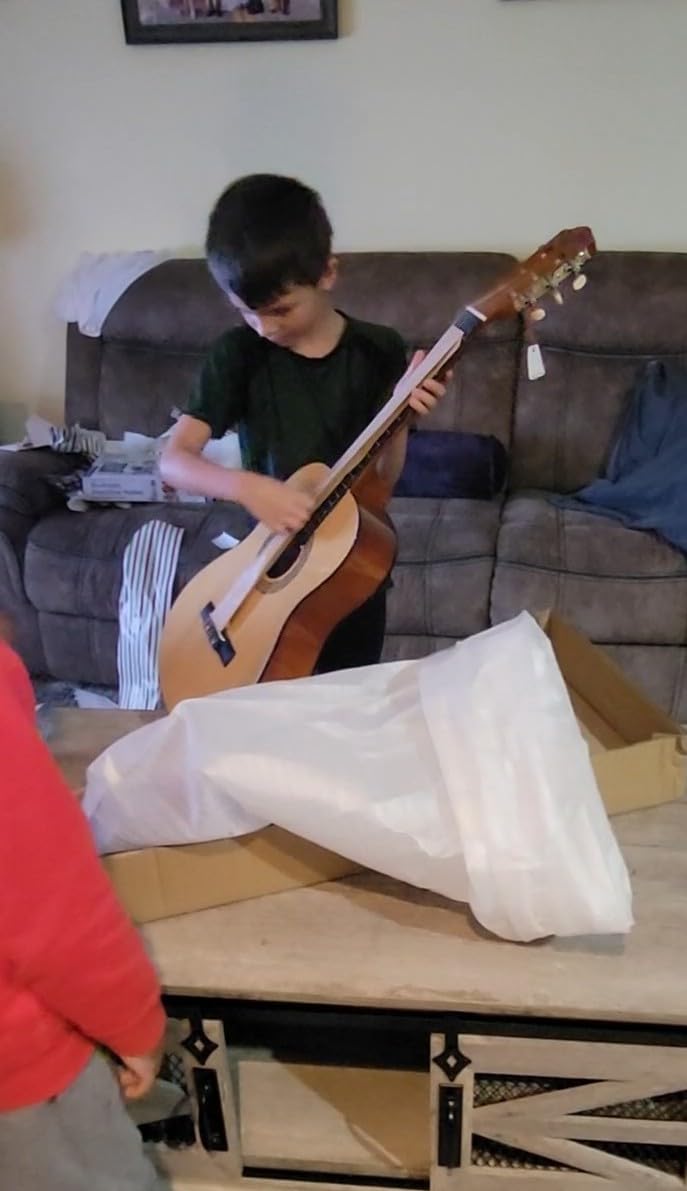
The Pyle is the kit we would choose when a parent wants one purchase that covers everything. You get a 36-inch 3/4-size classical with a linden wood body, birch headstock, dyed hardwood fingerboard, 18 frets and a 22.8-inch scale, plus a gig bag, detachable strap, spare nylon strings, picks and a cleaning cloth.
Reviewers like the sound for what it is. The tone is described as warm, clear and crisp, which suits a child working through first-position material in a practice room. Action is low and the junior scale is genuinely comfortable for small hands, which is where most of the four star and five star reviews come from.
The one thing every reviewer talks about is settling time. The guitar arrives out of tune with loose strings, and owners report needing two to four days of stretching and retuning before it holds pitch consistently. Experienced players are blunt that this is normal for new nylon strings and that the fix is patience, not a return.
Quality control is the second theme. Finish sometimes arrives scratched or cracked, the fingerboard coating can flake, and the supplied gig bag is thin with a zipper that fails often. There are no fret markers or inlays, so a beginner will need a printed diagram or a teacher to find the notes at first.
Does the 3/4 scale work for adults too?
It does. A 36-inch body with a 22.8-inch scale is noticeably smaller than a full-size classical, and many adults buying their first instrument find that reassuring rather than limiting. The trade is volume and low-end weight in the tone. If you plan to play in a group or accompany a singer, choose a full-size model such as the ADM 39-inch or the Hola! instead.
For a child between about seven and eleven this is the sweet spot: a real six-string classical with a proper neck, an included bag, and a body they can still carry themselves. That combination is genuinely hard to find in a single box.
What to check in the first week
Give it a full week before judging it. Check the tuning twice a day while the strings stretch, look for any buzz at the nut on the first and second strings, and confirm the neck sits straight against the body. If it is still flat by day seven, a setup visit will sort it rather than a replacement.
Set your expectations on the bag too. The included gig bag is fine for a car seat and a bedroom, but it will not survive a suitcase. Plan on a proper case when the student starts travelling to lessons with it.
5. Music Alley 34 Inch Junior Classical Guitar – The Lightest Real Classical for Children
Music Alley 34 Inch Junior Classical Guitar for Kids, Natural
34 inch junior scale
Basswood body with ash top
43 mm nut width
2.1 pound build
Pros
- Correct junior proportions on a real classical instrument
- Nylon strings gentle on developing fingers
- Very light at 2.1 pounds
- Note stickers and guided lessons included
Cons
- Thin and quiet in a practice room
- Budget tone and construction quality
- Outgrown quickly by players past early teens
The Music Alley sits between the toy kits and the serious student guitars, and at 2.1 pounds it is the lightest instrument here. A 2.1-pound body is a genuine practical difference for a child, because a guitar they can lift without help is a guitar they will practise on without being asked.
It is a 34-inch junior-scale classical with a basswood body, an ash top, a maple fingerboard and a 43 mm nut width. That narrower nut is why small hands can fret it comfortably, and the nylon strings are kind on fingers that are still building calluses. The included note stickers and guided lesson content get a child playing something in the first week.
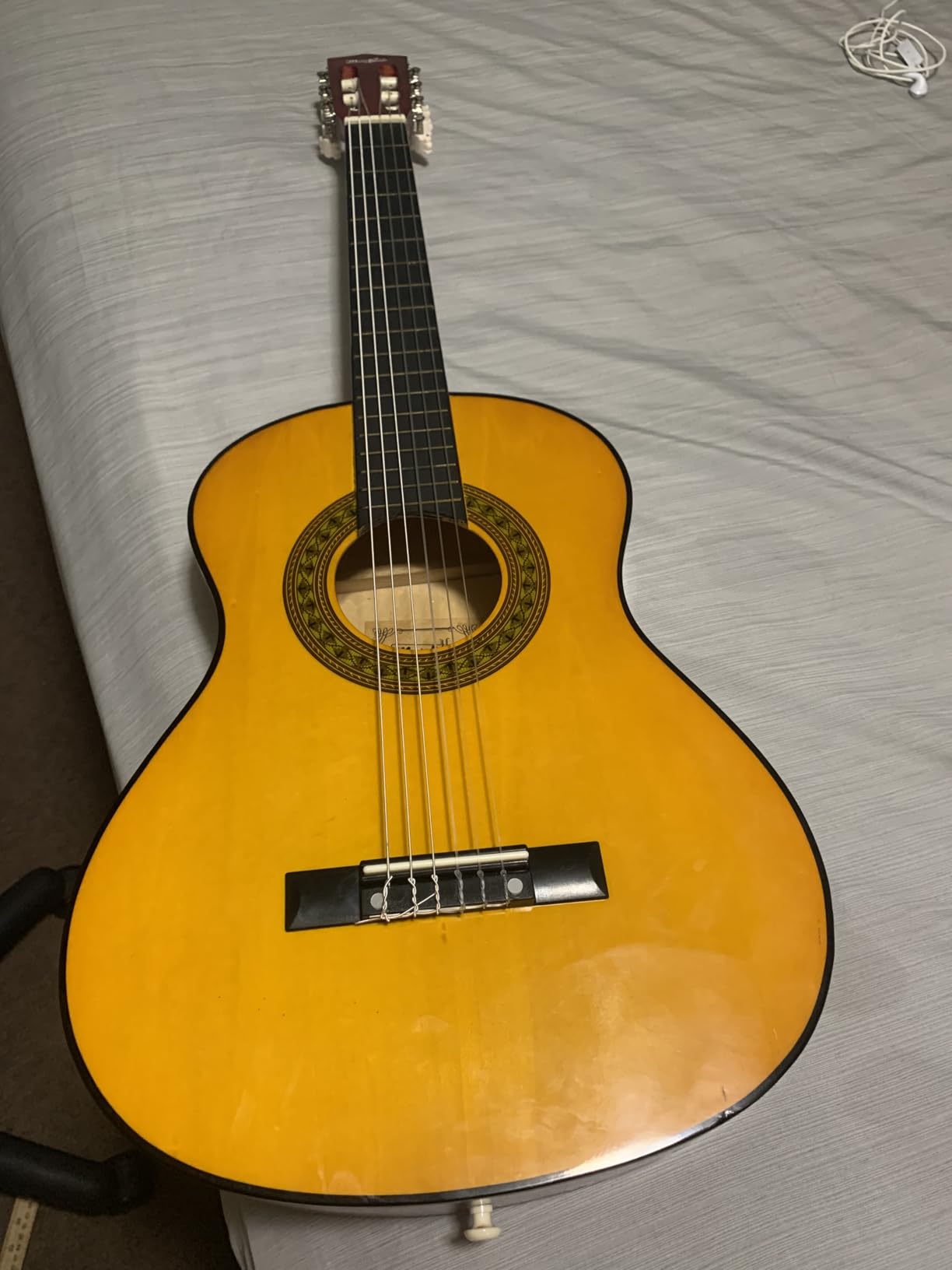
The 4.2 average across 6903 reviews reflects a clear split. Parents of young children are satisfied, and satisfaction tracks closely with realistic expectations. The lower share of top-star ratings compared with the Yamaha models comes down to sound: owners describe the volume as thin and the build as basic.
That is fine in a bedroom and unsatisfying the first time someone plays with a group. The instrument is a stepping stone by design, and most owners treat it that way, keeping it for the first year or two and moving on.

How does it compare with a 3/4 full-size classical?
The 34-inch body is smaller and lighter than a 36-inch 3/4, and the 43 mm nut is narrower than the classical standard. That is the appeal: it fits smaller hands better and costs less to carry around. What you give up is volume, and the Music Alley gives up more than most, so it works best as a solo practice instrument.
If your child is near the top of the age range where this size fits, weigh the two-year cost of replacing it against a slightly larger 3/4 that they will grow into. Both approaches are reasonable; the mistake is buying a junior size for a child who has already outgrown one.
When this is the wrong choice
Choose something else if the player already reads notes, takes lessons with a teacher who expects a specific instrument, or plays in any ensemble. Teachers and parents who take those paths usually find the tone and stability too limited, and the price difference between this and a proper 3/4 student guitar narrows fast.
6. ADM 30 Inch Classical Guitar Bundle – The Best Bundle for Ages Six to Ten
ADM Beginner Acoustic Classical Guitar 30 Inch Nylon Strings Wooden Guitar Bundle Kit for Kid Boy Girl Student Youth Guitarra Online Lessons with Gig Bag, Strap, Tuner, Extra Strings, Picks,Blue
30 inch laminated basswood
Arched back for sustain
25.6 inch scale
3.4 pound build
Pros
- Arched back gives fuller and more sustained sound than flat kits
- Very complete bundle with case tuner hanger and lessons
- 30 inch size matches children six to ten
- Brand replaces transit damage proactively
Cons
- Nylon strings drift for the first few weeks
- Included tuner has no battery
- Action can be set high
- Soft case is unpadded
The ADM 30-inch is the one to consider when an arched back matters. Most kits in this price band use a flat plywood shell, which sounds thin; an arched back gives this model noticeably more sustain and a fuller voice for a 30-inch body, and several reviewers with long playing histories single that out as the reason it sounds better than expected.
The bundle is the other argument. It includes a case, picks, shoulder strap, digital tuner, guitar hanger, fingerboard sticker, spare replacement strings and a month of online lessons. The 30-inch laminated basswood body is well matched to children around six to ten, and the build is 3.4 pounds with a maple rosewood fingerboard and nato neck.
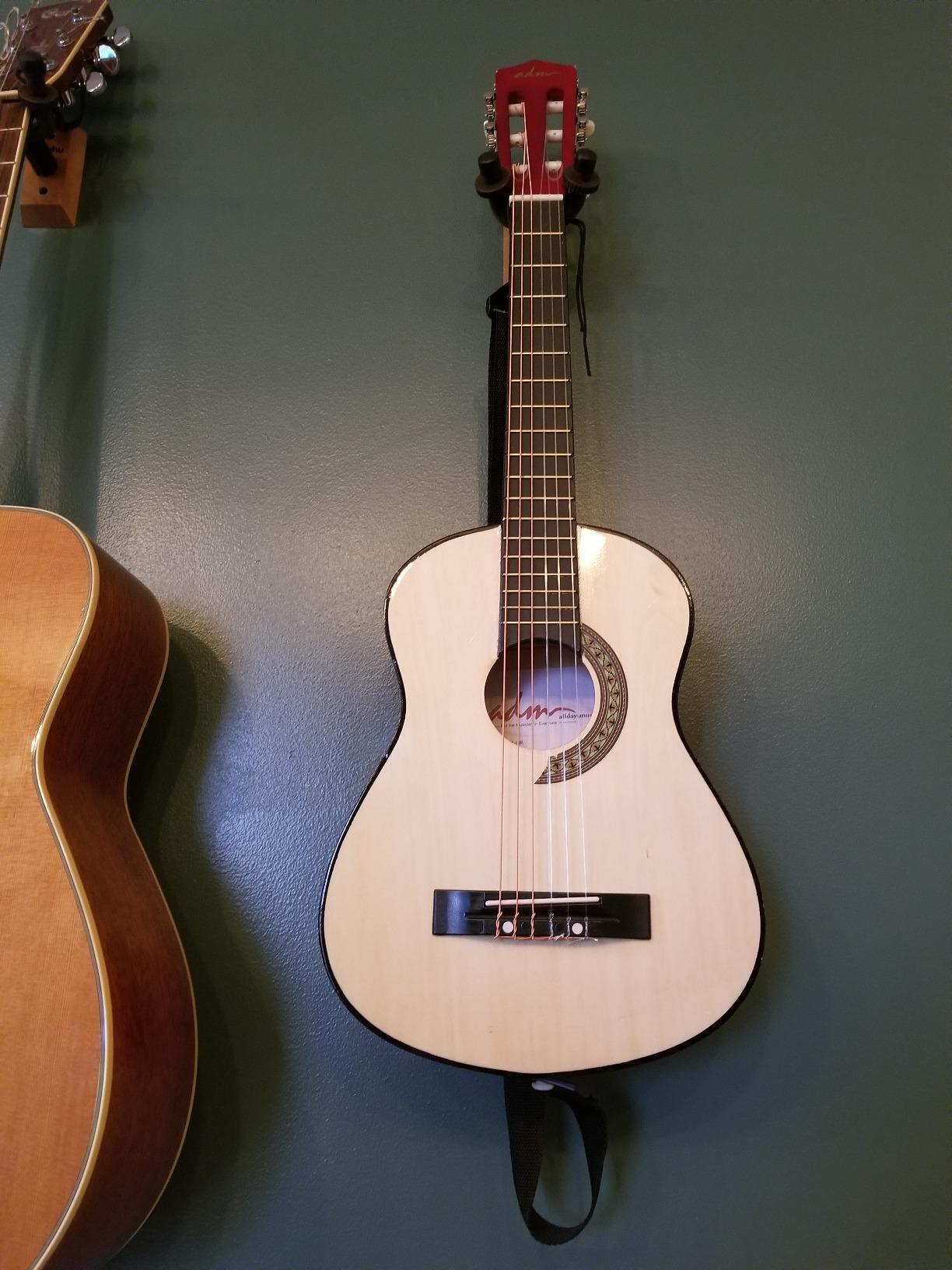
There is one thing to know before day one: it arrives untuned, on purpose, to protect the instrument in transit. Reviewers report the nylon strings going out of tune repeatedly for the first few weeks until they settle, and several note that once set up, the guitar holds tuning well for longer than the price suggests.
Smaller complaints include a digital tuner that arrives without a battery, action that can be set high enough to make clean chords difficult, and a high E string that buzzes at the nut. The soft case included is unpadded, which is worth replacing before the guitar travels anywhere.

What does the arched back actually change?
Two things a beginner will hear. Sustain lasts longer after you pluck a note, so a simple arpeggio pattern sounds finished rather than clipped, and the low end has more weight, so chords sound fuller. On a small body those are the differences you notice first, and they are the reason several reviewers describe this as sounding more expensive than it is.
It does not turn a 30-inch kit into a full-size classical. The volume ceiling is still set by the body size, and the laminated top does not develop the way a solid top does. For a first instrument at this size, though, it is a real upgrade over the flat-back kits.
What to do about the first month of tuning
Tune it twice daily for the first two weeks and stop worrying about it. Nylon stretches and settles, and a stable classical guitar that reached equilibrium in a month is still a stable guitar. If it is still drifting at the six-week mark, the strings are usually the cause rather than the headstock, and a fresh set solves it.
7. ADM 39 Inch Full Size Classical Guitar – The Best Full Size Bundle
ADM Full Size Classical Nylon Strings Acoustic Guitar 29 x 75x 50mm Classic Guitarra Starter Bundle for Adult with Free Lessons, Gig Bag, Tuner, Footstool, Kids Student Beginner Kits, Nature
39 inch body with 25.7 inch scale
Solid spruce top with scalloped X bracing
Dual-action truss rod
8.1 pound build
Pros
- Warm bright tone several experienced players rate highly
- Dual-action truss rod is rare at this tier
- Full-size body with traditional 25.7 inch scale
- Complete bundle with footstool stand and capo
Cons
- Fret ends can be sharp out of the box
- Supplied strings are basic
- Gig bag is closer to a dust bag
- Nut sits high for some barre chords
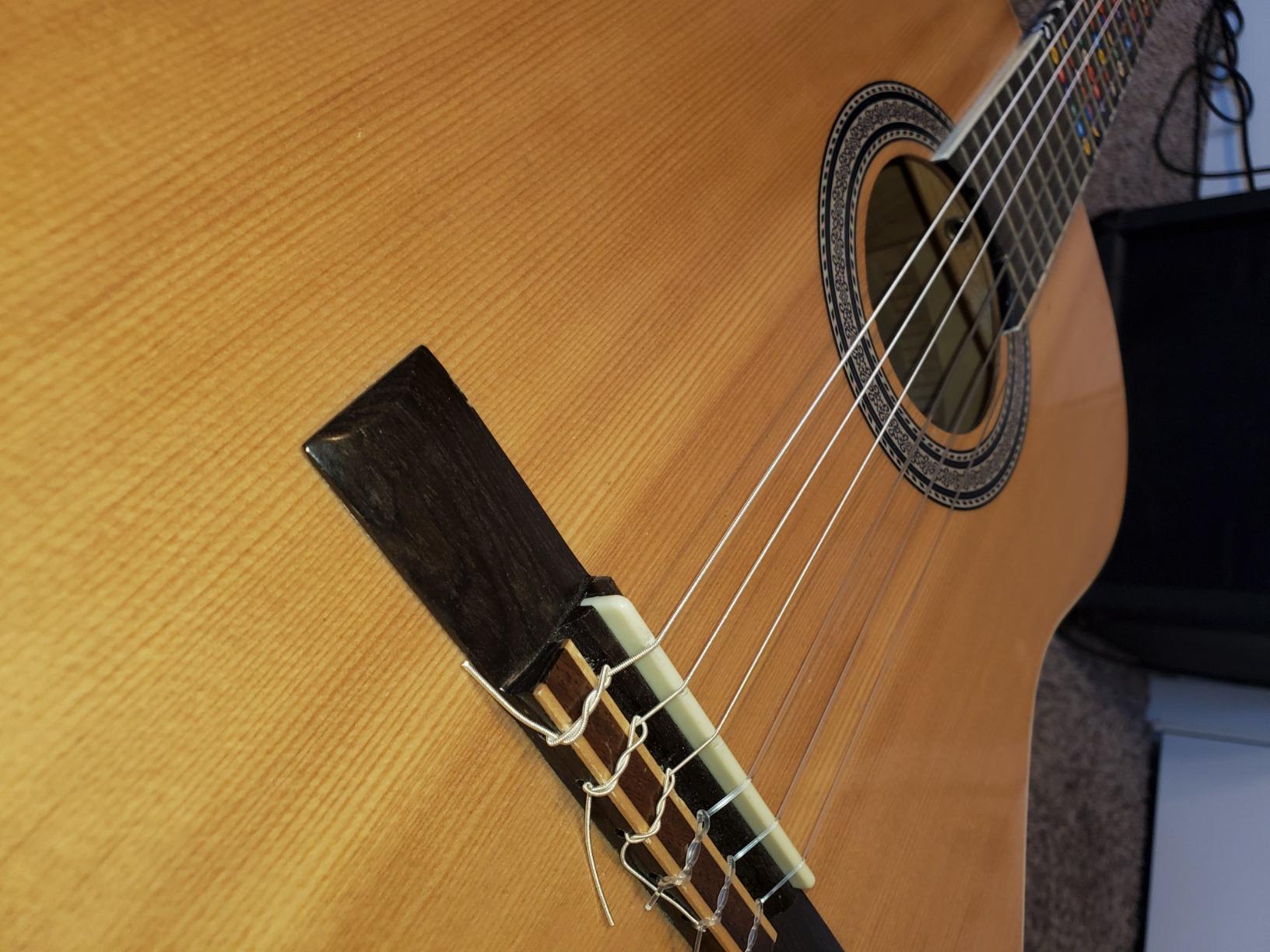
This is the most interesting specification sheet in the group for an adult beginner. A 39-inch full-size body with a 25.7-inch scale, a solid spruce top with scalloped X bracing, a nato neck, and a dual-action truss rod. A truss rod on a classical guitar at this level is unusual, and it is the feature that separates this from the other full-size options here.
Reviewers with decades of playing experience repeatedly praise the tone, and several describe it as comparable to instruments costing several times more. The bundle is also the most complete of the adult models: gig bag, digital tuner, footstool, stand, capo, polish cloth and a month of free lessons, with chrome geared tuning machines.
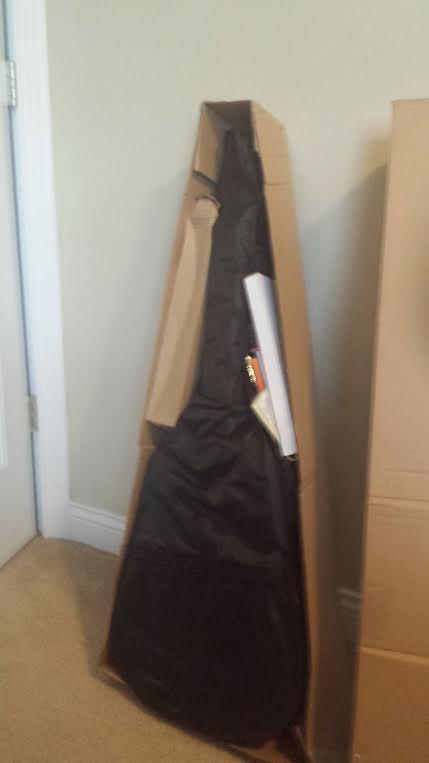
The setup caveat is universal across reviews, so plan for it. The strings need time to stretch, the nut sits high enough that some barre chords are hard to press, and the fret ends can need sanding. None of these mean a bad instrument, but all of them mean the first visit to a repairer is worth budgeting for rather than being surprised by.
The included gig bag is the weakest accessory, described as closer to a dust bag than a case. At 8.1 pounds this is also the heaviest guitar in the roundup, which matters for an adult carrying it to lessons on public transport.
Why does a truss rod matter on a classical guitar?
Because a classical neck is under tension from the strings pulling the headstock backwards, and without a rod you have no way to compensate when humidity or temperature changes the wood. With a dual-action rod you can add or remove a quarter turn to reset neck relief. For a beginner who cannot judge action by feel yet, that is one adjustment you can make yourself instead of paying for.
It also means this guitar can be set up properly by a beginner over a season change, which matters in heated rooms and dry winter air. If your storage conditions swing wildly, this is a genuine practical advantage over the C40II.
How much setup should you expect to need?
Count on a basic setup shortly after purchase: saddle height, nut height and a fret-end check. Beyond that, the truss rod means you can manage the seasonal drift yourself. Owners who paid for a full setup report low action and accurate intonation afterwards, which is where the tone praise comes from.
8. Winzz 4/4 Beginner Classical Guitar – The Sunburst Full Size Option
Winzz 4/4 Size Beginner Classical Guitar, Sunburst
39 inch 4/4 body
2.05 inch traditional fretboard
Dual-action truss rod
High gloss sunburst
Pros
- Warm clear tone sufficient for classical and fingerstyle
- Lightweight and easy to carry
- Truss rod helps it hold tuning
- Complete accessory bundle
- Clean gloss finish
Cons
- Basswood body is less refined than spruce or cedar
- Needs several adjustments before it settles
- Engineered wood fingerboard is less responsive than solid timber
Sometimes the deciding factor for a first guitar is that the student likes looking at it, and the Winzz is the only high-gloss sunburst in this roundup. The finish is described by reviewers as clean and not cheap-looking, which is a real difference when a child is the one holding the instrument.
Underneath the finish it is a 39-inch 4/4 body with a traditional wide fretboard at 2.05 inches, six soft nylon strings and a dual-action truss rod. Reviewers across several countries describe the value for money as excellent and highlight the light weight, which makes it easy to carry to lessons or to a gathering.
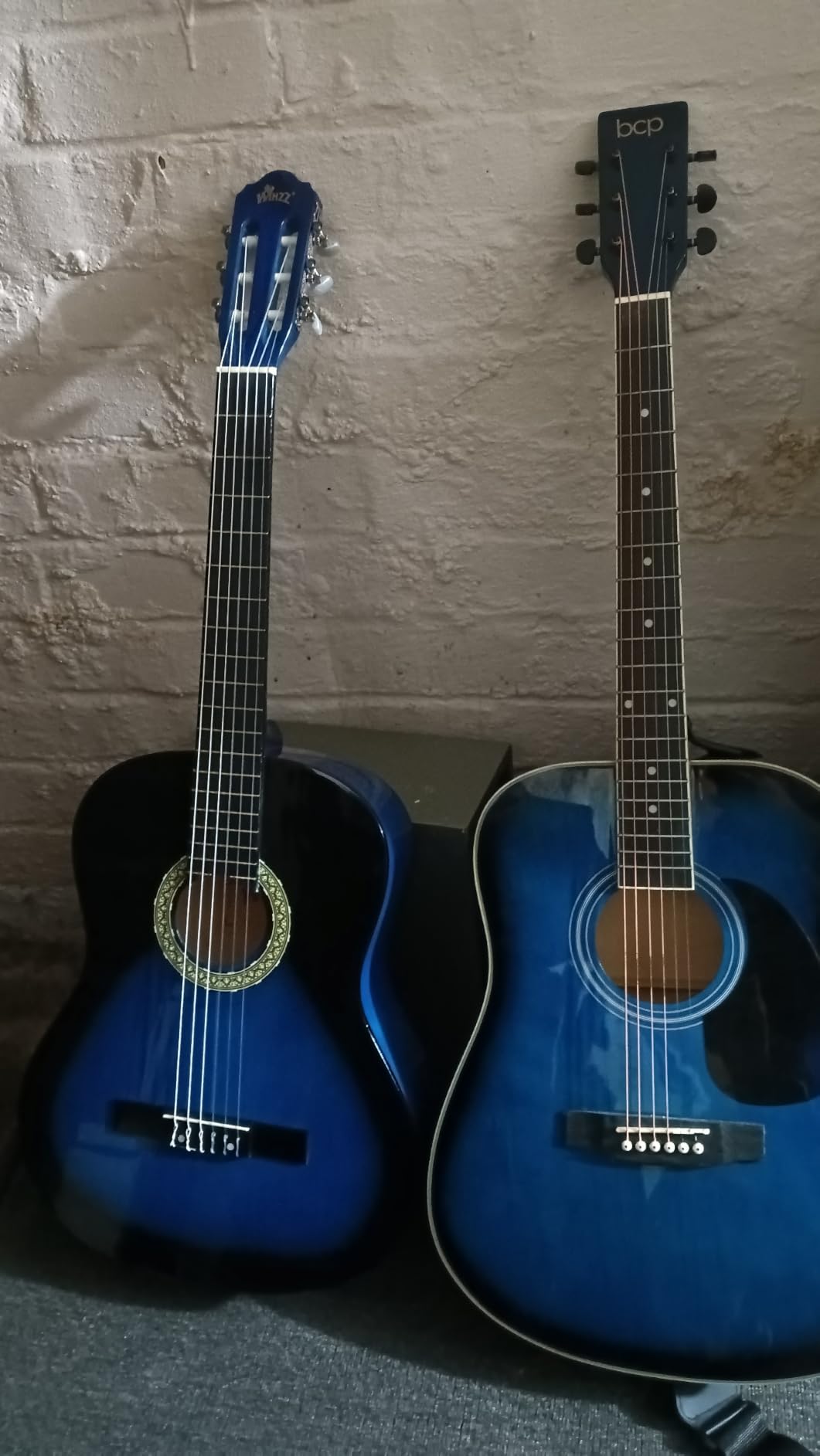
The limitation is the wood. A basswood body with an engineered wood fingerboard produces a less refined tone than spruce or cedar, and the tone is described as sufficient rather than impressive. If your goal is classical repertoire, the difference is audible later in the year when you start comparing instruments with other students.
It also takes several adjustments before it holds tuning consistently, and the review base here is small at 532. That is not a warning, just a note that long-term durability is less well documented than for the Yamaha models, where years of owner reports exist.
Is a truss rod enough to make a budget guitar last?
It is enough to make it adjustable, not enough to make it a better instrument. A truss rod protects the setup, and the setup is what determines how comfortable the guitar is to play for long sessions. It does not change the fundamental character of the wood, and a basswood body will always sit behind a spruce one in tone.
For a first instrument played daily, the value of being able to fix your own action without a repair bill outweighs a modest tone difference. For someone who already knows what they want to sound like, it is not enough.
Who should pick this over the Yamaha?
Pick it if appearance matters to the player, if a complete accessory bundle saves a shopping trip, or if the lighter body suits a smaller adult. Pick the Yamaha C40II if tone, long-term resale and a deep pool of owner experience matter more than a finish. Both are defensible; they simply optimise for different things.
9. VEVOR 30 Inch Classical Starter Kit – The Lowest Cost Way to Start
VEVOR Classical Guitar, 38 Inch, Wood Classical Guitar Starter Kit for Beginners, with Nylon Strings, Gig Bag, Strap, Tuner, Extra Strings, Picks, Capo, Basswood, for Teenagers Adults Students, Black
30 inch basswood body
50 centimeter scale
Seven piece bundle
2.5 pound build
Pros
- Very low cost for a complete nylon string kit
- Basswood gives more resonance than plastic toys
- High precision tuning pegs
- Tight string spacing reduces finger fatigue
Cons
- Entry level tone and sustain
- Highest one-star review share in this roundup
- Binding and finish wear quickly
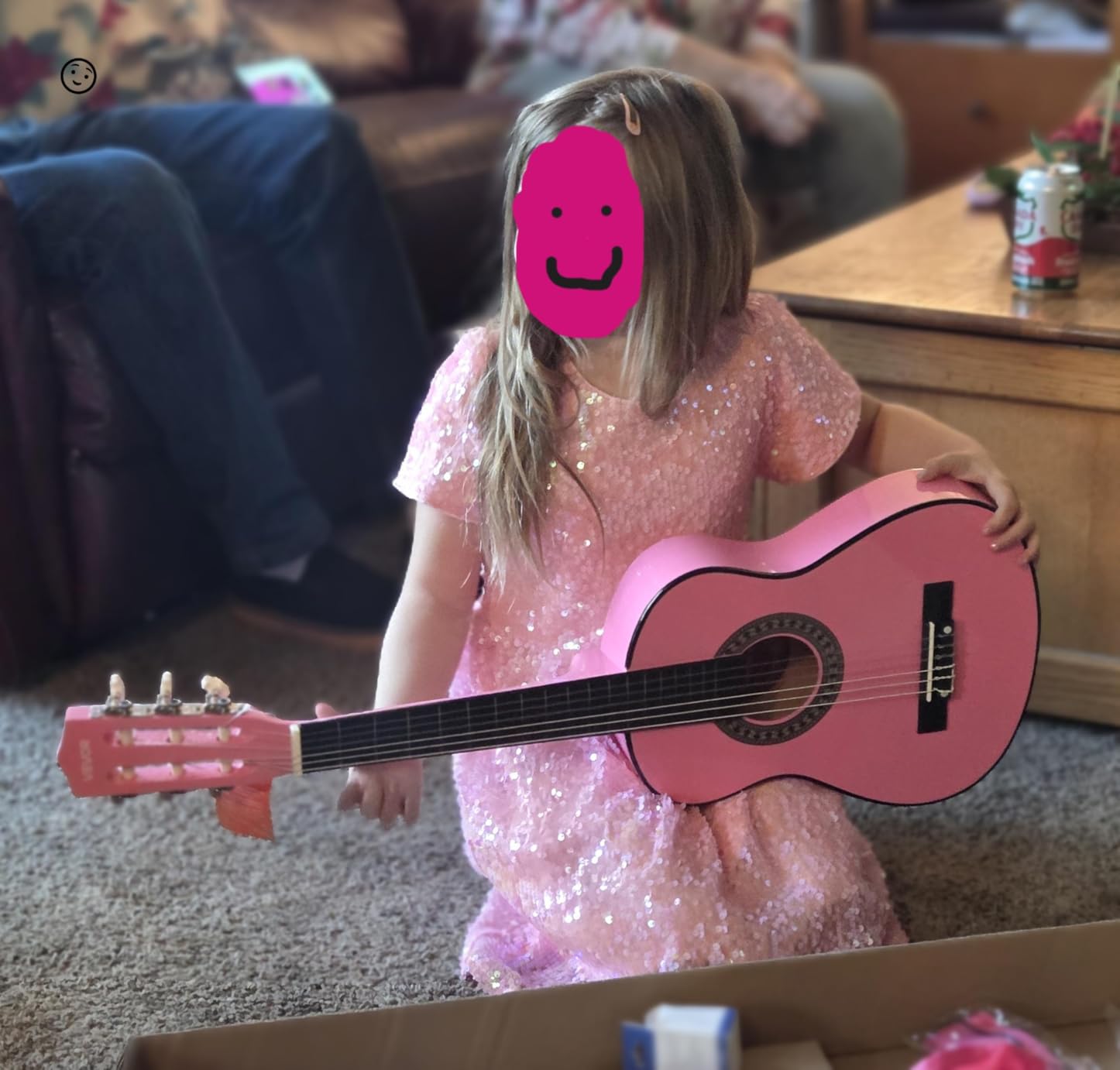
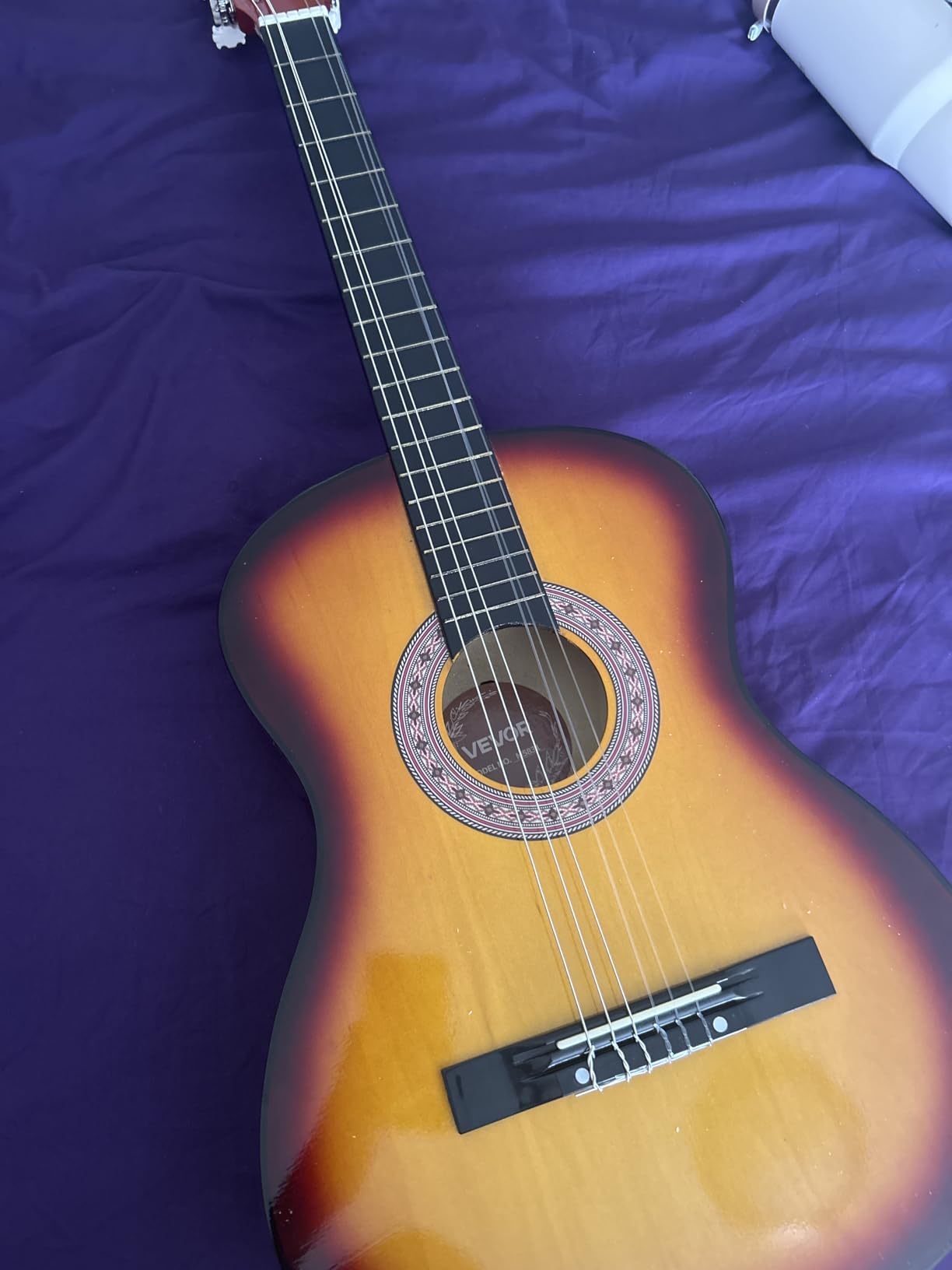
At the bottom of the price range, the VEVOR delivers a complete seven-piece set: gig bag, dust cloth, spare strings, three picks, shoulder strap, tuner and capo. The 30-inch body is basswood with maple elements, weighs 2.5 pounds, and carries high precision tuning pegs and tight string-to-fret spacing designed to keep finger fatigue down.
Owners mostly treat it as a disposable first instrument or a gift. The majority are satisfied with the completeness of the kit and with the fact that it is manageable for a child to play. The tuning pegs and close string spacing do make it easier to tune than most kits at this level.
Be clear-eyed about the ceiling, though. This model has the highest one-star share in the roundup at roughly 10 percent, with complaints about tone quality and durability relative to the price. The binding and finish wear quickly with regular handling, and the sound is entry level with modest sustain.
That is an acceptable trade for a first instrument that will be replaced, and an expensive mistake for anyone expecting a guitar to grow into. If the child is under about seven, this is a reasonable start. Above that age, a 3/4 Yamaha or the Pyle kit will hold attention far longer.
Is a cheap nylon kit a false economy?
Only if you buy it twice. The real risk is buying a kit because it is cheap, having the child outgrow it in a year, and then buying a better one anyway. If you know that is the plan, the saving is real because the first instrument gets used hard instead of being protected.
The false economy case is different: buying a cheap kit for a child who is clearly ready to progress. In that case the money is better spent on the 3/4 student model, and the kit is only worth it if you already know the size will be right for a short window.
What a low price kit still needs
Even the cheapest classical needs a proper setup before it is comfortable. A saddle height adjustment and a nut check will do more for playability than any accessory in the box. Budget for one visit to a repairer, keep the guitar away from heat sources, and expect to restring it once the strings go dull rather than twice.
10. Fender FA-25N 3/4 Nylon String Acoustic Guitar – The One With a Two Year Warranty
Fender FA-25N 3/4 Size Nylon String Acoustic Guitar, Beginner Guitar, with 2-Year Warranty, Perfect Beginner Guitar for Kids that is Easy on Fingers, Includes 3 Months of Free Lessons, Natural
3/4 size body
Agathis top with sapele back
Walnut fretboard and bridge
23.3 inch scale
Pros
- 3/4 body makes chords and fingering easier for small hands
- Soft nylon strings are a gentle introduction
- Two year manufacturer warranty
- Open gear tuning machines hold accurate tuning
Cons
- Modest tone for the money
- Shorter scale limits volume and low end
- Guitar only with no bag or accessories
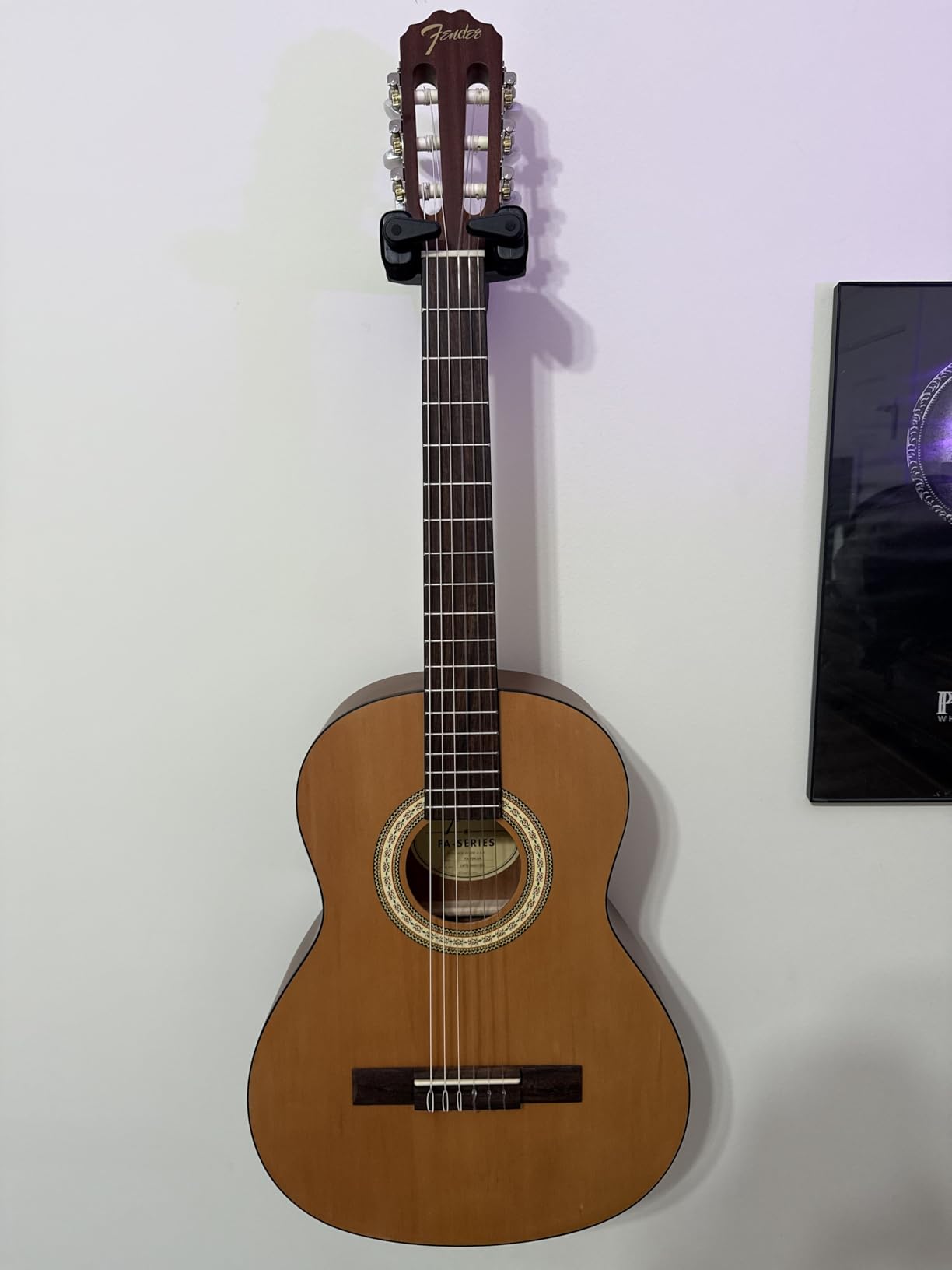
The Fender is the only instrument here with a two year manufacturer warranty, and for a first guitar bought for a child that matters more than it sounds. Two years covers most of the period when a young beginner is dropping things and the warranty period is exactly when a finish or hardware problem tends to appear.
It is a 3/4-size nylon string acoustic with an agathis top, sapele back and sides, a walnut bridge and fretboard, a C-shaped neck and super soft nylon strings. The 23.3-inch scale keeps chords and finger placement manageable for small hands, and open-gear tuning machines hold accurate tuning. Three months of Fender Play lessons come included at no extra cost.
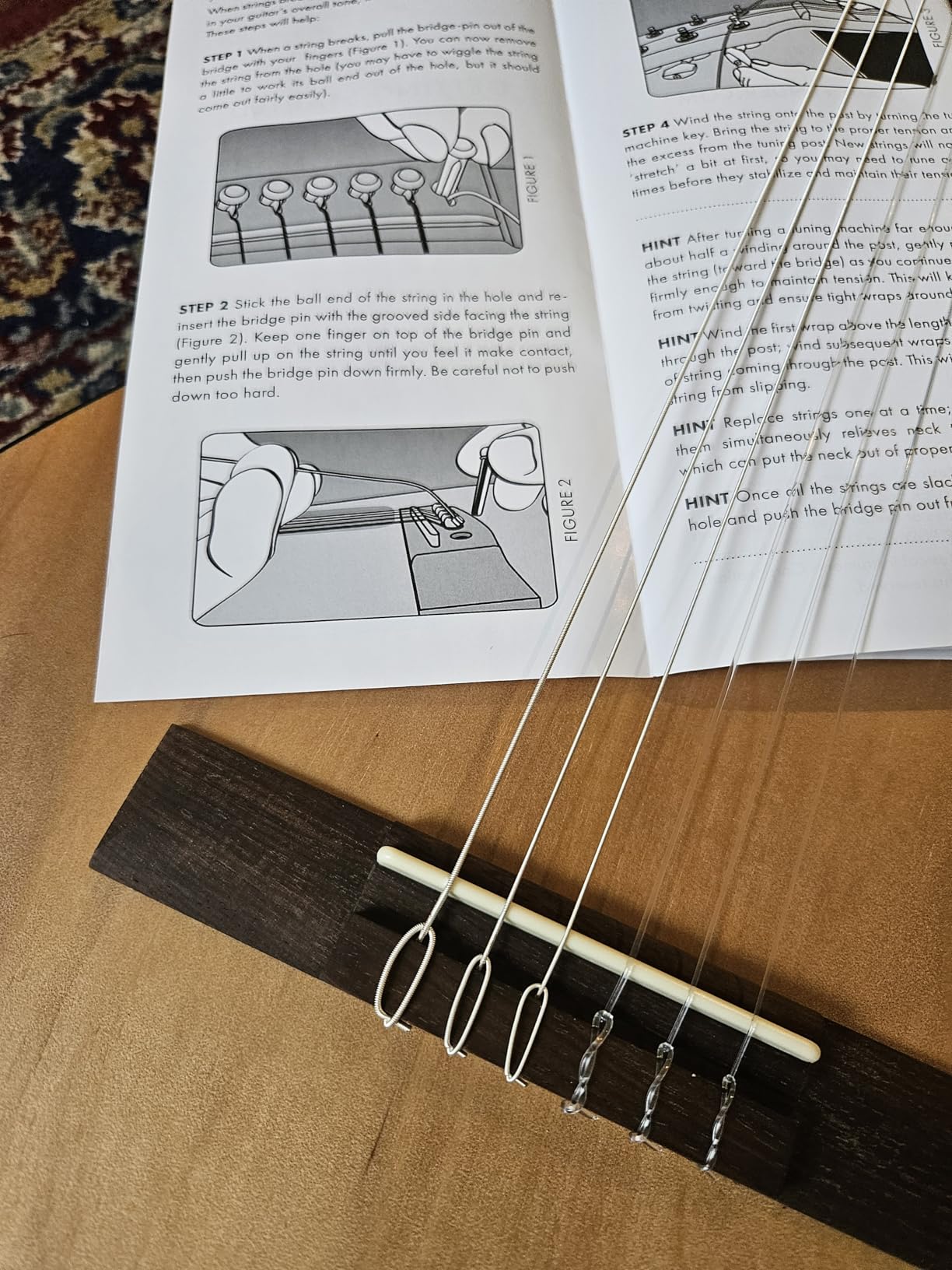
Reviewers pick this model over generic budget kits for three reasons that have nothing to do with tone: the fit for small hands, the softness of the strings, and the warranty. Those are the right priorities for someone in their first month, when sore fingertips end practice sessions.
The reservation is that the agathis top and sapele body deliver a plain, modest tone, and the shorter scale limits volume and low end projection. It also arrives as the guitar alone, with no bag, tuner or accessories, so budget for those separately.
Is a two year warranty worth more than a bundle?
For a child, frequently. Bundles solve the first week of accessories, but they solve it with thin bags and clip-on tuners that get replaced anyway. A warranty covers the whole first two years of drops, bumps and hardware settling, which is a longer and more useful window.
For an adult who already has a tuner and a gig bag, a bundle is the better value. The accessories are the difference in everyday convenience, and the warranty on a guitar that is handled carefully matters less once the fragile first year has passed.
When the 3/4 scale runs out of road
The shorter scale and smaller body limit how much sound the instrument can produce, so a student who starts playing with other musicians or accompanying a singer will hear the ceiling quickly. At that point the move is a full-size instrument such as the ADM 39-inch or the Hola! rather than a bigger 3/4.
There is no urgency in that upgrade. Many players use a 3/4 classical for years, and a full-size model is a nice-to-have for tone rather than a requirement for playing.
11. Hola! Music 39 Inch Classical Guitar – The Best Low Action Option
Hola! Music 39″ Full Size Classical Guitar, Nylon Strings, Natural Gloss
39 inch full size
Spruce top with mahogany back and sides
52 mm nut width and 19 frets
Two-way truss rod
Pros
- Low comfortable action for sensitive fingers
- Full rich tone from spruce top
- Flawless gloss finish and straight neck
- Bound fretboard removes sharp fret ends
- Padded gig bag included
Cons
- Some guitars have cheap tuning gears that break early
- Occasional sharp frets and dead sounding strings
- Gig bag is thin
- Support can be slow when hardware fails
The Hola is the one to look at if your fingers hurt. The most repeated description across its reviews is smooth, low action, and multiple owners mention playing with sensitive or arthritic fingers as their reason for buying. For a beginner whose left hand is still adapting to pressing steel-free strings for an hour, that comfort difference is everything.
It is a full-size 39-inch guitar with a spruce top, mahogany back, sides and neck, a walnut fretboard, 19 frets and a traditional 52 mm nut width, plus a two-way truss rod with an included Allen key. The bound body and fretboard eliminate the sharp fret ends that show up on cheaper models, and a padded gig bag is included rather than sold separately.
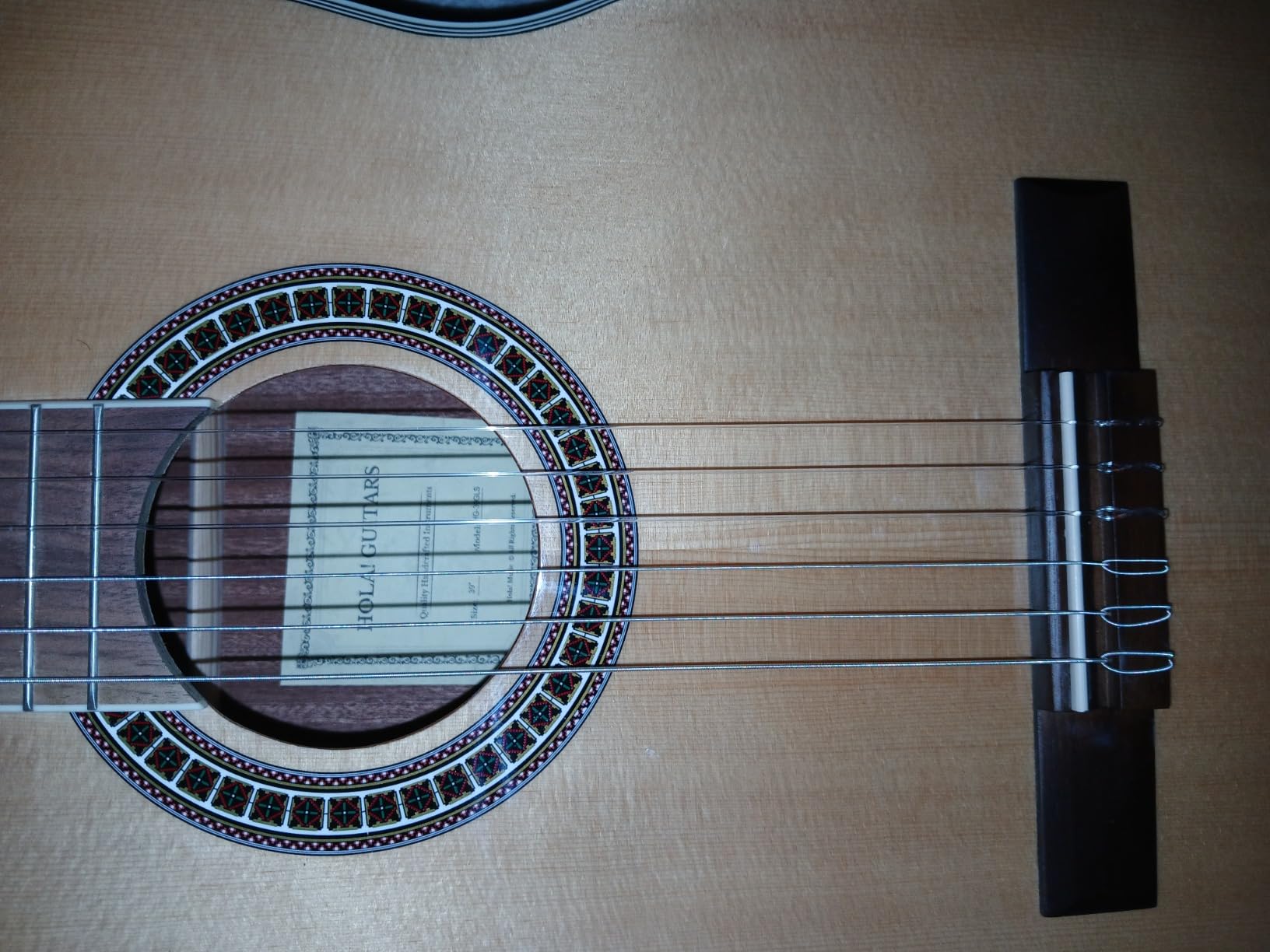
Long-term owners return to this guitar, and several buy a second one, which is a strong signal for something at this level. They praise the smooth low action, the warm tone from the spruce top, and the finish quality above the Yamaha and Fender alternatives at similar money.
The failure mode to know about is the tuning hardware. A minority of buyers report cheap pot-metal tuning gears that break during the first string change, plus occasional sharp fret edges and strings that will not ring true. Customer support is also described as slow when hardware fails, so check the gears early and often in the first month.
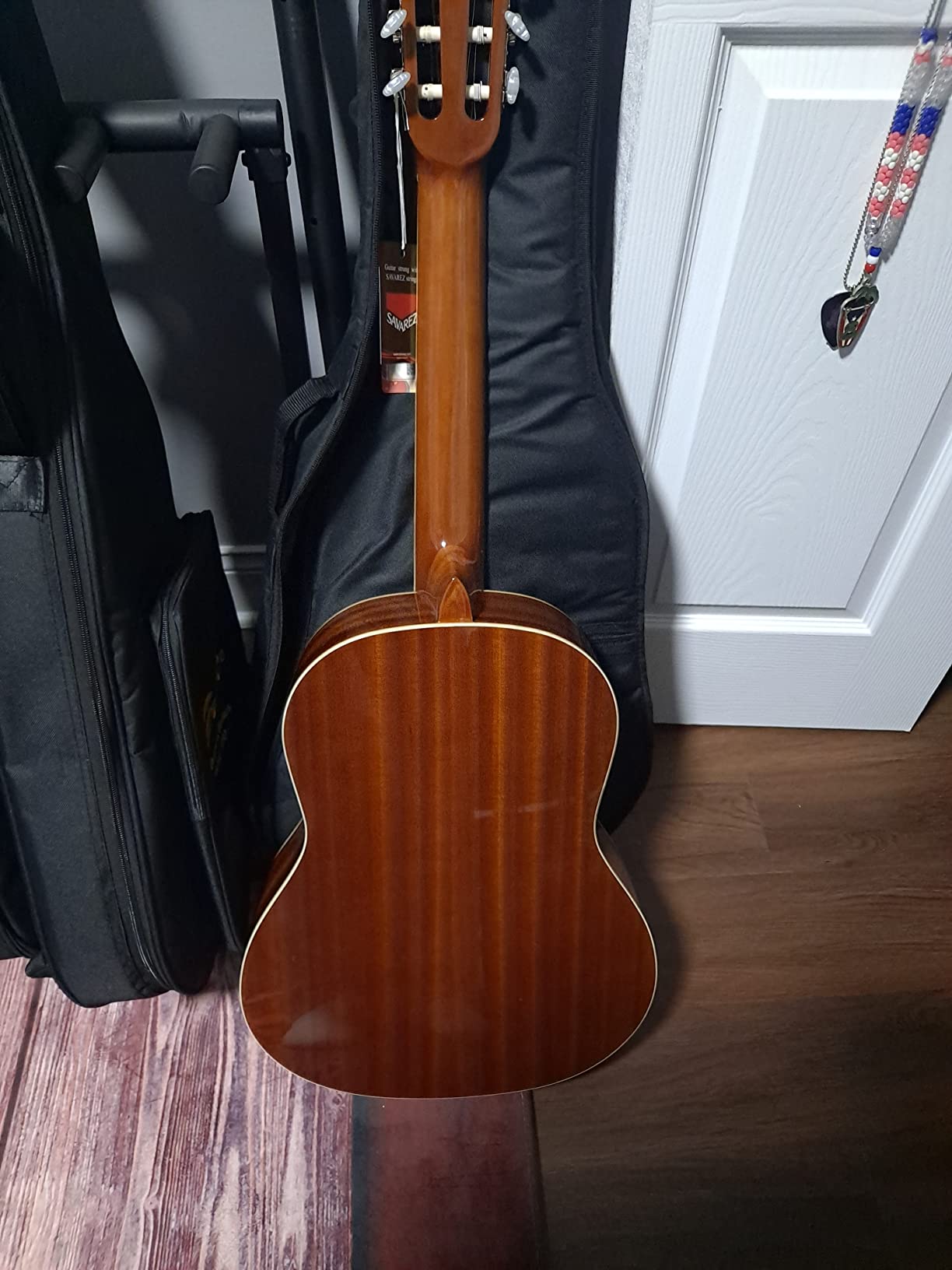
Is low action worth prioritising over tone?
For the first six months, yes. Action determines how hard you press, how long you can play before your hand gives out, and whether practice is something you look forward to. A guitar that hurts is a guitar you stop playing, and no amount of tone quality compensates for that.
After that, tone starts to matter more, particularly once you are learning pieces where you want a fuller sound. The good news with this model is that you are not choosing one over the other, because the spruce top gives a full, rich, mellow tone as well.
What to inspect before the first lesson
Check the tuning machines by turning them through their full range and watching how they feel, because that is the part most likely to fail on this model. Run a finger along the frets for sharp edges, confirm the strings ring cleanly, and keep the included Allen key somewhere obvious so the truss rod adjustment is something you can do.
12. Vangoa 39 Inch Classical Guitar Bundle – The Most Attractive Complete Set
Classical Guitar 4/4, 39 Inch Full Size Nylon String Guitar for Beginner Adults, Guitar Bundle with Gig Bag & Footstool, Sapele Brown, by Vangoa
39 inch sapele body
Mahogany C-shape neck
Laminated fretboard
Engraved vintage headstock
Pros
- Bright balanced tone with a wide dynamic range
- C-shape neck and smooth fretboard suit adult beginners
- Very complete bundle ready to play
- Engraved headstock and antique inlay
Cons
- Laminated fretboard is less premium than solid timber
- Small review base so long term reliability is less documented
- Sapele tone is brighter and less warm than spruce or cedar
The Vangoa is the best-looking instrument in the group, and the highest rated at 4.6. The engraved vintage headstock, antique inlay and ABS shock-resistant binding give it an appearance that reads as far more expensive than the entry-level price band it sits in, and that matters when the person playing it is an adult who wants an instrument they are proud to have on the sofa.
Under the styling it is a 39-inch 4/4 guitar with a sapele top, back and sides, a mahogany C-shape neck, a smooth laminated fretboard and open high-precision tuning knobs. The woods are air-dried for up to five years, which the maker credits for resonance, and the tone is described as bright, clear and wide in its dynamic range.
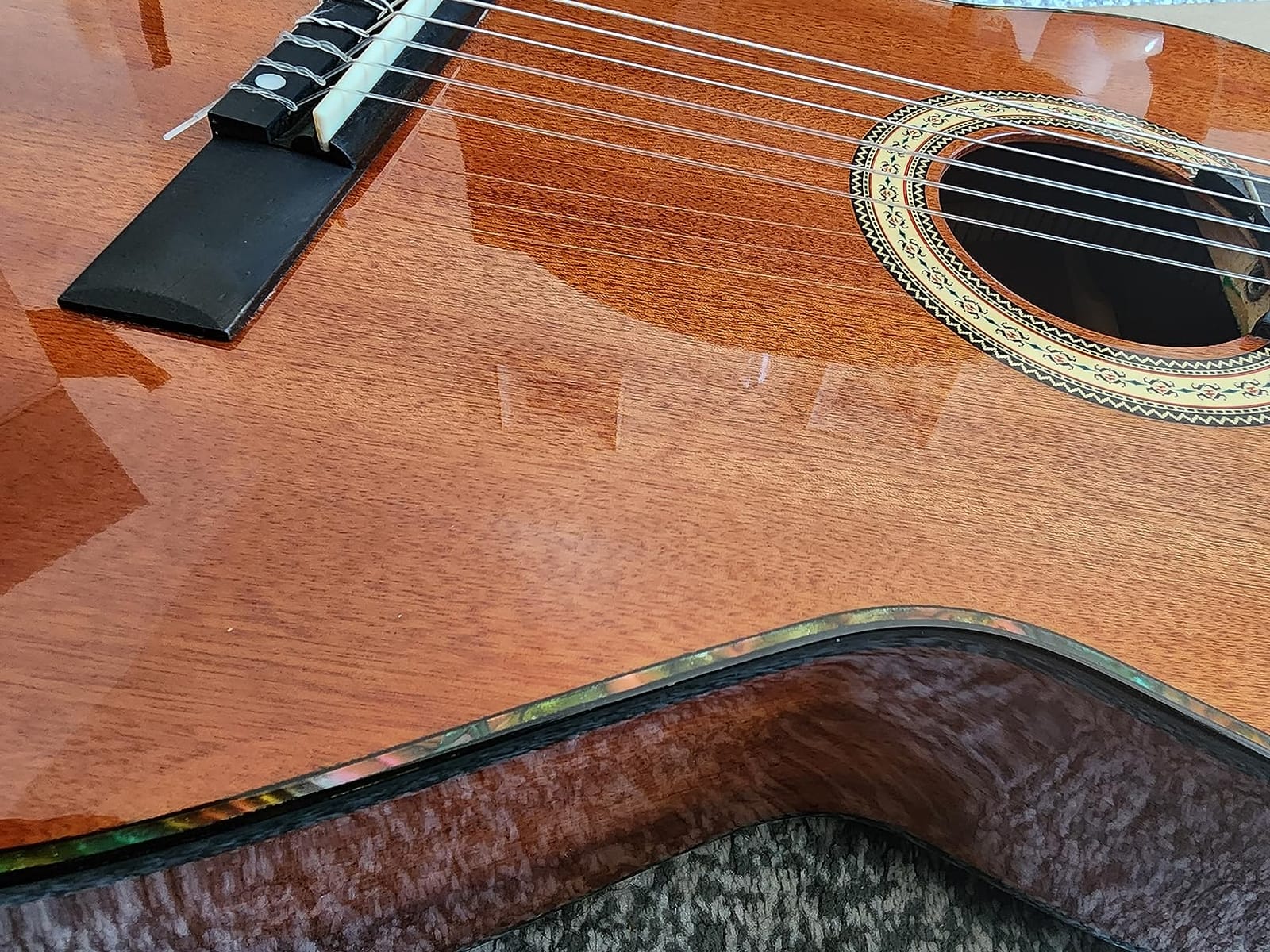
The bundle is the most generous of the full-size models: tuner, capo, cleaning cloth, manual, picks, spare strings, accessory pouch, footstool and strap, plus a gig bag. Nothing needs buying before the first lesson, which removes a decision entirely from day one.
Two honest cautions. The review base is 125, the smallest here, so long-term durability is less well documented than the Yamaha models where years of reports exist. And a laminated fretboard is a step down from solid timber, while the sapele tone is brighter and less warm than traditional spruce or cedar.
Does a bright top suit a beginner better than a warm one?
Neither is more correct, but they behave differently under the fingers. A brighter top articulates faster, so the notes you just fretted cut through clearly, which helps a beginner hear whether each finger landed properly. A warmer top rounds the edges and sustains longer, which is easier on the ear once technique is settled.
For the first year, articulation is arguably the more useful trait, and the Vangoa’s wide dynamic range means you can practise quietly and play loudly without a volume control. That is a genuine advantage over cheaper guitars that only sound good at one level.
What a small review base means for you
It means less evidence about how it holds up over a decade, not that there is anything wrong with it. The 72 percent five-star share and only 1 percent one-star share suggest very little polarisation, so the risk is not a known fault, it is simply less history. If you keep guitars for many years, the Yamaha models are the safer bet on that basis alone.
How to Choose Your First Classical Guitar
Most disappointing first guitars are not bad guitars. They are the wrong size, badly set up, or bought for a player who was going to outgrow them in eight months. Here is how to avoid each of those outcomes, using the models above as worked examples.
Size first, everything else second
Size is the one decision that cannot be fixed later, and it is the one beginners get wrong most often. The practical test is whether the player’s hand can span the first four frets while the thumb sits behind the neck without the wrist bending. If it cannot, a smaller body will make everything else easier.
Map it roughly like this. A 30-inch body suits children of about four to seven, and the 34-inch and 36-inch sizes cover roughly seven to eleven and up. The 39-inch full-size models fit most adults and older teens. Our guide to kids guitars by age covers the child sizing decisions in more detail.
Buy the largest size the player can comfortably fret rather than the smallest size they can grow into. A child who has to stretch for every note stops practising, and no amount of build quality compensates for that.
Laminate versus solid top, and what actually changes
A laminate top is a thin layer of spruce or similar wood bonded to a cheaper backing. A solid top is a full-thickness plank of tonewood. The difference is that a solid top responds to pressure and vibration in a way a laminate largely does not, so it gets louder, richer and more responsive as it is played, and it is the reason a solid-top guitar can sound noticeably better after a year.
For a brand new beginner, that development happens after the technique is there to use it. Most players spend their first six months working on chord shapes and clean finger placement, and a well-set-up laminate will not slow them down. Solid top matters more for a player who already plays and wants a better sound, or for a student whose teacher specifically asks for one.
Two models here have solid tops. The ADM full-size guitar has a solid spruce top with scalloped X bracing, and the Hola! uses a spruce top. Both also carry truss rods, which is why they cluster at the more considered end of this list.
Spruce versus cedar tops
Spruce is bright, clear and holds its tuning well, which makes it the common choice for players who will eventually play louder and more percussive styles. Cedar is warmer and rounder with a quicker response, and many classical players prefer the way it sits under the fingers.
For a first guitar, both are defensible. Choose spruce if the plan is to move toward flamenco or a broader folk repertoire later, and cedar if the plan is classical repertoire in a room rather than on a stage. Do not agonise over it. The size and the setup affect how the guitar feels far more than the tonewood does.
Why a truss rod matters more than most guides admit
A truss rod lets you adjust neck relief without removing the strings, which matters because the neck on a classical guitar is under constant tension and the wood moves with humidity. Without a rod, that movement is only correctable by a repairer. With a rod, a beginner can make a quarter turn of adjustment and solve the problem themselves.
Four models here have one. The ADM full-size guitar and the Winzz have dual-action rods, and the Hola! has a two-way rod with an included Allen key. If your guitar lives in a room with heating, air conditioning, or big seasonal swings, that is a real advantage. If it lives in a stable room, it is a nice-to-have rather than a deciding factor.
What to check when the guitar arrives
Run through this before the first lesson rather than after. Check that all six strings are fitted and the guitar is close to in tune, look along the neck from the headstock to see whether it is straight, and press each string at the third fret to look for buzzing at the nut.
Next, check the action at the twelfth fret. If you cannot slide a sheet of paper under the strings, they are too high for a beginner. Finally, run a finger along the fret ends, because sharp fret edges cause painful blisters and are present on several models here. None of these checks takes more than ten minutes, and all of them are fixable by a repairer.
Strings and the first month of tuning
New nylon strings stretch, and almost every review on this page mentions the settling period. Two to four days of twice-daily tuning is normal for a budget kit, and up to a month for the cheapest hybrids. Once the strings stop stretching, the guitar holds pitch, and this is not a defect.
Budget models arrive with basic strings, and several owners replace them. Use a normal-tension nylon set rather than high tension in year one, and do not mix gauges. On hybrid kits such as the 30-inch models, check the maker’s specification before fitting any replacement set.
When a used guitar is the smarter buy
A used market route gives you access to solid-top and higher-tier instruments at entry-level money, and the trade is setup cost and unknown history. Look for a straight neck, an even gap at the twelfth fret, no cracks around the sound hole, and tuners that move smoothly. Budget a full setup regardless of condition, because almost every used guitar needs one.
Buy used only if you can play the instrument in person, or if the seller can provide clear photographs of the neck angle and the fretboard. Blind purchases carry more risk than the money saves, especially at the low end where a damaged soundboard is not repairable.
Frequently Asked Questions
Are classical guitars good for beginners?
Yes. Nylon strings put far less pressure on developing fingertips than steel, and the wider 52mm nut width gives each finger enough room to press a string without touching its neighbour. Most teachers start students on a classical instrument for that reason, and the fingerstyle technique carries over to acoustic and electric playing later.
What size classical guitar should a beginner buy?
Buy the largest size the player can comfortably fret. Children aged four to seven usually manage a 30-inch body, roughly seven to eleven suits 34-inch and 36-inch instruments, and adults and older teens should look at 39-inch full-size models. If the hand cannot span the first four frets without contorting the wrist, size down.
Is a Yamaha C40 a good guitar for a first instrument?
It is one of the most recommended beginner classical guitars, holding a 4.5 average across 1649 reviews. Owners praise the rich tone, the firm tuning pegs and the consistent build quality. The two things to know are that it has no truss rod, so neck relief cannot be adjusted, and some examples arrive with action that needs saddle work.
Is a Cordoba Protege a good guitar?
The Protege line is widely recommended as an entry point because it upgrades finish and hardware over the standard models at a similar spending level. It did not make our final twelve because the available models here either cost more for less documented reviews or shipped with fewer accessories, but the reputation among owners is solidly positive.
Is Alvarez a good classical guitar brand for beginners?
Alvarez is a well established name in classical guitars and its Regent series is frequently called out as a hidden gem for consistent quality control at the entry level. We did not include a Regent model in this roundup because we could not verify current review data for one, so treat the reputation as useful background rather than a tested recommendation here.
What accessories do I need for a first classical guitar?
At minimum a clip-on tuner, a gig bag and a footstool, plus a spare set of normal-tension nylon strings. A humidifier matters if the guitar lives in a dry or heated room. Models bundled with a footstool, such as the ADM full-size and the Vangoa set, cover the awkward parts of starting from scratch.
Can I learn classical guitar on my own without a teacher?
You can make steady progress alone, because nylon strings are forgiving and the repertoire is available in tablature and standard notation online. A teacher mainly shortens the first few months by correcting hand position and nail technique early. If money is tight, spend it on one hour of setup advice rather than on lessons you cannot sustain.
What strings should a beginner use on a classical guitar?
Start with a normal-tension nylon set rather than high tension, because high tension raises the action and the fretting effort. Never fit steel strings to a classical guitar. On hybrid kids kits with three steel and three nylon strings, check the maker specification before replacing the set, and expect to restring once rather than twice in the first year.
Final Verdict
After working through twelve beginner classical guitars, the Yamaha C40II is still the pick for an adult starting lessons in 2026. It is not the fanciest instrument here and it will not develop a solid top, but its even build, firm tuning pegs and deep pool of owner experience mean fewer surprises in the first six months than anything else in the group.
If the player has smaller hands, the Yamaha CGS103AII is the better buy and the highest rated of the twelve. For a child under about seven, the MasterPlay 30-inch or the VEVOR kit will do the job for a year or two, and for a young student who wants a real classical with a proper neck, the Pyle 3/4 kit is the most complete single purchase. Whatever you choose, budget for one setup visit and for a fortnight of tuning before judging it.