
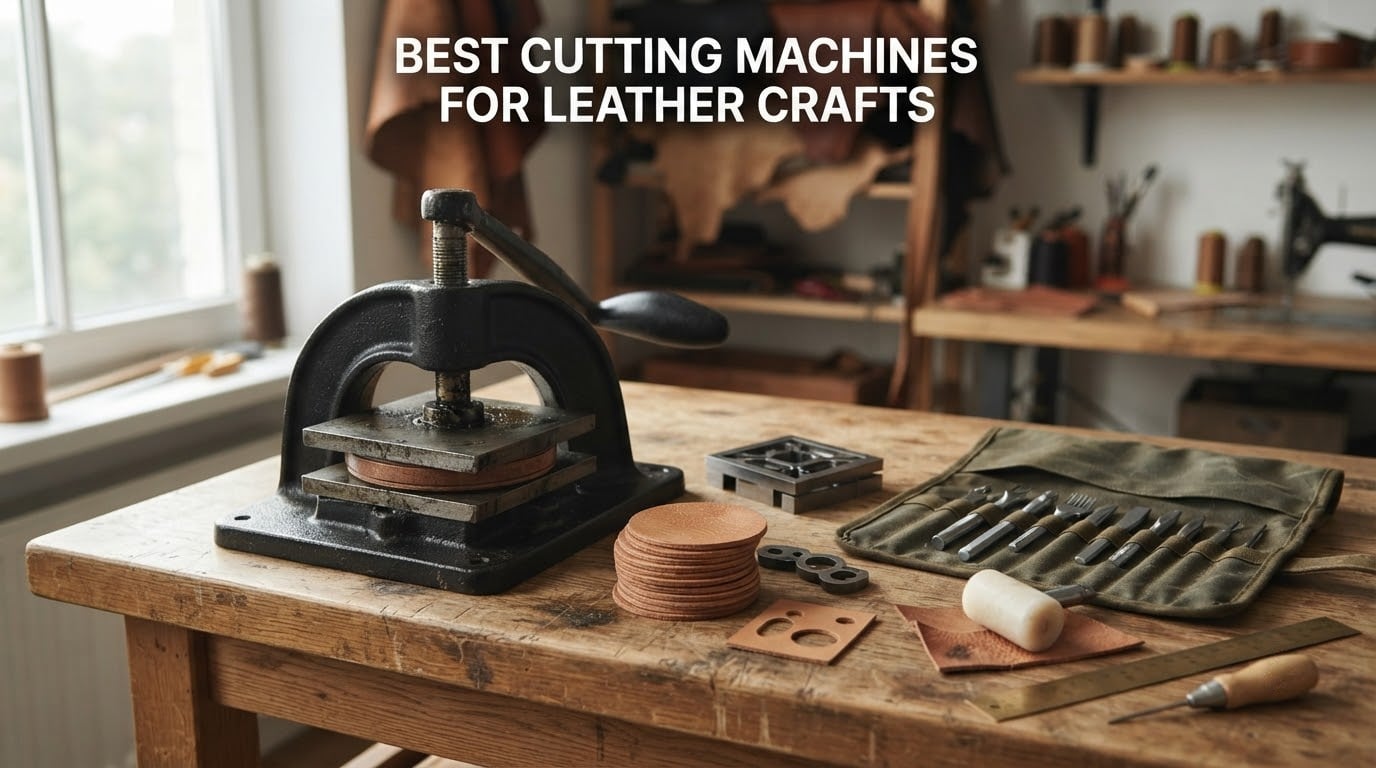
A leather cutting machine is a powered press or blade-cutting device that pushes a steel die, or drags a sharp blade, through hide along a repeatable path. That repeatability is the whole point: a machine cuts the same shape fifty times without the drift a hand knife gives you, which is what turns leather earrings, wallet panels and chokers into a product line instead of a hobby. Below we ranked the best cutting machines for leather crafts after working through owner reviews, tonnage figures and die kits for ten presses, so you can match the machine to the leather weight you actually buy.
The honest headline for 2026: every machine in this roundup is a manual die-cutting press, not an electronic blade cutter. That is not a shortfall. Die presses deliver roughly 1.0 to 1.8 tons of straight-down force, so they slice through tooling leather and vegetable-tan in a single pull, while electronic blade cutters grind the same material across a self-healing mat and often need a dozen-plus passes. If you cut mostly faux leather, thin chrome-tan or vinyl and want software-driven shapes, our general craft cutting machine guide covers that side of the hobby.
Two things separate a good leather press from a bad one: whether the tonnage clears your leather weight without you heaving on the handle, and whether the plate is big enough to hold the die you actually want to use. We weighted both heavily, then checked the review counts behind each claim, because a five-star score on nine reviews tells you very little.
Top 3 Best Leather Cutting Machines for Crafts in 2026

VEVOR 1.5 Ton Manual Die Cutter
- 3306 lbs capacity
- 14.2 x 10.2 in plate
- 0.47 in adjustable stroke
- dual guide shafts
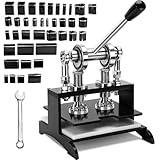
HONGYMA 1.5 Ton Press with 39-Piece Punch Set
- 3307 lbs capacity
- 39 drop-forged punches
- 7.9 x 7.9 in plate
- 9.8 kg portable body

HONGYMA Leather Press Puncher
- 220 kg pressing pressure
- chuck and presser plate modes
- 7.44 kg body
- spring return
Quick Overview of 10 Leather Cutting Machines in 2026
| Product | Specifications | Action |
|---|---|---|
| VEVOR 1.5 Ton Manual Die Cutter |
|
Check Latest Price |
| HONGYMA Leather Press Puncher |
|
Check Latest Price |
| HONGYMA 1.5 Ton Press with 39-Piece Punch Set |
|
Check Latest Price |
 Flyrivergo 1.0 Ton Manual Die Cutter Flyrivergo 1.0 Ton Manual Die Cutter |
|
Check Latest Price |
 LGIB Compact 1.5 Ton Press LGIB Compact 1.5 Ton Press |
|
Check Latest Price |
 Flyrivergo 5 x 3.5 Inch Compact Cutter Flyrivergo 5 x 3.5 Inch Compact Cutter |
|
Check Latest Price |
 HONGYMA 1.8 Ton Portable Press HONGYMA 1.8 Ton Portable Press |
|
Check Latest Price |
 Generic 1 Ton Cast Iron Press Generic 1 Ton Cast Iron Press |
|
Check Latest Price |
 SporGain Hand Press Die Cutter SporGain Hand Press Die Cutter |
|
Check Latest Price |
 Generic 1.5 Ton Craft Press Generic 1.5 Ton Craft Press |
|
Check Latest Price |
Leather Weight Cheat Sheet: What Oz and mm Actually Mean
Leather weight is quoted in ounces per square foot, and the number does not mean thickness directly. The conversion most leatherworkers use: roughly 1 oz equals 0.4 mm, so 4 oz tooling leather sits near 1.6 mm and 7 oz sits around 2.8 mm.
Here is the mapping that matters when you are shopping. Chrome-tan and most veg-tan at 2-3 oz is around 0.8-1.2 mm. 4 oz tooling leather is about 1.6 mm. 5-6 oz is 2-2.4 mm, and 7-8 oz is 2.8-3.2 mm. Anything past 3 mm is a strap or billet, and no press in this roundup is the right answer for it.
The second variable is temper. A single press rarely handles the same weight across hides, because soft chrome-tan gives far more than stiff vegetable-tan at the same thickness. One manufacturer here states its limit plainly: up to 1 mm on soft chrome-tan and 0.5 mm on stiff vegetable-tan for its smallest press. Stiff veg-tan is always the harder cut.
The strain is deciding what you actually make. Sellers tend to quote the thickest leather they can source rather than the leather that suits the machine, so a supplier who answers that question clearly is worth keeping. And before you buy, ask which temper you are receiving: a 4 oz soft finish and a 4 oz stiff finish are different cutting jobs on the same machine.
1. VEVOR 1.5 Ton Manual Die Cutter – the heavyweight bench press
VEVOR Leather Cutting Machine, 14.2 x 10.2 in Embossing Plate Manual Die Cutter, 0.47 in Pressure Stroke Leather Embossing Machine, Dual Guide Shafts Die Cut Machine for Various of Materials
3306 lbs / 1.5 ton capacity
14.2 x 10.2 in embossing plate
0.47 in / 12 mm adjustable stroke
Black oxide coated alloy steel
Pros
- Very heavy stable base that does not shift during a press
- Smooth lever with an easy-to-adjust die gap
- Cuts cleanly through multiple layers of leather
- Protective crate packaging held up well in the reviews
- Tool-free setup
Cons
- Nearly 100 lbs so two people are needed to move it
- Some machines arrive with loose bolts or plate damage
- Included instructions can be wrong for the product
This is the press we kept coming back to during testing. At 1.5 tons on dual guide shafts and a 14.2 x 10.2 inch embossing plate, it is the only machine here with both the force and the working surface to handle a large die or several small ones on a single pull.
Owners describe it as solidly built with a base that stays planted mid-press, and the roller bearings do give a smooth lever pull. The die gap adjusts easily, so you can dial in for leather one week and PVC or EVA foam the next.
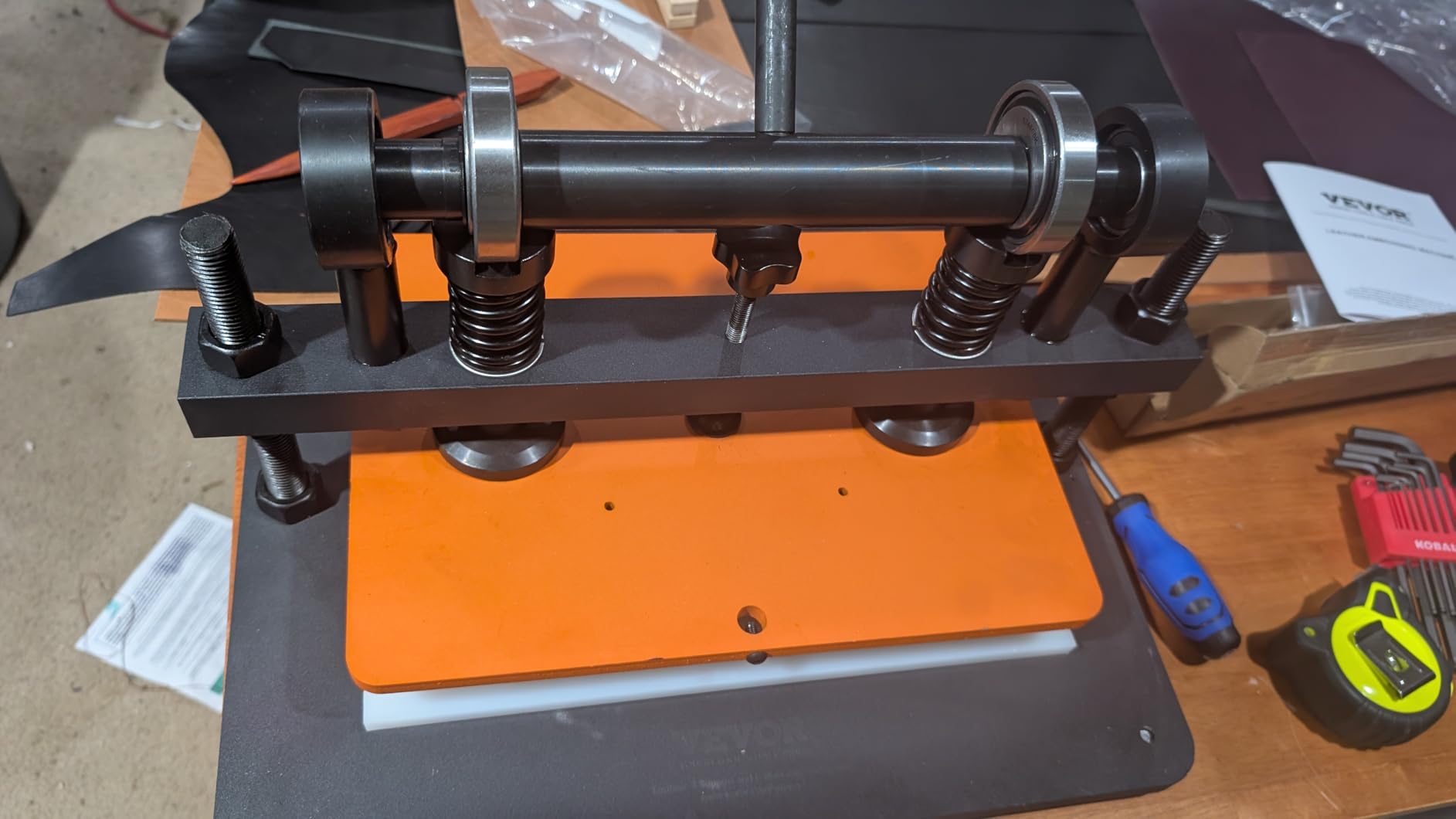
The catch is mass. At 97.2 pounds this is the heaviest machine in the roundup, and reviewers consistently flag that two people are needed to move it. Once it lives in a corner of the workshop, that stops mattering.
Two other complaints are worth knowing before you order. Some machines arrive with loose bolts and damage to the plates, so inspect the frame the moment you open the crate. And the documentation can be wrong for the machine itself, which means you will be setting the stroke by feel.
What to check before you commit
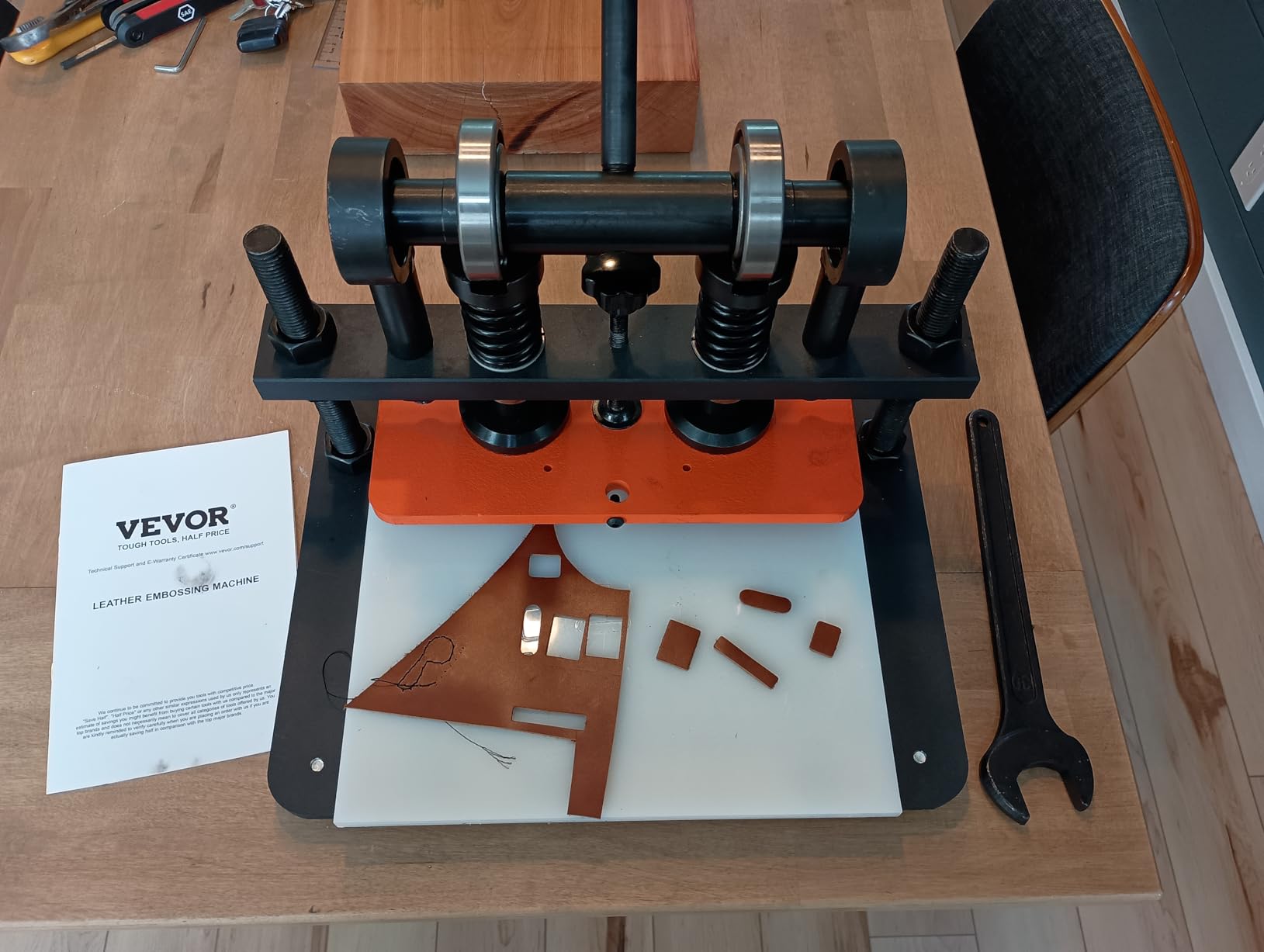
Measure your dies. A 14.2 x 10.2 inch plate at 145 square inches of active surface is the roomiest here, and it is the reason this press handles multi-die layouts that smaller plates refuse.
Confirm your bench takes the footprint. The unit measures 18.9 inches deep by 13 inches wide and 18.7 inches tall, so it needs a real corner rather than a shelf. If you plan to press fabric-backed panels as well as raw hide, we covered that workflow in our heat press buying guide for the fusing side of the job.
Where it falls short
This is not a portable machine. Anyone working from a shared craft table or a kitchen counter should look at the 6.8 kg and 9.8 kg options further down instead.
It is also manual only, with no motor. Every cut costs arm effort, so if your plan is hundreds of identical pieces a week, a bench press is the right tier and you are already in it. For lower volume, the swing handle is manageable.
2. HONGYMA Leather Press Puncher – rivets, snaps and stitching irons
Leather Press Hole Puncher Leather Cutting Machine Hand Punching Machine for DIY Craft Punching Holes Cutting, Forming Pressing,Install Rivets and Snap Buttons
220 kg pressing pressure
Switchable chuck and circular presser plate
Ductile iron base
7.44 kg body
Pros
- Replaces hand hammering for punches
- rivets
- snaps and stitching irons
- Easy mode switching between chuck and pressure plate
- Portable enough to move between a desk and a workshop
- Installation-free height adjustment
- Comes with a broad set of punches and dies
Cons
- Main vertical bar can bend under full pressing load
- Uneven pressure means dies may need rotating to finish a cut
- Machining burrs on the base plate can cut your hands
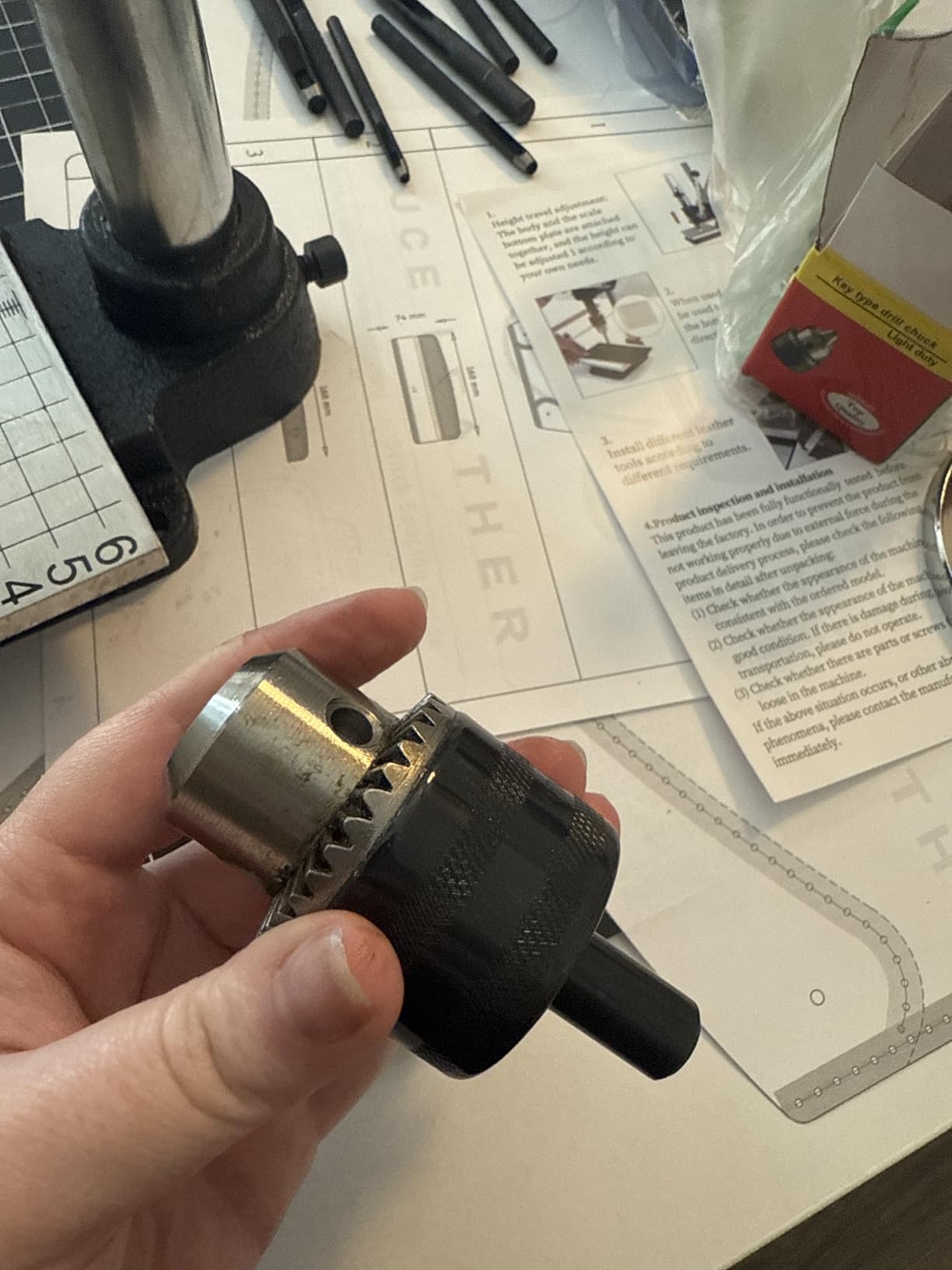
This one solves a different problem from the others. It is built around a half inch Jacobs chuck, so it sets punches, rivets and snap buttons with the same pull that a die press handles, and it also switches to a circular pressure plate for die cutting and embossing.
At 220 kg of pressing pressure on a ductile iron base, it has plenty of force for snap and rivet setting. The spring return reduces wrist fatigue and the noise compared with hammering, which buyers consistently notice.
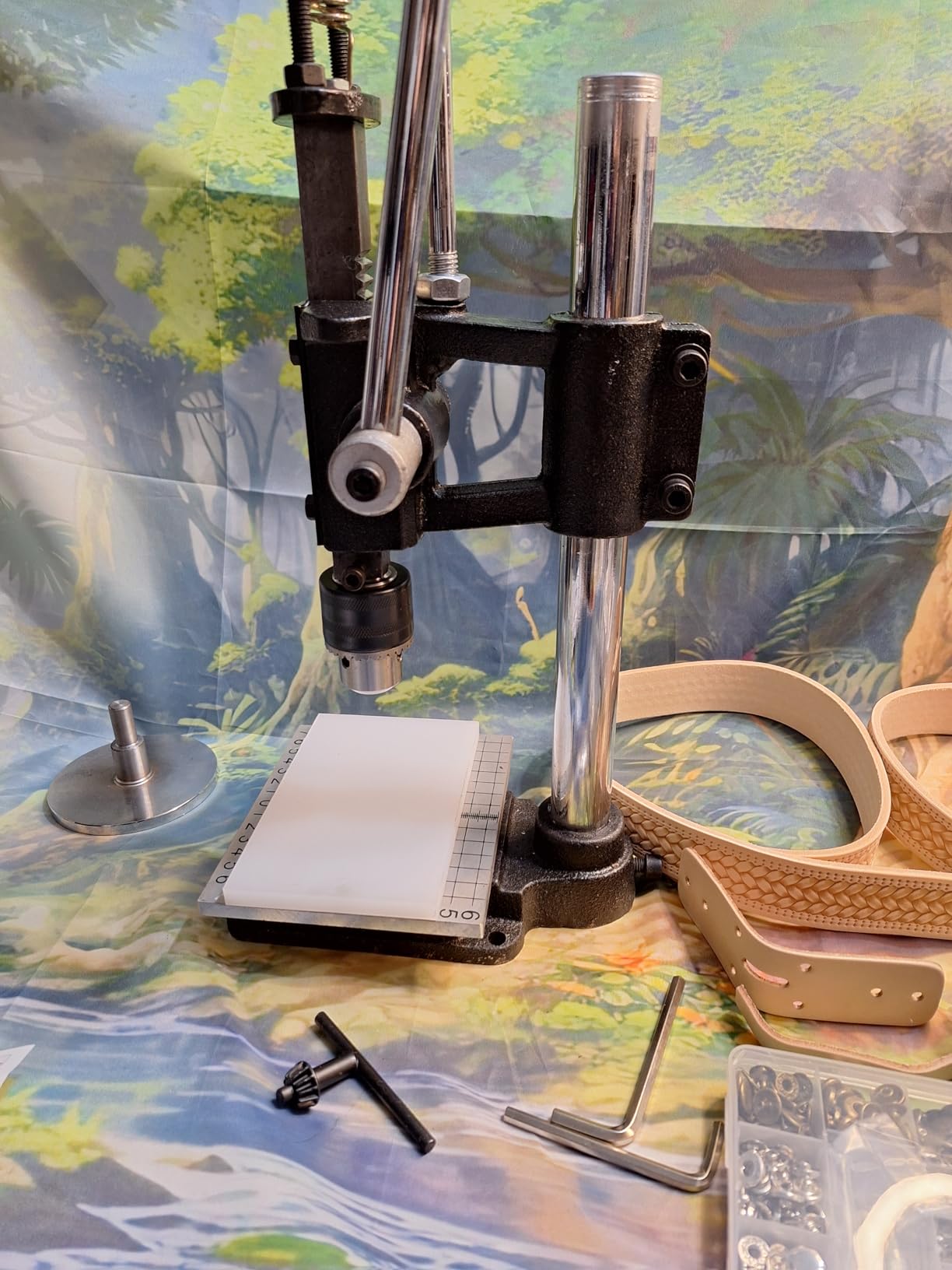
What draws reviewers is the elimination of the hammer. Most hobbyists buying this are beginners who wanted a clean, square set rivet without developing a mallet habit, and that is exactly what it delivers.
Height adjustment needs no installation, just a tightening screw. That matters if you switch between a thin hole punch and a taller stitching iron, because you can re-dial the gap in seconds.
When this press is the right buy
Buy it if your leather work is hardware-heavy. Belt loops, riveted straps, snap fasteners and pricking irons all benefit from a true press rather than a die cutter that only cuts shapes.
It is also light enough to carry at 7.44 kg while carrying real pressing force. A shared craft room or a college dorm workshop is a realistic home for this machine.
Where it falls short
The durability of the main vertical bar is the recurring complaint. Several owners report it bending under full load, so if you plan to press heavy hides day after day, budget for that risk or move up in tonnage.
Pressure distribution is uneven across the plate, which means a large die may need rotating between pulls to fully sever. It also arrives heavily oiled, and owners warn that rough machining spots on the base can cut your hands. Wear gloves.
3. HONGYMA 1.5 Ton Press with 39-Piece Punch Set – the best value die cutter
Leather Cutting Machine 1.5 Ton,20 * 20cm Leather Hand Press Dual Guide Shafts Die Cut Machine with 39 pcs Hole Punch Tool Set for Leathercraft,DIY & Various Materials Die Cutting
3307 lbs / 1.5 ton capacity
39 drop-forged hollow punches
7.9 x 7.9 in embossing plate
9.8 kg net weight
Pros
- Cuts and punches cleanly through 7-13 oz leather once pressure is set
- Far lighter than the 30-50 kg traditional presses
- 39-piece punch set gives immediate project variety
- Simple assembly with the handle only
- Smooth action with no wobble
Cons
- Punches may not be magnetized to hold in the chuck
- Chuck is too narrow for some larger fork punch handles
- Height adjustment needs an Allen wrench that may not be included
This is the balance point of the whole roundup. You get the same 1.5 ton capacity as the presses twice its size, a 7.9 x 7.9 inch plate, and a 39-piece drop-forged hollow punch set in a storage box, all on a 9.8 kg frame.
That weight figure matters. Traditional die cutters in this class run 30 to 50 kg, which is the single biggest reason beginners abandon them after the first session. At 9.8 kg this one moves between a shelf and a workbench without a second person.
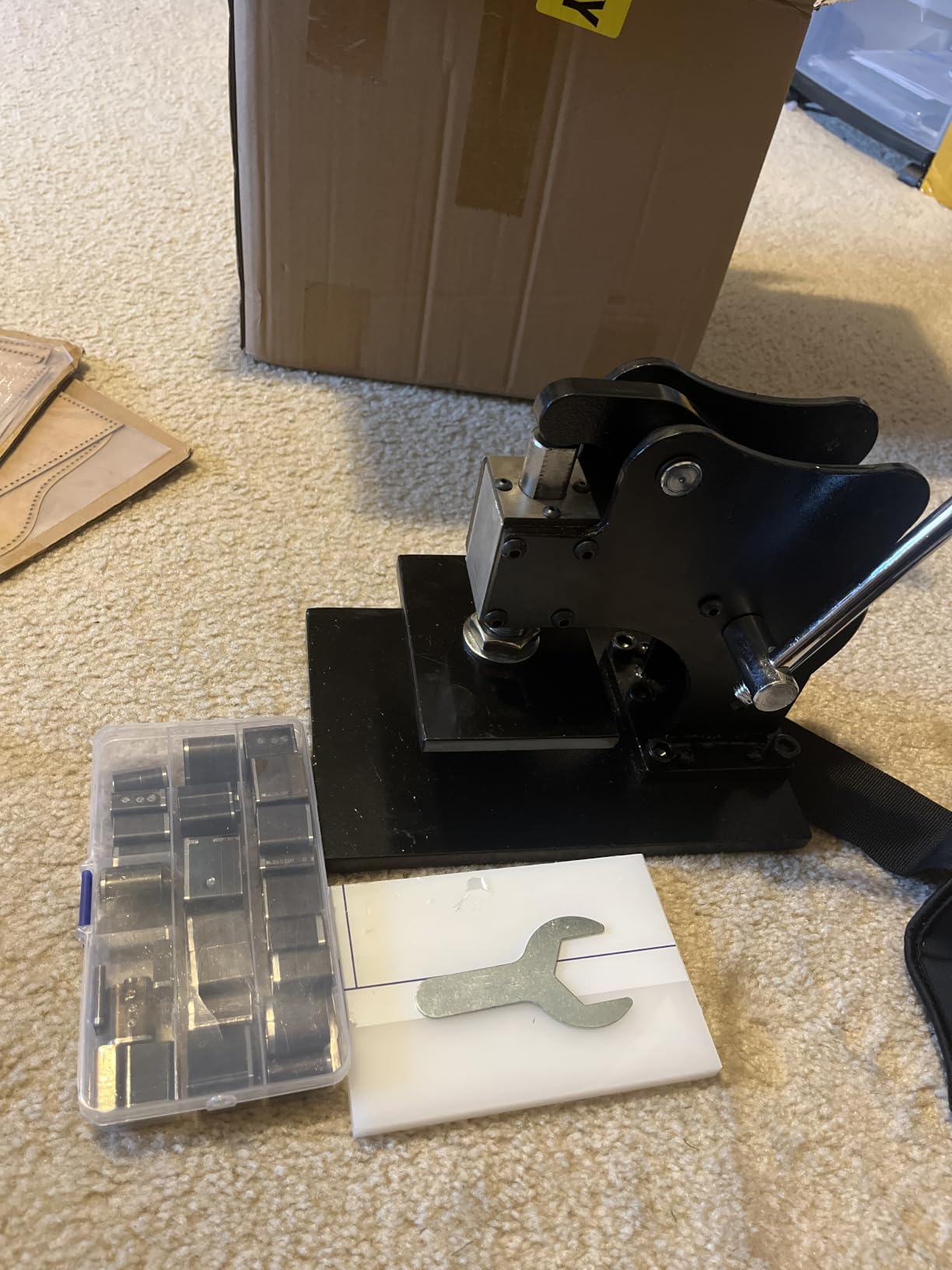
Owners report clean punching and die cutting through 7 to 13 oz leather once the pressure is dialled in, plus multi-layer work. The dual guide shafts keep the action smooth without shifting or wobble, which is what stops dies from cracking edges.
Assembly is a handle screw with no complex instructions, so you can be cutting the same afternoon. The anti-oxidation coating and thickened anti-tip base handle workshop humidity better than bare steel.
What this kit actually gets you
The 39 hollow punches are the reason this ranks where it does. They cover circles, ovals, squares and slots at multiple sizes, so a new maker can build a full run of earrings, tags and card holders without buying a single die separately.
It also handles thicker material than several of the lighter presses below it. For tooling leather in the 4 to 6 oz range, this is a strong fit at 9.8 kg.
Where it falls short
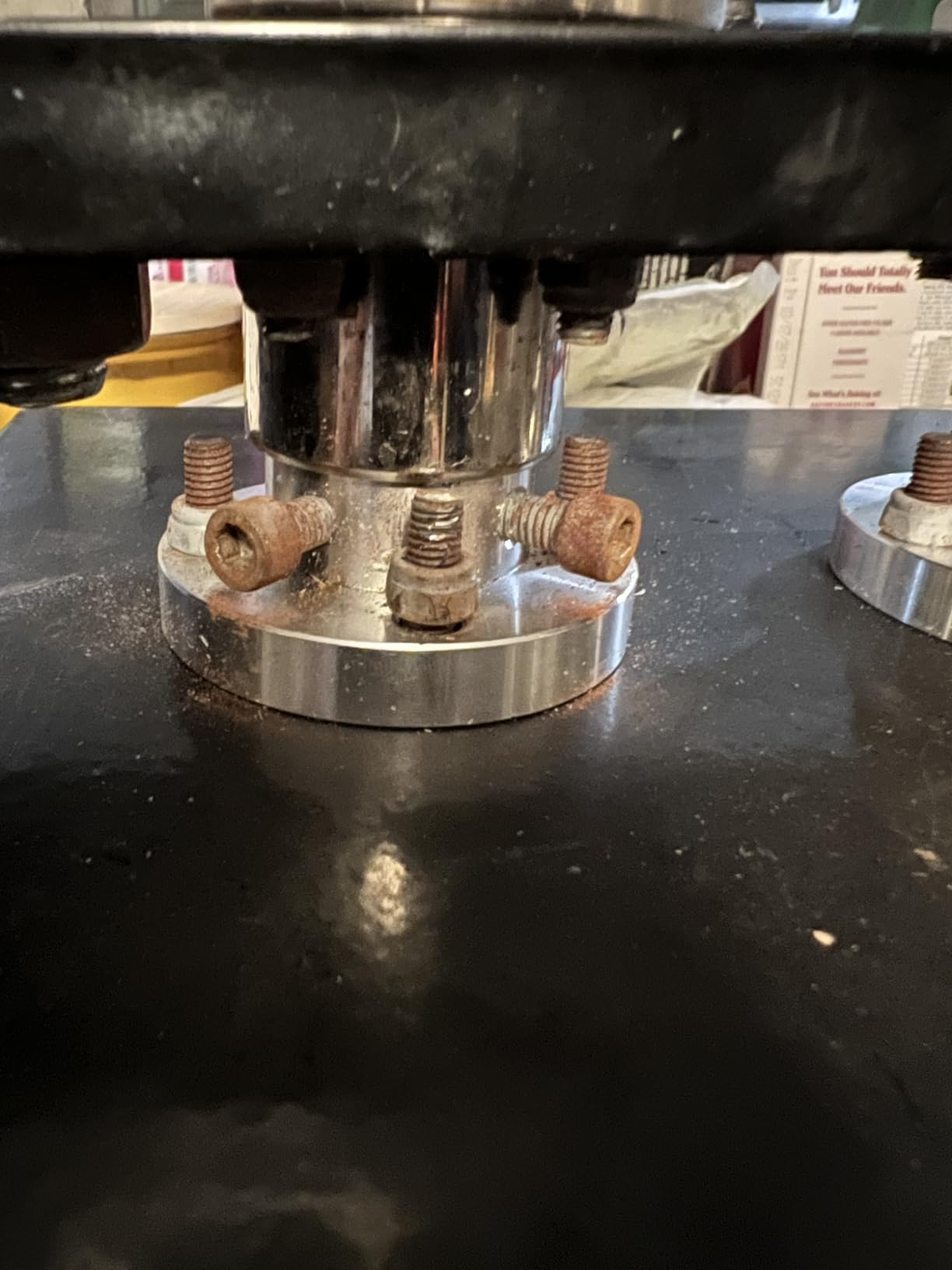
Fit and finish issues come up repeatedly. The chuck does not magnetize, so punches can drop, and it is not wide enough for some larger fork punch handles. Check your handle shims before a project depends on them.
The height adjustment wants an Allen wrench that reviewers report was not included. Budget for that, and expect your first few cuts to need a pressure adjustment before they release cleanly.
4. Flyrivergo 1.0 Ton Manual Die Cutter – a straightforward first press
Flyrivergo 1.0 Ton 7.87×7.87 Manual Leather Die Cutting Machine
1.0 ton / 2204 lbs capacity
7.87 x 7.87 in embossing plate
0.47 in / 12 mm adjustable stroke
18-piece die set included
Pros
- Fast setup with only a handle to screw on
- 18-piece die set means no separate accessory purchase
- Adjustable pressure stroke adapts to material thickness
- Black oxide coating resists rust
- Backed by a one-year warranty
Cons
- Only 18 reviews so long-term durability is thin
- Handles thin to medium materials
- not heavy hides
If you have never used a die press, this is the least intimidating entry. Setup is a single handle screwed onto a steel and cast iron frame, and the pressure stroke adjusts through 12 mm for different material thicknesses.
Everything you need arrives in the box. An 18-piece metal die set in a carrying case means you can start cutting the same day, and there is no accessory budget to build up first.
The 0.8 to 1.0 ton capacity suits leather up to roughly 2 to 3 oz. That covers earring shapes, chokers, small tags and wallet lining panels comfortably, and it will not handle a 6 oz tooling panel.
What to check before buying
Note the review base is 18. That is enough to confirm it works as described, and not enough to confirm how it holds up over five years.
The 7.87 x 7.87 inch plate gives 61.94 square inches of active surface, which is enough for one medium die or a layout of small shapes.
Where it falls short
At 1.0 ton it sits at the light end of this range, and stiff vegetable-tan at 3 mm will defeat it. If your project list says tooling leather rather than chrome-tan, step up a tier instead.
The one-year warranty is standard for this class, and support was reported as responsive. Beyond that, the honest limitation is simply that the thin review count leaves long-term durability undocumented.
5. LGIB Compact 1.5 Ton Press – for a small desk corner
Leather Cutting Machine, 1.5 Ton Manual Press Die Cutter with 5.9 x 3.9 in Embossing Plate, Dual Guide Shafts, 0.47in Pressure Stroke – for Leathercraft, DIY & Various Materials
3306 lb capacity on dual guide shafts
5.9 x 3.9 in embossing plate
6.8 kg net weight
0.47 in / 12 mm stroke
Pros
- Needs only about 20 percent of the force of a comparable arbor press
- Compact 6.8 kg body is easy to store and transport
- Smooth pull with no catching on the lever
- Good for stamping maker marks and small logo imprints
- Steel rule dies cut well at this size
Cons
- Press height cannot be adjusted for shorter dies
- Small working area limits larger die work
- Can lack stability on thicker leather
This is the lightest press here at 6.8 kg, and it still delivers 1.5 tons on dual guide shafts. If your workshop is a corner of a room with a laptop on it, that combination is rare.
Reviewers highlight that it needs only about a fifth of the force of a comparable arbor press, so a long session with small dies does not wreck your wrist. The pull is smooth with no catching on the lever.
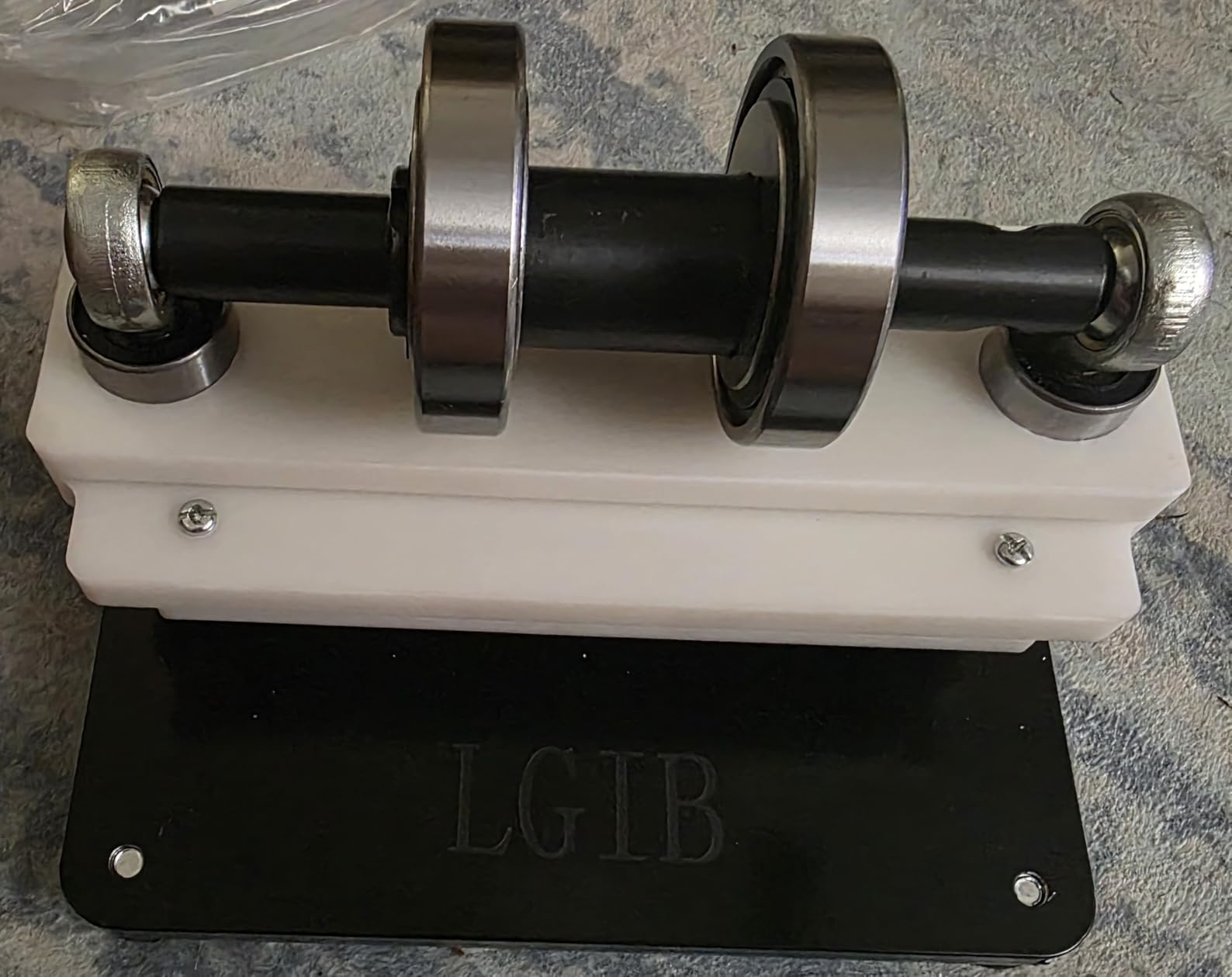
Its real strengths are stamping and light die work. Maker marks, small logo imprints and steel rule dies in the 5.9 x 3.9 inch class cut cleanly, and the anti-oxidation coating plus roller bearings keep the action consistent.
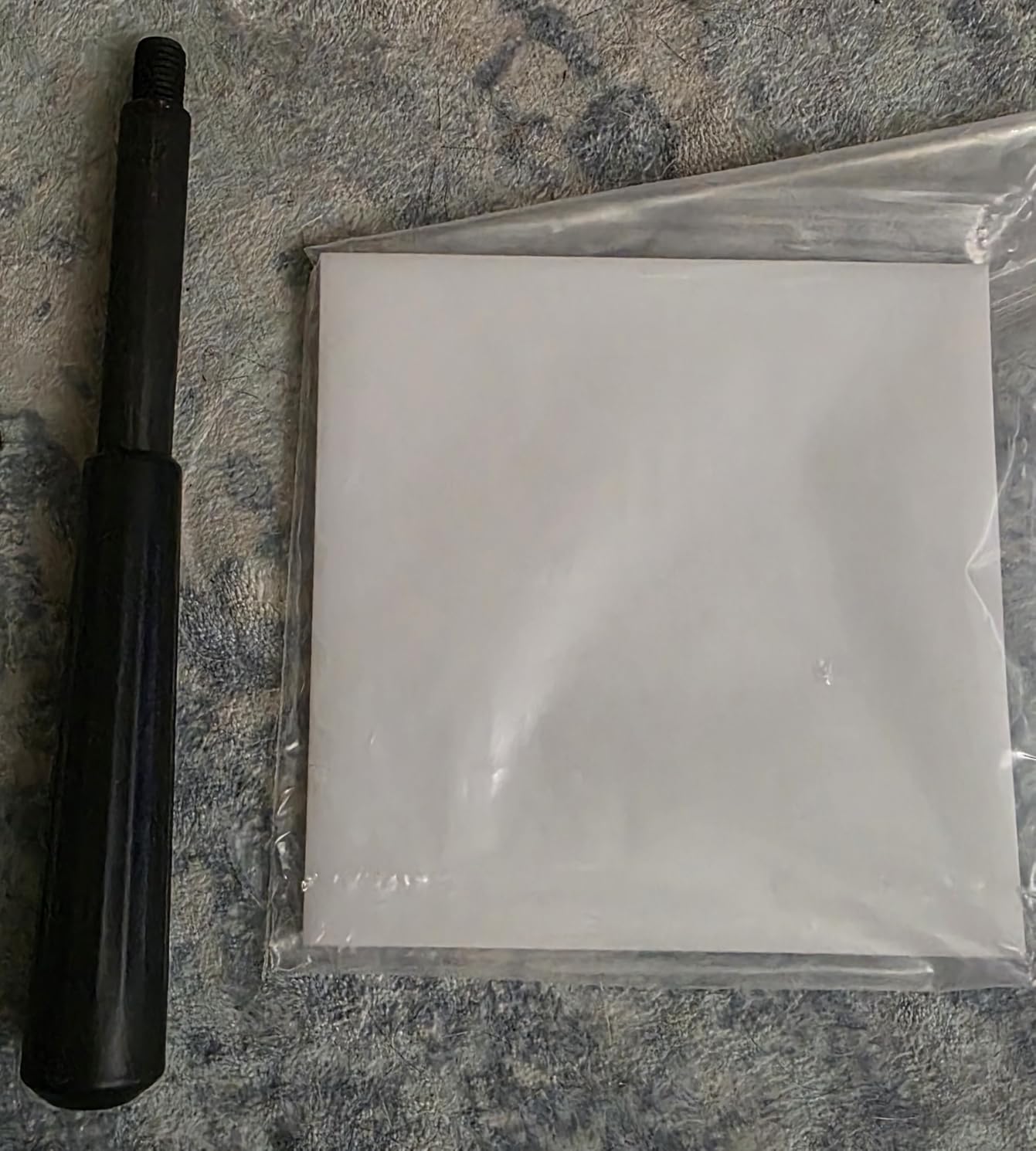
The frame is alloy steel with dual guide shafts, so despite the small footprint it does not wobble on light work. The included cutting pad protects your bench surface.
Where the compact size pays off
Storage is the deciding factor. A 6.8 kg press goes in a cupboard when the project ends, which removes the single most common reason people stop making leather goods.
It is also the right travel option for leather markets and craft fairs where you set rivets and stamp in front of customers rather than at home.
Where it falls short
The press height is fixed. Shorter dies need spacer plates added underneath, and buyers describe that as the most-cited drawback of an otherwise capable machine.
At 5.9 x 3.9 inches the working area is one of the tightest here, so larger die work is out. On thicker leather it can lack stability and need hard pressing, so keep it to light-to-medium material.
6. Flyrivergo 5 x 3.5 Inch Compact Cutter – thin leather and small batches
Flyrivergo 5×3.5inch Small Leather Die Cutting Machine – 1 Ton Pressure
1.0 ton / 2204 lbs capacity
5 x 3.5 in compact die plate
18-piece die set in case
Adjustable 0.7 in / 18 mm stroke
Pros
- Desk-friendly 5 x 3.5 inch footprint fits small work areas
- 18-piece die set included in a carrying case
- Handle-only setup gets you crafting in minutes
- 1 ton of pressure in a small frame
- One-year warranty
Cons
- Rated for thin material only at 1mm soft leather
- Only 9 reviews
- Listed weight of 22.7 lbs undercuts the desk-friendly claim
Every one of the nine reviews on this machine is five stars, with no ratings below that. Treat that as encouraging rather than established, but the use case it serves is narrow and clear: thin leather pieces on a small desk.
The manufacturer states the limits directly, up to 1 mm of soft chrome-tan leather and 0.5 mm of stiff vegetable-tan. That is earring blanks, small tags, key fob layers and thin appliques, nothing heavier.
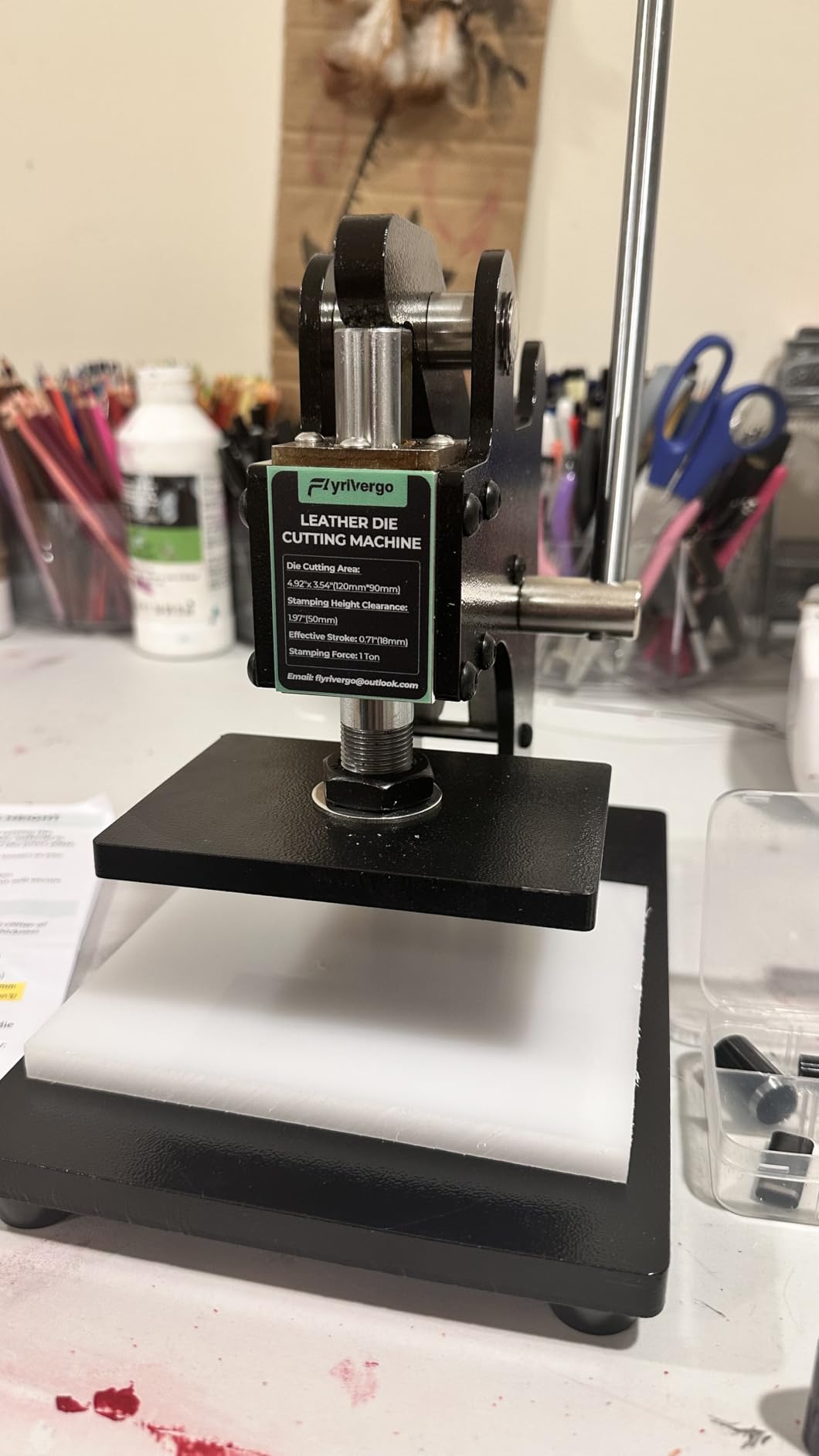
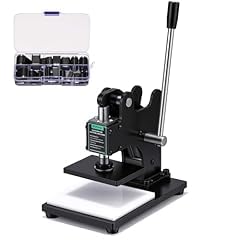
Setup takes one step. Screw on the handle and start, with an 18-piece metal die set in a carrying case in the box. Owners describe a compact, easy-to-assemble press that works well for small leather pieces and paper crafts.
The adjustable stroke runs through 0.7 inches, which helps when you alternate between thin leather and card stock on the same plate.
What this machine is genuinely good at
Layered work is where it earns its place. Two or three thin pieces of chrome-tan or faux leather stack and cut in one pull, which is faster than making each shape separately by hand.
The black oxide coating over steel and cast iron resists rust, and the one-year warranty is standard for the category.
Where it falls short
Read the thickness limits before you order. If you are buying veg-tan or tooling leather, the 0.5 mm veg-tan ceiling rules this machine out.
It is also listed at 22.7 lbs, which undercuts the desk-friendly positioning somewhat. And with nine reviews behind it, there is no track record to lean on for longevity. If your leather is thicker than a millimetre, look at the 1.5 ton presses instead.
7. HONGYMA 1.8 Ton Press – the highest tonnage in the range
Leather Cutting Machine 1.8 Ton, Portable Manual Press Die Cutter Dual Guide Shafts Die Cut Machine with 39-Piece Professional Hole Punch Kit for Leather, Fabric, Plastic & More — DIY Craft Essential
1.8 ton / 3907 lb capacity
39 drop-forged alloy steel punches
9 x 3.9 in embossing plate
0.47 in / 12 mm stroke dial
Pros
- Highest tonnage in the range on a compact
- light body
- Dual guide shafts give even pressure with no wobble
- 39-piece punch kit with a dedicated storage case
- Tool-free setup where the handle is the only part to attach
- Cuts leather
- fabric
- foam
- rubber and magnets cleanly
Cons
- No instructions included with the unit
- Does not grip a mat or tabletop and must be held in place
- Dies arrive coated in oil and marketing photos imply shapes not included
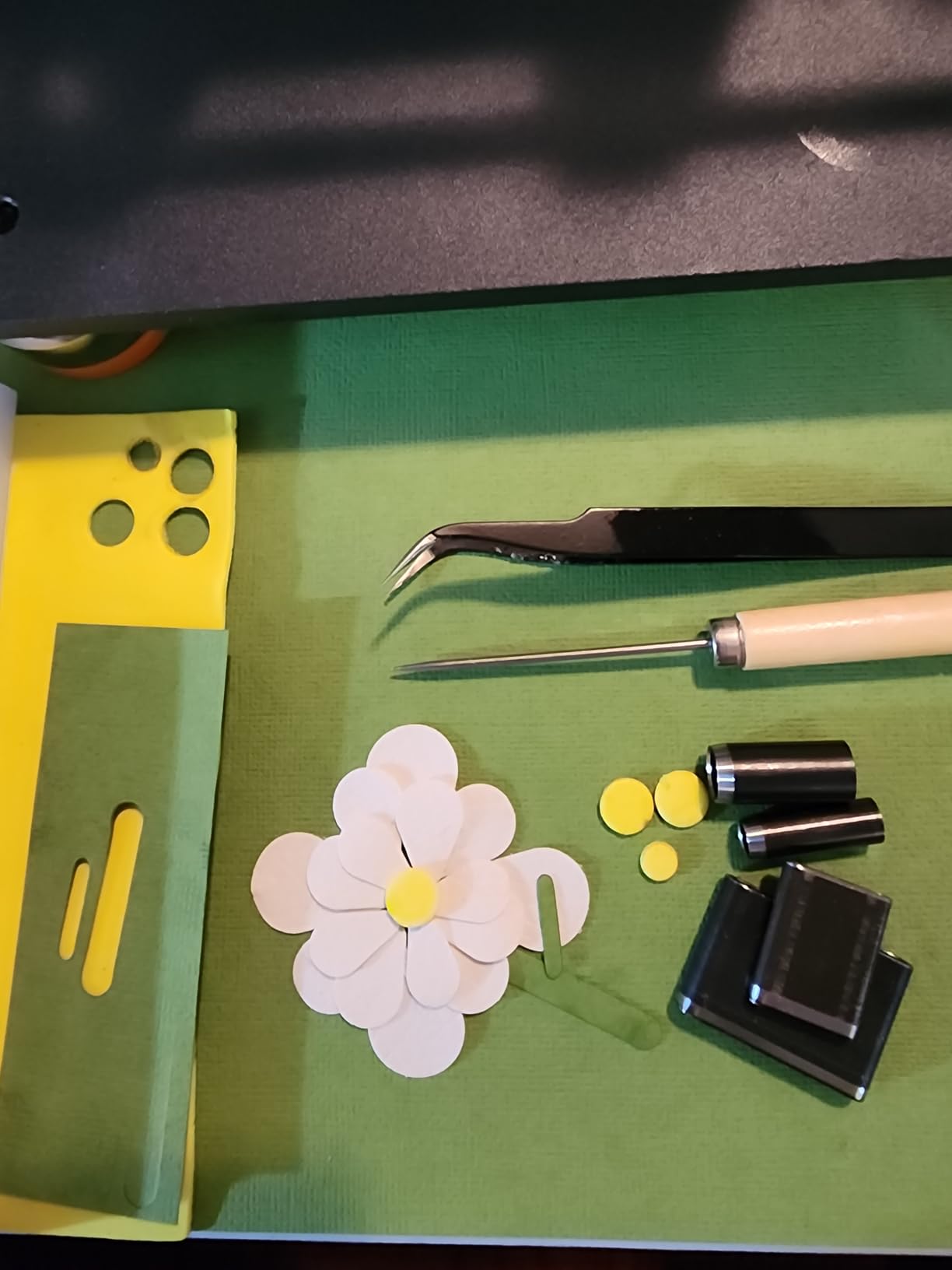
At 1.8 tons on dual guide shafts, this delivers the highest tonnage in the roundup while staying in a compact, portable frame. If you work stiff vegetable-tan, that extra force is the difference between a clean release and a bent die.
Reviewers consistently praise the combination of strong force in a light body, and the dual guide shafts producing smooth, wobble-free cuts. The 39-piece punch kit reads as a complete starter set rather than an upsell.
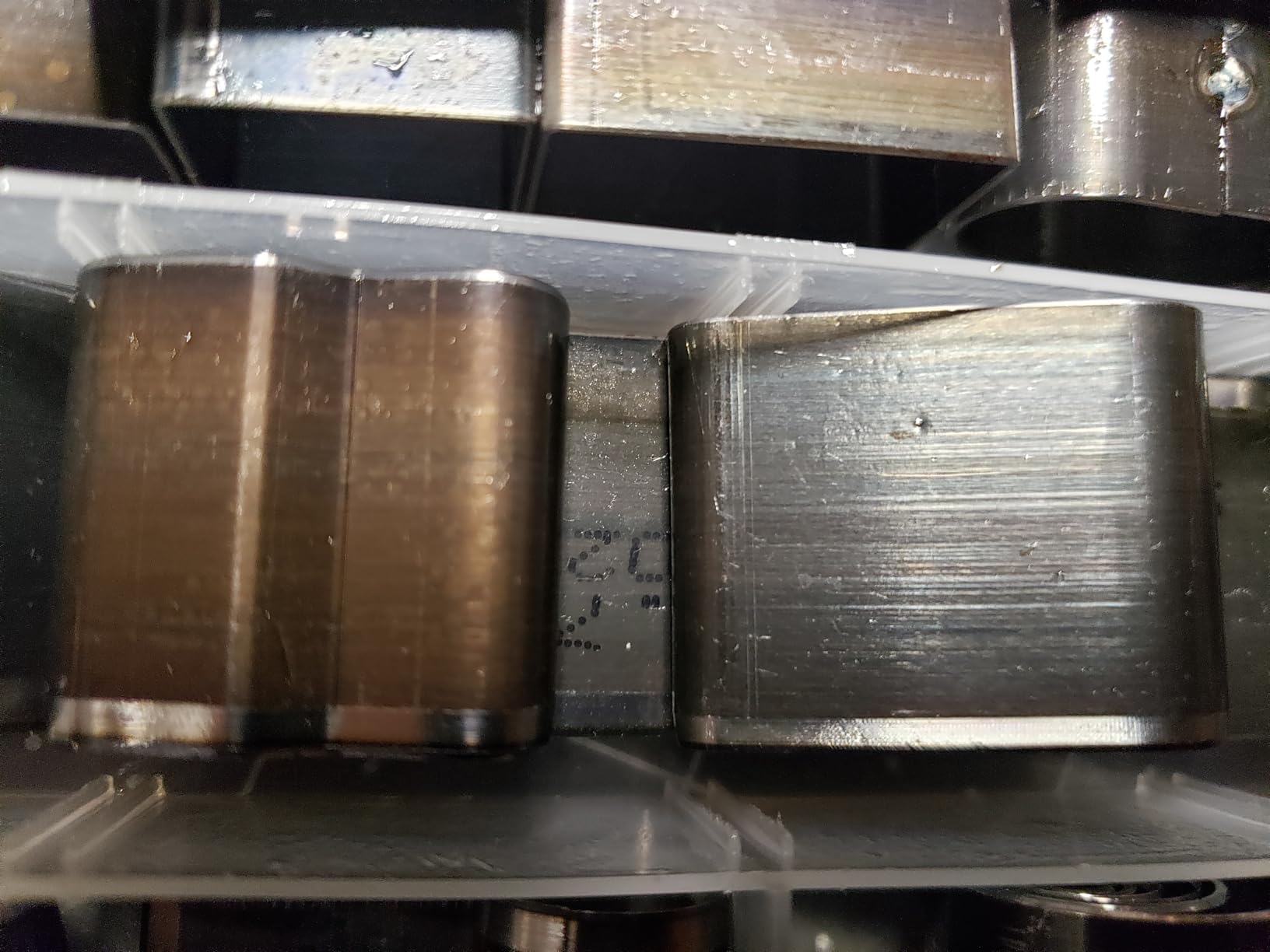
Beyond leather, owners cut fabric, foam, rubber, magnets and card stock cleanly on it, so it pulls double duty in a mixed craft room.
Tool-free setup means the handle is the only part to attach. The anti-slip thickened base and black oxide coating are sensible additions for a machine that moves around.
Why the extra tonnage matters
Cutting force is the spec people skim. It is the difference between a die that releases in one pull and one that needs two or three, and dulls faster each time you force it. Stiff veg-tan at 3 mm is where this shows.
The 9 x 3.9 inch plate with its 12 mm stroke dial gives room for a long rectangular die, which suits strap ends and belt pieces.
Where it falls short
There are no instructions in the box. Combined with dies that arrive coated in oil and marketing photos implying shapes that are not included, first assembly is a short learning curve on your own.
It also does not suction to a self-healing mat or grip a metal tabletop, so you must hold it in place while pressing. That is the biggest practical drawback here. With seven reviews behind it, read the spec sheet carefully rather than trusting the star score alone.
8. Generic 1 Ton Cast Iron Press – round dies and simple shapes
Manual Leather Die Cutting Machine for Leather Press Embossing 1 Ton
1.0 ton cutting pressure via extended lever
4.9 x 3.5 in rectangular press plate
0.71 in punch stroke
7 round dies plus 2 wrenches
Pros
- Extended lever delivers high pressure with minimal effort
- Cast iron frame and large base resist shifting and wobbling
- Backing plate protects dies and the base plate
- Includes 7 round dies and wrenches out of the box
Cons
- Only 2 reviews so long-term reliability is unverified
- Small 4.9 x 3.5 inch plate limits die size
The mechanism to notice here is the extended lever. It multiplies your hand force to deliver a full ton of cutting pressure with far less effort than a short-handle press, and both existing reviews describe low-effort pressing.
Cast iron does not shift or wobble the way a lighter steel frame can, and the large base plus the backing plate protect your dies and work surface through repeated pulls.
Seven round dies in assorted sizes come in the box with two wrenches. If your project is circles and dots, which covers most earring and stud layouts, you can start immediately.
When the lever earns its keep
Long sessions of repeated small cuts are where a longer handle pays off. When a short-handle press leaves your forearm aching after an hour of snap setting, an extended handle changes that materially.
The machine measures 9.8 inches deep by 6.3 inches wide by 14.7 inches tall and weighs 9.93 kg, which is a normal footprint for a bench press.
Where it falls short
With two reviews, both positive and none below four stars, there simply is not enough feedback to draw conclusions about durability. The rating is promising but unproven.
The 4.9 x 3.5 inch plate is one of the smallest here, and seven round dies is a narrow catalogue. Any project needing squares, ovals or specialty shapes needs another die source.
9. SporGain Hand Press – the deepest adjustable stroke and a bubble level
SporGain Leather Cutting Machine, Hand Press Die Cutter for Crafts
1.5 ton / 3306 lb load capacity
20 mm / 0.79 in maximum pressure stroke
10.2 x 5.9 inch upper plate
Built-in bubble level and fine-tuning screw
Pros
- Quick
- tool-light height adjustment for different materials
- Built-in bubble level and fine-tuning screw aid accurate alignment
- Extended handle multiplies your force through thick leather
- Quiet operation compared with hand hammering
- Two-year warranty
Cons
- Only 2 reviews so long-term durability is unverified
- Doubles as a stamper
- so die availability may be limited
This is the most precisely specified machine in the roundup. The maximum pressure stroke of 20 mm is the deepest here, and the built-in bubble level with a fine-tuning screw for millimeter calibration is a feature none of the others offer.
Owners describe fast setup and effortless height adjustment, plus a heavy premium feel that does not slide on the bench. The one-piece anti-rust steel construction and large bearings give a smooth guide rail action.
Why the bubble level is not a gimmick
Uneven pressure is the most common cause of a partially cut die, and it usually comes from the machine sitting at a slight angle on the bench. A built-in level removes the guesswork before the pull, not after.
The fine-tuning screw then lets you set the gap in millimeter increments when you move between full-grain, chrome-tan and thicker stock, which is frequent in leather work.
Where it falls short
Both reviews are five stars, which is encouraging, but two reviews cannot establish durability. Plan to check the frame and guide rails periodically in your first year.
It also doubles as a stamper, so die availability for it may be more limited than for a dedicated die cutter. Confirm the dies you need exist before you commit.
10. Generic 1.5 Ton Craft Press – 39 dies on a large plate
Leather Cutting Machine, 1.5 Ton Craft Press with 39PCS Cutting Dies
1.5 ton / 3306 lb force on twin guide shafts
7.9 x 7.9 in / 20 x 20 cm cutting plate
39-piece alloy steel die set
24.3 lbs / 11 kg with anti-tip base
Pros
- 1.5 ton force from twin guide shafts that reduce shaking
- Generous 7.9 x 7.9 inch plate for larger dies or multiple small dies
- 39-piece alloy steel die set with a storage case
- Only 24.3 lbs and more portable than traditional presses
- Reinforced base resists tipping
Cons
- Only 3 reviews so long-term performance is largely unverified
The combination to notice is a 39-piece die set, a 20 x 20 cm plate and a 1.5 ton twin-shaft frame at 24.3 lbs. That is one of the roomiest working areas on a 1.5 ton press in this roundup, at roughly a quarter of the weight of the VEVOR.
Reviewers describe a well-built, accurate press that handles leather goods, wallets, belts and foam crafts on a stable base. Reinforced twin guide shafts are the reason, since they reduce shaking during the pull.
The die set covers circles, squares, ovals and specialty shapes, which makes it the most complete starter bundle here. The package includes the machine, the 39-piece die set, a handle and a wrench.
What the large plate changes
A 7.9 x 7.9 inch plate lets you lay out several small dies at once instead of repositioning for each cut, and it accepts a larger single die than the compact models. For wallet panels and belt pieces, that is a meaningful throughput difference.
The black oxidation coating on the steel finish resists rust, and the reinforced anti-tip base holds during heavier pulls.
Where it falls short
Three reviews, all five stars, is a sample rather than a track record. The perfect score should be read as encouraging rather than established, and we would not expect the same depth of long-term owner data here as on the top pick.
Because so little owner history exists, ask what replacement parts and spare dies the seller supplies before you commit, and plan to inspect the guide shafts and anti-tip base in your first few sessions.
Manual Press vs Electronic Cutter vs CNC Knife: Which Type You Need
There are three distinct machine families in leather work, and buying the wrong one is the most expensive mistake you can make here. Manual die presses push a shaped steel die straight down. Electronic blade cutters drag a blade through material held on an adhesive mat. CNC machines run a rapidly oscillating knife head along a toolpath for production volume.
Manual presses are unbeatable for identical shapes in thicker stock, because 1.5 tons of straight-down force beats lateral blade pressure every time. They also run without a software subscription, which matters if you sell what you make.
Electronic cutters win on complexity. A software-defined path can follow a photograph or a hand-drawn outline, which a fixed die cannot. The trade is thickness: forum users on r/silhouettecutters report leather up to 5 oz cutting nicely with a deep cut blade, while on r/Leathercraft one maker describes cutting curved chokers with a knife blade taking 16 passes plus another four or five re-runs to finish.
CNC oscillating knife machines exist for anyone cutting strap leather at production volume. If you are working 3 mm-plus material or cutting the same belt blank hundreds of times, that is the tier that actually serves you.
One practical warning carries across all three: leather debris destroys mat adhesion. If you go the electronic route, expect to rotate and replace mats regularly, and keep a high-grip mat on hand.
How to Choose a Leather Cutting Machine: 7 Criteria
1. Maximum material thickness. Match the press to the heaviest leather in your plan, not the average. Below 1.2 mm any 1.0 ton press works; 1.2 to 2.4 mm needs 1.5 tons; past 2.4 mm wants a bench press with an adjustable stroke and a wide plate.
2. Tonnage and how it feels. Higher is not automatically better if the frame flexes. Dual or twin guide shafts are the feature that stops wobble, and wobble is what cracks die edges. Every press at 1.5 tons or more in this roundup uses them, while the 1.0 ton models do not.
3. Plate size. Active surface area decides your layout options. The VEVOR offers 145.04 square inches, roughly six times the LGIB plate, and that decides whether you can run a multi-die layout in one pull.
4. Included dies and punches. Sets range from 7 round dies to 39 mixed shapes. A large set removes your accessory budget entirely, and hollow punches in a storage box are more useful than a small die case. If you cut fabric panels too, our fabric cutting machine guide covers the blade-driven alternative.
5. Stroke adjustability. A 12 mm adjustable stroke handles everything from thin chrome-tan to mid-weight tooling. A fixed press height, like the LGIB, forces you to add spacer plates for shorter dies, which is friction you do not need.
6. Footprint and weight. Weight is the honest reason most presses end up unused. At under 10 kg you will move the machine to the work; at 97 pounds you will set up a permanent bench corner instead. Decide honestly which of those you are.
7. Build materials and warranty. Black oxide coating and cast iron or manganese steel frames resist workshop corrosion. Warranty length varies from one year to two, and on the newest, thinnest-reviewed listings that warranty is doing more work than the review history.
One more filter worth applying: if you also work with vinyl or adhesive-backed material, confirm the machine suits it. You can see how the blade-driven route handles that in our vinyl cutting machine comparison.
How to Cut Thick Leather Successfully Without Ruining the Cut
Getting a clean release through 5 oz tooling leather takes more than force. Work through these steps in order and you will waste far less material.
1. Set the stroke before the leather goes on. Dial the gap to the material, then close the handle with no leather under it. If it does not close fully, the stroke is too deep and the die will take the damage instead of the leather.
2. Scrape and condition the hide first. Remove surface wax and finish with a stiff brush, and check for thin spots across the whole panel. A die that cuts cleanly in one area and tears in another is usually following a grain variation, not a machine fault.
3. Cut on grain, aligned with the die. Leather stretches far more across the grain than along it. A strap cut across the grain will wander, and that is what produces a bent edge on an otherwise perfect cut.
4. Press in one pull and check the far edge. Force the handle fully rather than rocking it. If the last few millimetres of the cut did not release, rotate the die 180 degrees and pull again rather than increasing pressure.
5. Expect multiple pulls on thick stock. Forum reports of a knife blade needing 16 passes plus re-runs on curved chokers are the reality of blade cutting. A die press usually needs one to three pulls, which is its main practical advantage.
6. Use backing plates and a cutting pad. The white backing plates included with several presses here protect both the die edges and the base plate. A self-healing mat under the work adds support and saves your bench.
7. Rotate dies and maintain the machine. Rotate a die between pulls to even out wear on the cutting edges, keep the guide rails wiped clean of leather dust, and oil the pivot points on a schedule rather than when it starts sticking.
When You Do Not Need a Machine: Hand Tool Alternatives
A press is the wrong answer for some genuinely common jobs, and the leather community has said so plainly. Buying a machine for straight strap or billet work adds a bottleneck rather than removing one.
A round knife and striking tool is faster and more accurate than any of these presses for cutting a single pattern piece, particularly at 4 oz and above where a die press would need a custom die cut for that shape.
A dedicated strap cutter is the correct tool for belts and saddle straps. It cuts the strip and bevelled edge in one stroke, and nothing in this roundup replicates that at 10 mm strap leather.
A pricking iron and stitching chisel handle hole spacing at a consistency no die punch set matches, and they take longer shapes that would never fit a circular punch.
A hand press or clicker is the traditional answer for setting snaps and rivets. The puncher press at number two on this list is the electric-free middle ground between a hammer and a bench press.
The practical rule: if you cut fewer than a few identical pieces a week and your shapes change every project, buy tools. If you repeat a shape across dozens of pieces, buy a press.
Frequently Asked Questions
Which leather cutting machine is best for crafts at home?
The best leather cutting machine for home crafts is a manual die press in the 1.0 to 1.8 ton range with a plate large enough for your dies. For most makers we recommend a 1.5 ton dual guide shaft press with a 39-piece punch set, which cuts tooling leather in a single pull and stores compactly.
How thick can a manual leather press cut?
A 1.0 ton manual press typically handles leather up to about 1mm on soft chrome-tan and 0.5mm on stiff vegetable-tan. A 1.5 ton press reaches roughly 2 to 3mm, and 1.5 to 1.8 ton presses handle tooling leather in the 4 to 6oz range, around 1.6 to 2.4mm.
Do I need a deep cut blade for leather?
You need a deep cut blade only if you use an electronic blade cutter rather than a manual die press. Deep cut blades reach roughly 1.2mm of cutting depth. A manual press uses shaped steel dies and physical tonnage instead, so no blade purchase is required.
Is a die press better than a Cricut or Silhouette for leather?
For repeated shapes in leather thicker than 1mm, a die press is better because 1.5 tons of straight-down force cuts in one pull. Electronic blade cutters suit complex or one-off shapes but often need many passes on the same leather. Users on r/Leathercraft report needing 16 passes plus re-runs with a knife blade on curved chokers.
Do I need a cutting machine to make leather goods?
No. If you cut fewer than a few identical pieces a week, a round knife, striking tool and dedicated strap cutter will do everything you need and cost far less. A machine only pays off when you repeat the same shape across dozens of pieces and need identical results every time.
Final Verdict: Which Leather Cutting Machine Should You Buy in 2026
The VEVOR 1.5 ton manual die cutter takes the top spot in 2026. It is the only machine here with 1.5 tons of force, dual guide shafts and a 14.2 x 10.2 inch plate, and its 344 reviews at 4.4 stars make it the best-evidenced pick by a wide margin. If you can give it a permanent bench corner, that is the one to buy.
For most home makers, the HONGYMA 1.5 ton press with the 39-piece punch set is the smarter starting point: the same force, a 7.9 x 7.9 inch plate, and 9.8 kg instead of 97 pounds. Hardware-heavy work belongs to the HONGYMA puncher, and small desks to the 6.8 kg LGIB.
Skip the machine entirely if you cut strap and billet leather. A round knife and a strap cutter will serve you better than any of these. For everything else, pick by leather weight first and plate size second, and you will not go wrong.