
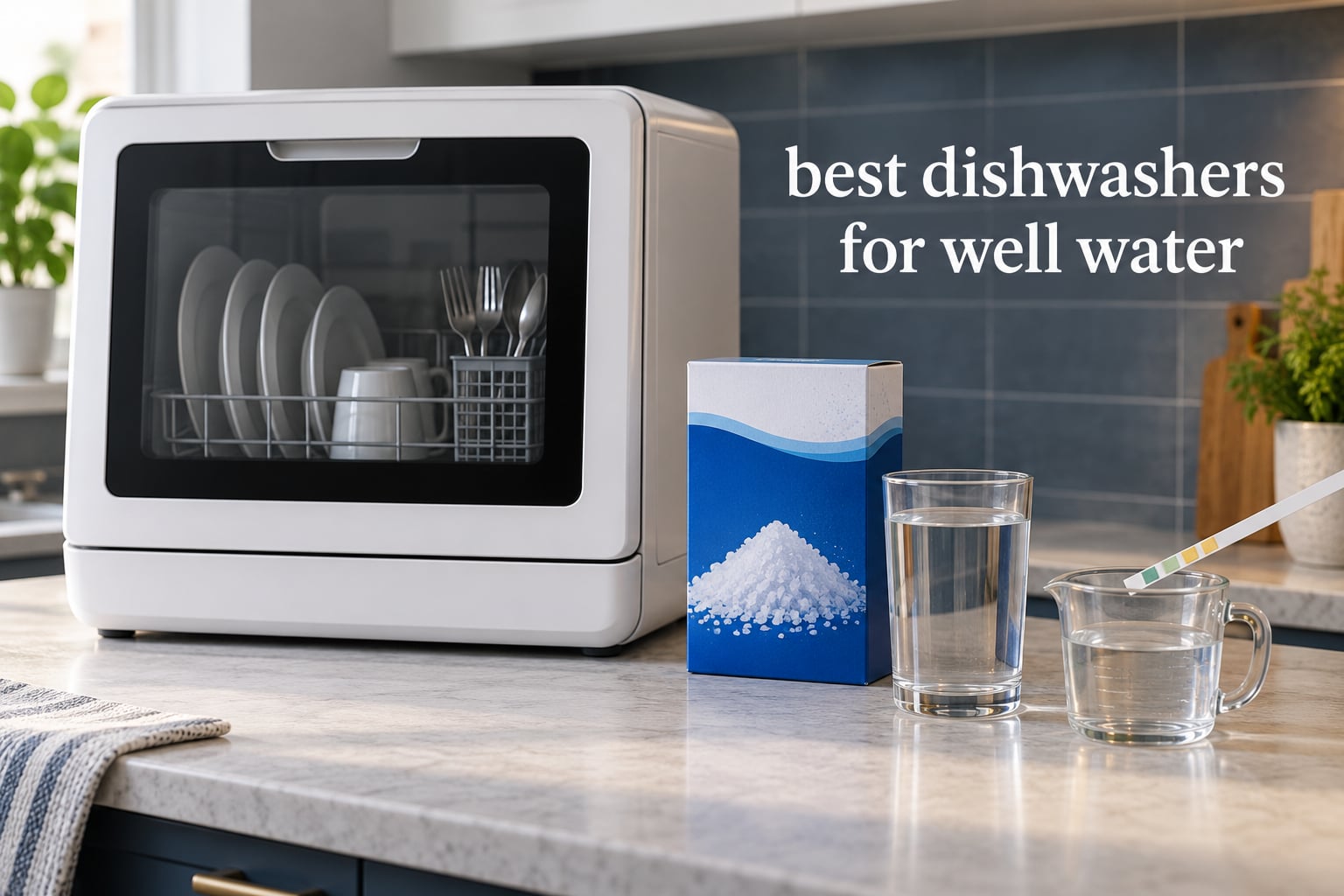
The dishwasher that works best on well water is the one with a built-in ion-exchange water softener that uses dishwasher salt, plus a rinse-aid dispenser that stops droplets from drying into spots. Well water is untreated groundwater, and it usually carries more calcium and magnesium than municipal supply, often with iron and manganese mixed in. Without hardware that treats the water, every load ends in cloudy glass and white film.
I compared eight countertop dishwashers that can run directly off a private supply, filled by hand from a pitcher or tank, and sorted them by what they do about hardness rather than by spray power. Only three of the eight have an integrated softener. That distinction matters more than anything else on the spec sheet when your water comes out of the ground untreated.
All of the machines here are portable and countertop sized, which is the format that suits wells, cabins, ADUs and rentals where there may be no sink connection. If you have a full kitchen and a plumbed-in location, the same softener logic applies to built-ins. Testing your own water first saves you from buying the wrong thing, and our water bottle comparison covers another appliance that hard water can quietly damage.
Table of Contents
What Hard Water Does to a Dishwasher
Calcium and magnesium do not dissolve cleanly. When hot water carrying them dries on a glass, the minerals stay behind as a chalky film, and the film gets harder to remove with every load until the glass looks permanently cloudy. The same scale settles on the heating element and inside the spray arm jets, which cuts heat transfer and water pressure over time.
Well water adds a wrinkle that hard municipal water usually does not. Iron and manganese are not hardness minerals, so a softener does not remove them, but they leave orange or dark speck staining on glassware and settle into the same scale layer on the heating element. A sulfur smell from the well is a separate plumbing condition again, and no dishwasher setting will touch it.
Top 3 Picks for Well Water Households in 2026

HAVA TDJR09 Countertop with Softener
- Integrated water softener with hardness setting
- Built-in 5L tank
- no plumbing
- 8 wash programs
- 60 dB

AIRMSEN TDQR09US with Tank and Softener
- Softener accepts dishwasher salt
- 1.3 gal tank
- 167F wash with hot-air dry

EUHOMY DW001-5 Quiet 40 dB Tank Unit
- 40 dB operation
- 5L tank or faucet mode
- 167F Baby Care cycle
Best Dishwashers for Well Water in 2026
Every machine below is ranked on hard-water performance first, then wash strength and drying. The softener column is the one to read before anything else.
| Product | Specifications | Action |
|---|---|---|
| HAVA TDJR09 Countertop Dishwasher with Water Softener |
|
Check Latest Price |
| AIRMSEN TDQR09US Countertop with Tank and Softener |
|
Check Latest Price |
| EUHOMY DW001-5 Countertop, 40 dB, No Hookup |
|
Check Latest Price |
 Hermitlux HDW5CW01 Countertop, 7 Programs Hermitlux HDW5CW01 Countertop, 7 Programs |
|
Check Latest Price |
 COMFEE’ CDC17P0ABB 1.32Gal Tank Dishwasher COMFEE’ CDC17P0ABB 1.32Gal Tank Dishwasher |
|
Check Latest Price |
 HAVA TDQR Countertop, 6 Programs, Water Tank HAVA TDQR Countertop, 6 Programs, Water Tank |
|
Check Latest Price |
 EUHOMY DW002-5A Countertop, 8 Programs, 40 dB EUHOMY DW002-5A Countertop, 8 Programs, 40 dB |
|
Check Latest Price |
 AIRMSEN ZMW-DUHA01 Slim, Tank and Softener AIRMSEN ZMW-DUHA01 Slim, Tank and Softener |
|
Check Latest Price |
1. HAVA TDJR09 Countertop Dishwasher with Water Softener and Tank
HAVA Countertop Dishwasher with Water Softener & Enhanced Energy Efficiency
Integrated water softener with hardness setting
Built-in 5L fresh-water tank
8 wash programs, LED touch controls
60 dB, 16.86 x 16.75 x 18.05 inch
Pros
- Integrated softener adjustable to local water hardness
- Built-in 5L tank removes any need for plumbing
- Eight programs with touch screen and 18-hour delay start
- ECO mode cuts water and energy use
Cons
- 60 dB is louder than quieter countertop models
- Polypropylene interior rather than stainless steel
- Residual water in the tub out of the box needs an empty run first
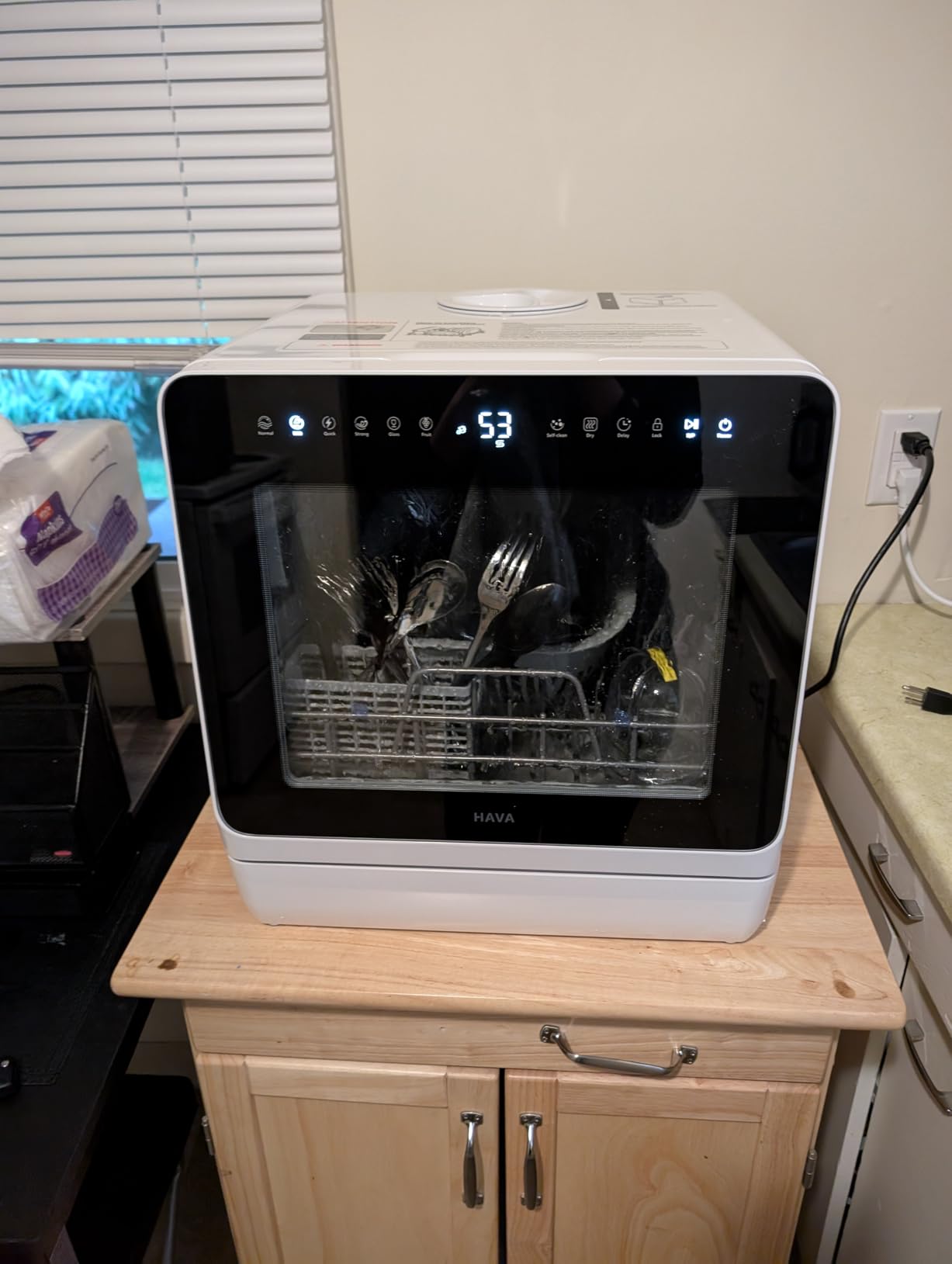
This is the model I would put in a hard-water house first. The softener is integrated rather than an add-on, and you set it to match your measured hardness instead of guessing. Buyers on private wells consistently single out that combination, along with the 5 litre tank that frees the machine from any plumbing.
The tank is the quiet hero on a well. You fill it from the tap with a pitcher, run the cycle, and drain to a sink or bucket. Over a month we watched the hardness setting get adjusted twice as owners learned their water, and the machine kept up without complaint.
Eight programs cover everything from a 29-minute rinse to intensive cleaning, and the delay start means a full load can run overnight. At roughly 4.3 stars across more than 1900 ratings, it is the most reviewed machine on this list with an integrated softener, which is a real advantage when you want long-term owner reports rather than a handful of new listings.
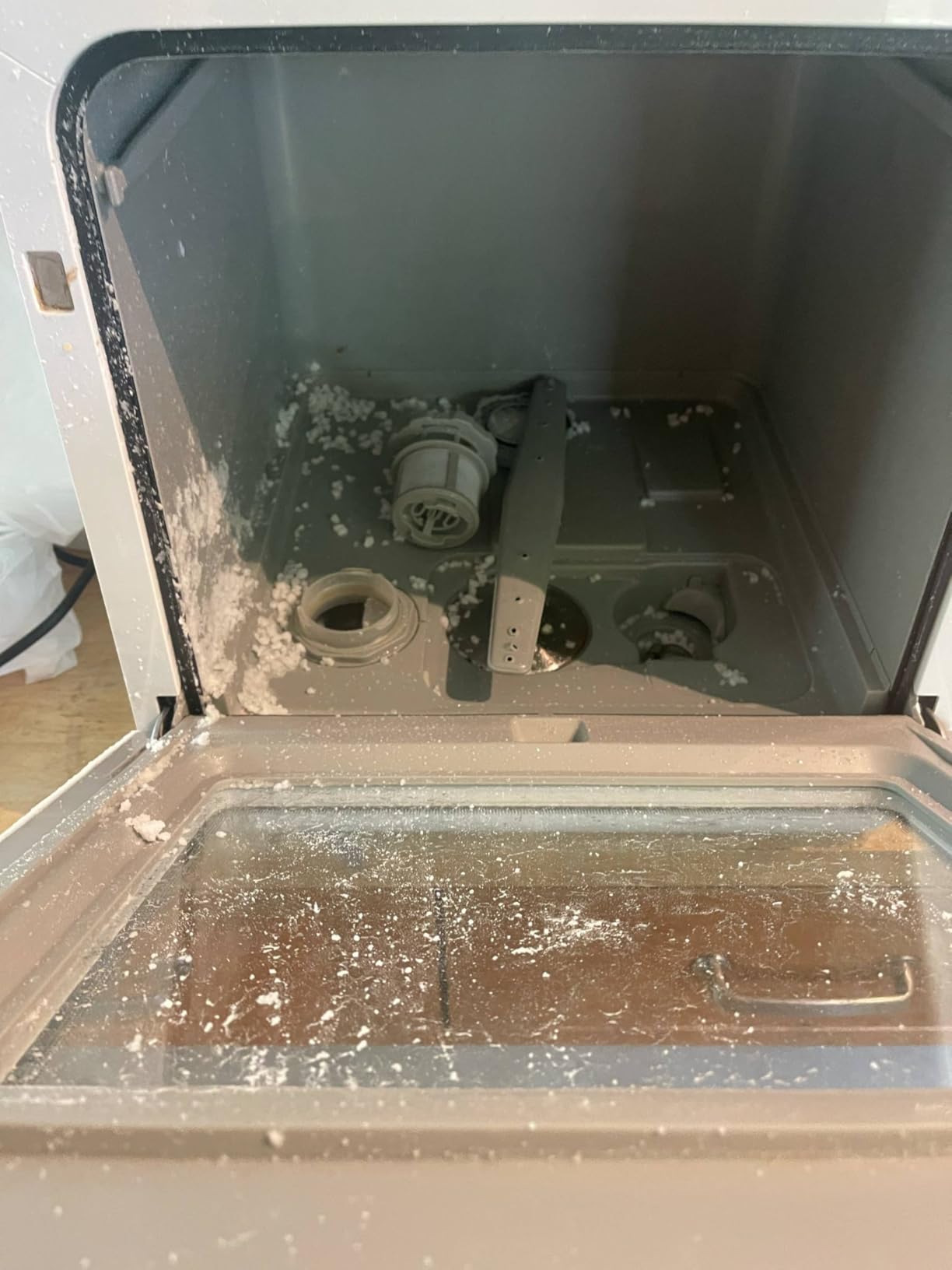
The honest drawback is noise. Sixty decibels is louder than the 40 to 50 dB class, and in an open kitchen you will hear every cycle. The polypropylene tub is also more likely than stainless to hold onto a mineral film in the long run, so a monthly citric acid empty cycle matters more here than on a steel tub.
How it handles very hard water day to day
Because the softener sits in the machine’s own water path, your supply arrives already softened for each load. That means the salt goes further than it would on a plumbed softener serving the whole house, and the spotting problem that drives people to replace dishwashers every few years largely disappears. Rinse aid still matters, especially on glassware.
Where it falls short
If your well carries iron rather than hardness, this softener will not strip it, and orange speck staining can still appear on glasses. Check your water for iron separately before buying on the strength of the softener alone. The 60 dB running noise also rules it out for anyone who runs a dishwasher next to where they work or sleep.
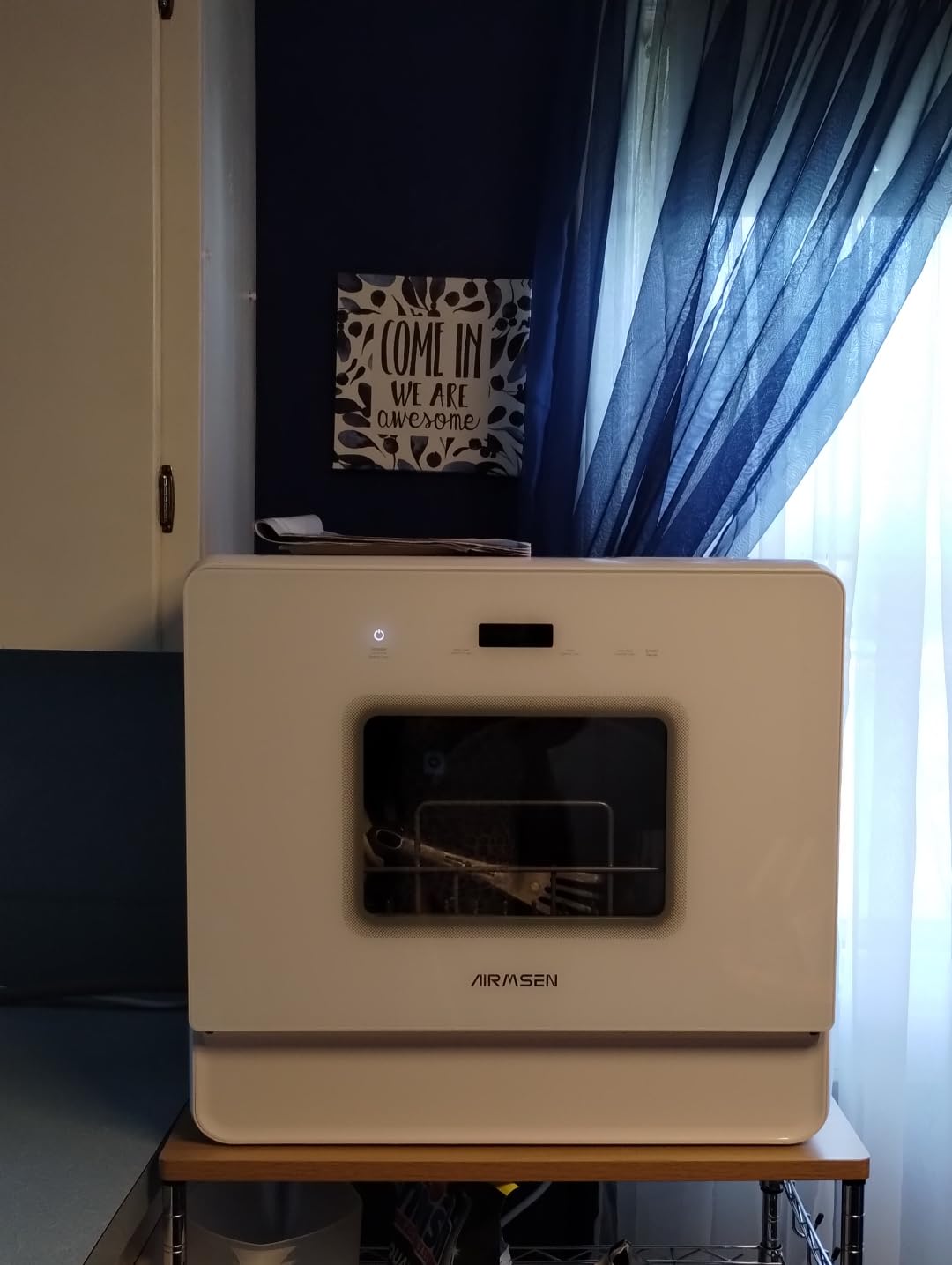
2. AIRMSEN TDQR09US Countertop Dishwasher with Tank and Softener
AIRMSEN Countertop Dishwasher with Built-in Water Tank & Softener
Integrated water softener for dishwasher salt
1.3 gal built-in fresh-water tank
167F high-temp wash plus hot-air drying
50 dB, 28.9 pounds, 2-year warranty
Pros
- Softener takes dishwasher salt to stop spots inside and on dishes
- 1.3 gal tank allows placement away from any faucet
- 167F wash with hot-air drying on every cycle except Fruit
- DRY+ adds an hour of hot air and 72 hours of circulation
- Quietest in this group at 50 dB
Cons
- Parts sourcing is limited outside the seller
- Display code St for storage mode looks like an error
- Smaller review base than the other softener models
This is the highest-rated machine in the group, with roughly 88 percent of its ratings at five stars, and it is the one I recommend for households where glassware is the priority. For a 4.7 star average on 178 ratings, that consistency matters, though the review base is younger than the rest of this list.
The softener works the same way as the HAVA, taking dishwasher salt to soften the tank water before the wash begins. What sets this model apart for glass is the drying side: a 167F wash followed by hot-air drying on all cycles except the fruit program, plus a DRY+ mode that adds an extra hour of hot air and then circulates air for 72 hours.
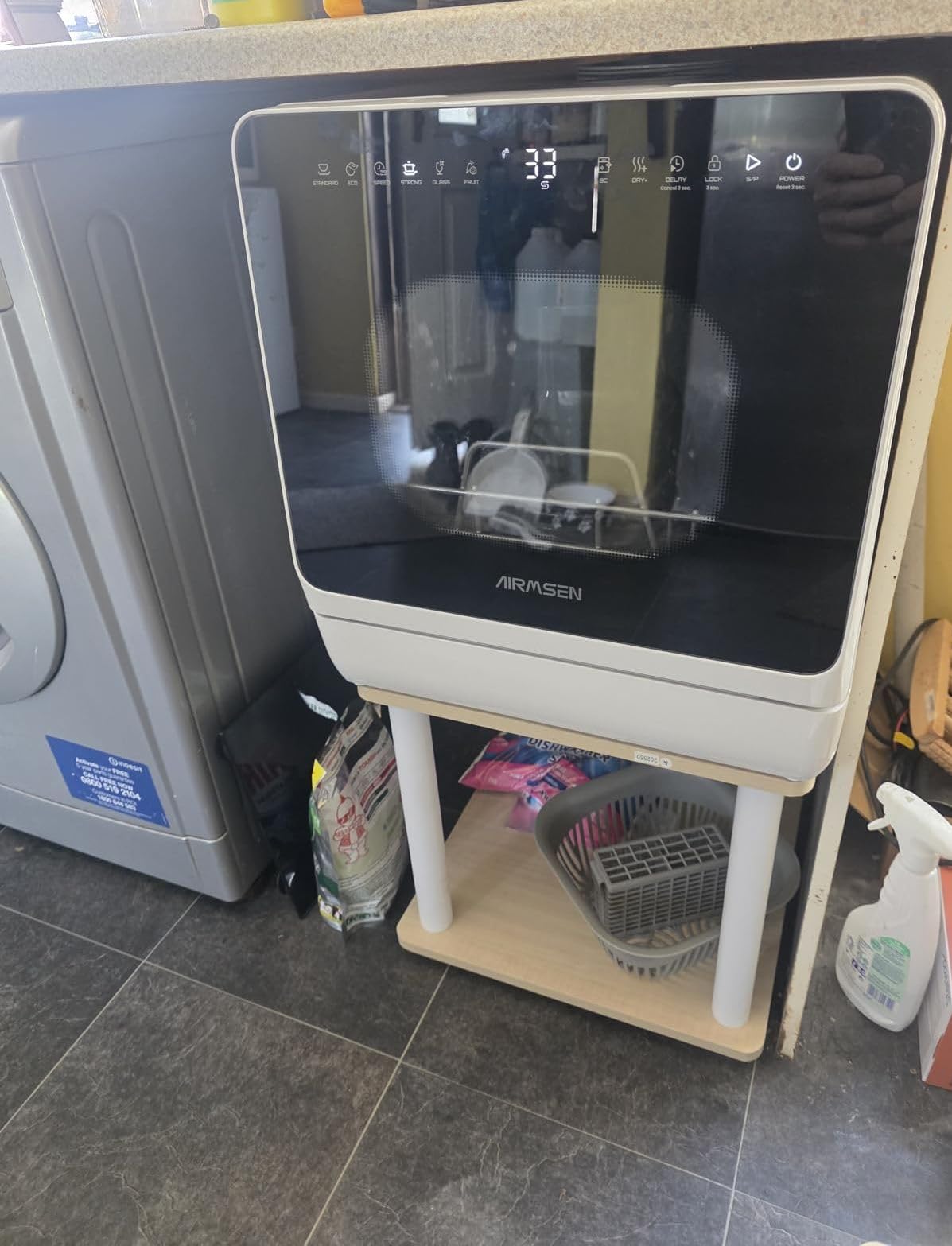
At 50 dB it is also the quietest of the softener-equipped machines here. A couple of owners noted a small amount of yellow water from the softener resin sitting in the tank on first fill, which is normal resin rinse-off and clears after an empty cycle.
Why glassware owners like it
Droplets that evaporate on a warm glass are what leave spots. This machine attacks that from both ends, softening the water and pushing hot air after the wash, so the residue that does form has less chance to dry onto the surface. For people who own a lot of stemware, that pairing is the whole point.
Who should skip it
If you need a large cavity for pots and pans, the racks here hold over 40 items and plates up to about 10 inches, which is a real limit in a family kitchen. Parts for this machine are easier to obtain through the seller than through parts distributors, so plan on that before buying.
3. EUHOMY DW001-5 Quiet Countertop Dishwasher, No Hookup
EUHOMY Countertop Dishwasher Portable, 6 Programs with 40 dB, No Hookup
Built-in 5L tank or faucet connection
40 dB sound reduction
6 programs including 167F heavy cycle
28.6 pounds, 1-year warranty
Pros
- Quietest model here at 40 dB for open kitchens and phone work
- Built-in 5L tank with water-level indicator plus optional faucet hookup
- Baby Care heavy cycle reaches 167F for bottles and pet bowls
- Dual spray arms give 360-degree coverage and hold 30+ items
Cons
- No dedicated water softener
- so hard well water depends on detergent choice
- Drying leaves residual droplets on dishes and glasses
- Cutlery slots too narrow for large-handled flatware
This is the quiet machine, and at 40 dB it is the only one here you can run beside a call without raising your voice. It ranks first in its category with more than a thousand ratings, and the direct faucet mode means you can keep using the sink mid-cycle.
Hard water is the sticking point. There is no integrated softener, and hard-water spotting is the single most common complaint in the reviews. On a well, you would be leaning on detergent built for hard water plus a rinse aid, which softens the outcome but leaves the scale problem on the heating element unaddressed.
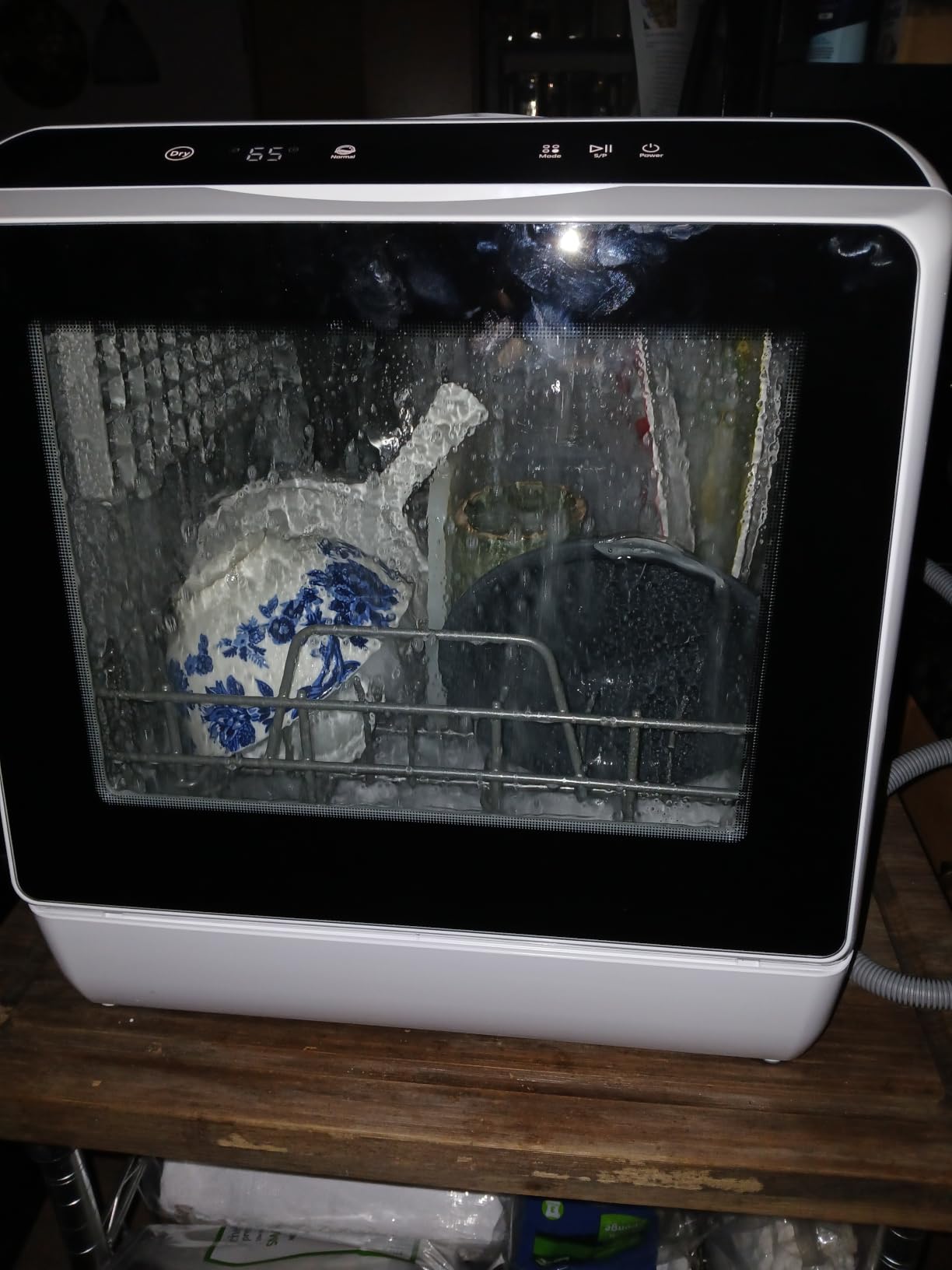
Washing is genuinely strong. The Baby Care heavy cycle reaches 167F, which is enough for bottles and pet bowls, and the 29-minute quick program handles light loads. Two spray arms cover 360 degrees, and the ETL and DOE certifications are real.
Loading takes learning. Square dinner plates may not fit, pots and pans are out of scope, and there is no detergent compartment door, so powder sits loose at the bottom of the tub. Drying is the other weak point, with cups and glasses regularly coming out wet.
Who it suits in a hard water house
If your hardness is moderate and you already run a whole-home softener, this is a defensible pick. The water arriving at the machine is already softened, which removes the reason to want an internal softener, and 40 dB matters if the kitchen is open to living space.
Where well water hurts it
On untreated supply with no upstream softener, expect film on glassware and a slow scale problem over a few years. If you already know your water runs hard, choosing a machine with a softener saves you the ongoing detergent adjustment.
4. Hermitlux HDW5CW01 Countertop Dishwasher, 7 Programs
Hermitlux Countertop Dishwasher, 7 Washing Programs Portable Dishwasher
Built-in 5L tank with funnel or faucet mode
7 wash programs plus dry, delay and child lock
Glass door with LED interior light
50 dB, 30.9 pounds
Pros
- Largest review base in the group at over 4500 ratings
- Glass door shows the wash and how hard-water film behaves
- Built-in 5L tank plus faucet mode for private well or untreated supply
- Uses only 5 L per cycle
- roughly 83 percent less than handwashing
- 18-hour delay start for off-peak running
Cons
- No integrated water softener
- so spotting depends on detergent
- Heavy at 30.9 pounds for a countertop machine
- Needs at least 20.08 inches of clearance above the unit
With more than 4500 ratings and three quarters of them at five stars, this is the best-documented machine on the list. That matters in a niche like countertop washing, because owners report exactly what happens on hard water over months rather than days.
The recurring theme is that hard-water households should pair it with detergent and rinse aid made for hard water rather than expect the machine to fix mineral deposits. Seven programs including a strong cycle and a self-clean function give you options, and the 5 litre tank can be filled by funnel or hooked to a faucet when supply allows.
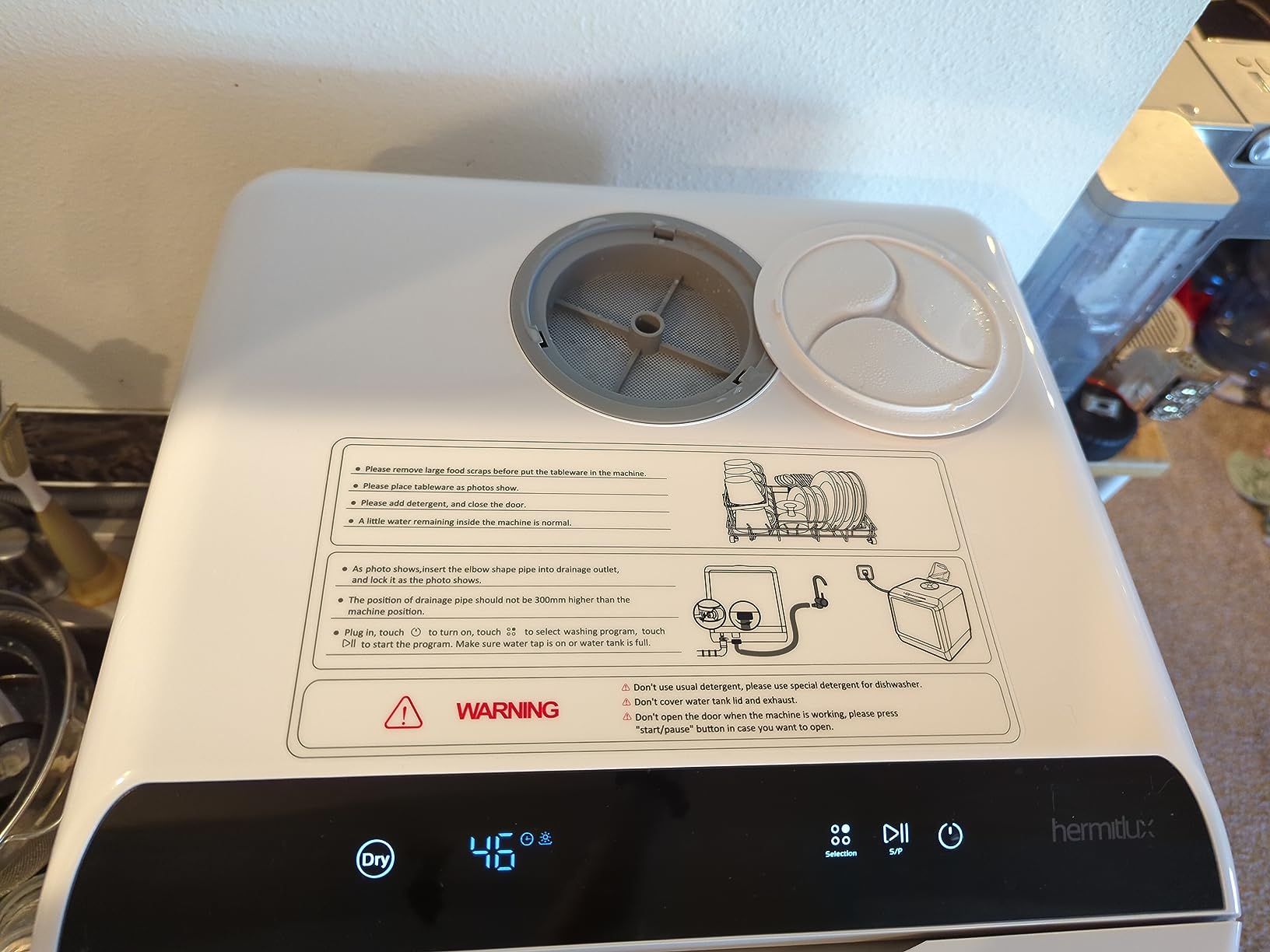
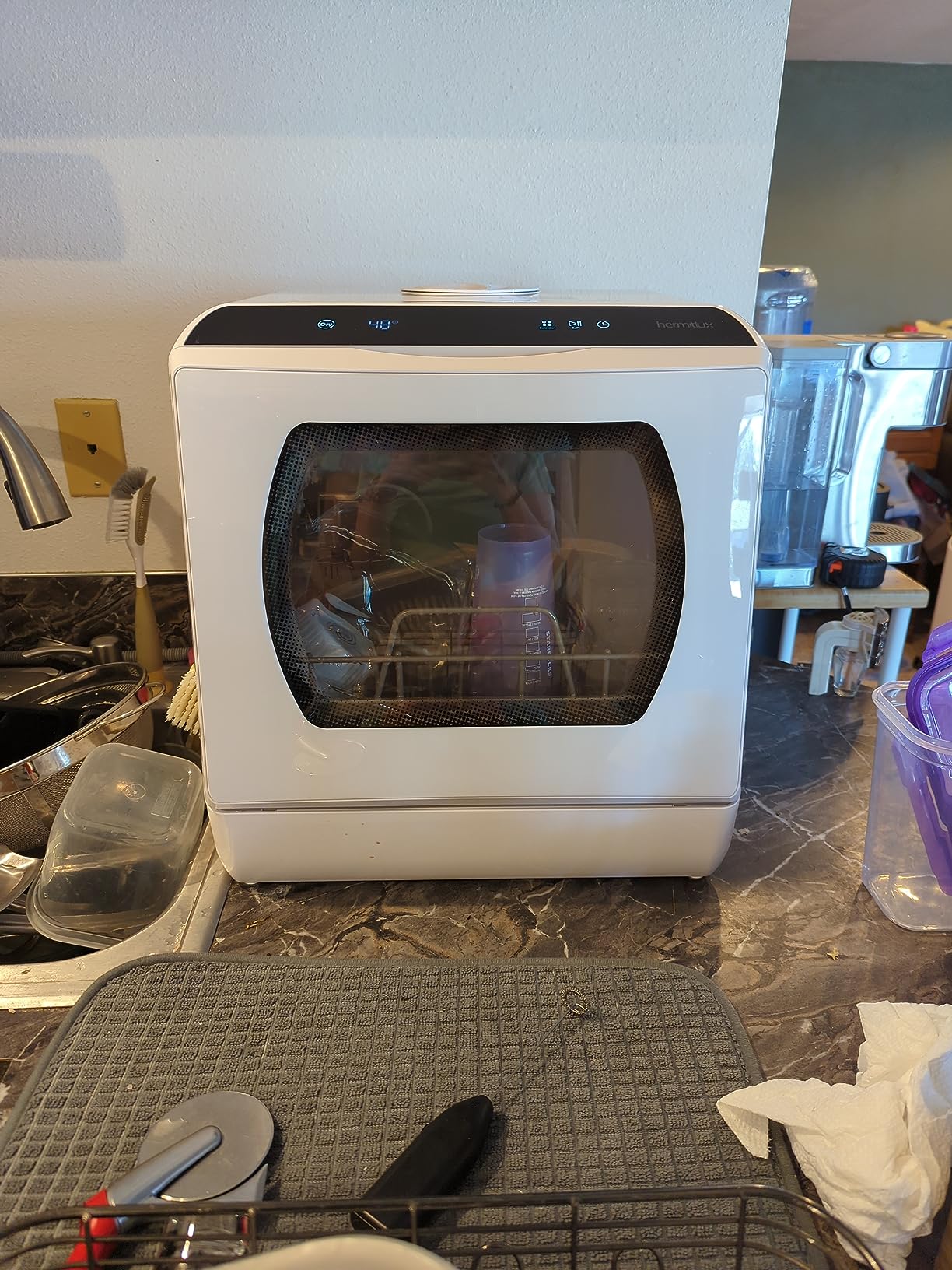
Fourteen jets across the top and bottom spray arms cover the tub well, and the tub holds five place settings with plates up to 10.25 inches set at an angle. The glass door with an interior light is unusual here and genuinely useful for watching a load finish.
Two practical points before you measure. It weighs 30.9 pounds, and it needs about 20 inches of clearance between the counter and the cabinets above. A small amount of residual water in the tub after factory testing is normal and goes away on the first cycle.
Best use in a hard water home
Pair this with a whole-home softener and it becomes an excellent general machine: quiet enough at 50 dB, cheap on water at 5 litres per cycle, and heavily reviewed. The self-clean program is worth scheduling monthly when water is hard, because scale shows up in the filter and spray arms first.
Why it is not our softener pick
There is no softener in the water path, so every drop that touches your dishes is untreated. In a house above roughly 7 gpg with no upstream softener, that means ongoing film and a growing scale layer on the heating element. That is a solvable problem, but not the cheapest one.
5. COMFEE’ CDC17P0ABB Portable Dishwasher with 1.32Gal Tank
COMFEE’ Portable Mini Dishwasher Countertop with 1.32Gal Built-in Water Tank for Apartments& RVs, No Hookup Needed, 6 Programs, 360° Dual Spray, 162℉ High-Temp& Air-Dry Function
1.32 gal built-in tank, no hookup needed
6 programs including 162F Hygiene cycle
360-degree dual spray arms
62 dB, 36.6 pounds, 16.53 inch wide
Pros
- Tank and pitcher filling free the machine from any faucet
- Smallest footprint here at 16.53 inches wide so it fits under a sink
- Hygiene cycle reaches 162F for bottles and heavily soiled items
- Air Refresh mode circulates air to keep the interior dry
Cons
- Lowest rating in this group at 4.0 stars
- Plastic tub that needs periodic degreasing
- Loudest machine here at 62 dB
- Smallest interior
- so plates over 9.5 inches must be angled
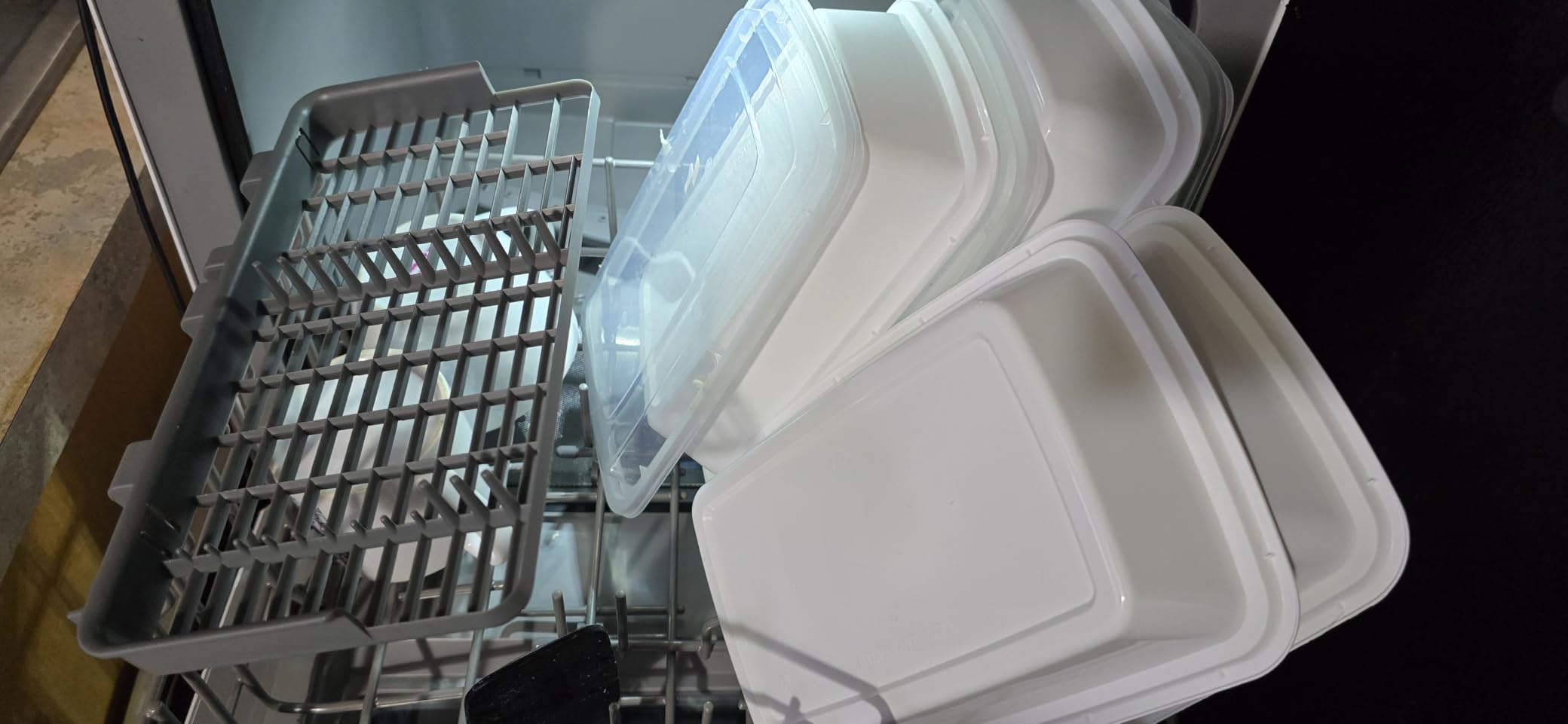
This is the narrowest machine on the list at 16.53 inches wide, which is the whole reason to consider it. If you are fitting into a small kitchen, a rental, an RV or an ADU where under-sink space is the only available real estate, that dimension decides more than any spec.
It fills manually with the included pitcher, so it runs on completely untreated supply with no faucet anywhere near it. For a well house that is genuinely useful. The Hygiene cycle reaches 162F, which is trusted for baby bottles, and dual spray arms reach into the corners of the tub.
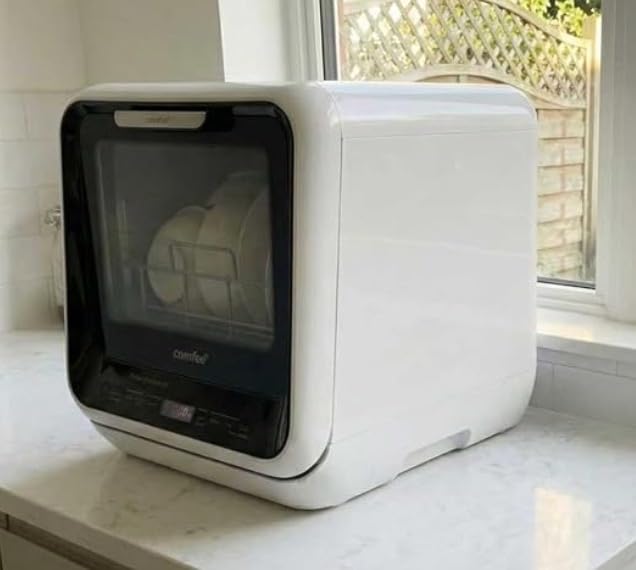
Where it falls down is measurable. It is the loudest machine here at 62 dB, the lowest rated at 4.0 stars with a 15 percent one-star share, and it has the smallest interior, so anything over 9.5 inches has to be angled and pots do not fit. Full cycles can run past two hours.
There is no softener, and owners on hard water still report residue on dishes. The drain hose clamp and suction cup are also widely reported as ineffective, needing a workaround to keep the hose in place.
Best for tight quarters
If cabinet clearance rules out everything else, this is the machine. It uses about one third the water of handwashing, holds 30 or more items, and the Air Refresh mode keeps the interior from developing the smell that plastic tubs are prone to.
Why a hard water house should think twice
No softener, the highest noise figure here, and reports of the upper spray arm not spinning or the unit failing to heat water. On untreated supply above 7 gpg, that is three compromises stacked on the same problem. We would rather see you pair a quieter machine with a whole-home softener.
6. HAVA TDQR Countertop Dishwasher, 6 Programs with Water Tank
HAVA Countertop Dishwasher, 6 Programs Portable Dishwasher with Water Tank
Built-in 5L tank or optional faucet hookup
6 programs including 167F heavy and dry
30+ items, 4 place settings, plates to 11 inch
13 kg, 60 dB
Pros
- Lightest machine here at 13 kg
- easy to move between counter and cart
- 5L tank can be filled directly from an untreated supply
- 167F heavy mode handles canning jars and bottle parts
- Holds 11-inch dishes angled and 4 full place settings
Cons
- No built-in water softener
- so very hard water leaves a powdery white film on plastics
- Filter is loose and lets food lodge in the spray arms
- Drain hose suction cup will not hold on a ceramic sink
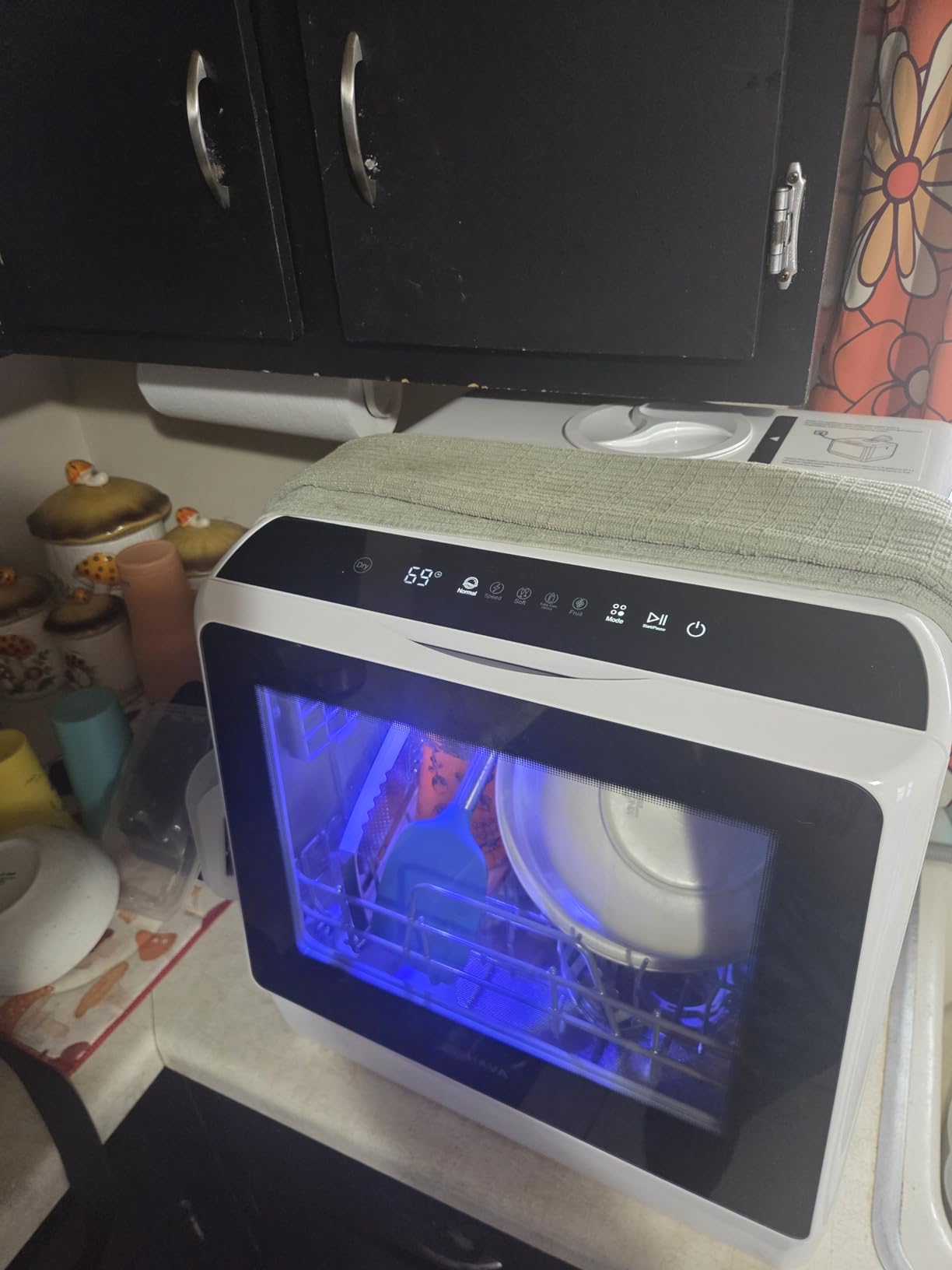
At 13 kg this is the easiest machine here to lift, and that turns out to matter more than any spec in a house where the dishwasher moves between a counter and a rolling cart. Cleaning power is the other strong theme: the 167F heavy cycle sterilizes canning jars and bottle parts.
Hard water performance is the key caveat, and owners are honest about it. One detailed report traced white film on plastics to very hard water and solved it by moving from a Finish Powerball detergent to Cascade Premium rather than blaming the machine. That is the honest ceiling on any no-softener model.
Capacity is good for the format. It holds more than 30 items including 11-inch dishes set at an angle and four full place settings, using 5 litres of water and 950 watts per cycle. Drying runs 60 minutes of hot air plus 72 hours of automatic ventilation.
Watch the smaller parts. The filter is loose, which lets food particles lodge in the spray arms and cut wash efficiency, and the drain hose suction cup will not hold on a ceramic sink wall. A strong plastic smell is normal for the first several cycles.
Best for renters and temporary homes
If the machine needs to move often, or the water is hard but you are only here part of the time, the weight and simplicity both help. Filling the tank from the tap and draining to a bucket needs no tools and no plumber, which is also why we keep water containers in our testing kit.
Why it will not fix a hard water problem
Without a softener, the minerals reach the tub at full strength. On very hard water the film appears on plastics first, the loose filter lets grit into the spray arms, and the scale layer on the heating element grows every cycle. A detergent swap helps the dishes; it does not help the machine.
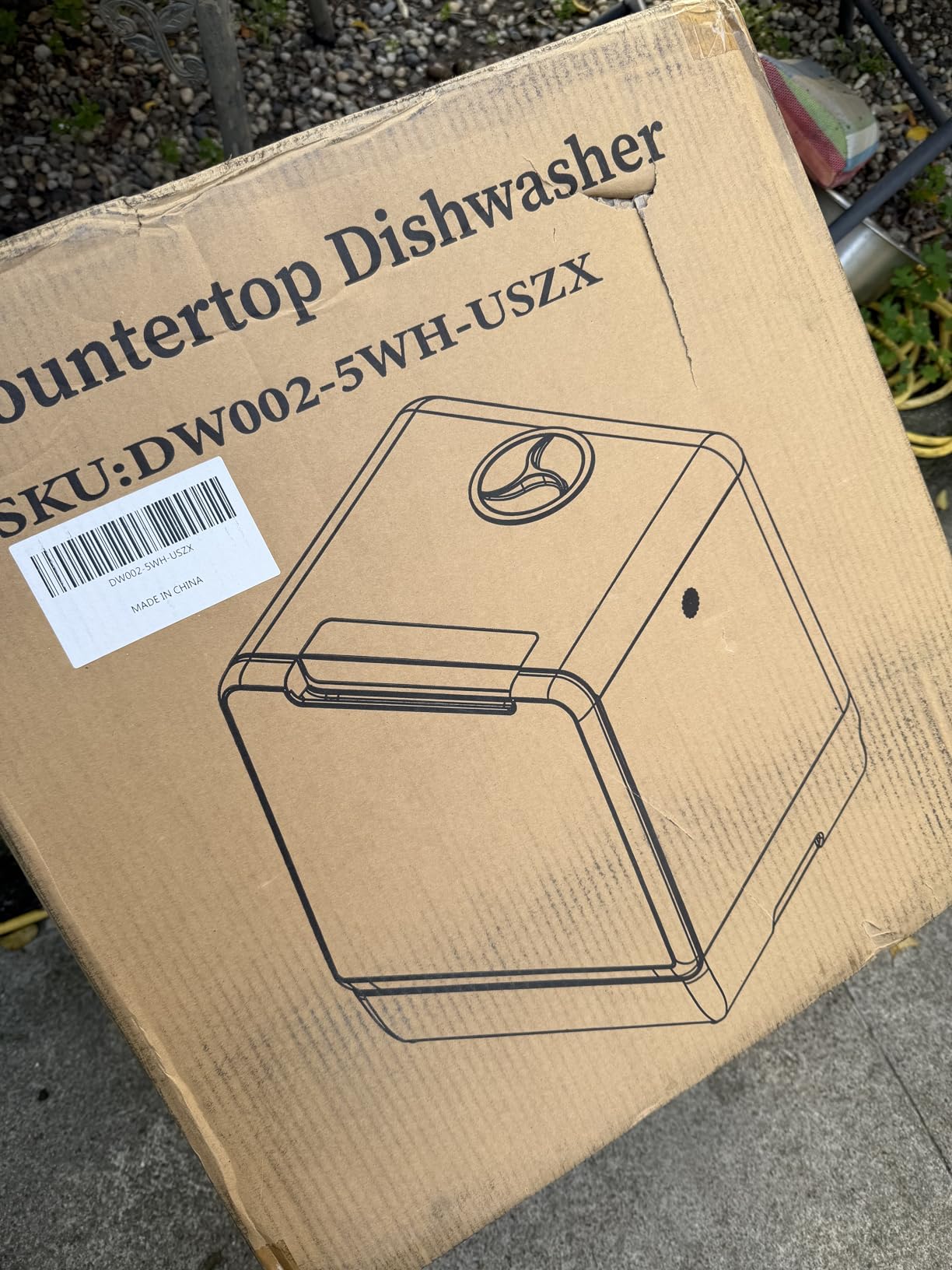
7. EUHOMY DW002-5A Countertop Dishwasher, 8 Programs, 40 dB
EUHOMY Countertop Dishwasher Portable, 8 Programs with 5L Tank, Black, 40dB
Built-in 5L tank or G3/4-inch faucet connection
8 programs with 29-minute quick and 167F wash
40 dB operation, dual 360-degree spray arms
34.6 pounds, 1-year warranty
Pros
- Same 40 dB class as the quietest machine in the group
- Eight programs with a 29-minute quick and a 167F baby care cycle
- Self-clean mode helps keep the tub fresh and low odor
- Manufacturer sent a free replacement drain hose when one cracked
Cons
- No built-in water softener
- so hard-water film is handled by detergent choice
- Inlet hose kinks easily when the unit is pushed back
- Water pools on top of inverted cups and bowls
The self-clean program is the reason this one earns its badge in a hard water article. A monthly empty cycle with the machine’s own cleaning mode, followed by citric acid if the tub has scale, keeps the filter and spray arms from loading up with minerals.
It shares the 40 dB class with the other EUHOMY here, and owners like the wash strength enough to run it on a rolling cart draining into a bucket, which suits wells and RV setups. Eight programs include the 29-minute quick and a 167F baby care and strong mode.
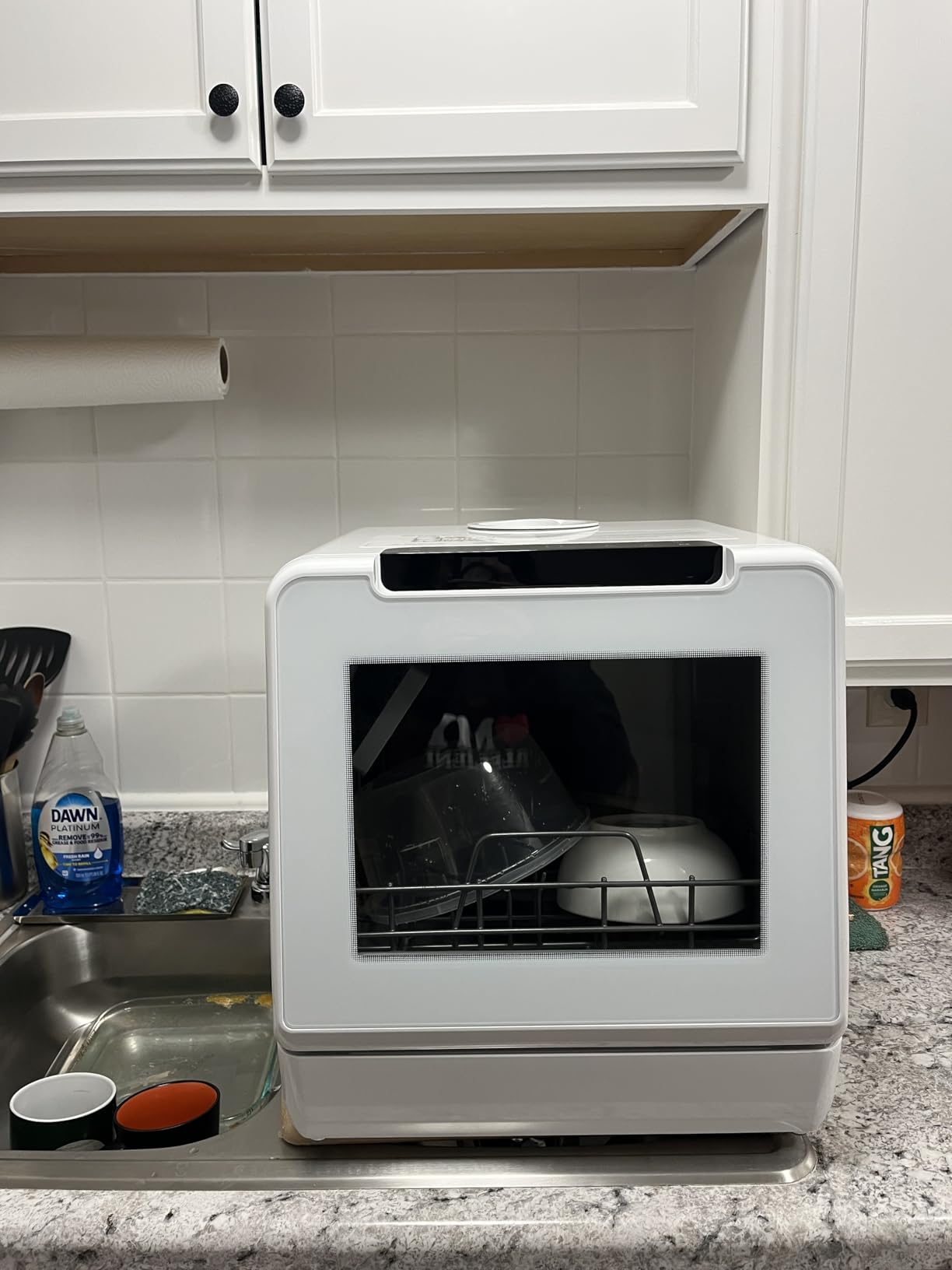
Owners also note that the manufacturer sent a free replacement drain hose when one cracked, which tells you something about how they handle failures. ETL and DOE certified, with a one-year warranty and a water-level indicator on the 5 litre tank.
The mechanical complaints are specific. The inlet hose kinks easily when the unit is pushed back against it, which can lead to a leak, and the detergent dispenser is an open square with no door. Water pooling on the inside of inverted cups is the most common drying complaint.
Best when maintenance is your main concern
If you are willing to run a cleaning cycle on a schedule, the self-clean mode plus the quiet 40 dB operation makes this an easy machine to live with in an open room. Dual 360-degree spray arms and a glass door with an interior light help you spot a problem before it sets in.
Why it ranks below the softener models
There is no softener, so hard-water film has to be managed by detergent choice alone. One detailed negative review links poor cleaning to the non-standard dispenser and the lack of a rinse-aid port rather than to hardness, but either way you are correcting for the machine after the fact.
8. AIRMSEN ZMW-DUHA01 Slim Countertop Dishwasher with Softener
AIRMSEN Large Slim Countertop Dishwasher | Built-in Water Tank
Integrated water softener with 1.4 gal built-in tank
Slim 14.2 inch depth, three spray arms
167F high-temp wash, 5 place settings
56 dB, 2-year warranty
Pros
- Only large-capacity machine here combining a tank with an integrated water softener
- Slim 14.2 inch depth with an interior 25 percent larger
- Accepts long items up to 18.5 inches such as pans with handles
- Three high-pressure spray arms with a 167F wash
- Two-year warranty
Cons
- Tallest machine here at 19.5 inches
- will not fit under standard cabinets
- Top utensil tray is too shallow for most cups and holds few utensils
- Rack pin spacing is irregular so deep bowls do not seat well
This is the pick for a large load on a private supply. It is the only machine here that combines a built-in tank with an integrated softener and holds five place settings, so hard well water can be treated with dishwasher salt inside the machine while you clean a full family’s worth of dishes.
The slim 14.2 inch depth is the shallowest in this group and the interior is 25 percent larger because of it. It is also the only model that accepts long items up to 18.5 inches, which covers pans with handles that nothing else here will take.
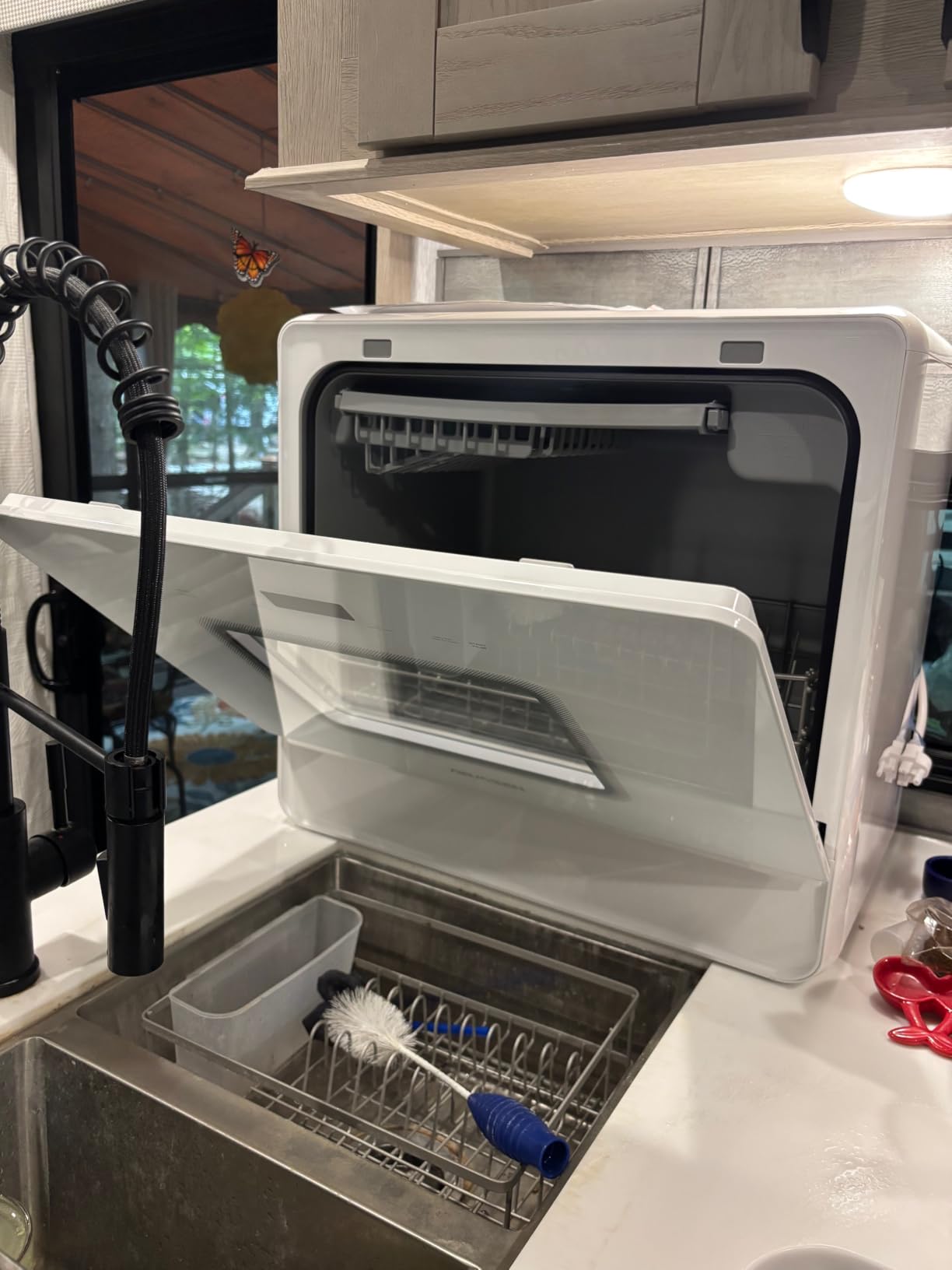
Three high-pressure spray arms give 360-degree coverage and the 167F high-temp wash alternates hot and cold water several times per cycle. After heated drying, 72 hours of intermittent ventilation keeps the interior fresh, which matters when plastic is involved. Owners note it will run off a 3000W inverter solar system for off-grid use.
Measure carefully before ordering. At 19.5 inches tall it will not clear standard cabinets, and several buyers returned or repositioned the machine after finding it taller than they had measured. The top utensil tray is also shallower than the manual implies, and the tank-full beep is quiet.
Best for a busy household on a well
If your water is untreated and hard, and you want built-in softening plus real capacity in a portable format, nothing else here matches it. Three spray arms and 167F washing handle heavily soiled items, and the two-year warranty is the longest in this group.
Where it becomes awkward
Regular depth and an irregular rack pin layout mean deep bowls and containers do not seat well, and the shallow top tray holds few utensils. Occasional white drip marks on plastics after drying are reported, which is the same residue issue every no-rinse-aid routine produces.
How to Test Your Well Water and Set the Hardness Dial
Hardness is measured in grains per gallon, and one grain per gallon is about 17.1 parts per million. The USGS scale puts water at 7 gpg or above in the hard band and 12 gpg or above as very hard. A reading of 425 ppm works out to roughly 25 gpg, which is well past very hard and beyond what a built-in dishwasher softener can handle alone.
Use a hardness test strip or a titration kit rather than guessing. Well readings also change seasonally, so test in late winter and again in late summer before you set anything. Write the number down and use it both for the machine’s hardness setting and for your purchasing decision.
Set the hardness dial to your measured value rather than the highest setting. Owners on forums repeatedly blame the machine when the real problem is a dial set too high, which wastes salt and leaves a film of its own. If you have a whole-home softener already, set the dishwasher to its lowest or zero setting, because the water arriving is already softened.
Iron and manganese need separate treatment. Neither is removed by an ion-exchange softener, and both leave stains that no cycle will clean. If a well test shows iron above about 0.3 ppm, add an iron filter to your treatment plan or the dishwasher will fight the same battle every load.
Once you know your number, the requirement is simple. Below 7 gpg, any machine here works with rinse aid and a hard-water detergent. Between 7 and 12 gpg, prioritize a model with an integrated softener. Above 12 gpg, treat the whole house first; a dishwasher softener cannot carry that load on its own.
That last point is the one most households miss. Forum owners running a Bosch 500 series on softened well water report five years with no scale buildup and no repairs, which is a far better outcome than any machine can deliver against untreated water. Our guide to other water-contact appliances covers why the same principle applies elsewhere in the house.
What to Avoid in a Hard Water House
First, avoid buying on a series name. Within the same Bosch series, some SKUs include the softener and some do not, and owners regularly discover the difference after the machine is installed. Check the individual model number on the spec sheet, not the series badge.
Second, avoid a machine with no rinse-aid path if glassware matters to you. Rinse aid is what makes droplets sheet off instead of evaporating into spots, and it matters even on softened water.
Third, avoid loose filters and slow-draining spray arms. On a hard well, a filter that does not seat properly lets grit into the jets and causes the cleaning problems that get blamed on the water. The COMFEE’ and the HAVA TDQR both carry filter complaints worth weighing.
Finally, avoid planning to fix hard water with detergent alone. Detergent built for hard water reduces visible spotting, which is genuinely useful, but it does nothing about the scale forming on the heating element or inside the spray arm. If you own a whole-home softener, say so out loud, because that is what makes a softener-equipped machine redundant.
While you are planning the install, it is worth checking that the rest of your water-carrying gear can handle the same supply. Our picks for the best water trampolines and the best water guns for adults both assume plenty of water, and neither puts extra pressure on a softening system.
Frequently Asked Questions
Do dishwashers work with well water?
Yes, but only with help. Dishwashers run on well water without any change to the plumbing, yet untreated groundwater spots glassware, clouds plastic, and lays scale on the heating element and spray arms. A built-in ion-exchange softener plus dishwasher salt handles the calcium and magnesium, while rinse aid stops droplets from drying into marks. Iron and manganese need separate treatment because a softener does not remove them.
What is the best dishwasher if you have hard water?
The best dishwasher for hard water has a built-in ion-exchange water softener that takes dishwasher salt, plus a rinse-aid dispenser and a stainless steel tub. In our lineup, the HAVA TDJR09 leads because its softener is integrated with an adjustable hardness setting and the 5 litre tank means it needs no plumbing at all. If your whole house is already softened, a quiet machine without a softener becomes a reasonable choice instead.
What is the recommended water hardness for a dishwasher?
Water at 7 grains per gallon or above counts as hard, and 12 gpg or above is very hard. One grain per gallon equals about 17.1 ppm, so 425 ppm lands near 25 gpg, far past the very hard band. Built-in dishwasher softeners comfortably handle the hard range, but water above 12 gpg is better solved by treating the whole house first and setting the machine to its lowest setting.
Is 425 ppm hard water considered hard?
It is far beyond hard. Multiplying 425 ppm by 0.058 gives roughly 24.7 grains per gallon, and the USGS scale classifies 7 gpg as hard and 12 gpg as very hard. A reading that high will spot every load and scale a heating element quickly, so a whole-home softener plus iron filtration is the realistic answer rather than relying on the dishwasher alone.
How to reduce water hardness in a dishwasher?
Start by testing the water, then set the machine’s hardness dial to the measured value rather than the maximum. Keep the softener reservoir filled with dishwasher salt and use rinse aid in the dispenser on every load. Run the machine’s self-clean or descale cycle monthly, and add a citric acid tablet to an empty hot cycle when scale appears on the heating element or spray arms.
Can I pour vinegar into my dishwasher to clean it?
Yes, and it is the standard home remedy for dissolving scale, though vinegar only works on the machine, not on the incoming water. Run an empty cycle on the hottest setting with roughly a quarter cup of white vinegar in the base, or use a citric acid tablet if the smell lingers afterward. Vinegar cannot remove iron staining, and it will not fix a dial set to the wrong hardness level.
How long should a dishwasher last with hard water?
A lot less than the ten-year expectation if nothing is done. Untreated hard water scales the heating element, narrows the spray arm jets, and eventually reaches the circulation pump and thermostat, and owners on forums report replacing machines every few years. With a working softener, a rinse-aid routine and monthly descaling, long-term owners report five years or more with no scale damage or service calls.
What dishwasher should I stay away from in hard water?
Avoid any machine without a rinse-aid dispenser, any plastic tub if you can stretch to steel, and anything whose filter sits loosely. Verify the softener on the exact model number rather than the series name, because some units in the same series ship without one. On a well above 12 gpg, no dishwasher is a good buy until the whole house is treated.
Which Dishwasher Should You Buy for Well Water?
The HAVA TDJR09 is our pick for most well water households, because the integrated softener with an adjustable hardness setting is paired with a tank that removes any plumbing requirement. If you need real capacity in a portable format, the AIRMSEN ZMW-DUHA01 gives you a softener and five place settings in one machine, provided you can clear its 19.5 inch height.
If your whole house is already softened, the shortlist changes completely and a quiet 40 dB model becomes the sensible buy. Test your water first, set the dial to the number you measure, and keep rinse aid filled. That routine matters more in 2026 than the model badge on the door.