
Choosing the best stage pianos for gigging musicians comes down to three things nobody puts on the box: how the board feels at 1am after a five-hour drive, whether it reaches the FOH desk cleanly, and whether you can still lift it onto the stand. We spent weeks comparing ten of the most widely deployed 88-key stage pianos, weighing their action, outputs and load-out penalties against what working players actually say about them.
Every instrument below is built for a stage, not a living room. That means a weighted or semi-weighted keybed, road-ready outputs, patch recall that does not require a settings dive, and a chassis that tolerates being carried up church steps at speed. If you want a home instrument for practice, our kids keyboard and piano picks cover a different category entirely.
Below is a ranked list of the ten boards, followed by a buying guide that covers key action, weight, signal routing and polyphony, plus a section on backup boards and what to check when buying used. Prices change constantly, so use the check-price buttons rather than any number you remember.
Top 3 Stage Piano Picks for 2026
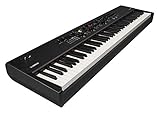
Yamaha CP88
- 88 natural wood keys
- GH3 graded hammer action
- Balanced XLR and 1/4 inch outputs

Roland RD-2000 EX
- PHA-50 hybrid wooden action
- V-Piano plus SuperNATURAL engines
- Nine sliders and eight encoders

Best Stage Pianos for Gigging Musicians in 2026
| Product | Specifications | Action |
|---|---|---|
| Yamaha CP88 |
|
Check Latest Price |
| Roland RD-08 |
|
Check Latest Price |
 Korg SV2-SP Korg SV2-SP |
|
Check Latest Price |
| Roland RD-2000 EX |
|
Check Latest Price |
 Roland RD-88 EX Roland RD-88 EX |
|
Check Latest Price |
 Studiologic Numa X Piano GT Studiologic Numa X Piano GT |
|
Check Latest Price |
 Kawai MP11-SE Kawai MP11-SE |
|
Check Latest Price |
 Nord Stage 4 88 Nord Stage 4 88 |
|
Check Latest Price |
 Nord Piano 6 Nord Piano 6 |
|
Check Latest Price |
 Korg Grandstage X Korg Grandstage X |
|
Check Latest Price |
1. Yamaha CP88 – Best Stage Piano Overall
Yamaha CP88 88-Key Weighted Hammer Action Stage Piano with Sustain Pedal
88 natural wood keys with GH3 graded hammer
Balanced XLR and 1/4 inch outputs
FC3A pedal and 3 year warranty
Pros
- Bright mix-cutting grand and upright voices
- Five electric pianos including strong Rhodes and Wurlitzer
- Balanced XLR plus 1/4 inch stereo outs and dual AUX inputs
- No touchscreen so patches stay one-to-one
- Seamless sound switching with no cutoff
Cons
- Heavier to lift than slim stage slabs
- Action feels firm and quick rather than delicate
- Default piano distortion buried in a counter-intuitive menu
- Weak choice if organ is your main sound
The CP88 is the one I keep coming back to because it does the unglamorous things well. A gigging worship leader and a jazz trio keyboardist can share the same board, and the bright default grand that giggers report is mix-cutting holds up when the band is loud and the FOH engineer is not being generous.
The action is 88 natural wood keys with synthetic ebony and ivory key tops on a GH3 graded hammer action. Graded means the low end is heavier than the top, which is exactly what a piano-trained finger expects, and it gives you real dynamic shaping rather than an on-off switch.
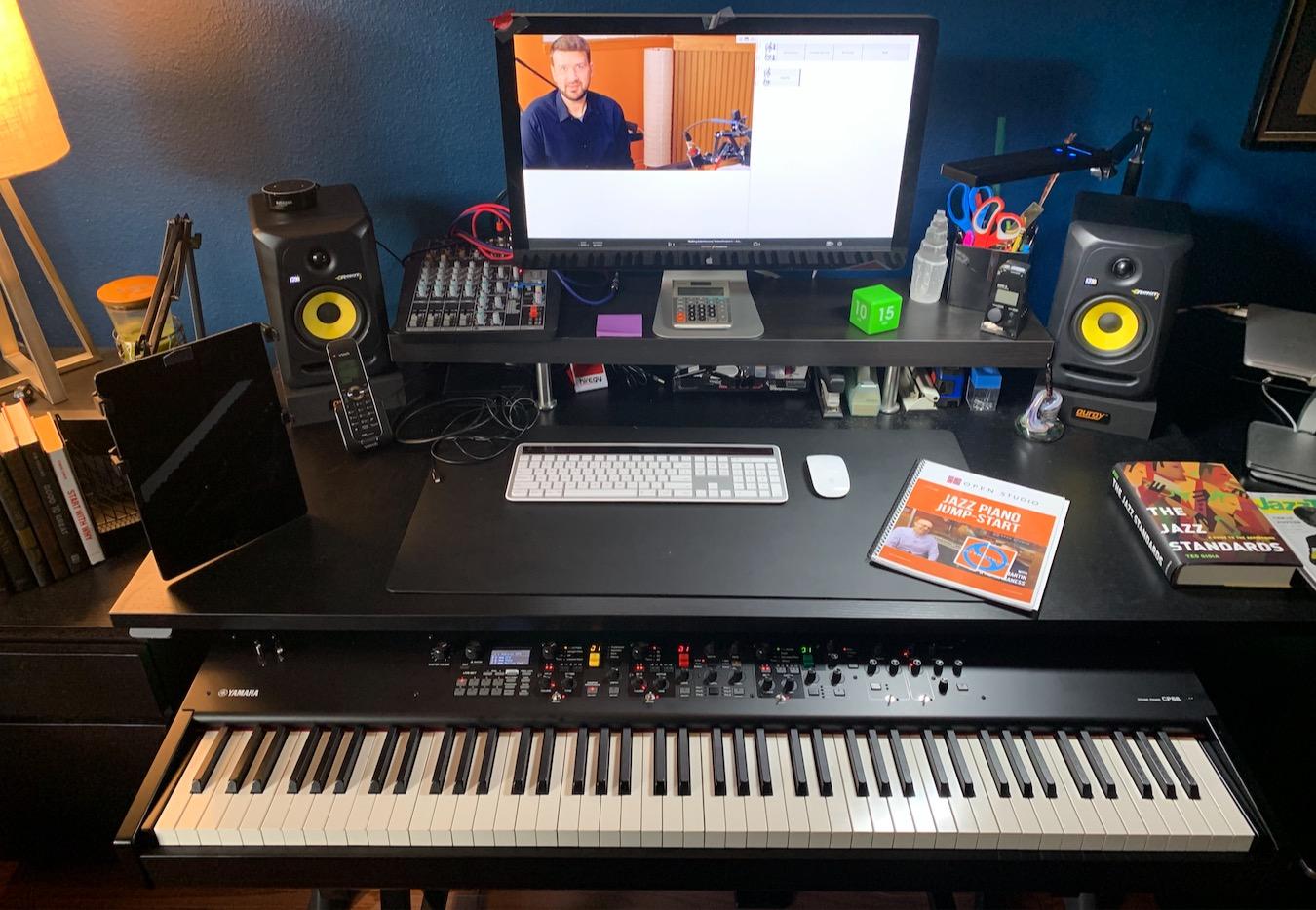
On the connectivity side this is a proper stage instrument. You get balanced XLR outputs alongside unbalanced 1/4 inch stereo outs, dual 1/4 inch AUX line inputs for doubling a sound or feeding a click, and a two-channel USB audio and MIDI interface, so it doubles as a DAW controller without extra hardware.
The control layout is deliberately one-to-one with no touchscreen. That is a blessing under stage light. Every function you need in a set is a physical control, and Seamless Sound Switching lets you change sounds mid-note without the cutoff that catches players out between songs.
Two gripes are worth knowing before you commit. The default piano distortion is stronger than most players want and the adjustment sits in a menu path few people find, and the black keys have a pronounced wooden feel that some players describe as taking a week or two to acclimatise to. Owners also report CP88 knobs and switches degrading after months of nightly gigging, so budget for periodic spares.
Is the CP88 action right for classical players?
It is a strong match for pianists who want graded weight and dynamic range without the price and logistics of a wooden-key flagship. Teachers and recital players do use it, though if your touch is feather-light, the firmer, quicker response takes some adjustment.
If you play the same repertoire on the same acoustic and expect that exact tactile response, test a wooden-key board such as the Kawai MP11-SE before you settle.
Is the CP88 the right board for a worship leader or wedding band player?
Yes. Balanced XLR outputs go straight into a mixing desk, the electric piano voices cover the Rhodes and Wurlitzer sounds that church and function band sets lean on, and the included FC3A sustain pedal removes one more box from the rig.
It is less suitable if your set is organ-driven. Owners rate it as a poor match for organ specialists, and you would be looking at a Stage-style board instead.
2. Roland RD-08 – Best Value for a Lightweight Rig
Roland RD-08 Stage Piano, 88-Note Weighted-Action PHA-4 Keyboard
88-note PHA-4 weighted action with Ivory Feel
39.5 pounds
SUPERNATURAL plus ZEN-Core engines
Pros
- Lightest full 88 weighted board in this roundup
- SuperNATURAL piano engine layers acoustically with EPs
- Action widely praised with fast mode switching
- Over 3000 ZEN-Core sounds including classic XP-80 and JV-1000 patches
- USB MIDI works out of the box for DAW control
Cons
- Onboard stereo speakers are extremely weak
- Una corda is not supported by the SuperNATURAL engine
- USB audio interface needs a separate paid upgrade
- Roland and Boss software utilities can be dated
At 39.5 pounds the RD-08 is the board in this roundup you can genuinely carry in one hand, which makes it the pick for a solo act doing small rooms and a worship leader who has no crew. The SuperNATURAL engine is ported from the RD-2000 and RD-88, so the core piano and electric piano voices are not a cut-down set.
Below that sits the ZEN-Core engine with more than 3000 additional sounds covering organs, synths, strings and brass. Owners single out the classic XP-80 and JV-1000 patches, which matter if you have a vintage synth set list to reproduce and no external module.
Musically the PHA-4 weighted action with Ivory Feel is the older-generation Roland feel, but it is responsive and owners call it superb for the price. Mode switching is fast, which is what you want when a song ends and the next patch is a different world.
There are real limits. The onboard stereo speakers are extremely quiet and useless on their own without a PA or monitors, so treat them as a headphone practice aid. The SuperNATURAL engine does not respond to the una corda soft pedal, and the USB audio interface requires a separate paid upgrade whose cost is not always disclosed up front, though plain USB MIDI works immediately for DAW control.
Can the RD-08 work as a MainStage controller?
Yes, and this is where it quietly beats more expensive boards. USB MIDI control works with no paid upgrade, and a compatible three-pedal unit is plug and play, so a MainStage or Logic rig needs nothing else.
Budget for the paid upgrade only if you want to record audio from the board itself. If your DAW workflow is MIDI plus software instruments, the base instrument is already enough.
Should a gigging musician buy the RD-08 or spend up for an RD-88 EX?
Choose the RD-08 if carrying weight is your binding constraint or you are building a controller-based rig. Choose the RD-88 EX if you need onboard speakers for a small room, a MIDI pedal in the box, and more content for a working band set.
If your main instrument is the piano rather than a controller, neither is the answer, because the RD-08 speaker system will not cover a venue and the RD-88 EX will not change that.
3. Korg SV2-SP – Best for Vintage Electric Piano Character
Korg SV2-SP 88-key Stage Vintage Piano
72 sounds and 64 memory locations
K-ARRAY speakers at 15 watts per side
64.7 pounds
Pros
- Authentic vintage electric piano character
- Professional level German Italian Austrian and Japanese grand samples
- Over ten times the sample data of earlier SV models
- K-ARRAY stereo system gives 15 watts per side
- 64 memory locations for storing live patches
Cons
- Heaviest board here at 64.7 pounds
- Deep chassis and large footprint complicate transport
- Only 72 onboard sounds
- One year warranty is the shortest in the roundup
The SV2-SP exists for a specific player: someone whose set list is built on vintage electric pianos and wants a stage board that can cover a rehearsal room without a separate amplifier. The K-ARRAY designed stereo system puts out 15 watts per side, which is real volume compared with the near-token speakers on other slabs.
Sample data is over ten times what earlier SV models carried, with professional level German, Italian, Austrian and Japanese grand piano sounds. That breadth matters because the vintage EP character is the reason to buy this board, and it is the character owners report getting.
Patch storage is 64 memory locations, which is enough for a full set plus alternates. The same family is available in 73-key and 88-key configurations, with or without speakers, so a smaller venue rig is possible without changing instrument family.
The problems are logistical and tonal. At 64.7 pounds with a deep chassis this is the heaviest instrument here, which is genuinely awkward for a solo load-in, and 72 onboard sounds is fewer than RD-series boards with large libraries. The one year warranty is also the shortest of the ten.
Is the SV2-SP loud enough to rehearse without an amp?
Yes, that is the design intent. Fifteen watts per side from a purpose-designed speaker array fills a small room and supports the vintage EP sounds better than any other board in this list.
For a live room with a PA, those speakers become dead weight. If your gigs are almost all amplified, that capability and the weight it adds are not earning their place.
Is the SV2-SP practical for a solo musician who carries their own gear?
Only with help. Owners and reviewers consistently flag 64.7 pounds plus a deep body as a two-person job or a cart job, and a matching case pushes the total further.
If you gig solo in small rooms, a lighter board will serve you better. If you have a crew, a backline tech, or a permanent rig and the vintage EP tone is your signature, this is the one to shortlist.
4. Roland RD-2000 EX – Best Premium Stage Piano
Roland Premium Digital Stage Piano RD-2000 EX
PHA-50 keyboard action
Two V-Piano expansions pre-installed
SuperNATURAL with 128-voice polyphony
62 pounds
Pros
- PHA-50 action is a major step up from the older PHA-4
- German Concert and Essential Upright V-Piano titles included
- Two independent engines plus 128-voice SuperNATURAL polyphony
- Nine sliders and eight encoders with LED status indicators
- Durable pro-grade build
- Onboard sounds strong enough without leaning on VSTs
Cons
- Very heavy for a portable stage instrument
- A two-person or cart job for most players
- EX upgrade path costs more than buying the earlier board and expansion separately
- External speaker setup is described as fiddly
The RD-2000 EX is the flagship answer here, and the reason is the PHA-50 keyboard action. Owners upgrading from older Roland instruments including the A88 and FP-90X describe it as a huge improvement, because it is a hybrid action that blends weighted key feel with a slimmer, more responsive hammer mechanism than the PHA-4 generation.
Underneath, it runs two independent engines. Roland V-Piano modeling technology handles the acoustic side and ships with the German Concert and Essential Upright expansions pre-installed, and the SuperNATURAL engine covers electric pianos and additional sounds with 128-voice polyphony.
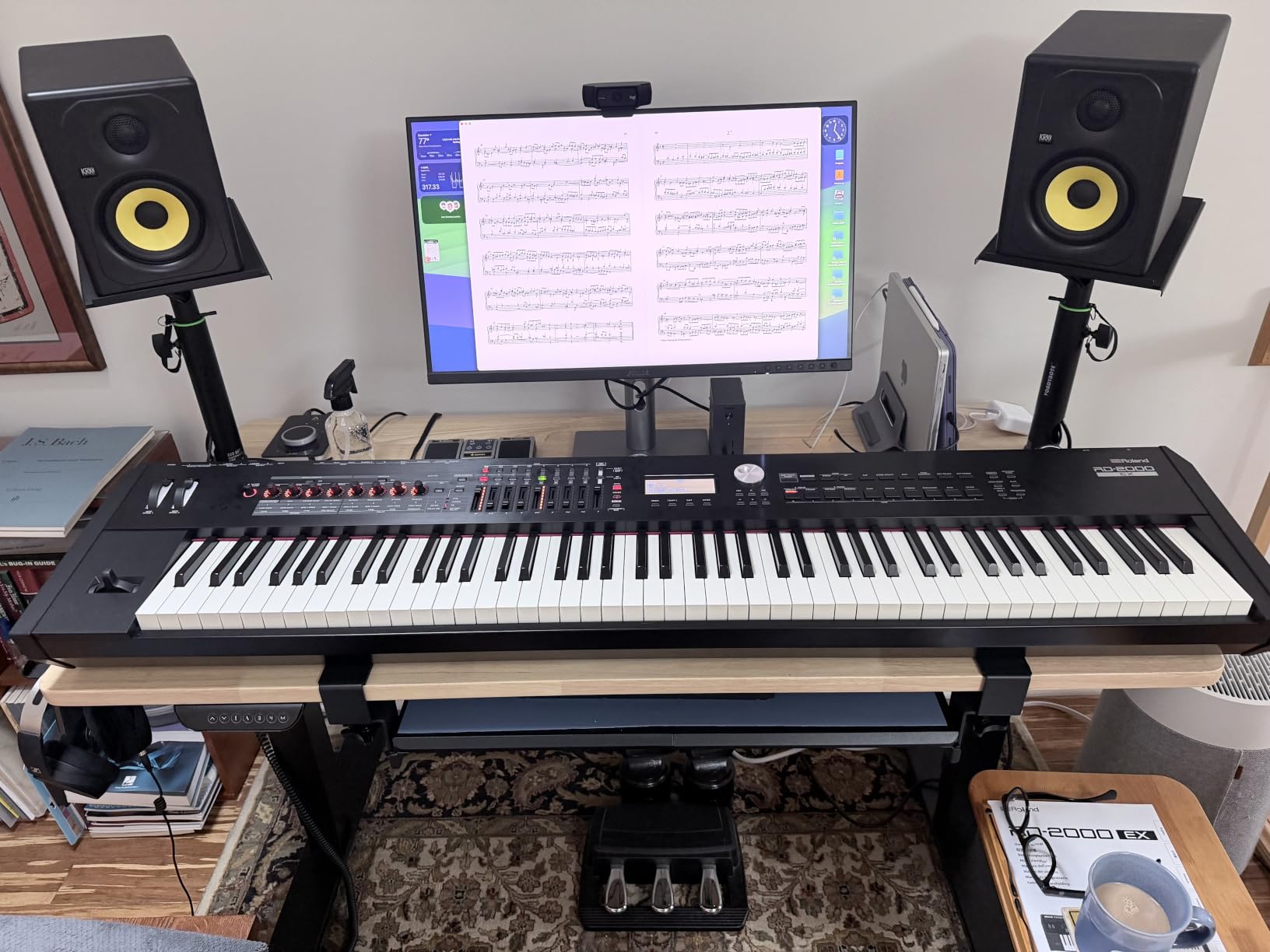
The panel is the other quiet win. Nine sliders and eight encoder knobs with LED status indicators give deep real-time control without a menu, and owners praise the working equalizer and sound settings, specifically noting no unwanted echo artifacts in the factory patches.
Weight is the honest drawback at 62 pounds. Owners stress it is far too heavy to move casually and that a top quality stand is essential, with one review framing it plainly as a two-person or cart job for most players. One owner also argues the value proposition is weak against buying the earlier RD-2000 and adding the expansion separately.
Do I need the RD-2000 EX if my rig runs on MainStage?
Probably not. If a laptop is generating your sounds, the modelling depth here is largely unused, and a lighter board with reliable MIDI control will serve the same gig more easily.
Buy it because the internal voices are the instrument. Owners report the onboard sounds are strong enough that they stop reaching for VSTs, which is exactly the case where a modelling engine earns its weight.
Is the RD-2000 EX portable enough for a solo act?
Not comfortably, at 62 pounds. Even with the lightest case, the board plus stand plus pedals is a two-person lift for most players and needs a wheeled path to the stage.
It suits a player with a crew, a fixed backline, a rehearsal room, or a worship tech team that moves gear with a cart. For a solo singer-songwriter working small rooms, choose a lighter board instead.
5. Roland RD-88 EX – Best Mid-Range Board With Speakers
Roland RD-88 EX Stage Piano, 88-Note Keyboard
PHA-4 hammer action with Ivory Feel
SuperNATURAL Acoustic Piano 3 Expansion
41.5 pounds with onboard stereo speakers
Pros
- Authentic SuperNATURAL acoustic and electric piano sounds
- Room-filling onboard stereo speakers
- Compact and light enough for straightforward transport
- Large ZEN-Core library plus built-in rhythms
- USB audio and MIDI with a MainStage control mode
- DP-10 damper pedal included
Cons
- PHA-4 action is a generation behind the PHA-50 on the RD-2000 EX
- Speakers are fine for practice but need a PA in a live room
- Deepest acoustic piano content needs the paid expansion
The RD-88 EX is the value pick for a working player who needs a complete instrument rather than a controller. At 41.5 pounds it is still an easy two-hand carry, and the room-filling onboard stereo speaker system means you can soundcheck a patch in a bedroom, a green room or a small hall without hunting for a monitor.
Sound-wise it runs the SuperNATURAL Acoustic Piano 3 Expansion plus the ZEN-Core engine with more than 3000 additional sounds, so the same board covers a worship set, a function band and a solo jazz trio without a second instrument.
The USB audio and MIDI interface includes a dedicated control mode for Apple MainStage, and a USB memory port handles MP3 and WAV playback for backing tracks plus data backup. Built-in rhythms are there for accompaniment and are more useful in rehearsal than in a live set, but they are included.
The honest comparison is the keybed. PHA-4 is an older generation feel next to the PHA-50 in Roland’s flagship, and speakers that fill a practice room still need a PA once a drummer is playing. One owner also notes the deepest acoustic content requires the paid expansion.
Can the RD-88 EX handle worship, wedding and theatre work?
Yes. This is arguably its best use case. A worship leader gets a damper pedal in the box, a wide library for the set, and enough onboard volume to rehearse. A theatre accompanist gets splits, layering and a reliable piano voice.
For a large worship hall the speakers become irrelevant and the balanced connections do the work, so judge it on action feel and library depth rather than its monitor capability.
Is the RD-88 EX a good value against the RD-2000 EX?
It is, for most players. You trade the PHA-50 action and the pre-installed modelling expansions for 20 pounds of portability and onboard speakers you will rarely use in a live room.
Choose the RD-2000 EX only if key feel and internal acoustic depth are the reason you play. Choose the RD-88 EX if you want the most complete working instrument for the money.
6. Studiologic Numa X Piano GT – Best for Multi-Split Sets
Studiologic Numa X Piano GT Digital Piano with 88 Hammer-Action Keys
TP/110 hammer keybed with bounce reduction
300-voice polyphony and an internal mixer
TFT color display with color-adaptive encoders
Pros
- Keybed widely praised as the best in its class with quiet low-bounce keys
- Outstanding acoustic and electric piano sounds
- Fast intuitive editing with a color display and color-adaptive encoders
- 300-voice polyphony plus an internal mixer for live routing
- Unusually slim and light for an 88-key hammer-action board
- SLP3-D three-pedal unit included
Cons
- No pitch and modulation wheels for organ and synth players
- Hammond and organ emulation is an inaccurate imitation
- External power supply instead of an internal one
- Some boards arrive pre-opened or with occasional key contact faults
The Numa X Piano GT is the sleeper in this roundup for a one-man-band rig. The TP/110 keybed with hammers and strong bounce reduction gives long, quiet, low-bounce keys that several owners say beat the Yamaha and Nord boards they tried, and the instrument fits a slim 76-key flight case at roughly 46.3 pounds.
Where it wins hardest is live flexibility. A 300-voice polyphony ceiling and a built-in internal mixer mean you can route sounds and effects at the gig, and 200 sounds cover acoustic pianos, electric pianos, keyboards, bass, guitars, organs, synths and orchestral material.
The interface is genuinely fast. A TFT color display with color-adaptive encoders changes what the encoders do according to the on-screen context, and Zoom, Edit and Play modes keep zone parameters at your fingertips, which is the opposite of a menu dive.
The gaps are specific. There are no pitch and modulation wheels, which organ and synth players will miss, and the Hammond-style organ emulation is criticised as an inaccurate imitation. It also uses an external power brick rather than an internal supply, and a few owners report boards arriving pre-opened as display models or with an occasional dead key contact.
Is the Numa X Piano GT light enough to carry solo?
For an 88-key hammer-action board, yes. Around 46.3 pounds and slim enough to case in a 76-key flight case, it is one of the more manageable options here for a solo performer.
It is still a two-hand lift in a case, so plan your stand and pedal board as part of the same carry. Owners report the light chassis is a large part of why the instrument suits touring.
Is the Numa X good enough to be a main instrument or only a backup?
Main instrument, for pianists and one-man-band players. Several owners call its Rhodes the best they have heard, and later piano firmware updates significantly improved the onboard piano quality.
It is the wrong main instrument for an organ or synth player who relies on wheels and authentic tonewheel behaviour. Check those two things in a shop before you commit.
7. Kawai MP11-SE – Best for Acoustic Piano Feel
MP11-SE Digital Stage Piano
Grand Feel wooden key action
SK-EX and SK-5 acoustic grand sounds
Kawai GFP-3 triple pedal unit included
Pros
- Grand Feel wooden-key action is repeatedly called the most authentic digital action available
- Highly responsive and dynamic with a convincing escapement feel
- SK-EX and SK-5 grand sounds praised for warmth and realism
- Deep Virtual Technician editing parameters
- GFP-3 triple pedal unit made by Kawai
- Regarded by classical pianists and teachers as a teaching and recital instrument
Cons
- Roughly 76 pounds makes solo load-in and load-out difficult
- No internal speakers so an amplifier is required to hear it
- Matching hard case is hard to source and needs a dolly
- Cheap amplification undermines the instrument
- Owners report the case and piano together need a hand truck
The MP11-SE is the highest-rated instrument here, and the reason is not the sounds so much as the Grand Feel wooden-key action. On PianoWorld and TheGearPage threads it is repeatedly described as the best action available on a stage piano, with a convincing escapement feel and the dynamic responsiveness that pianists say rivals a real grand.
The sound set is equally serious. SK-EX, SK-5 and EX acoustic grand voices come with a wide variety of Virtual Technician parameters, so you can adjust string resonance, tuning and note-off behaviour until it matches the room or the song.
One underappreciated inclusion is the GFP-3 triple pedal unit, manufactured by Kawai itself, with independent sound sections and an intuitive panel. Owners consistently treat the pedal unit as a genuine professional advantage rather than an afterthought.
The logistics are the trade-off, and they are severe. Reviewers put the weight at approximately 76 pounds, there are no internal speakers at all, and a matching hard case is difficult to source, so the piano plus case needs a dolly or hand truck. One owner explicitly traded 30 pounds of portability for this key feel, which tells you what you are choosing.
Is the MP11-SE practical for a gigging musician who moves their own gear?
Only if you have a cart, a crew, or a fixed backline. The board plus a quality stand plus a case is a wheeled operation, and there is no internal speaker, so you also need a decent amplifier.
Owners warn that a cheap amplifier undermines the instrument. If you are choosing a lightweight board, the obvious comparison is the Yamaha CP88, which lands in a similar class of acoustic seriousness at a weight you can actually lift.
Is the MP11-SE worth it for a non-classical player?
For a worship leader or jazz player who grew up on an acoustic, yes, because the response to touch is the thing they came for. It is also valued as a teaching and recital instrument, which no other board on this list is regularly described as.
For a pop or funk keyboardist chasing organ and synth sounds, the money is better spent on a board with more engines and a lighter chassis. The MP11-SE is a piano specialist.
8. Nord Stage 4 – Best for Organ and Synth Layers
Nord Stage 4 88-Key Fully-Weighted Keyboard
Fully weighted 88-key triple-sensor keybed
B3 Tonewheel Vox Farfisa and two pipe organ models
Three attenuable synth layers
Pros
- Three engines in one instrument: piano
- organ and synthesizer
- Fully weighted triple-sensor keybed with a fast smooth feel
- Award-winning organ simulations including B3 Tonewheel Vox and Farfisa
- Doubled sample memory raises Nord Piano Library fidelity
- Three independently attenuable synth layers for complex patches
- Strong showing in the Stage Digital Pianos category
Cons
- Highest priced board in the roundup
- 53 pounds still needs a stand and two hands or a cart
- Organ and synth capability is unnecessary for a piano-only player
The Stage 4 is built for the player whose gig is not only piano. It runs three engines in one instrument, and the organ section is the headline: B3 Tonewheel, B3 Bass, Vox, Farfisa and two pipe organ models, which is why worship leaders and vintage organ players keep coming back to it.
The keybed is 88-key fully weighted with a triple-sensor layout, giving a fast, smooth feel with three ways of reading each key press. Doubled sample memory raises the fidelity and range available from the Nord Piano Library, so the acoustic side has not been sacrificed to make room for the organ section.
Three independently managed and attenuated synth layers from the Wave 2 Synth Engine are the third pillar. Being able to blend three synth parts separately means a live patch can be a genuine arrangement rather than one thick layer, which is exactly what a one-man-band set needs.
The trade-offs are weight and cost. At 53 pounds it still needs a stand and two hands or a cart, and it is the most expensive board here, which puts it out of reach for many gigging budgets. It also carries capability you may never touch if you only play acoustic piano.
Is the Nord Stage 4 worth the money for a worship leader?
If your service uses a Hammond-style organ patch, the tonewheel emulation is the reason to buy it and nothing else on the market matches that section in a single instrument. Pair that with the synth layers and you cover a full worship rig in one board.
If your set is piano and vocals only, the money buys engines you will mute. Look at a piano-focused board instead and put the difference into a better amplifier.
Is the Nord Stage 4 practical to carry solo?
Weight-wise it is mid-table, and Nord owners consistently praise how narrow and compact the chassis is in tight club stages, taking up less room than wider 88s.
Still budget two hands or a cart, plus a stand. A working musician with decades of load-ins describes using a Nord on the large majority of gigs purely for portability, which tells you how the ownership group thinks about it.
9. Nord Piano 6 – Best for a Pure Piano Focus
Nord Piano 6 88-key Stage Piano
Triple sensor keybed with Virtual Hammer Action
Dual piano and dual synth layers
16 banks and 36 programs for 576 locations
Pros
- Excellent Nord grand piano sound praised by first-time Nord players
- Triple-sensor keybed with dual piano and dual synth layers
- Solid build quality
- Virtual Hammer Action and per-key amp modelling
- OLED display and split point crossfades
- Two year warranty
Cons
- Only two owner reviews so feedback is extremely thin
- Steep learning curve for players new to the Nord platform
- No internal speakers for rehearsal
- 55.1 pounds for a keyboard-only instrument
The Piano 6 is what you want when the instrument is the piano and nothing else. Both available owner reviews confirm an excellent Nord grand sound, and one buyer new to the platform still found the sound convincing enough to rate it highly, which is the test that matters for a piano-first board.
The spec sheet backs that up. A triple-sensor keybed with Nord Virtual Hammer Action technology, dual piano and dual synth layers, a triple pedal, onboard effects, an OLED display and split point crossfades give you fast transitions between zones rather than an abrupt cut.
Patch storage is genuinely deep for a stage board: 16 banks with 36 programs, giving 576 locations. For a working player with multiple sets, several sound variations and a worship band plus a function band, that is room to stop improvising changes.
Be clear-eyed about the evidence and the trade-offs. There are only two owner reviews for this model, which is not enough to judge long-term reliability, and the Nord platform is specifically called out as having a steep learning curve for first-time users. At 55.1 pounds with no internal speakers, you also need a stand and an amplifier.
Is the Nord Piano 6 the right choice over the Nord Stage 4?
Yes, if you want a stage piano that behaves like an instrument rather than a workstation. The dedicated piano design gives you Virtual Hammer Action and dual piano layers with fewer distractions between you and the sound.
Choose the Stage 4 instead if organ or synth sounds appear in your set list. That engine breadth is the single biggest functional difference between the two boards.
Is it safe to buy a model with very few owner reviews?
Test it in person if you can, and buy from a seller with a straightforward return process. Very thin review data means you are relying on the manufacturer’s track record and your own hands rather than on other people’s long-term reports.
Also confirm the listing details carefully before you commit, because identical instruments on different listings can have inconsistent descriptions of what is included in the box.
10. Korg Grandstage X – Best for Singer-Songwriters
Korg Grandstage X 88-key Digital Piano with Real Weighted Hammer Action
RH3 graded weighted hammer action
Seven engines and 700 sounds
Balanced XLR plus 1/4 inch TRS outputs
Dual 5-pin MIDI and three foot inputs
Pros
- RH3 hammer action graded heavier low and lighter high
- 13 main grand sounds from German Italian and Japanese instruments
- Balanced XLR and 1/4 inch TRS plus dual 5-pin MIDI and three foot inputs
- NuTube tube effect adds analog warmth onboard
- Rhythm and chord progression section with automatic bass accompaniment
- Five year warranty and made in Japan
- Quick layer and split functions
Cons
- Only one owner review so reliability data is very thin
- 55.1 pounds is a two-handed load
- The single review rating should be treated as provisional
The Grandstage X is the newest and least proven board here, and it is also the one with the most ambitious specification sheet. Seven sound engines, 700 sounds, 13 main grand voices from German, Italian and Japanese classic grands, and a five year manufacturer warranty on a board made in Japan.
The RH3 action is a graded weighted hammer, heavier in the lower register and lighter in the upper, which is the specification a classical-flavoured piano player wants. The onboard NuTube tube effect adds analog warmth and saturation without external gear, which is a cheap way to make a plain piano patch sit better in a band mix.
For a solo singer-songwriter, the rhythm and chord progression section with automatic bass accompaniment is the quiet headline. It gives you a groove to play over, and the quick layer and split functions mean you can build a one-man-band set without a laptop.
Connectivity is stage-grade: two 5-pin MIDI inputs and outputs, three foot controller inputs, and balanced XLR plus 1/4 inch TRS outputs. What you do not have yet is evidence. There is a single owner review, so the perfect score on that one review is not statistically meaningful, and 55.1 pounds remains a two-handed load.
Is the Grandstage X a safe first Korg for a gigging player?
The specification suggests yes, with a proper warranty behind it and a range of outputs most competitors cannot match. Korg’s older electronic piano boards drew criticism for build quality on player forums, and this generation is generally seen as the answer to that.
Treat the thin review data as a reason to play it in a shop, not as a reason to avoid it. Confirm the action feels right and check the outputs against your rig before you commit.
Which gigs suit the Grandstage X best?
A solo set in a small venue, or a songwriter showcase where accompaniment matters. The automatic bass section, the tube effect and the 700 sounds cover a lot of ground from one board without external gear.
For a large room you will still be on the PA, and at 55.1 pounds it needs a stand and two hands. If you carry everything yourself, weigh that against a lighter alternative.
How to Choose a Stage Piano for Gigging Musicians
Start with how you play, then where you play, then what you play, then how you transport. Most disappointing purchases happen when a buyer starts with features and works backwards. Almost every board here will satisfy a feature list; the difference is whether it survives your load-in.
Key action types explained
A weighted hammer action uses actual weighted hammers under the keys, usually with graded resistance so the low register is heavier. It is the most demanding and the most realistic, and it is what pianists trained on an acoustic expect.
A semi-weighted or waterfall keybed adds light unweighted material above the pivot to stop the keys sliding, which feels lighter and is easier on the hands for players who bounce between gigging and other instruments. A synth action is unweighted and spring-loaded, fastest of the three, and belongs on stage keyboards rather than stage pianos.
Extra specifications worth asking about are escapement, the slight let-off when a key returns before the bottom, and aftertouch, which senses pressure after the note starts. The Kawai MP11-SE’s Grand Feel wooden keys and the Roland RD-2000 EX’s PHA-50 are the two actions in this roundup that pianists specifically single out.
Weight, footprint and the load-out budget
Board weight is the number people talk about, and it is not the number that decides whether you can do the gig. Add the case, the stand, the pedal board, the power supply and the cable loom, and a 50 pound board can become a 70 pound problem.
Our rule of thumb: under 45 pounds on board weight means one person can realistically move the rig, 45 to 60 pounds means a second hand is helpful, and above 60 pounds means a cart, a dolly or a crew. Width matters too, since a narrower chassis fits a tight club stage where a wide 88 does not.
Forum consensus across player boards is blunt about this. A working musician with decades of load-ins described 50 pounds as light, with the caveat that you need help. Another, with two back surgeries, simply could not manage a heavy board, and the Kawai wooden-key players in the same threads describe their instruments as a beastly solo carry.
Outputs and how your board reaches the FOH desk
Balanced XLR outputs are the professional standard because they reject noise picked up along long cable runs, which is exactly what a snake across a stage does to an unbalanced quarter-inch line out. A worship tech team or an FOH engineer can patch a board with XLR outputs straight into the desk.
A DI box is the alternative, and it is a good one. Converting an unbalanced output to a balanced XLR run inside a proper transformer or active DI can sound excellent. The claim that you must own a board with XLR outs is overstated; the real point is that you should know what you have and give the engineer a clean, hum-free signal.
In this roundup, the Yamaha CP88, Korg Grandstage X, Kawai MP11-SE and Nord boards give you balanced outputs. The Korg SV2-SP lists a 6.35mm jack connection and no balanced output, so plan a DI. Remember that onboard speakers are not a monitoring solution, they are a rehearsal and hotel-room aid.
Polyphony, timbrality and splits
Polyphony is how many notes a board can sound at once. For most gigging work, 128 voices is more than enough, and the Studiologic Numa X Piano GT’s 300-voice ceiling gives you headroom when you layer a soft pad under a piano. Roland’s SuperNATURAL engine on the RD-2000 EX runs at 128-voice polyphony.
Timbrality is how many different sounds you can have sounding at once, and that is what matters when you layer. The Nord Stage 4 gives you three independently attenuable synth layers, and the Nord Piano 6 offers dual piano and dual synth layers, which is the same idea applied more simply.
For splits, the useful question is how many zones and how they are recalled. The Numa X’s Zoom, Edit and Play modes and the Nord’s split point crossfades both make transitions less abrupt, and the RD-88 EX gives you a fast path from one zone to the next mid-song.
Piano sound versus organ and synth coverage
Decide how much of your set list is not a piano. If the answer is most of it, the Nord Stage 4 and the Korg Grandstage X earn their price with multiple engines, tonewheel organ models and layerable synth sections. The Korg SV2-SP covers vintage electric piano character with a strong speaker system.
If the answer is almost none of it, the Kawai MP11-SE and Yamaha CP88 put their money into the acoustic voice, and the Roland RD-08 gives you a full weighted 88 for a carryable weight. Choose the board whose weaknesses match the gigs you do not have.
Backup Boards, Redundancy, and Renting Versus Buying
Two questions come up constantly on player forums and almost never get answered in roundups: should you carry a second keyboard, and should you buy at all if you only gig occasionally.
Why giggers carry a second sound source
Across PianoWorld, Gearspace and TheGearPage threads, the practical advice is that career-level giggers carry a second keyboard or sound module purely as redundancy. The logic is simple arithmetic: the cost of a backup board is trivial compared with a cancelled show or a festival fee you do not get back.
A cheap 61-key or 73-key weighted board is enough. It only has to cover the essentials, a piano, a couple of EP sounds and your sustain pedal input, so that a failed key, a dead output or a dead internal power supply does not end the night.
Total load-out weight: the number that decides the gig
Work out the full rig before you buy: board weight, plus case, plus stand, plus pedal board, plus power supply and cables. Add about 15 percent for the parts you forget. A board you can lift in a shop is a board you can lift in a car park at midnight in the rain.
If the total is above roughly 70 pounds, budget for a second person or a folding cart. That is not a failure of commitment, it is how professionals move gear, and it is the reason a 39.5 pound board exists.
Renting, and what to test when buying used
For occasional gigs, renting is a sensible option and rental houses are a genuinely useful reference point, because what they stock tells you which boards survive being moved constantly. Try the board you would rent at least once, in the room you would play it in.
On the used market, the recurring question is what to test. Play every key at low volume and then loud, looking for one that stays silent or dead. Test half-pedaling and the sustain pedal, check every output with a cable you can see is live, and look at the action for keys that have gone stiff or developed a rattle.
Check the power supply and original accessories, because replacement parts for older models are the most common surprise cost. Budget for a full service if the seller cannot show you the board working.
Frequently Asked Questions
What are the best stage pianos for live performances?
The best stage pianos for live performance depend on your rig. The Yamaha CP88 suits most working players with balanced XLR outputs, a graded hammer action and a bright piano that cuts through a band. The Roland RD-08 is the lightest full 88 weighted option, the Kawai MP11-SE has the most authentic wooden-key action, and the Nord Stage 4 wins for organ and synth layers.
What are the best keyboards for a gigging musician?
Weight and output routing decide more than features. Boards under about 45 pounds can be moved by one person, above 60 pounds you need a cart or a second person, and balanced XLR outputs reach the FOH desk cleanly over long runs. Always add case, stand and pedal board to the board weight before deciding.
What is the difference between a stage piano and a digital piano?
A digital piano is built to make sound by itself through speakers in a furniture-style cabinet, for home practice. A stage piano is built to be patched and routed: it has a weighted or semi-weighted keybed, professional outputs such as balanced XLR, MIDI, a road-ready chassis and usually no onboard speakers, because it feeds a PA, a keyboard amp or in-ear monitors.
Who makes the best stage piano?
No single brand wins every category. Yamaha is known for natural wood keys and a bright, mix-cutting grand voice. Roland leads on action consistency and value across the RD range. Kawai is the reference for wooden-key acoustic feel. Nord leads on organ tonewheel simulation and synth layering, and Korg covers vintage electric piano character and broad sound libraries.
Which stage piano has the best piano sound?
It depends on your set list. For a pure acoustic piano role, the Kawai MP11-SE with SK-EX and SK-5 grand sounds is the most authentic, and the Yamaha CP88 is the brighter, more mix-cutting option for a band. For vintage electric piano character, the Korg SV2-SP leads, and the Nord boards are recognised for their grand sound even by first-time Nord players.
Do stage pianos need built-in speakers?
No. Onboard speakers on a stage piano are a rehearsal and hotel-room aid, not a monitoring solution, and several boards in this roundup are stronger without them. If you need to hear the instrument in a small room, a board such as the Korg SV2-SP with 15 watts per side or the Roland RD-88 EX with its stereo system will cover it. For a live room, plan on the PA or in-ear monitors.
Our Final Verdict for 2026
After weighing all ten, the Yamaha CP88 is our pick for the best stage pianos for gigging musicians, because it balances a graded wood-key action, balanced XLR outputs, strong electric piano voices and a build that has already been through years of nightly work.
Pick the Roland RD-08 if you carry everything yourself, the Kawai MP11-SE if key feel matters more than weight, the Nord Stage 4 if your set list needs organ and synth layers, and the Korg Grandstage X if you play solo and want accompaniment on board. Check the price on the button for the board you decide on, and take it to a rehearsal room before you commit.