
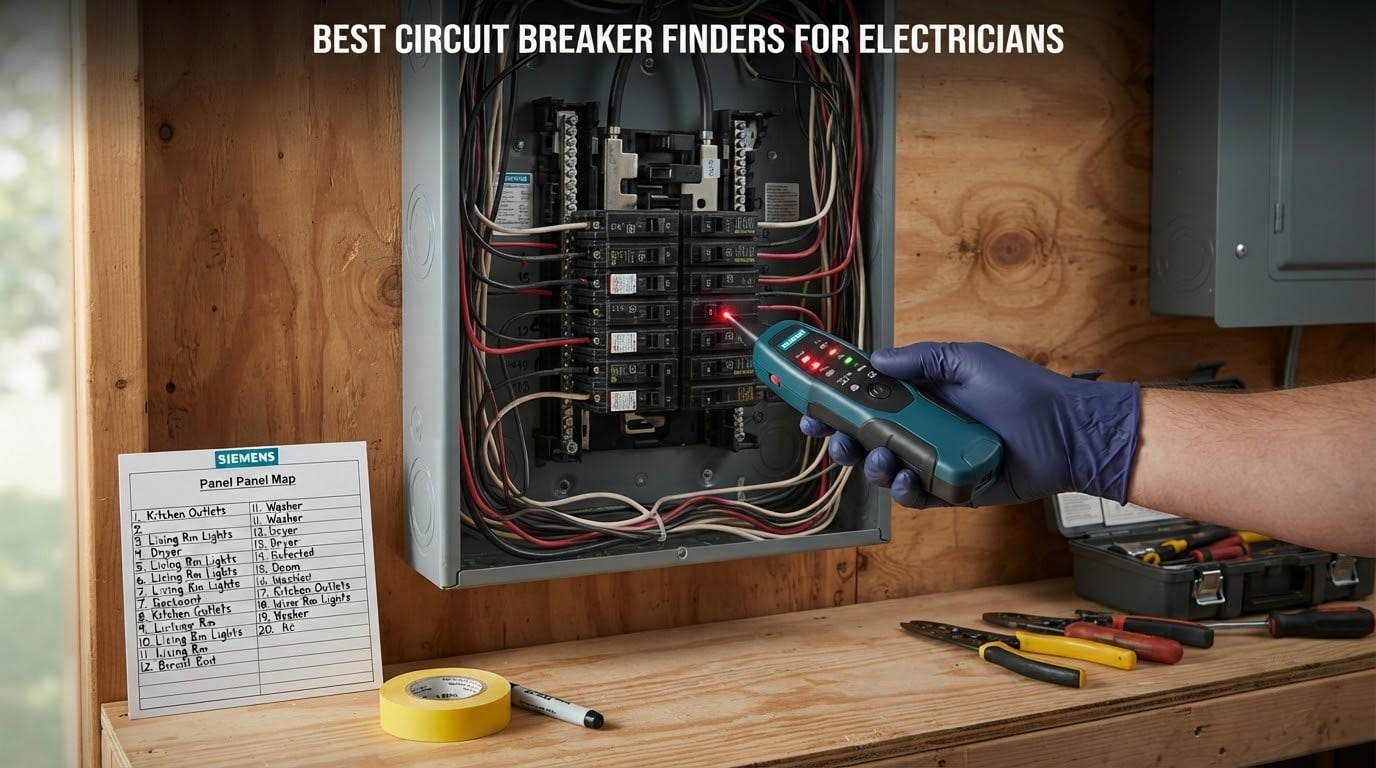
Do circuit breaker finders really work? Yes, on standard North American residential panels, and a good one turns a two-hour breaker-flipping job into a ten-minute scan. The tool works by injecting a signal onto the circuit at a receptacle, then detecting that same signal at the panel. That honest caveat matters: none of these devices is infallible, and every trade forum says to double-check the result before you start work on a circuit.
We put ten of the most widely used finders through the same comparison, from the pocket-sized plug-in models up to the full kit that traces through drywall and onto de-energised circuits. The list is organised the way an electrician actually shops: what the tool measures, how it behaves in a crowded panel, what happens when the circuit is dead, and how much documentation you get.
Everything below reflects specifications, included accessories and aggregated owner feedback for each model. We also lean on what working tradespeople say in public forums, because the honest failure modes of these tools are barely documented by the manufacturers. Our methodology is straightforward: read the manual coverage, the accuracy complaints, the accessory lists, and the safety certifications, then rank the tools on how confidently you can act on what the receiver tells you.
Table of Contents
How a Circuit Breaker Finder Works
A circuit breaker finder is a two-piece device. The transmitter is the part you plug in, and the receiver is the part you carry to the panel.
- You plug the transmitter into the receptacle, lamp holder or junction box that feeds the circuit you want to identify. On most models the transmitter is also a GFCI and receptacle tester, so it doubles as a wiring check.
- The transmitter drives a repeating signal onto that circuit through the existing wiring. It does not need a new wire or a connection at the panel.
- You take the receiver to the breaker panel and switch it on, typically walking it down each breaker handle in the column one at a time.
- As the receiver passes the breaker that feeds the circuit you plugged into, the signal couples into that branch and the receiver beeps, flashes, or drives its signal strength display up.
- You stop, flip that breaker, confirm the de-energised circuit at the receptacle, and write the label.
That mechanism explains both the strength and the weakness of every product in this guide. It is a genuine signal on a real conductor, not a guess, so a clean result is trustworthy. It also means the signal can leak into a neighbouring conductor that shares a junction box, a long parallel run of neutral, or a multi-wire circuit where the same breaker serves two hot legs. That leak is what produces the false positives owners complain about most.
If you have ever used one of these on a stud finder to locate hidden framing, the logic is the same idea in a different medium: push a signal into the material, then sweep a sensor across the surface until the reading peaks. We covered that category in our guide to the best stud finders, and the comparison of how the two signal-and-scan tools behave is worth keeping in mind.
Top 3 Circuit Breaker Finders for Electricians in 2026
These are the three that earned a place in a service van this year. The Klein ET310 wins on the combination of accuracy, review volume and price, the ET450 wins on raw capability, and the KAIWEETS KT301P wins on the readout you actually look at.
Klein Tools ET310
- 90-120V AC range
- Integrated GFCI outlet tester
- Transmitter stores inside receiver

Klein Tools ET450
- Traces de-energised circuits
- Traces through drywall and masonry
- 12V to 480V voltage indicators

KAIWEETS KT301P
- Backlit LCD voltage and signal readout
- Outlet and GFCI tester built in
- Adapter bundle with carrying case
Best Circuit Breaker Finders for Electricians in 2026
All ten tools in the table below locate breakers on live 120V circuits. The differences that actually matter in service are the voltage ceiling, whether the unit traces dead circuits, whether it shows a numeric signal, and how the receiver confirms a match.
| Product | Specifications | Action |
|---|---|---|
| Klein Tools ET310 |
|
Check Latest Price |
 Extech CB10 Extech CB10 |
|
Check Latest Price |
 Sperry Instruments CS550A Sperry Instruments CS550A |
|
Check Latest Price |
| Klein Tools ET450 |
|
Check Latest Price |
| KAIWEETS KT301P |
|
Check Latest Price |
 Focemta FTCT 01 Focemta FTCT 01 |
|
Check Latest Price |
 Fluke BK120 SmartTrace Fluke BK120 SmartTrace |
|
Check Latest Price |
 Instrodots CBF01 Instrodots CBF01 |
|
Check Latest Price |
 AstroAI Circuit Breaker Finder AstroAI Circuit Breaker Finder |
|
Check Latest Price |
 Klein Tools 80101 Kit Klein Tools 80101 Kit |
|
Check Latest Price |
1. Klein Tools ET310 AC Circuit Breaker Finder
Klein Tools ET310 AC Circuit Breaker Finder
90-120V AC
Tx plugs in, Rx scans panel
Built-in GFCI tester
Tx stores in receiver
Pros
- Fast accurate identification versus flipping breakers one at a time
- Transmitter doubles as a GFCI outlet tester
- Clear audible and visual alert at the panel
- Transmitter docks inside the receiver for storage
- Reliable on standard residential wiring layouts
Cons
- Signal cross-talk on interleaved wiring causes false positives
- Parallel conductor runs and chase-box junctions bleed the signal
- Manual asks you to unplug every device on the circuit
At 24294 reviews and a 4.7 average, the ET310 has the deepest owner feedback base in this category by a wide margin, and that matters more than any spec line. It is the first tool we hand to an apprentice, and in our experience it produces a clean, unambiguous result on a standard residential panel more often than anything else at this level.
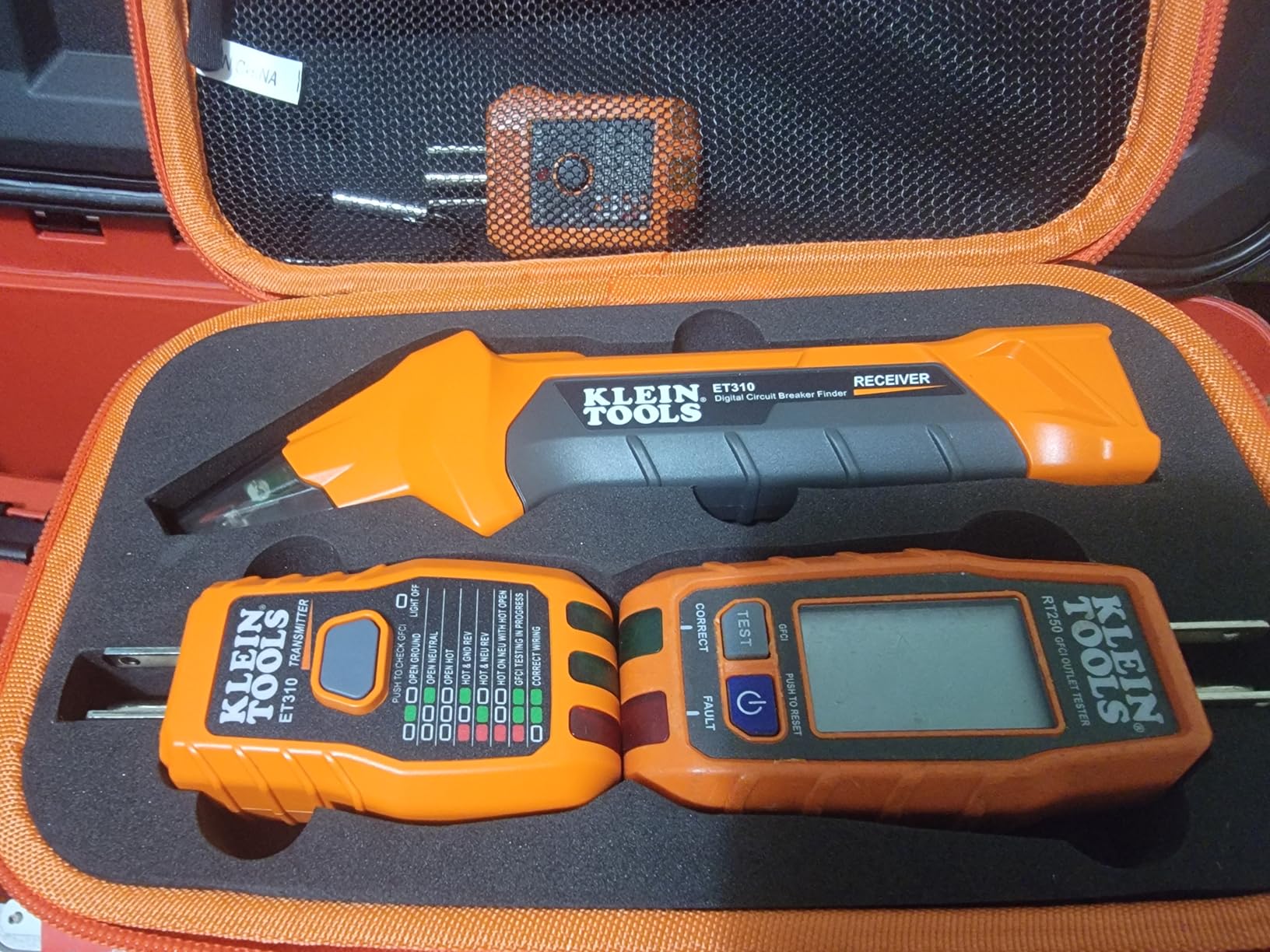
The design is the classic two-piece arrangement. The transmitter has a three-pin plug for a grounded North American receptacle and doubles as a GFCI outlet tester with a push-to-check button, so it can trip a stuck reset. The receiver walks the panel and gives both an audible alert and a visual one. At 7.2 ounces and 10.96 x 2.16 x 1.39 inches it disappears into a tool pouch, and the transmitter stores inside the receiver so the pair cannot be separated in a bag.
The real limitation is wiring, not the tool. In older homes where neutrals are run in parallel through multiple junctions, or where outlets share a chase box, the injected signal bleeds into an adjacent circuit and you get two beeps instead of one. That is the single most common complaint in the reviews, and it is the honest reason professionals confirm the result by switching the breaker and testing at the receptacle before touching anything.
Second limitation, and it is a practical one: the manual tells you to unplug every device on the circuit before testing. On a kitchen or a workshop circuit that is several minutes of work per circuit, which eats into the time saving. Third, some owners report needing to scan the conductors at the panel rather than the breaker handles to get a stable reading.
When the ET310 is the right call
It is the right call for residential service, remodels, panel upgrades, EV charger circuits and rental turnovers where the panel is a standard 90-120V AC loadcentre. The integrated GFCI tester saves you carrying a second device, and the rating and review volume mean a failure is far more likely to be a wiring issue than a device issue.
It is the wrong call when you are chasing a dead circuit, tracing through masonry, or working in a panel where circuits share neutrals heavily. For those jobs you need the ET450 below.
When the ET310 will disappoint you
Expect to verify. Owners in r/electrical and on electrician talk forums consistently describe confirming a result by switching the breaker and confirming at the receptacle, and the tool itself instructs it. On modern panels where circuits are neatly separated the signal behaves well, but on a 1970s rewire with junctions everywhere you should budget for a second pass.
Also note the 90-120V operating range. Anything above 120V, including many commercial and industrial panels, is outside what this unit is rated to do. Buy the ET450 or a commercial tracer instead.
2. Extech CB10 AC Circuit Breaker Finder and GFCI Receptacle Tester
Extech CB10 AC Circuit Breaker Finder and GFCI Receptacle Tester
110-125V AC
Two-pass calibration
Variable sensitivity dial
Outlet and GFCI testing
Pros
- Two-pass calibration cuts multiple-breaker false signals
- Variable sensitivity dial filters ghost chirps in busy panels
- Transmitter detects open ground and open neutral plus reverse polarity
- 9V battery included so it works out of the box
- One year manufacturer warranty
Cons
- Two-pass routine and sensitivity dial both add steps
- Firm 9V battery seating needed or the receiver stays silent
- Less dependable on older cluttered or poorly labelled panels
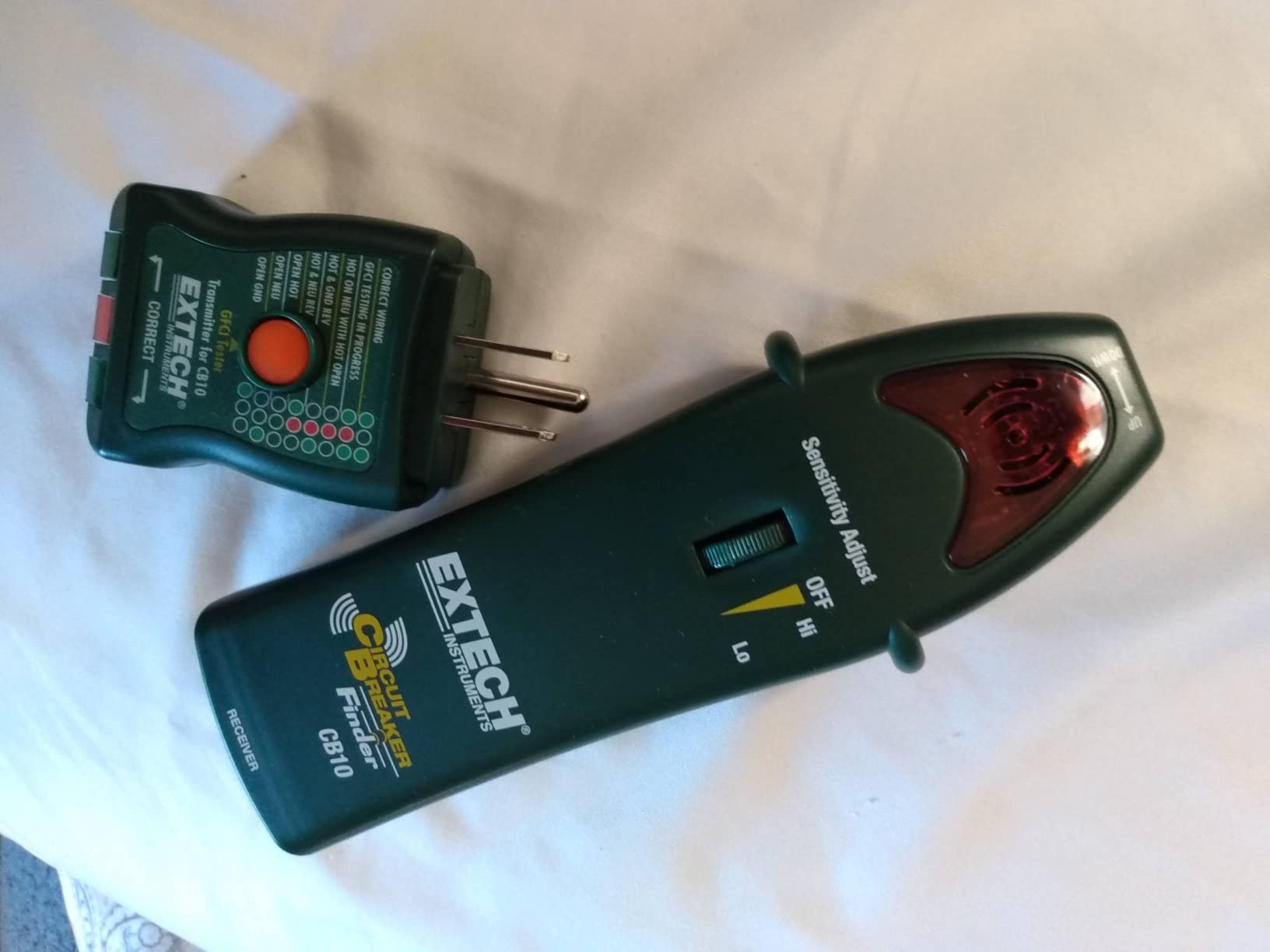
The Extech CB10 is the one in this list that actively solves the crowded-panel problem rather than just tolerating it. Two features do that work: a two-pass calibration scan that teaches the receiver the panel before it gives an answer, and a variable sensitivity dial you can turn down until neighbouring circuits stop chirping.
Everything else is competent. The transmitter locates breakers and fuses on live 110-125V AC circuits without interrupting power, and it works as an outlet tester reporting open ground, open neutral and reverse polarity, with a dedicated GFCI trip button. The receiver runs on a 9V battery that is included in the box, which matters on a job where you want the tool to work on the first pull from the bag.
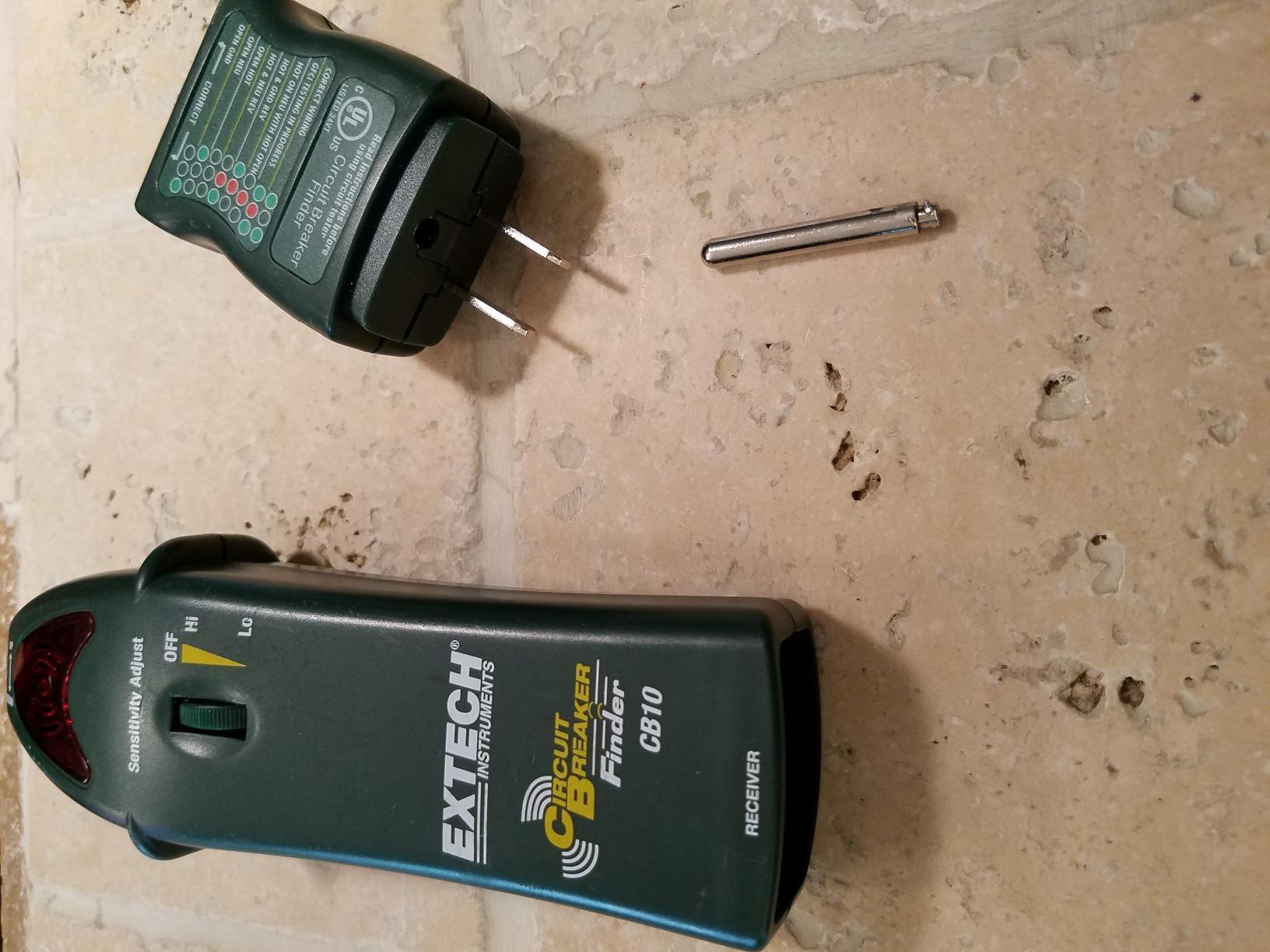
The two features that make it accurate are the two features that slow it down. The calibration pass means two sweeps of the column per circuit instead of one, and the sensitivity dial has to be re-tuned whenever you move to a different panel. Mapping a whole 30-circuit residential panel with the CB10 takes noticeably longer than mapping it with a single-scan tool, and the trade is worth making only if that panel is messy.
One practical note the reviews keep raising: if it does not beep, the 9V battery is usually not snapped firmly into the terminal clips, or the cover is not locked. That is a five-second fix once you know it, and it is the most common first-run complaint in the reviews.
When the Extech CB10 is the right call
Reach for it when the panel in front of you is the problem. Older homes with a mix of vintage and modern breakers, additions made by different trades, or a subpanel with unclear grouping are exactly where a fixed-sensitivity tool gives you three candidates and this one narrows it to one.
It is also a strong value for whole-panel labelling on light commercial work, since the outlet and GFCI testing means one tool covers two jobs you would otherwise carry separately.
When the Extech CB10 will disappoint you
Do not buy it for speed. The two-pass routine and per-panel sensitivity tuning make it the slowest workflow in this guide, and on a clean modern panel you are paying for accuracy you do not need. It also has no adapters for bare wires, lamp sockets or two-prong receptacles, so any circuit that is not a grounded three-hole outlet needs a workaround.
It is also rated for 110-125V AC only, so it stays out of 240V and higher commercial work.
3. Sperry Instruments CS550A Circuit Breaker Finder
Sperry Instruments CS550A Circuit Breaker Finder, Quickly Locate AC Circuits/Fuses, Visual LED, Plug Style Transmitter/Auto-Sensing Receiver, 120V AC, Yellow
120V AC 50-60Hz
Plug-in transmitter
Auto-sensing receiver
UL Listed
Pros
- Almost no setup - plug in and scan
- Audible alert plus bright LED on both units
- Safe to use near sensitive electronic equipment
- Compact and light at 3.68 ounces
- UL Listed for 120V AC service
Cons
- No manual sensitivity control in electrically noisy panels
- Lowest average rating in this group at 4.0
- Occasional false or ambiguous signals on complex panels
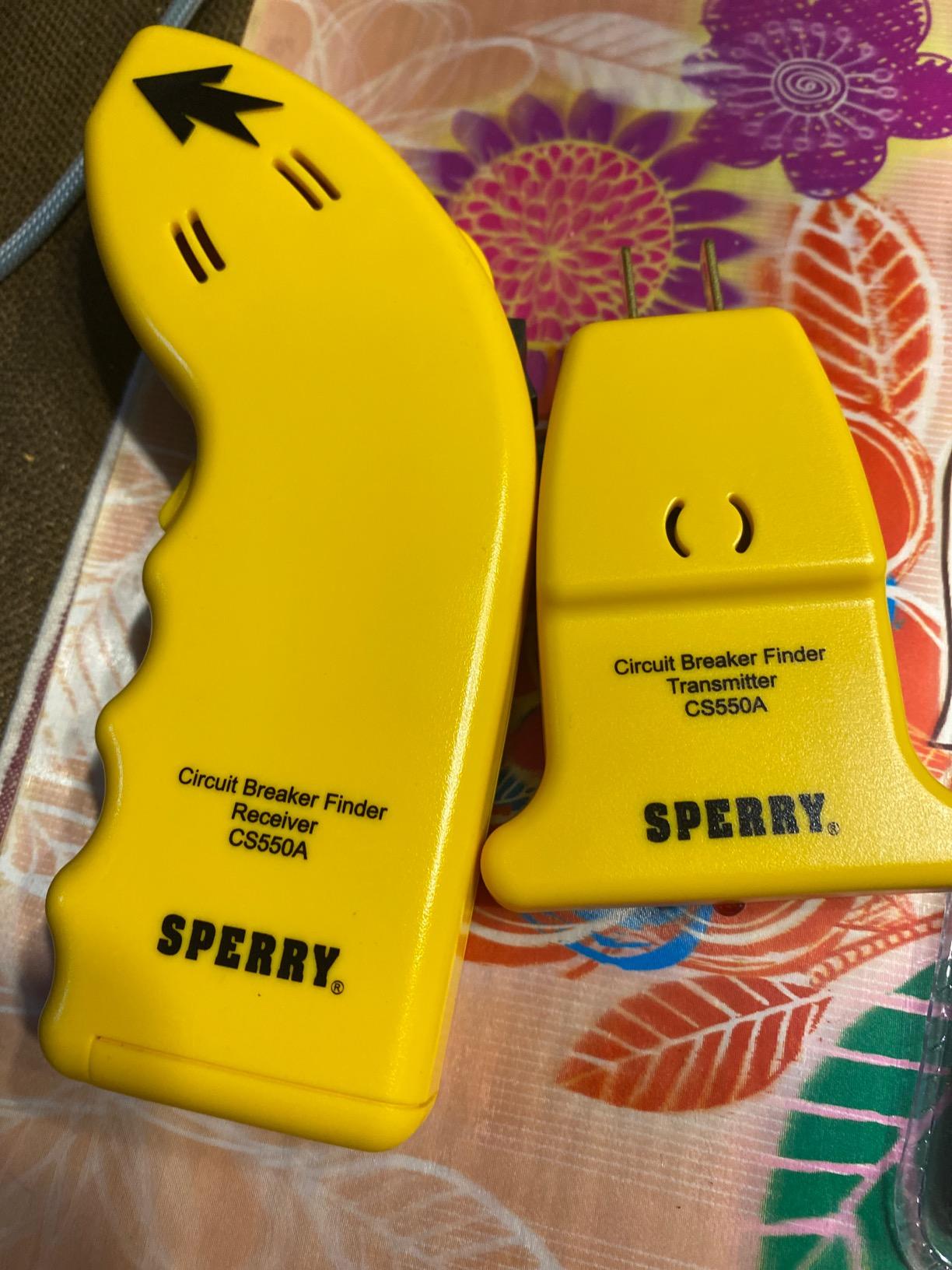
The CS550A is the simplest tool here and the easiest to explain. Plug the transmitter into the outlet, switch on the receiver, and walk it down the breaker column until the LED lights and the buzzer sounds. There is no calibration pass, no sensitivity dial, and nothing to learn beyond that.
For a clean residential panel that is genuinely all you need. At 3.68 ounces and 6.3 x 3.4 x 1.3 inches it is the smallest unit in the guide, and it is UL Listed for 120V AC 50-60Hz service. Manufacturers also note it is safe to use near sensitive electronic equipment without interrupting power, which is useful if the circuit feeds a home office or an AV rack.
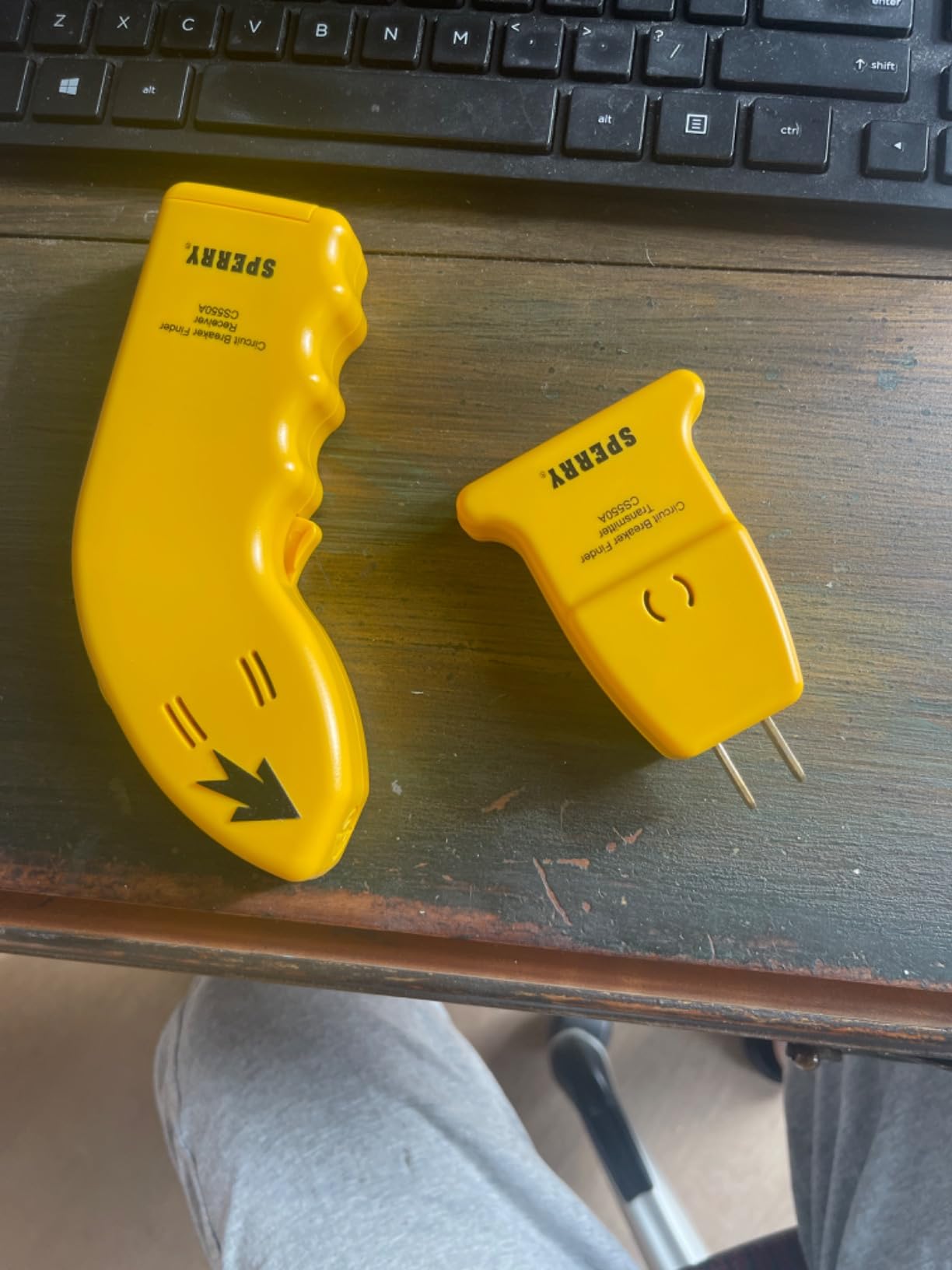
What it does not have is any way to tune the receiver. The auto-sensing design means the sensitivity is fixed, so in a busy panel with lots of parallel neutrals, the same cross-talk that affects every finder here is worse because you cannot turn it down. That shows up in the numbers: a 4.0 average is the lowest in this group, with 11% of reviews at one star, and the recurring theme in those reviews is ambiguous or multiple signals.
The build is also basic plastic with a plug-style transmitter only, so lamp holders and bare wires need an adapter you have to source separately.
When the Sperry CS550A is the right call
It suits a first panel, a rental unit turnover, or anyone who wants to learn panel labelling without spending real money. If your work is entirely on modern 120V residential panels with neatly separated circuits, the simplicity is a feature and the tool will do the job.
It also works as a secondary confirmation tool. Electricians often carry a second, dead-simple finder purely to re-check what a more capable tool reported, and this fills that role at the right price.
When the Sperry CS550A will disappoint you
Old panels and multi-wire circuits are where it will frustrate you. There is no dial to turn, so if the signal leaks you simply get a wrong or doubled answer with no way to recover except moving the plug to a different point on the circuit. The fixed receiver also means it is the least useful of these ten in a garage or detached building where conductors run long distances through conduit.
If you are doing this work professionally, the time lost re-scanning a wrong breaker usually costs more than the difference between this and a better tool.
4. Klein Tools ET450 Advanced Circuit Breaker Finder and Wire Tracer Kit
Klein Tools ET450 Advanced Circuit Breaker Finder and Wire Tracer Kit
12V to 480V range
Traces dead and live circuits
Through drywall and masonry
20-ft lead included
Pros
- Traces energised and de-energised breakers
- fuses and wires
- Adjustable sensitivity reaches through drywall and masonry
- Voltage class indicators for 12V to 480V
- Receiver adds a flashlight and non-contact voltage mode
- 3-foot and 20-foot leads with clips and blade prongs
Cons
- Highest cost in the category for simple panel labelling
- Underground and shielded-cable tracing needs the manual
- Higher learning curve and a bulkier accessory set
The ET450 is the only tool in this roundup that does the two things most circuit tracers cannot. It traces circuits that are not energised, and it traces them through building materials. Adjustable receiver sensitivity carries the signal through drywall, cement block, shielded cable and soil, which turns it from a panel-labeling tool into a general wire tracer for chasing wiring inside walls.
The transmitter carries external voltage indicators at 12V, 48V, 120V, 240V and 480V, so you can identify the class of circuit you are on before you commit. The receiver gives audible and visual signal strength feedback, adds a built-in flashlight for dark panels, and includes a non-contact voltage function so you can check energisation safely. It works on a 12V to 480V range, which is the widest here by a wide margin.
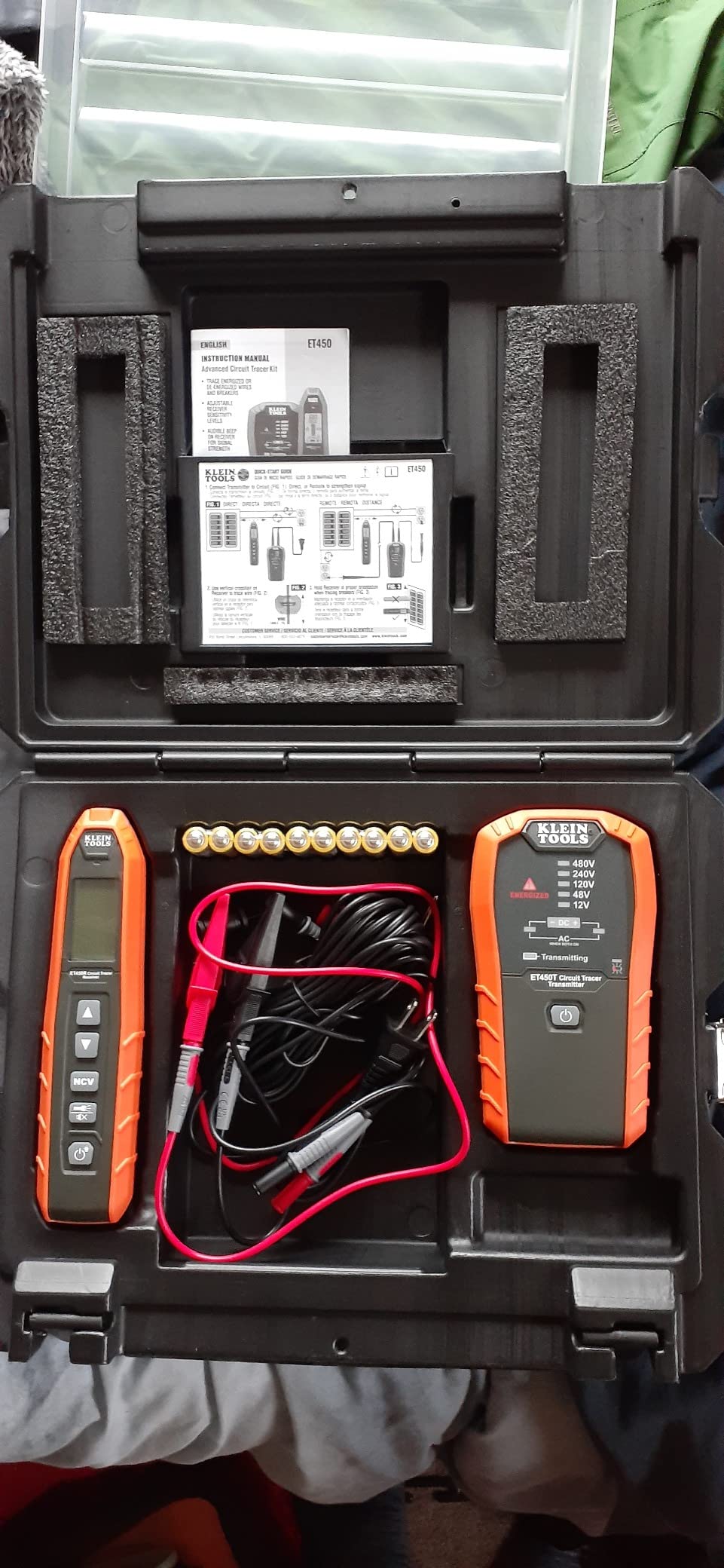
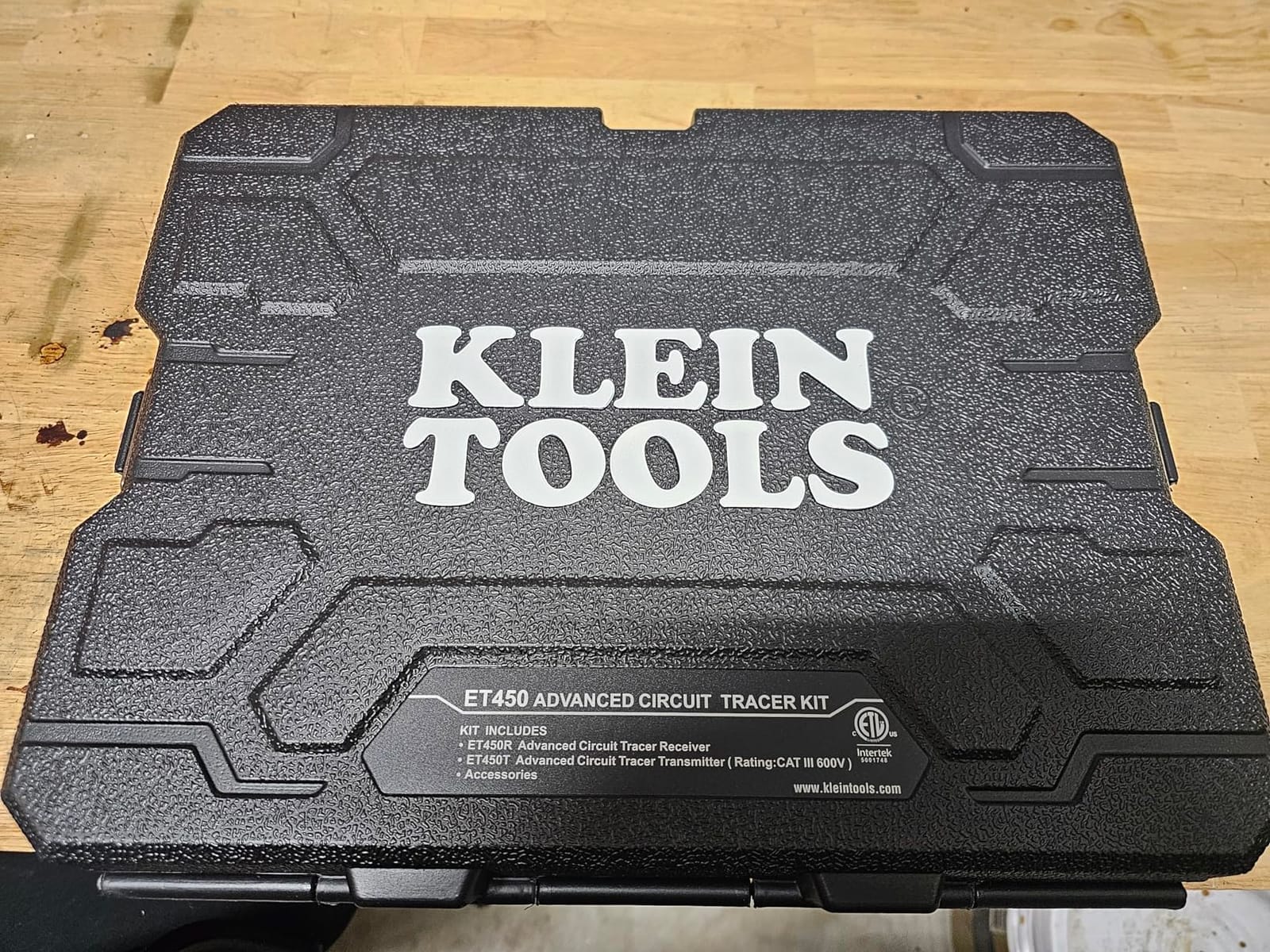
It can also isolate a single conductor inside a bundle, which is the capability you actually need when you are in a crowded attic or chase and you know the wire you want but not which one it is. The kit is complete: transmitter, receiver, blade and ground prongs, alligator clips, 3-foot and 20-foot lead adapters, AC plug leads, batteries, instructions and a carrying case.
At 2 pounds and 16.12 x 12.75 x 4 inches it is also by far the bulkiest item here, and that is fine in a truck or a van but not in a belt pouch.
When the ET450 is the right call
It is the right call when you chase dead circuits. The most common limitation people hit with a basic breaker finder is that the circuit is already off, so there is nothing to inject into, and the tool simply refuses. This one does not need that. It also handles remodels where wiring was re-run, outdoor and detached-garage circuits, and conduit or pipe runs.
For plant and facilities maintenance on multi-phase panels, the voltage class indicators and the 480V ceiling make it the most capable unit in this guide by a wide margin.
When the ET450 will disappoint you
If your job is labelling a residential panel, you are paying for capability you will not touch, and you will carry 2 pounds of kit for it. Owners also report that the underground and shielded-cable modes are not intuitive and require reading the manual rather than working from instinct, so budget time to set the sensitivity properly before you rely on it through a wall.
Several reviewers end up using it as a general wire tracer more than a breaker finder, which tells you where its real value sits.
5. KAIWEETS KT301P Circuit Breaker Finder with LCD Display
KAIWEETS Circuit Breaker Finder with LCD Display, GFCI Outlet Tester, Electrical Circuit Tracer Tool with NCV Test & Flashlight, Includes Carrying Case and Adapters- KT301P
30-150V LCD range
Backlit voltage and signal display
Auto GFCI trip test
Three adapters included
Pros
- Backlit LCD shows voltage
- wiring status and signal strength
- Breaker finder
- outlet tester and GFCI tester in one kit
- Auto-hold keeps the last reading after unplugging
- Receiver adds a non-contact voltage test and flashlight
- Adapter bundle plus a carrying case
Cons
- Instructions are poorly written and hard to follow
- First-time users can get a reading that does not match reality
- No explicit CAT safety rating in the listed specifications
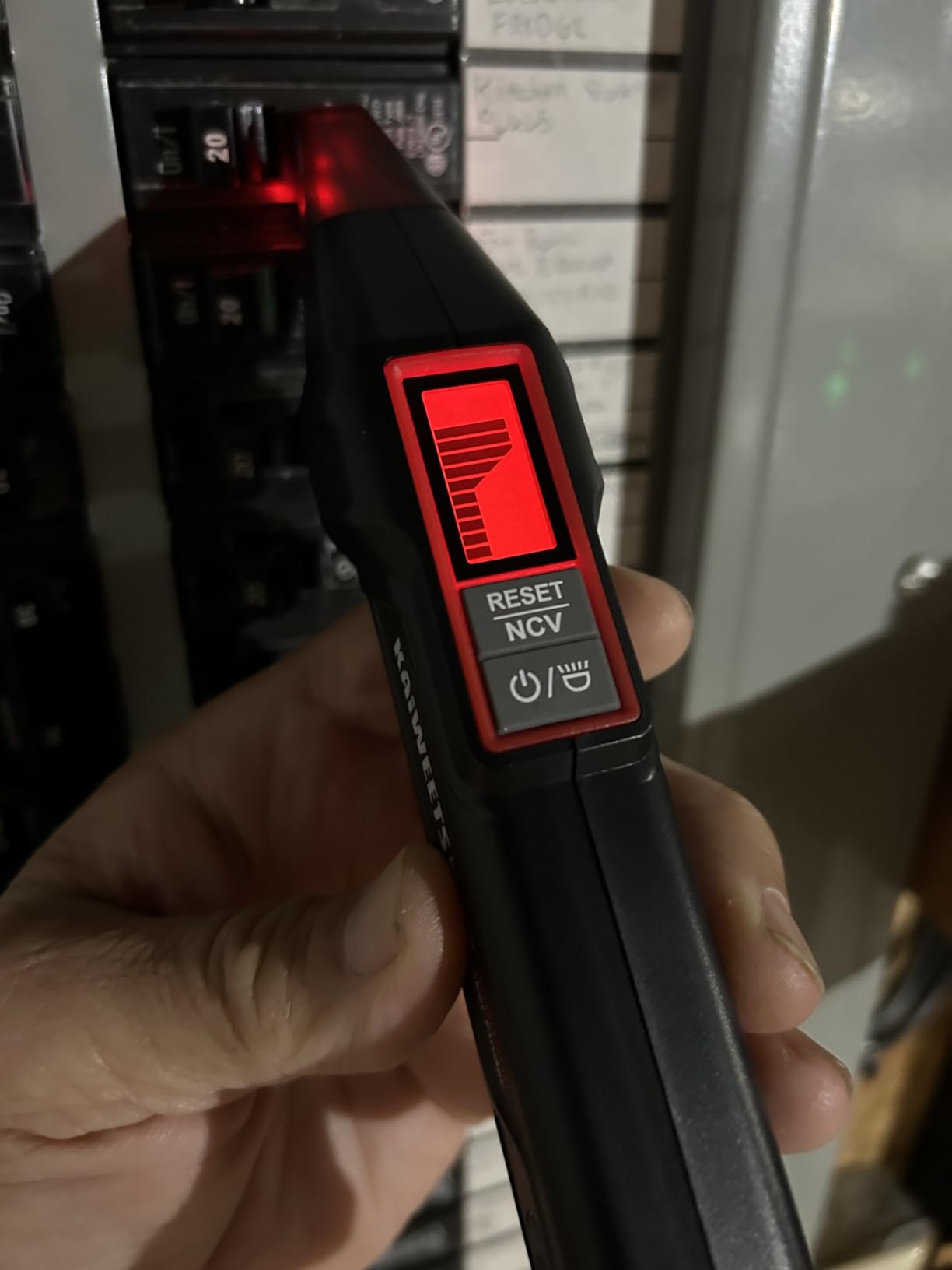
The KT301P is the one to buy when the thing that annoys you about cheap finders is that they only give you a beep and a red light. Its transmitter carries a large backlit LCD that shows real-time voltage on a 30-150V range, the outlet wiring status and a signal strength bar, and the backlight means you can read it in a dim panel or a tight space between studs.
It is also genuinely three tools. The transmitter tests outlets and diagnoses 7 common wiring faults, runs an automatic GFCI trip test with red and green LED feedback, and holds the last result on screen with an auto-hold function after you unplug it, which saves you walking back to a hard-to-reach receptacle. The receiver adds a non-contact voltage test and a flashlight.
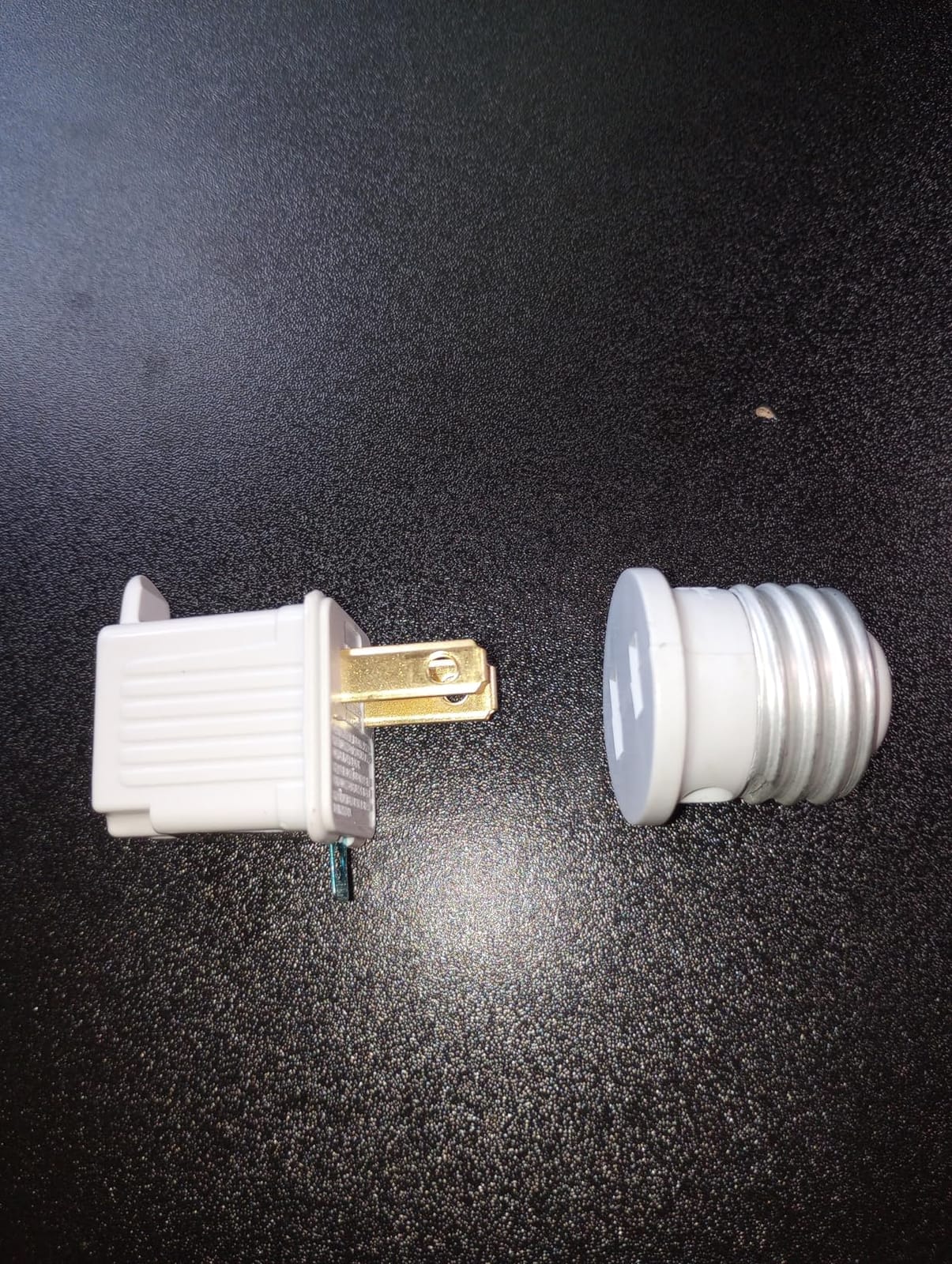
The accessory bundle is where it undercuts the trade-name brands. You get a 3-prong to 2-prong grounding adapter, a light socket adapter for lamp circuits, an alligator clip adapter for bare wire, and a carrying case, all in the box. That is the coverage the ET310 and the Extech CB10 leave you sourcing separately.
What holds it back is documentation and, to a lesser degree, the safety listing. The printed instructions are repeatedly described as poorly written, and that directly produces the second most common complaint: first-time users running the learn-and-scan sequence in the wrong order and getting a panel reading that does not match reality. Budget an extra ten minutes with the manual.
When the KAIWEETS KT301P is the right call
It is the right call when you want to see numbers rather than infer them. A signal strength bar and a live voltage reading are what let you distinguish a genuine peak from a bleed-through, which is the difference between a clean result and an afternoon of second-guessing on a messy panel.
It also suits anyone who needs the receptacle and GFCI testing anyway, and homeowners or apprentices assembling a first kit, because the adapter bundle removes the usual second purchase.
When the KT301P will disappoint you
Do not expect a documented CAT safety rating. The listed specifications carry CE and FCC markings but no explicit CAT rating, and if your work involves 120V commercial panels where a formal category rating matters to your company procedures, that is a real gap rather than a technicality.
It is also a live-circuit tool. It needs the circuit energised to inject, so it does nothing for you on a dead outlet or a circuit that has tripped, and the 30V minimum operating figure is stated without a matching upper limit for the finder function.
6. Focemta FTCT 01 Circuit Breaker Finder Kit
Focemta Circuit Breaker Finder Kit with GFCI Outlet Tester for 90-135V AC Circuits,includes Light Socket Adapter, 3-2 Prong Grounding Adapter & Clip adapter,Portable Electrical Tool with Carrying Case
90-135V AC
ETL-certified CAT II 135V
10-second data hold
Diagnoses 6 wiring faults
Pros
- Dual-function LCD shows live voltage and signal strength
- Outlet tester diagnoses 6 common wiring faults
- Displays GFCI test duration on screen
- Backup battery holds the reading for 10 seconds on power loss
- ETL-certified CAT II 135V with a screw-sealed battery compartment
Cons
- Instructions are very difficult to read
- Requires a live circuit so de-energised tracing is out
- Learn-then-scan process takes practice before results are predictable
The FTCT 01 does two things the other kits in this price band do not. First, it carries a formal safety listing, ETL-certified CAT II 135V, with a screw-sealed battery compartment on the transmitter, which is the standard you want if your company has a written tool policy. Second, its backup battery locks the test data for 10 seconds if power drops mid-test.
That second feature sounds minor until you are tracing a GFCI-protected circuit and the receiver dies at the interesting moment. The transmitter also shows the GFCI test duration on the large screen, a detail most comparable testers omit, and its outlet tester diagnoses 6 common wiring faults including open circuits and reverse polarity with clear red and green pass-fail LEDs.
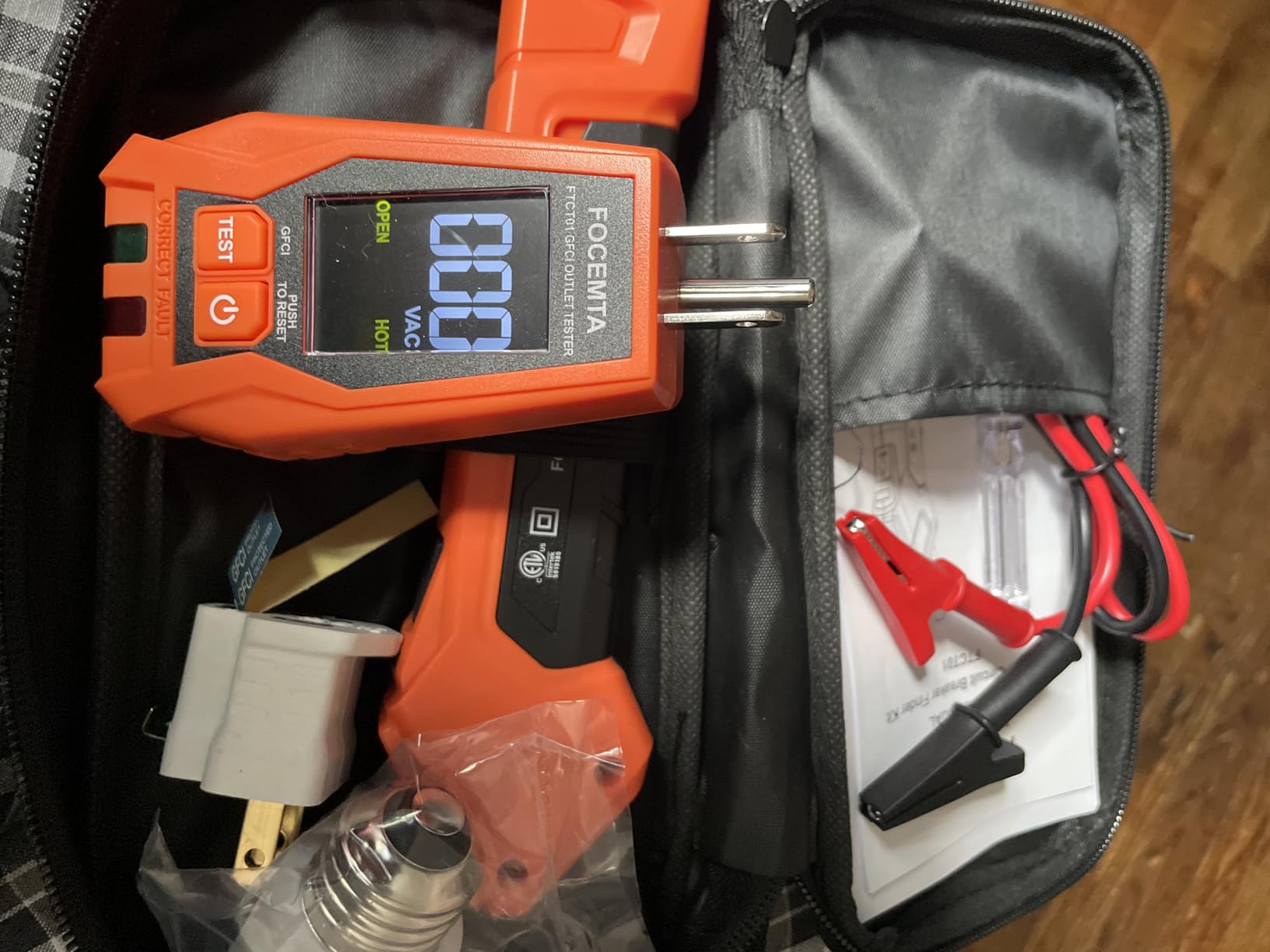
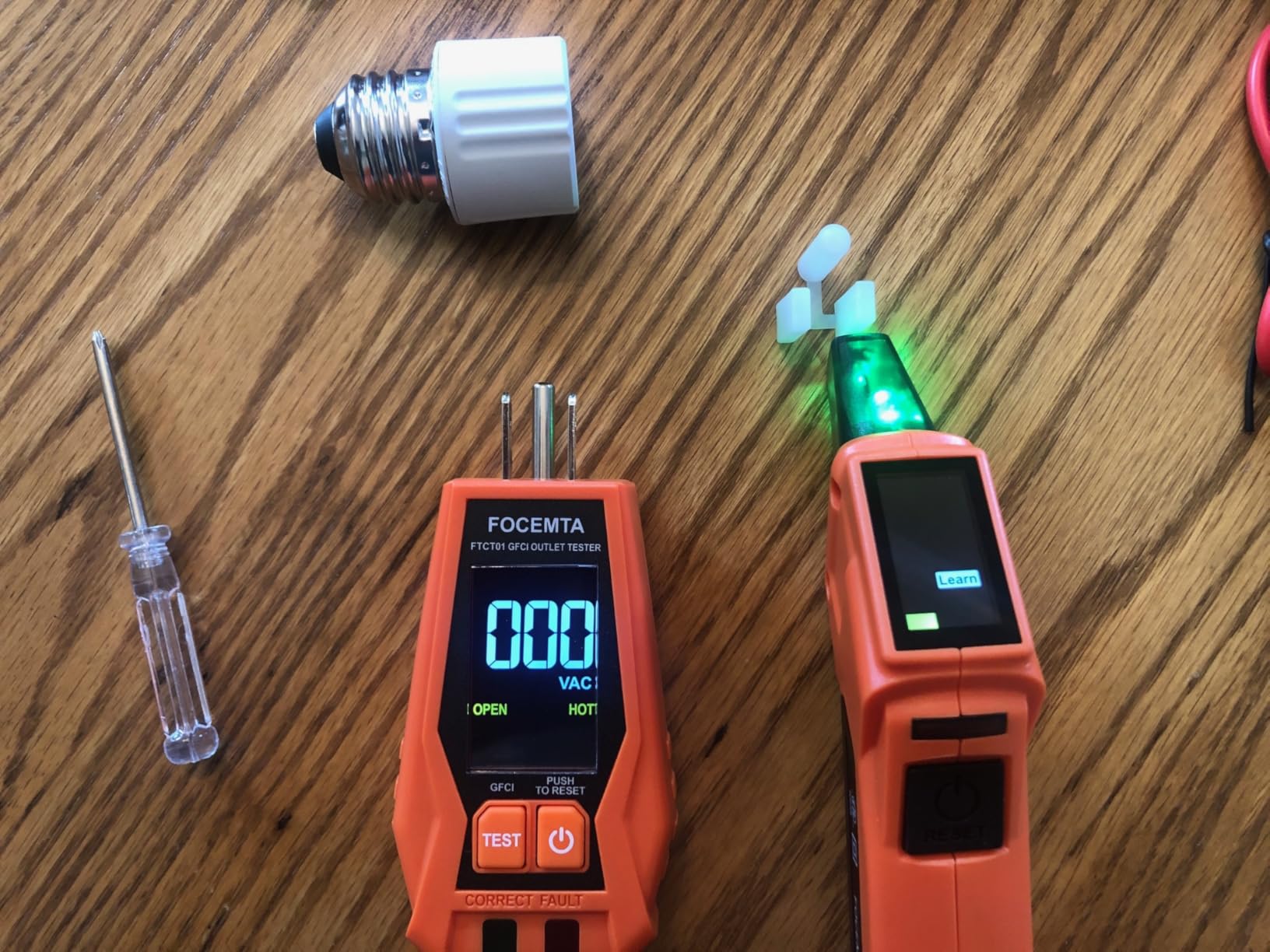
The housing is impact-resistant ABS at 3 ounces, and the upgraded clip adapter is a single metal-plastic fusion rather than a two-piece fitting, which the manufacturer points out reduces slippage and the short-circuit risk that comes with a loose bare-wire connection. The box includes the transmitter, receiver, a 9V and two AAA batteries, a screwdriver, a manual, a light socket adapter, a 3-prong to 2-prong grounding adapter, an alligator clip lead and a carrying case.
The weakest part is the same weak part the KT301P has, and it is worth saying plainly: the instructions are described by multiple reviewers as very difficult to read. Combined with a learn-then-scan process that needs practice, expect your first panel to take longer than it should.
When the Focemta FTCT 01 is the right call
Pick it when you are verifying GFCI protection rather than just identifying a breaker. The on-screen trip duration and the 10-second data hold make it the best of this group for documenting that a GFCI device actually operates within spec, which is what an inspector or a landlord file wants to see.
It is also the safest-listed option we found among the multi-function kits, and the 90-135V ceiling covers the 120V circuits found in most homes plus the 120/240V small-appliance range in a lot of residential panels.
When the Focemta FTCT 01 will disappoint you
It needs the circuit live, so the moment you are chasing an open or de-energised circuit, it does nothing. That is the entire reason to buy a more capable tracer, and this is not that tool. It also has no manual sensitivity control, so on a panel with heavy neutral sharing you are relying on the signal separation alone.
The documentation issue is real enough that we would want a colleague to demonstrate it once before handing it to an apprentice.
7. Fluke BK120 SmartTrace Breaker Finder and Socket Tester
Fluke BK120 SmartTrace Breaker Finder and Socket Tester
110V AC minimum
Tx rated to 150V
Four functions in one body
UL and IEC listed
Pros
- Accurate on crowded panels with confusing legacy wiring
- Dual-sensitivity NCV mode for terminal strips and supply cords
- Breaker finder
- NCV detector
- socket tester and flashlight in one body
- Compact at 11 x 6 x 2.25 inches
- UL 61010-1
- IEC 61010-2-030 and CE listed
Cons
- Transmitter plugs straight down and needs a full duplex receptacle
- Feels light in the hand next to Klein or Milwaukee units
- All outlets should be vacant during testing for reliable results
The Fluke BK120 earns its place on accuracy in the situations where other tools wobble. Owners with congested panels and messy legacy wiring report it identifying the correct breaker on the first or second scan in panels where cheaper finders repeatedly gave them two candidates. At 4.6 stars across 650 reviews it is not the most reviewed tool here, but the feedback is consistently specific about that strength.
It is four tools in one compact body: a breaker finder, a non-contact voltage detector, a socket tester and an LED flashlight. The NCV mode has a dual-sensitivity setting, which is what makes it useful on terminal strips and supply cords where a coarse detector either screams at everything or nothing at all. The transmitter has a built-in socket tester with clear LEDs for both standard and GFCI receptacles, and the whole thing is UL 61010-1 and IEC 61010-2-030 listed.
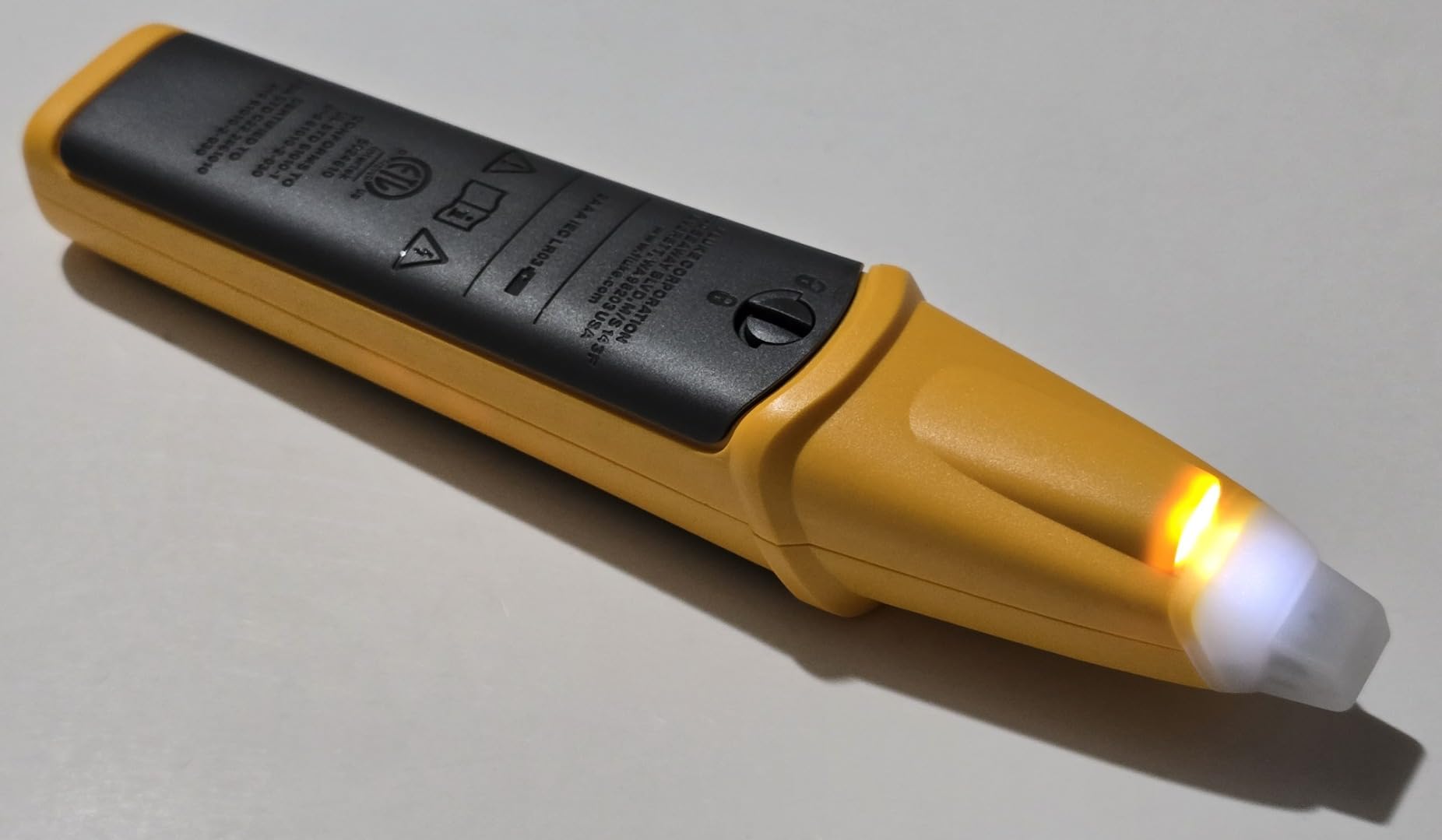
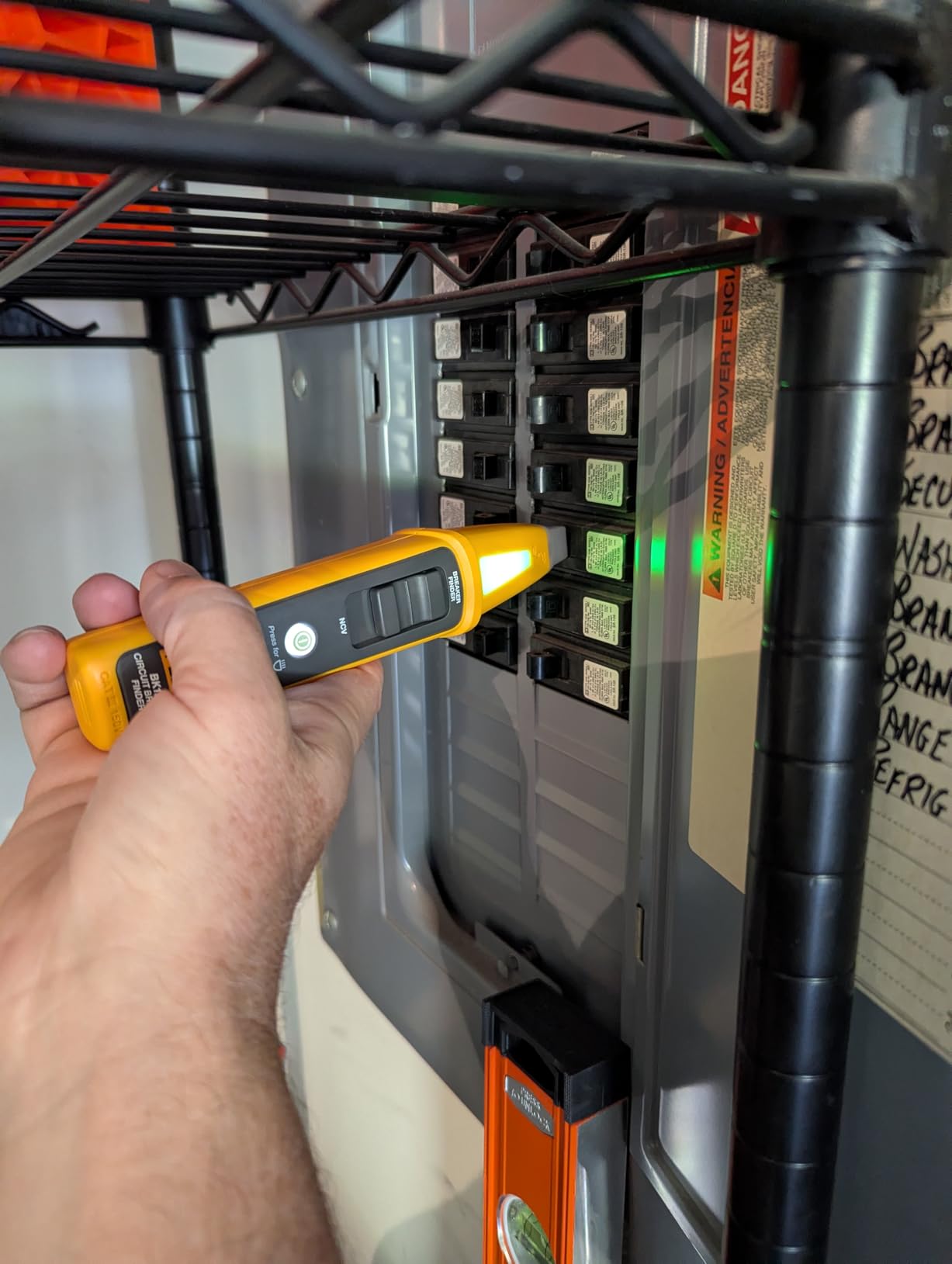
It uses a clear two-pass scan method with a solid green confirmation indicator, which is a better confirmation design than most: you are not interpreting a bar graph, you are waiting for a locked signal. The dimensions are 11 x 6 x 2.25 inches, meaningfully smaller than most competitors, and a pictorial quick reference guide is in the box with access to a full manufacturer guide.
The transmitter plugs straight down from its own body, which means it needs a full duplex receptacle and you cannot leave a normal plug in the upper or lower socket. Several owners describe this as an annoyance in older homes with half-receptacle boxes. It also feels light and less rugged in the hand than Klein or Milwaukee units, and all outlets on the circuit should be vacant during testing.
When the Fluke BK120 is the right call
It is the right call for engineers and serious diagnostics work where the answer has to be right the first time, particularly on panels that have been modified over decades. The dual-sensitivity NCV mode also makes it the most useful of these ten for non-contact voltage work on terminal strips and equipment cords, which is a daily task in facilities and plant maintenance.
For a technician who wants to carry one device instead of a breaker finder, a voltager and a socket tester, it replaces three items in a bag.
When the Fluke BK120 will disappoint you
Two limits stand out. The downward-facing transmitter plug is genuinely awkward in tight or partial receptacle boxes, and if your work is full of 1960s and 1970s houses with surface-mounted or half boxes, you will feel it. The build also reads as lighter than the Klein units, which matters if it lives in a van rather than a desk.
It is also not suited to European-market receptacles, and the transmitter is rated to 150V, so it is a residential and light commercial tool rather than an industrial one.
8. Instrodots CBF01 Circuit Breaker Finder Tool Kit
INSTRODOTS Circuit Breaker Finder, AC 90-135V Circuit Tracer Tool Kit
90-135V AC 50/60Hz
No sensitivity dial
Color LCD and analog bar display
CAT II 135V
Pros
- Three-step signal injection with no sensitivity dial to adjust
- Transmitter has a large color LCD plus green and red LEDs
- Receiver analog bar display with audible alert
- GFCI trip time reported in seconds plus 6 wiring conditions
- Auto-hold locks the reading at hard-to-reach outlets
Cons
- Thin long-term field feedback at 484 reviews
- Analog bar display does not confirm one breaker as definitively
- 90-135V ceiling excludes higher-voltage commercial panels
The CBF01 is designed around one decision: no sensitivity dial. You plug the transmitter into the outlet, switch on the receiver and scan, in three steps, and there is no control to misadjust. Manufacturers of cheaper tools add a dial precisely because that dial sometimes fixes a bad reading; this one removes the failure mode and accepts a slightly less capable result.
Its readability is the selling point. The transmitter has a large colour LCD with green and red LED indicators, and the receiver uses an analog bar display alongside its audible alert, so you can watch the signal rise and fall as you move rather than waiting for a single beep. The transmitter doubles as a GFCI outlet tester that reports trip time in seconds and detects 6 common wiring conditions, and its auto-hold locks the reading for hard-to-reach outlets.
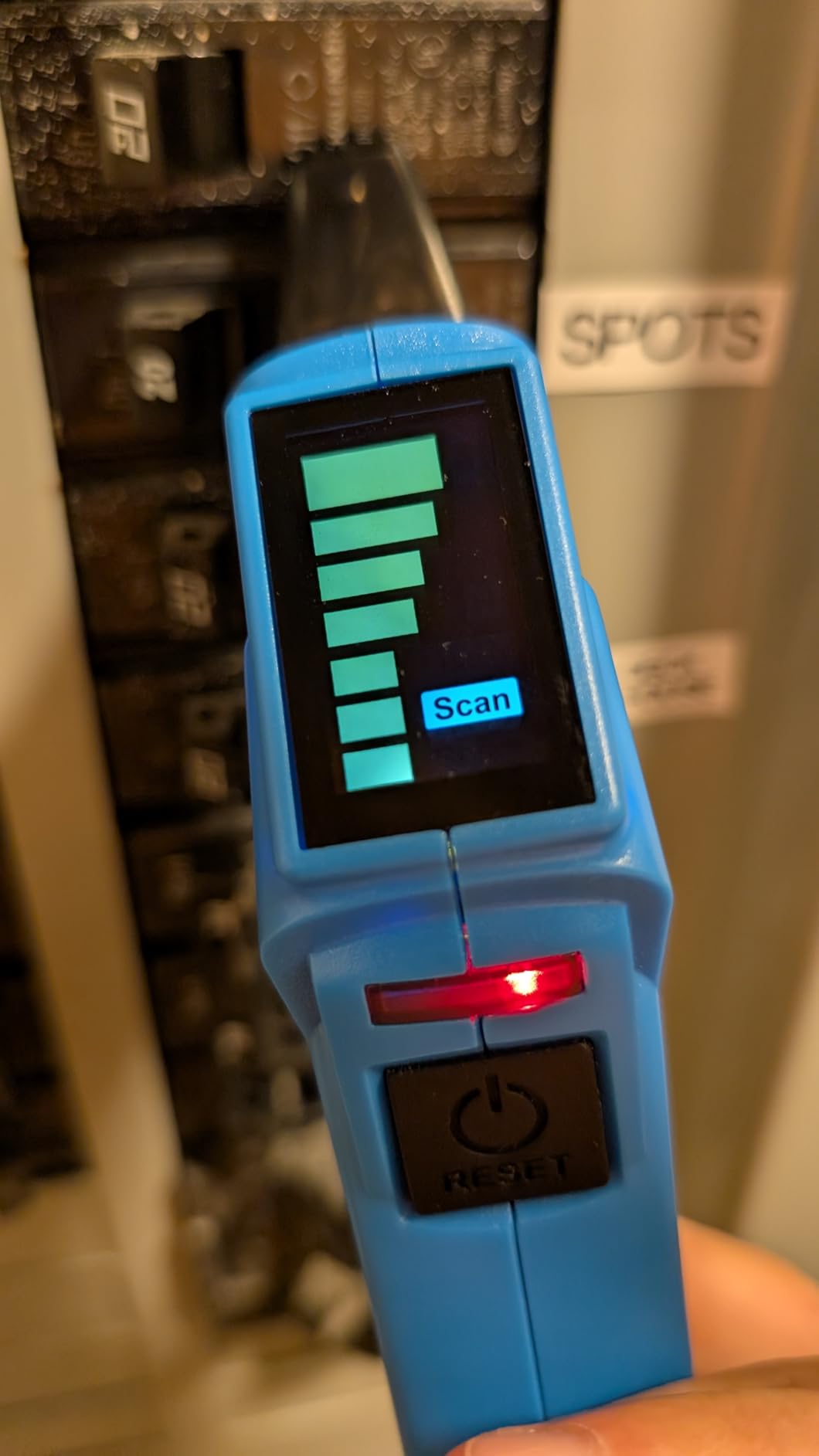
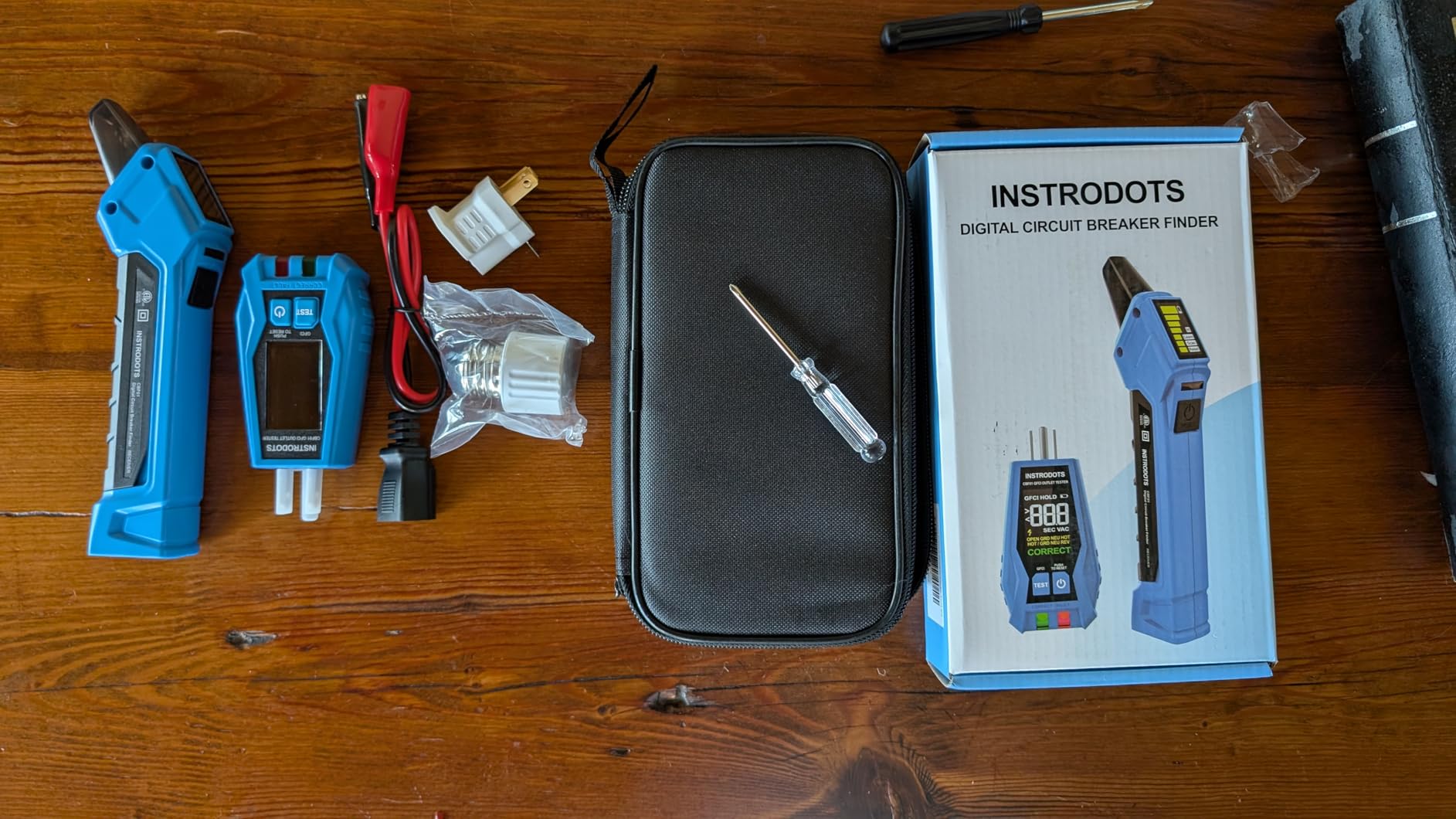
Both units have automatic power-off and low-battery indication, and the case is described as double-injection moulded with anti-dust, anti-skip and anti-drop protection. The kit ships with a 3-prong to 2-prong grounding adapter, a light socket adapter and an alligator clip adapter, plus two AAA and one 9V battery, a storage bag and a manual. It carries a CAT II 135V rating with an IEC61010-1 screw-sealed battery compartment.
The real trade-off is confirmation. An analog bar graph tells you the signal is strong, not that this specific breaker is the one. On a panel where two adjacent circuits read similarly, you still need a second pass, and the bar display does not lock in the way the Fluke’s green indicator does.
When the Instrodots CBF01 is the right call
It suits anyone who finds sensitivity dials confusing, and anyone handing a tool to a homeowner or a first-year apprentice who will not read the manual. A workflow with no adjustable control and a visual bar is much harder to misuse than one with a dial set wrong.
It is also a good roaming tool for property managers doing unit turnovers, where the point is speed and repeatability across a lot of different panels rather than precision on one difficult board.
When the CBF01 will disappoint you
At 484 reviews it has the thinnest long-term field history of the serious contenders here, and that is worth weighing on a tool you plan to depend on daily. The 90-135V ceiling also rules out higher-voltage commercial panels, and the documentation is thinner than the feature list suggests, which is a recurring complaint in the reviews.
On a busy panel with heavy parallel neutrals, the absence of a second-pass confirmation indicator is the limitation you will notice first.
9. AstroAI Circuit Breaker Finder with GFCI Outlet Tester
AstroAI Circuit Breaker Finder Tool with GFCI Outlet Tester for 90–120V AC
90-120V AC 50/60Hz
Digital receiver
Built-in panel LED
Carrying case included
Pros
- Strong value combining breaker finding
- outlet and GFCI testing
- Digital receiver filters interference for quicker targeting
- Audible beep and red flash give clear confirmation
- Built-in LED illuminates a dark panel
- Adapter set and carrying case in the box
Cons
- Limited to 90-120V AC
- narrower than 135V rivals
- No numeric voltage or signal display
- Cheaper plastic build than professional-grade brands
The AstroAI is the straightforward value pick. It combines a breaker finder, an outlet tester and a GFCI tester in one 9.33 x 5.51 x 2.56 inch body, and it carries CE, ETL, NIST and UL markings, which is unusual for a tool at this level. For a homeowner labelling an old panel, or an apprentice building a first tool bag, that combination of capability and certification is a sensible place to start.
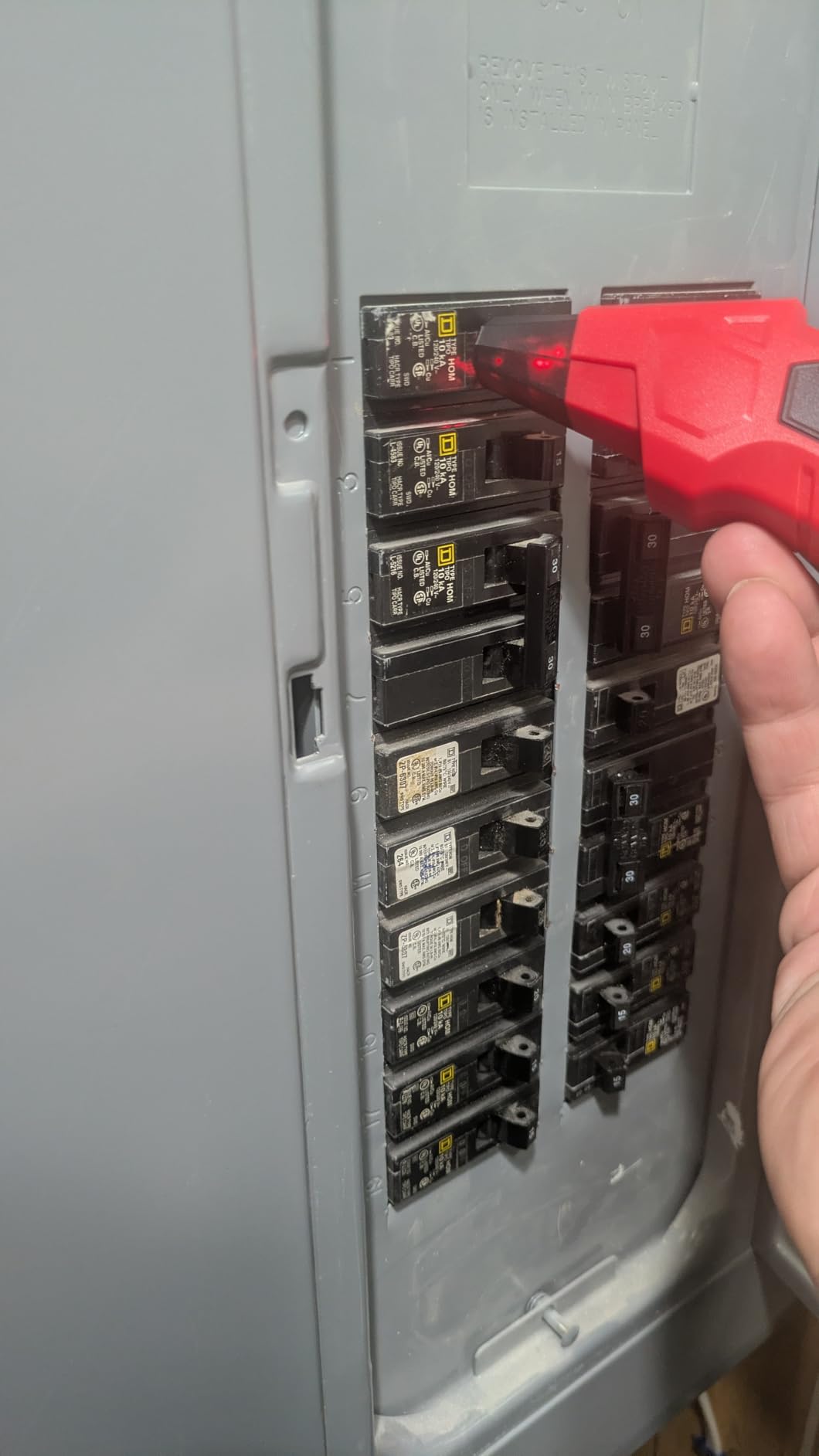
Its digital receiver is described by owners as filtering out interference, and confirmation is a beep with a red flash, which is clear at arm’s length in a garage or a basement. A built-in LED lights the panel so you are not working by phone torch. Auto-shutdown and low-battery alerts stop it dying mid-scan.
The adapter set in the box covers the three cases people hit most: a light socket adapter for lamp circuits, a 3-to-2 prong adapter for older two-wire receptacles, and an alligator clip adapter for bare conductors. A carrying case is included, so it is not a loose transmitter in the bottom of a bag.
What it does not have is a display. You get LED and beep only, with no numeric voltage and no signal strength, which means you cannot distinguish a strong peak from a mild bleed the way you can on the KT301P or the Fluke. The 90-120V range is also narrower than the 135V-rated units here.
When the AstroAI is the right call
It is the right call when the job is 120V residential, the panel is not unusually messy, and you want a second tool for verification rather than the primary one. Confirmation by beep and red flash is enough to confirm a breaker, so it works well as the cross-check we described in the Sperry section.
Owners consistently frame it as good value, which is the correct read: it does the three common jobs at a modest cost with certification markings most cheap kits do not have.
When the AstroAI will disappoint you
Crowded panels. With no signal strength display and a narrower operating range, this is the tool most likely to send you back for a second scan when breakers sit close together. The plastic build also reads as lighter duty than the Klein and Fluke units, and the documentation is not detailed enough for every first-time user.
If your work includes 240V circuits or any commercial panel, move up a tier rather than working around the ceiling.
10. Klein Tools 80101 Circuit Breaker Finder Kit, 4-Piece
Klein Tools 80101 Circuit Breaker Finder Kit, GFCI Outlet and Receptacle Tester Kit, Multimeter, NCVT, Outlet Tester, Leads, 4-Piece
4-piece kit
Breaker finder plus MM320 multimeter
NCV tester to 1000V
RT250 GFCI tester
Pros
- Four useful testers in one box for a starter tool bag
- MM320 multimeter covers 600V AC/DC and 10A DC
- NCVT3P detects 12-1000V AC with a flashlight
- RT250 GFCI tester has a backlit LCD and fault detection
- Highest five-star share of the Klein products here
Cons
- The finder is the basic Klein design with the same wiring limits
- Bulkier than a standalone finder with leads and six counted items
- No light socket or bare wire adapters included
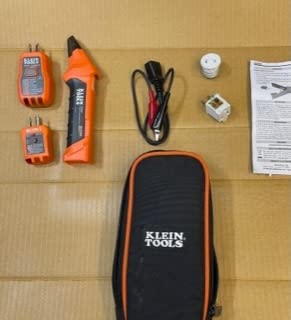
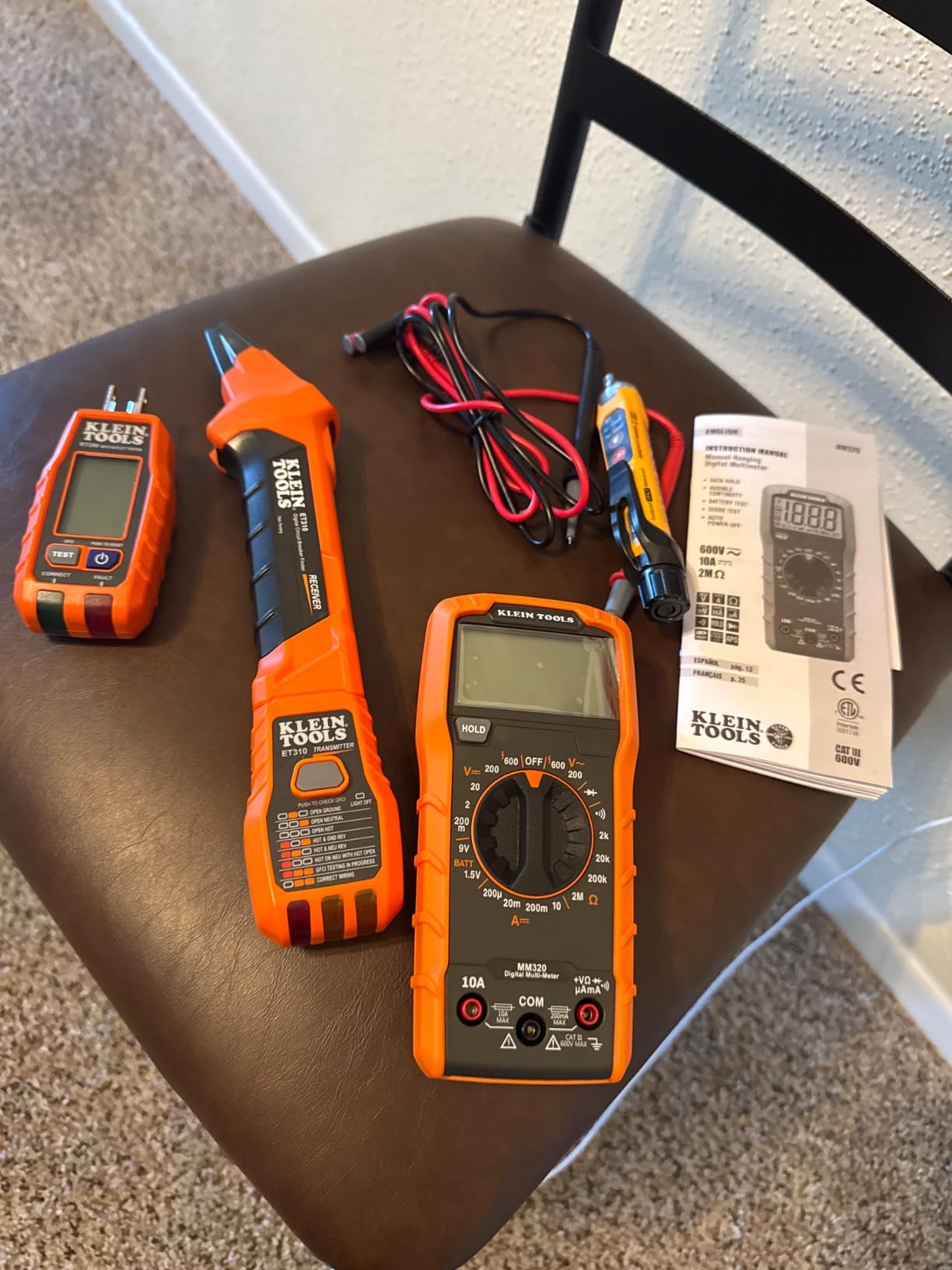
The 80101 is not a better breaker finder than the ET310. It is the same basic Klein two-piece design with the same strengths and the same cross-talk limits. What it adds is the rest of a starter kit in one box, and for a homeowner or an apprentice that is often the more useful purchase.
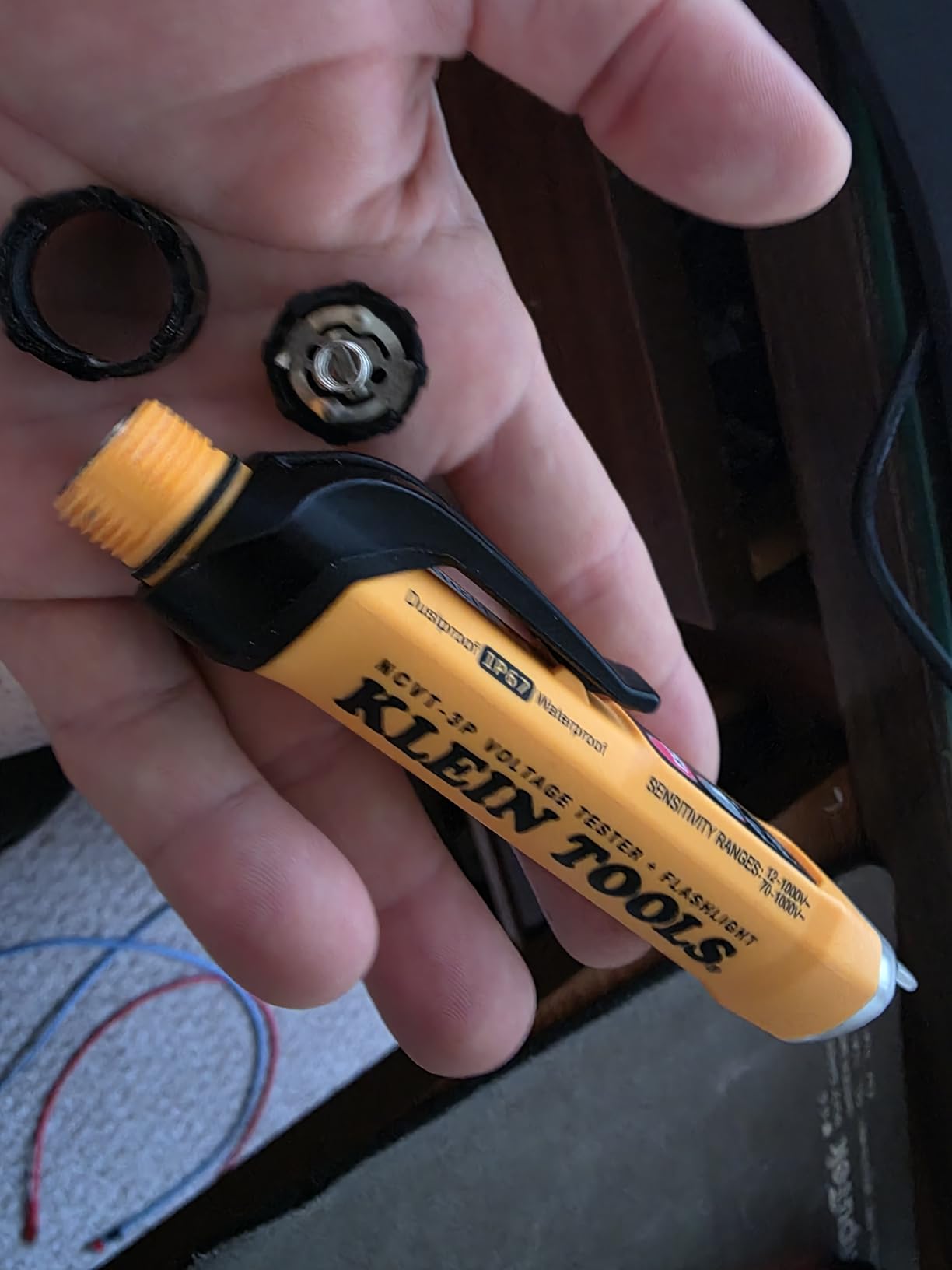
The bundle is a MM320 digital multimeter measuring up to 600V AC/DC, 10A DC current and 2MOhms resistance with battery, diode and continuity tests. A NCVT3P non-contact voltage tester with dual ranges from 12 to 1000V AC and a built-in flashlight. An RT250 GFCI receptacle tester with a large backlit LCD voltage readout and patent-pending open neutral and open ground detection. Plus the breaker finder and test leads.
It is UL and CE listed with a CAT II 135V and CAT IV 1000V rating, which covers a lot of ground, and at 86% five-star shares it has the highest five-star ratio of the Klein products in this guide. Owners treat it as the convenient one-box answer to the four things they actually need on a service call.
The trade-offs are bulk and specificity. At 1.8 pounds in a 20 x 14 x 4 inch package it is a box to carry rather than a tool to reach for, and the MM320 is an entry-level multimeter that will not cover every professional measurement task. There are also no light socket or bare wire adapters, which the KAIWEETS and Focemta kits include.
When the Klein 80101 is the right call
It is the right call when you are setting up a first tool bag and the breaker finder is one of four things you need, not the only thing. The backlit RT250 receptacle tester and the dual-range NCVT3P are the components owners single out, and together the kit covers outlet checks, live-wire detection, general measurements and breaker identification.
For an apprentice, it is a good demonstration of how the device classes differ, which is exactly the confusion that stops people buying the wrong tool.
When the 80101 will disappoint you
Do not buy it as a pro breaker finder upgrade. The finder component is the straightforward Klein design with no sensitivity adjustment, so it carries the same false-positive behaviour on interleaved wiring as the ET310 and none of the ET450’s reach.
It is also the least convenient thing to carry of the ten, and the MM320 will not replace a quality multimeter in a working electrician’s bag.
Accuracy, False Readings and Dead Circuits
No circuit breaker finder on the market is foolproof, and the most useful thing we can tell you about this category is where the limits are. Every trade forum we checked says the same thing in different words: the tool narrows the field, you confirm before you work.
The first limit is signal bleed. A transmitter drives its signal onto the whole circuit, and the circuit includes the neutral. Where neutrals are joined in multiple boxes, or where a long parallel run of neutral shares a pathway with a neighbouring circuit, the signal appears on two branches. That is what produces the two-beaker result, and it is why the Extech CB10’s two-pass calibration and sensitivity dial genuinely help rather than just sounding technical.
The second limit is multi-wire and shared-neutral circuits, where one breaker feeds two hot legs. The signal is present on both, and the receiver may point you at the paired breaker rather than the one you wanted. The third is AFCI and GFCI breakers, whose electronics can attenuate or reshape an injected signal. The result is a weaker or less consistent response, not a wrong answer, but it is not the crisp lock-in a plain breaker gives.
The fourth limit is the one DIYers hit first. Most of these tools need the circuit live. If a breaker has tripped, an outlet is dead, or you are chasing an open circuit, the transmitter has nothing to inject into and the tool simply will not work. On older homes where the practical repair is to open a box and find where the wires were capped off, this is the exact moment you need a tool, and the moment a basic finder is useless. The Klein ET450 is the answer in this guide, because it traces de-energised conductors and reaches through wall material.
One more practical note. Most manuals instruct you to unplug every device on the circuit under test, because a load on the circuit can distort the signal. On a kitchen or workshop circuit that is real time, and it is the most common complaint levelled at the fast tools in particular.
Circuit Breaker Finder vs. GFCI Tester vs. Non-Contact Voltage Pen
This is the single most common buying mistake in the category, and it comes from four different device classes all being sold under the same name. A receptacle analyzer belongs in a different category entirely, and we explain the difference in our comparison of signal-based scanning tools.
A true circuit tracer answers one question: which breaker feeds this outlet. A GFCI or receptacle tester answers a different question: is this receptacle wired correctly, and does the GFCI device trip. A non-contact voltage pen answers a third: is there voltage here right now. A receptacle analyzer, which sits above all three, records voltage, phase sequence and load balance across many circuits at once for commissioning work.
Most finders in this guide bundle the first two, because the transmitter is already plugged into a receptacle and the GFCI test costs nothing to add. That is why the KAIWEETS, Focemta, Instrodots and AstroAI units describe themselves as three tools in one. The Klein 80101 goes furthest and bundles a multimeter and a non-contact voltage tester as well. None of them replaces a receptacle analyzer, and none of them tells you about phase balance.
How to Label an Electrical Panel With a Breaker Finder
This is the job most people buy these tools for, and doing it in the right order is what makes the difference between a two-hour evening and a two-day one.
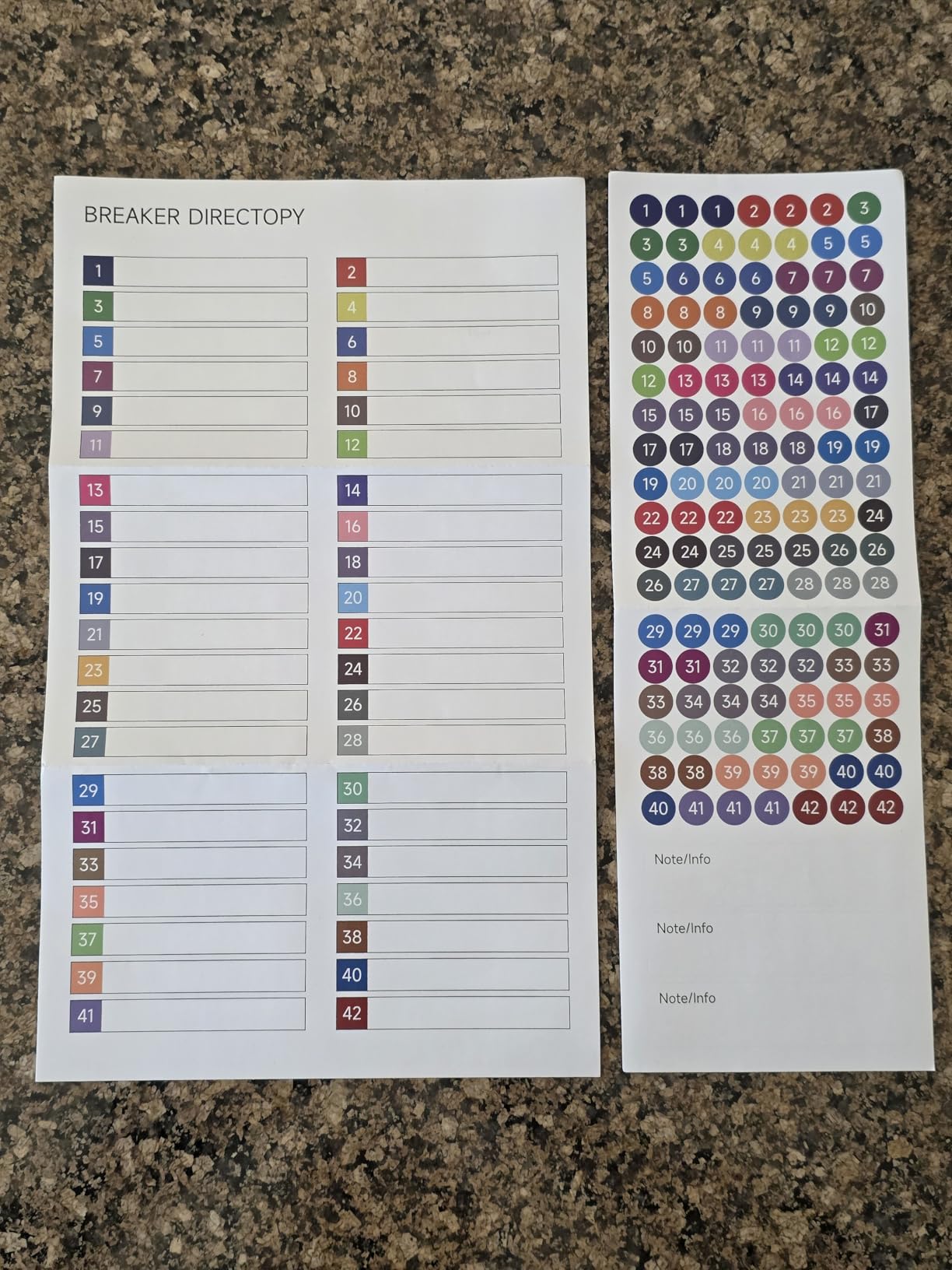
- Set up a system before you start. Number each breaker handle with a strip of masking tape and marker in column order, and open a spreadsheet or a document with one line per breaker. The deliverable is the map, not the tool.
- Start at the first breaker with the panel dead and every load on that circuit unplugged. If the circuit is already off, note it and move on, because a live-circuit finder will not give you a reading.
- Plug the transmitter into a known point on that circuit. The first receptacle in the circuit, near the panel, is usually the most reliable because there is less opportunity for the signal to bleed.
- Scan the panel column slowly with the receiver, moving past each breaker handle one at a time rather than sweeping the whole panel at once.
- When the receiver peaks, record the breaker number, then confirm it by switching that breaker off and testing the receptacle before you write the label. This confirmation step is the entire difference between a map you trust and a map you have to re-check.
- Label in plain language at the receptacle, not just the panel: kitchen small appliance, primary bath, garage door opener, bedroom 2 north. Generic labels cause the problem you bought the tool to solve.
- Finish with a full second sweep. Any circuit that gave an ambiguous or double result gets tested again from a different point on the circuit, and any dead circuit is opened up and traced to find where the wires were capped off.
Buying Guide: What to Check Before You Buy
Six criteria decide whether a breaker finder earns its place, and they matter in this order.
- Voltage range. Almost everything here is 120V residential gear with a ceiling somewhere between 120V and 480V. If your work includes 240V appliances, EV chargers or commercial panels, the ceiling is the first thing to check, not the last.
- Live circuits only, or live and dead. A finder that needs the circuit energised is fine for labelling a panel and useless for chasing a tripped breaker or an open run. Decide which job you actually do more of.
- Sensitivity control and confirmation method. A dial you can turn down beats a fixed receiver in a noisy panel, and a locked green indicator beats a bar graph you have to interpret.
- Readout. A backlit LCD showing live voltage and signal strength gives you evidence to reason with. LED and beep alone gives you an answer with no way to judge its quality.
- Adapters and accessories. Light socket, 3-to-2 prong and alligator clip adapters decide whether the tool covers lighting circuits, older two-wire receptacles and bare conductors, which is most of an older house.
- Safety listing and documentation. A CAT rating and a well-written manual matter more than any extra feature, because the manual is what tells you the correct learn-and-scan order and two of the kits here have poorly written instructions.
Ideal SureTrace-Style Tracing vs. the Klein ET310
One question comes up in almost every thread on this topic: is the Ideal or the Klein better? The honest answer is that the two occupy different tiers, and the tier matters more than the brand.
The Klein ET310 is a plug-in breaker finder with an integrated GFCI tester and a 90-120V range. At 24294 reviews and 4.7 stars it is the most proven unit in this guide, and it does the labelling job cleanly on standard residential panels. What it cannot do is trace a dead circuit or reach through a wall.
The SureTrace-class tools are built as general circuit tracers rather than panel labellers. They connect to a circuit with leads and clips, they carry adjustable sensitivity, and they trace through building materials and onto de-energised conductors. That capability is what you need for remodels, re-runs, outdoor circuits and plant work, and it is why they cost several times more.
So the choice is a workflow choice. If your week is residential service calls and panel labelling, the ET310 is the stronger value and the better-proven tool. If you chase wiring through walls or work on dead circuits, you need the tracer class, and within this guide the Klein ET450 is the tool that does it. The forum consensus we found matches this split: working electricians name Klein and Ideal as the two brands that come up unprompted, and the disagreement is almost never about accuracy, it is about whether they need the tracer features at all.
Frequently Asked Questions
Do circuit breaker finders really work?
Yes, on standard North American residential panels. The transmitter injects a signal onto the circuit at a receptacle and the receiver detects that signal at the panel, so the result is a real electrical measurement rather than a guess. The catch is that the same signal can leak into a neighbouring conductor in a shared junction box or a multi-wire circuit, so the universal advice from trade forums is to switch the breaker and confirm at the receptacle before you start work.
What is the best tester for electricians?
It depends on which device class you mean. For identifying which breaker feeds an outlet, the Klein Tools ET310 is the most proven, with 24294 reviews at 4.7 stars. For a non-contact voltage pen, the Klein NCVT3P covers 12 to 1000V AC. For receptacle and GFCI testing, the Klein RT250 has a backlit LCD with open neutral and open ground detection. The Klein 80101 kit bundles all of these plus a multimeter in one box.
What is the best tool to trace electrical wires?
For tracing through walls, floors and building materials, or for tracing a circuit that is not energised, you need a true circuit tracer rather than a plug-in breaker finder. The Klein Tools ET450 in this guide does both, with adjustable receiver sensitivity for drywall, masonry, shielded cable and soil, plus 3-foot and 20-foot lead adapters. Plug-in finders like the ET310 identify breakers at the panel but will not follow a wire through a wall.
Which circuit tracer is better, the Ideal or the Klein?
They serve different workflows. The Klein ET310 is a plug-in panel labeller with an integrated GFCI tester and an enormous review base, and it is the better value for residential service and panel labelling. The SureTrace-class tools connect with leads and clips and trace through wall material and onto dead circuits, which matters for remodels, re-runs and industrial work. Decide whether you need the tracer features or only the labelling, and the brand question largely answers itself.
Will a circuit breaker finder work on a dead circuit?
Most will not. They need a live circuit to inject a signal into, so a tripped breaker, a dead outlet or an open run leaves the tool silent. The exception in this roundup is the Klein ET450, which traces energised and de-energised breakers, fuses and wires. On older homes the practical fix for a dead circuit is to open a box and find where the wires were capped off, which is a job for a tracer-class tool rather than a plug-in finder.
How do electricians label their panel?
Number the breaker handles in column order first, then work down the list one circuit at a time with the transmitter plugged into a known point on that circuit. Scan the column slowly, record the breaker that peaks, then switch it off and confirm at the receptacle before writing the label. Label in plain language at both the panel and the receptacle, and finish with a second full sweep, re-testing any circuit that gave an ambiguous or double reading.
Conclusion
The best circuit breaker finders for electricians in 2026 are not all the same tool, and the right one depends on whether you are labelling a panel or chasing a wire. For most electricians doing residential service, remodels and panel upgrades, the Klein Tools ET310 is the pick. It has the deepest owner feedback base in the category at 24294 reviews and 4.7 stars, an integrated GFCI tester that saves a second device in the bag, and a physical size that fits in a pouch rather than a case.
For dead circuits, wall tracing and anything above 120V, the Klein ET450 is the buy. It is the only tool here that traces a de-energised conductor and reaches through drywall, masonry and soil, with voltage class indicators up to 480V.
For value, the KAIWEETS KT301P gives you a backlit LCD with live voltage and signal strength, three functions in one body, and the best adapter bundle in the mid range. Where accuracy on a messy panel is the deciding factor, the Extech CB10’s two-pass calibration and sensitivity dial beat everything else here, and the Fluke BK120 is the compact choice with the strongest certification behind it.
Whichever you choose, confirm the result at the receptacle before you touch anything. The tool narrows the field; it does not sign off on the work.