
Some of my favorite gaming moments happen when I am completely alone at the table. There is something special about setting up a board game just for yourself, pouring a cup of coffee, and losing track of time for an hour.
If you are searching for the best solo board games, you are not alone. Solo gaming has exploded in popularity, and designers are now building incredible single-player experiences that rival multiplayer sessions.
Our team at Fundex Games has spent the last three months testing over 30 solo and single-player titles across every genre imaginable. We started with the titles most recommended by Reddit’s r/soloboardgaming and BoardGameGeek communities.
Spirit Island and complex games like Mage Knight appear in nearly every recommendation thread there. We played dungeon crawlers at midnight, tile-laying games on rainy afternoons, and card-based puzzles during lunch breaks.
Through all that testing, we narrowed the list down to the ten standout games that actually deliver a satisfying solo experience. In this guide, I will walk you through each pick in detail.
You will learn what makes each game special, how the solo mode works, and whether it fits your experience level. I have also included practical notes about setup time, storage space, and learning curve because those details matter when you are building a solo collection.
Table of Contents
Top 3 Picks for Best Solo Board Games
Before we get into the full list, here are the three games that stood out above everything else we tested. These picks represent the best balance of quality, replayability, and solo design.
Cascadia earned our top spot because it teaches in under two minutes yet offers genuine strategic decisions every turn. Wingspan delivers incredible value with its 170 unique bird cards and dedicated Automa system. Friday proves that a solo game does not need a big box or a big budget to deliver hours of tense deck-building fun.

Cascadia
- Spiel des Jahres 2022 winner
- Beautiful wooden wildlife tokens
- Teaches in 2 minutes
- 30-minute playtime
- 1-4 players with solo mode

Wingspan
- 170 unique bird cards
- Kennerspiel des Jahres 2019
- Automa solo mode included
- Educational about real species
- 70-minute playtime

Friday
- Dedicated solo deck builder
- 4 difficulty levels
- 30-minute playtime
- Robinson Crusoe theme
- Compact and affordable
Best Solo Board Games in 2026
Here is the complete list of the best solo board games for 2026. The table below gives you a quick side-by-side view of player count, play time, and key features so you can spot the right fit at a glance.
| Product | Specifications | Action |
|---|---|---|
| Cascadia |
|
Check Latest Price |
| Wingspan |
|
Check Latest Price |
 Spirit Island Spirit Island |
|
Check Latest Price |
 The Night Cage The Night Cage |
|
Check Latest Price |
 Final Girl Final Girl |
|
Check Latest Price |
 Grove Grove |
|
Check Latest Price |
 One Deck Dungeon One Deck Dungeon |
|
Check Latest Price |
| Friday |
|
Check Latest Price |
 Ingenious Ingenious |
|
Check Latest Price |
 Unbroken Unbroken |
|
Check Latest Price |
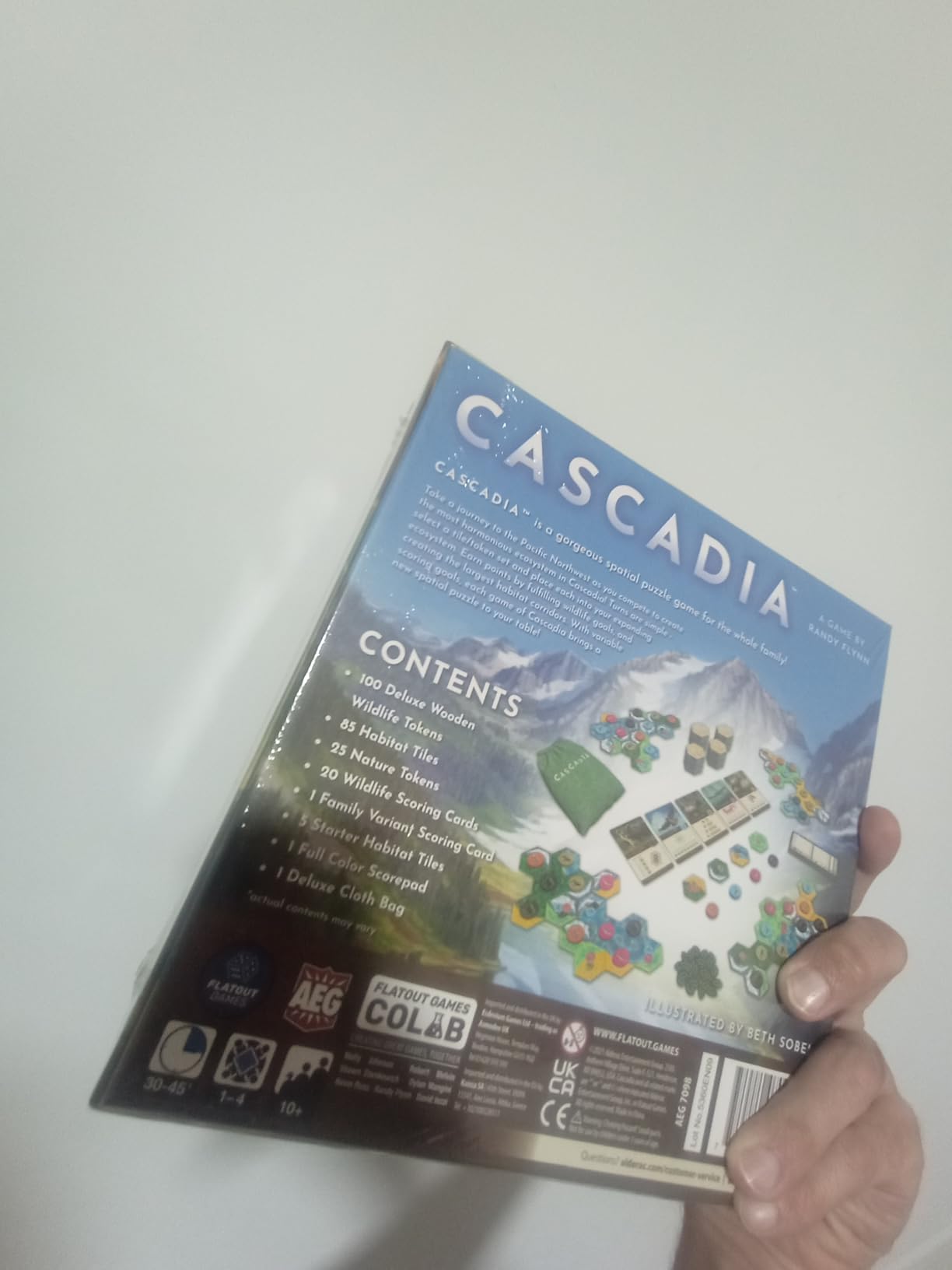
1. Cascadia – Award-Winning Solo Nature Puzzle
Cascadia, Award-Winning Cozy Nature Board Game Set in the Pacific Northwest
1-4 Players
30 Min
Spiel des Jahres 2022
Ages 10+
Pros
- Beautiful wooden wildlife tokens
- Easy to learn in 2 minutes
- Excellent replay value with scoring cards
- Family-friendly yet strategic
- Compact storage
Cons
- Scoring mechanics can confuse initially
- May feel simple for hardcore gamers
I spent a full week playing Cascadia every evening after dinner, and I never tired of it. The game asks you to build a habitat corridor by placing hexagonal tiles and attracting wildlife with pattern-matching rules.
In solo mode, you race against a target score that scales across four difficulty levels, which creates a satisfying pressure without feeling unfair. The wooden wildlife tokens are some of the nicest components I have handled in a game under any price point.
They have a satisfying weight and sit beautifully on the habitat tiles. Each game takes roughly 15 to 30 minutes, so I often play two or three sessions back to back while listening to a podcast.
What impressed me most was the scoring variability. The wildlife scoring cards change every game, which forces you to rethink your strategy even when the tile stack starts to feel familiar.
After 25 solo plays, I still encounter scoring combinations that make me pause and recalculate my entire board. The solo mode is woven into the base rules rather than tacked on as an afterthought.
You use a simplified automa that draws tiles and scores them based on a fixed priority list. It is easy to run, takes less than a minute per turn, and actually puts up a decent fight on the higher difficulty settings.
I did find the initial scoring explanation slightly confusing. The first two games, I had to double-check the reference card to confirm how each animal scored.
By the third play, the logic clicked, and I have not looked back since. For hardcore strategy fans, Cascadia might feel lighter than a heavy Euro game.
But for solo players who want a quick, rewarding puzzle with gorgeous table presence, this is tough to beat.
How Complex Is the Learning Curve
Cascadia teaches in about two minutes. You explain tile placement, wildlife token matching, and the scoring cards, then you are playing.
The solo automa adds one extra rule about how it selects tiles. I taught my niece in a single sentence, and she scored within ten points of me on her first attempt.
That low barrier makes Cascadia one of the best entry points for someone new to solo board gaming. If you have ever felt overwhelmed by the complexity barrier that keeps some players away from the hobby, this game removes that wall entirely.
Table Space and Storage Requirements
The box measures roughly 9.5 inches square and 2.75 inches deep. On the table, you need about the same footprint as a large dinner plate for your personal board and the shared tile pool.
I play it on a small coffee table without any issues. Storage inside the box is tidy.
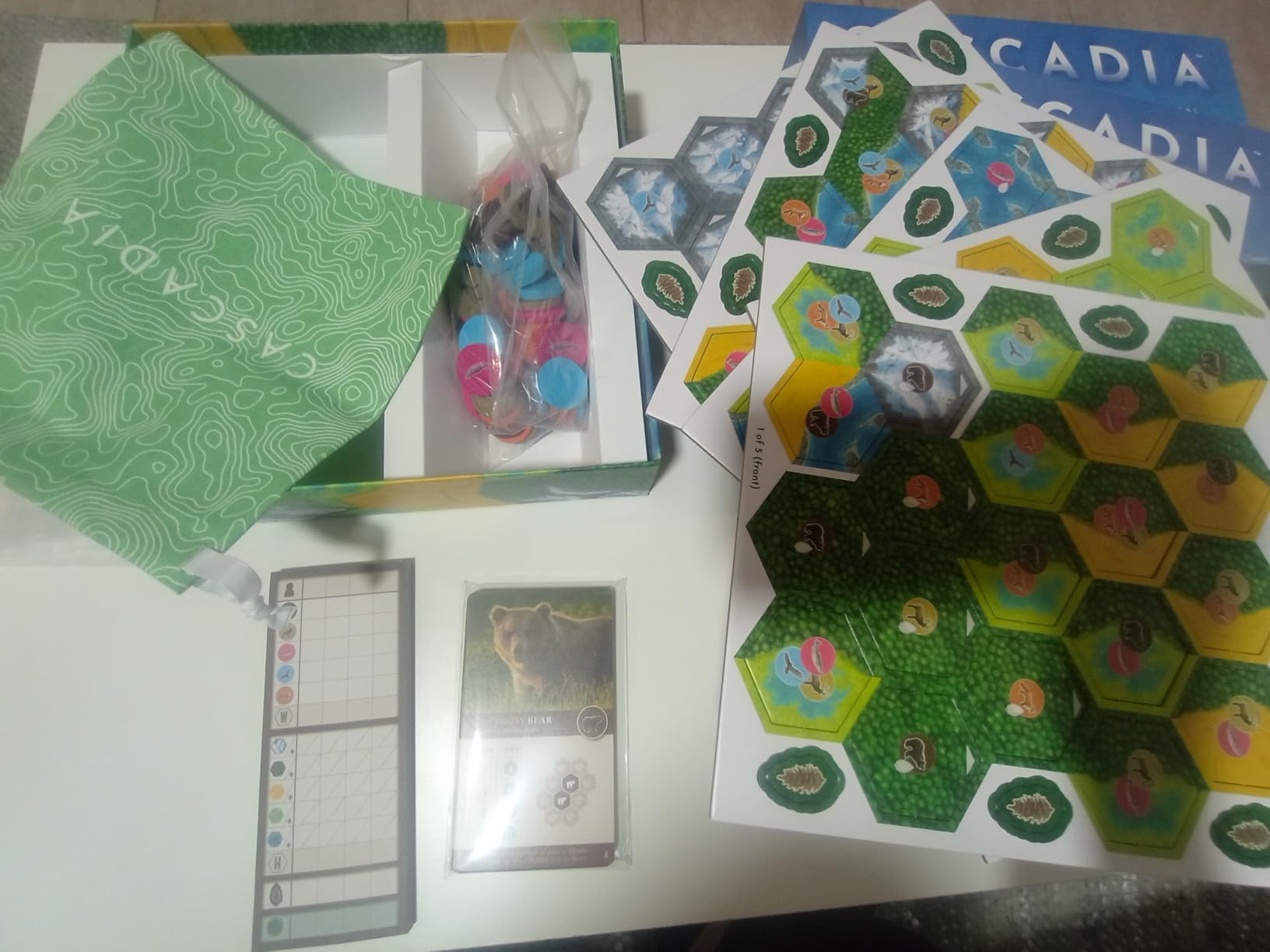
The included cloth bag holds all the tokens, and the tiles stack neatly. It takes up less shelf space than a standard hardcover book, so it is an easy addition even if your collection is already cramped.
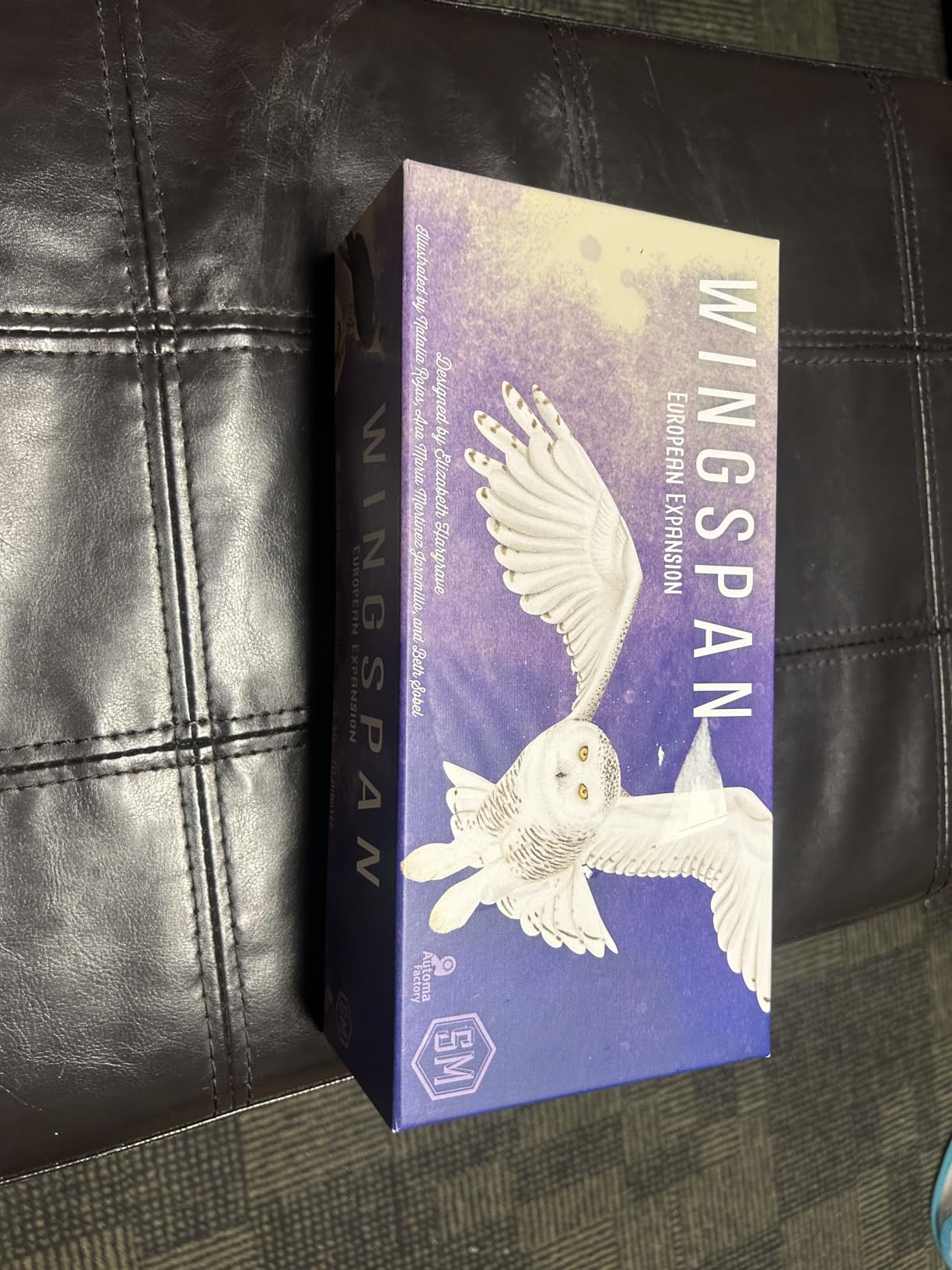
2. Wingspan – Bird-Collecting Engine Builder
Stonemaier Games: Wingspan by Elizabeth Hargrave
1-5 Players
70 Min
170 Bird Cards
Ages 10+
Pros
- Gorgeous bird illustrations
- 170 unique cards for replayability
- Educational about real species
- Quality wooden dice and egg miniatures
- Easy Swift-Start learning
Cons
- Dice tower can be flimsy
- Card sleeves may not fit tray
Wingspan is the game that made me stop dismissing nature-themed board games as too light. I played it solo using the included Automa deck, and the experience was every bit as engaging as the multiplayer sessions I had at a local game night.
The Automa system is a clever set of cards that dictate which actions the artificial opponent takes, and it scales smoothly across three difficulty levels. The engine-building loop is addictive.
You gather food, lay eggs, draw bird cards, and play birds into one of three habitats. Each bird you add gives you a new ability that combos with the rest of your tableau.
By the final round, you are chaining four or five abilities in a single turn, and the point total climbs fast. I especially love the educational component.
The 170 bird cards include real facts about wingspan, habitat, and diet. After a month of solo plays, I found myself recognizing bird names I had never heard before.
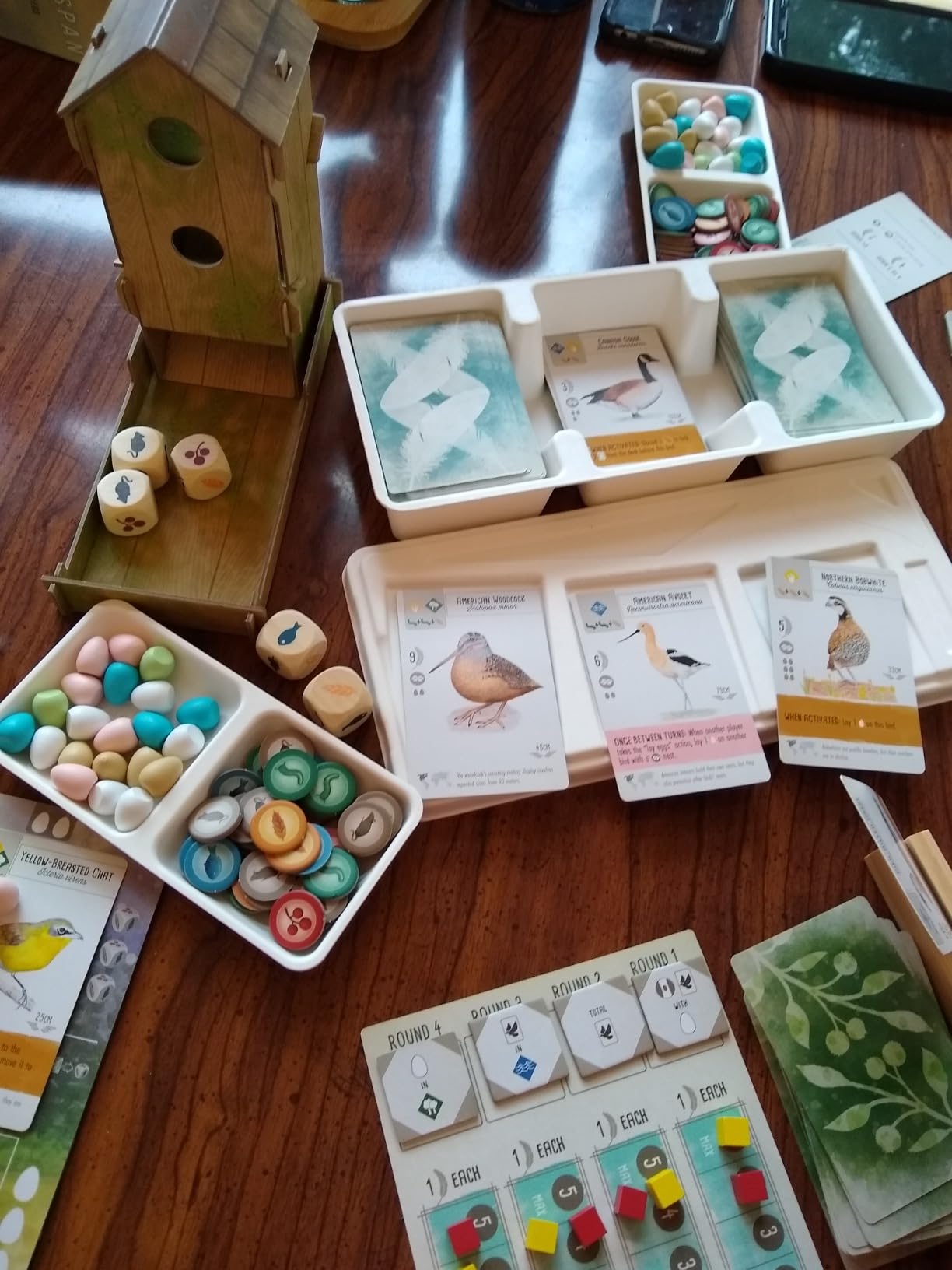
It is rare for a game to teach you something genuinely useful while still being fun. The production quality is exceptional.
The egg miniatures are thick and colorful, the custom dice feel great in the dice tower, and the player boards are sturdy with indented slots for action cubes. Even after dozens of sessions, nothing shows wear.
The solo Automa does require a small learning curve. You need to understand the priority system for which actions it takes, and occasionally the rules feel counterintuitive.
I recommend watching a five-minute video tutorial before your first play. After that, the Automa runs in under 30 seconds per turn.
My only real complaint is that the custom dice tower is a bit flimsy. I knocked it over once during setup and had to rebuild it.
Now I just roll the dice in a separate tray.
Who Is This Best For
Wingspan suits players who want a medium-weight engine builder with a relaxing theme. If you prefer aggressive conflict or cutthroat interaction, this is not your game.
The Automa never blocks you intentionally, and the solo experience is more about optimizing your own engine than fighting an opponent. It is also ideal for bird watchers, educators, and anyone who appreciates games that teach while they entertain.
I have recommended it to three friends who previously thought board games were too geeky, and all of them bought copies after their first play.
Setup Time and Storage Footprint
Setup takes about 10 minutes the first time, but drops to 5 minutes once you know the component layout. The included organizing tray helps, though it can be tight if you sleeve your cards.
The box is 11.5 inches square and 3 inches deep, so it needs a bit more shelf space than Cascadia. On the table, you need a full dining table or a large desk.
The player board, bird cards, food tokens, and egg supply spread out quickly. I play on a 36-inch folding table, and it is just enough room.
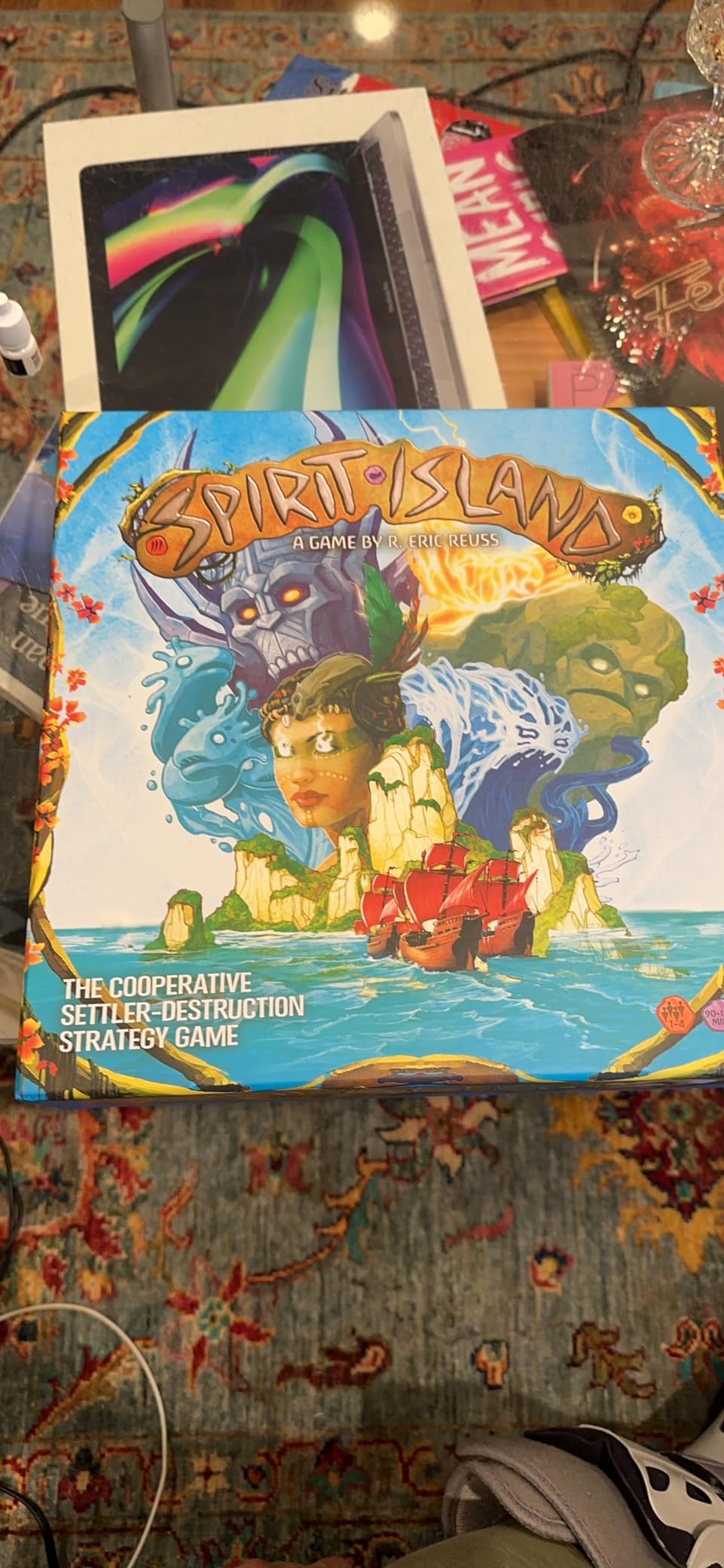
3. Spirit Island – Complex Cooperative Spirit Defense
Greater Than Games Spirit Island – Cooperative Strategy Board Game
1-4 Players
90 Min
8 Unique Spirits
Ages 14+
Pros
- Highly thematic and immersive
- Incredible replayability with many spirits
- True cooperative with no traitor
- Deep strategic gameplay
- Beautiful art and components
Cons
- Complex rules with steep learning curve
- Long setup time
- Heavy bookkeeping especially solo
Spirit Island is the most demanding game on this list, and it is also the most rewarding. I remember my first solo session vividly.
I chose the River spirit, spread my presence across the island, and watched in horror as the invaders built cities faster than I could destroy them. I lost badly.
Then I tried again with the Lightning spirit, and the game felt completely different. That replayability is the heart of Spirit Island.
The base game includes eight spirits, each with a unique power deck, special rules, and preferred strategy. Playing solo often means controlling two spirits at once, which doubles the strategic depth but also doubles the mental load.
I consider it a two-hour puzzle that demands your full attention. The theme is powerfully immersive.
You are not just placing tokens; you are defending a living island from colonizers. The invader deck determines where they explore, build, and ravage, and you must use your spirit powers to push them back before the island blights.
The narrative emerges naturally from the mechanics, which is the mark of brilliant design.
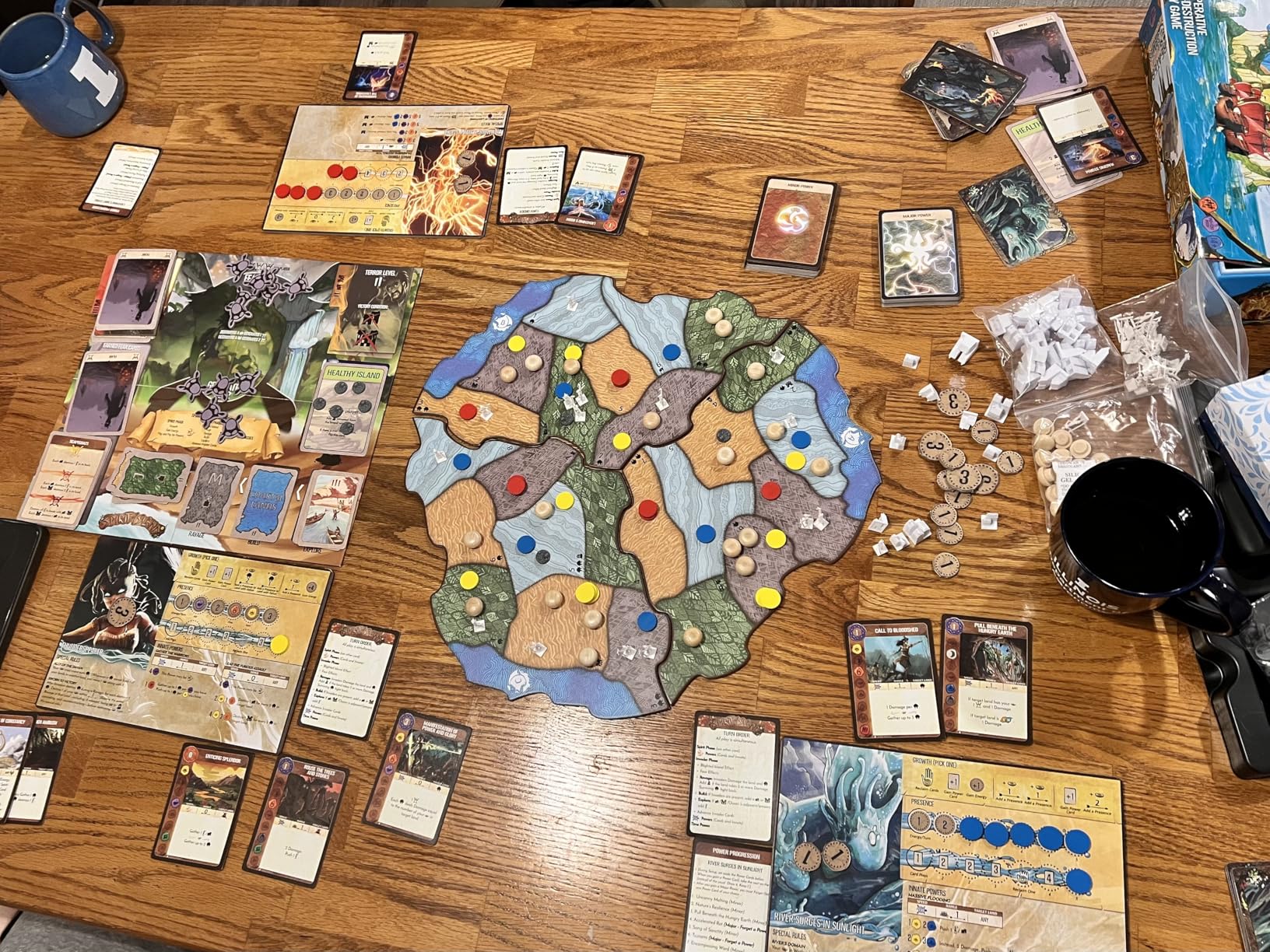
Solo play with two spirits is the recommended way to experience the game alone. The rulebook includes a clean system for running multiple spirits, and the cognitive challenge of coordinating two wildly different power sets is genuinely thrilling.
I have played over 40 solo games, and no two feel identical because the spirit combinations create entirely new puzzles. The adversary system adds even more replayability.
You can face England, France, Sweden, or Prussia, each with unique rules that alter the invader behavior. Level 1 adversaries are manageable.
Level 6 adversaries are brutal. I have beaten Level 3 with a single spirit, and I consider that one of my proudest gaming achievements.
The downside is real. Setup takes 15 to 20 minutes. The rulebook is dense.
Your first game will likely last three hours as you constantly reference rules. The solo bookkeeping of running two spirits can feel overwhelming.
But if you push through the initial learning wall, the depth on the other side is unmatched.
How Long Does It Take to Learn
Plan for three to four hours for your first play, including rule reading. I watched a tutorial video before my first session, and I still made a dozen rules mistakes.
The second play took two hours. By the fifth, I was finishing solo games in 90 minutes.
The learning curve is steep, but it is fair. Every mistake you make teaches you something about timing, power selection, and invader management.
If you are the kind of player who enjoys a challenge that demands mastery, Spirit Island will give you months of progression.
Table Space and Storage Requirements
Spirit Island is a big game. The island board is large, and each spirit needs its own board plus a deck of cards.
When playing solo with two spirits, you need roughly the same table space as a four-player game. I use a 48-inch table and still feel cramped when both spirits are fully developed.
The box is 11.6 inches square and nearly 3 inches deep. It stores the components reasonably well, but many players buy a third-party organizer because setup time is so long.
If shelf space is tight, this is a significant commitment.
4. The Night Cage – Candlelit Horror Maze
Smirk and Dagger The Night Cage
1-5 Players
Tile Horror
Dynamic Maze
Ages 14+
Pros
- Unique atmospheric horror experience
- High replayability with randomized setups
- Beautiful eerie artwork
- Adjustable difficulty settings
- Cooperative or solo play
Cons
- Rules challenging to learn initially
- May need extra lighting
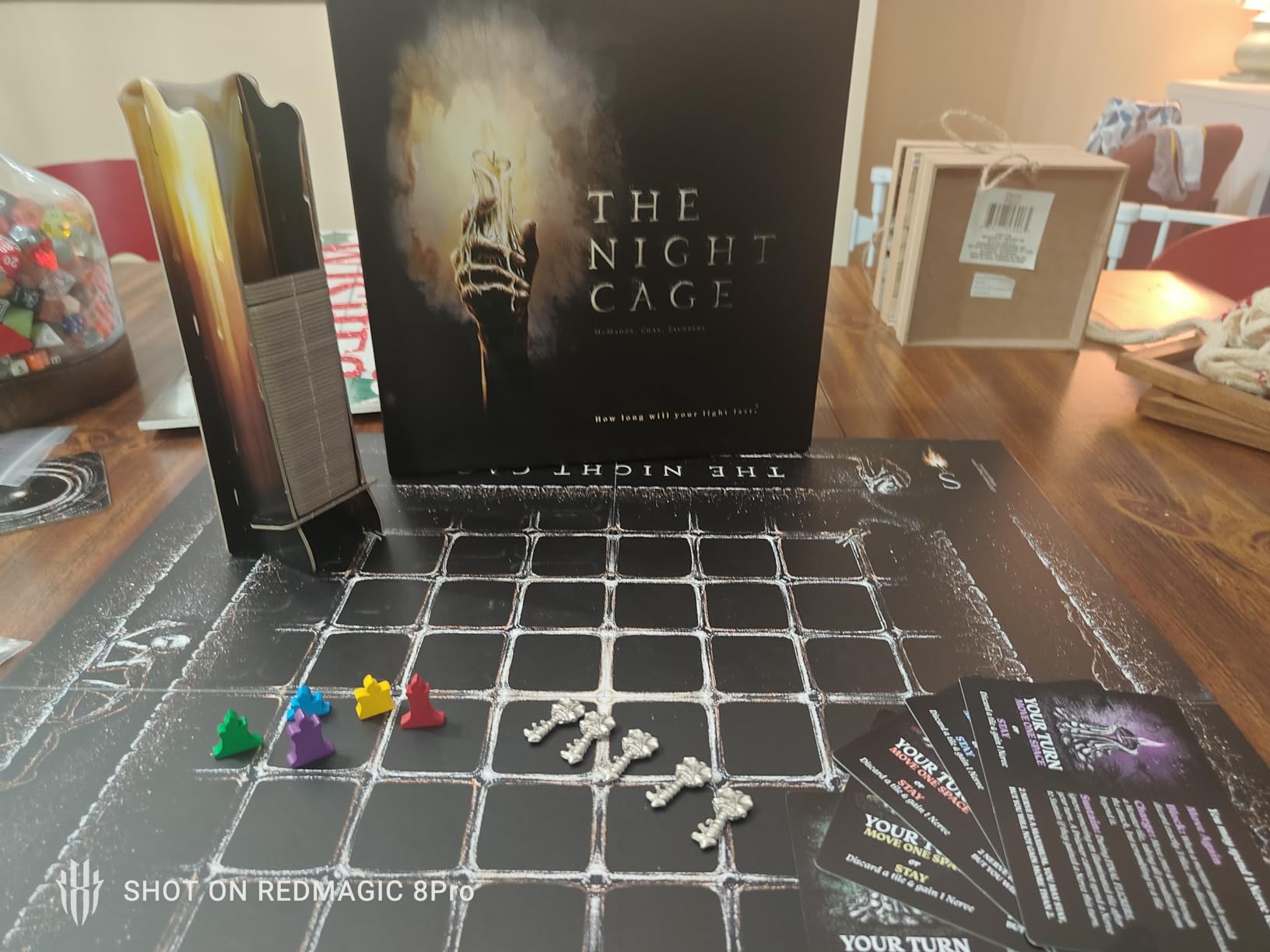
The Night Cage is unlike any other game on this list. You are trapped in a shifting maze lit only by your candle, and you must collect keys and find the exit before the maze collapses.
The horror theme is not just window dressing; it is baked into the mechanics. Your vision is literally limited by the candle tiles, and Wax Eaters stalk the shadows at the edges of your light.
I played this solo on a stormy night, and the atmosphere was perfect. The game creates genuine tension because you never know what tile you will draw next.
The maze shifts when you place certain tiles, which can either open a path or trap you in a dead end. Solo play is identical to cooperative play, except you control all the characters and make every decision alone.
The randomized setup gives it excellent replayability. The key locations, gate position, and monster spawns change every game.
Even after 15 plays, I still encounter layouts that surprise me. The advanced game mode adds new monsters and tighter win conditions for players who want a harder challenge.
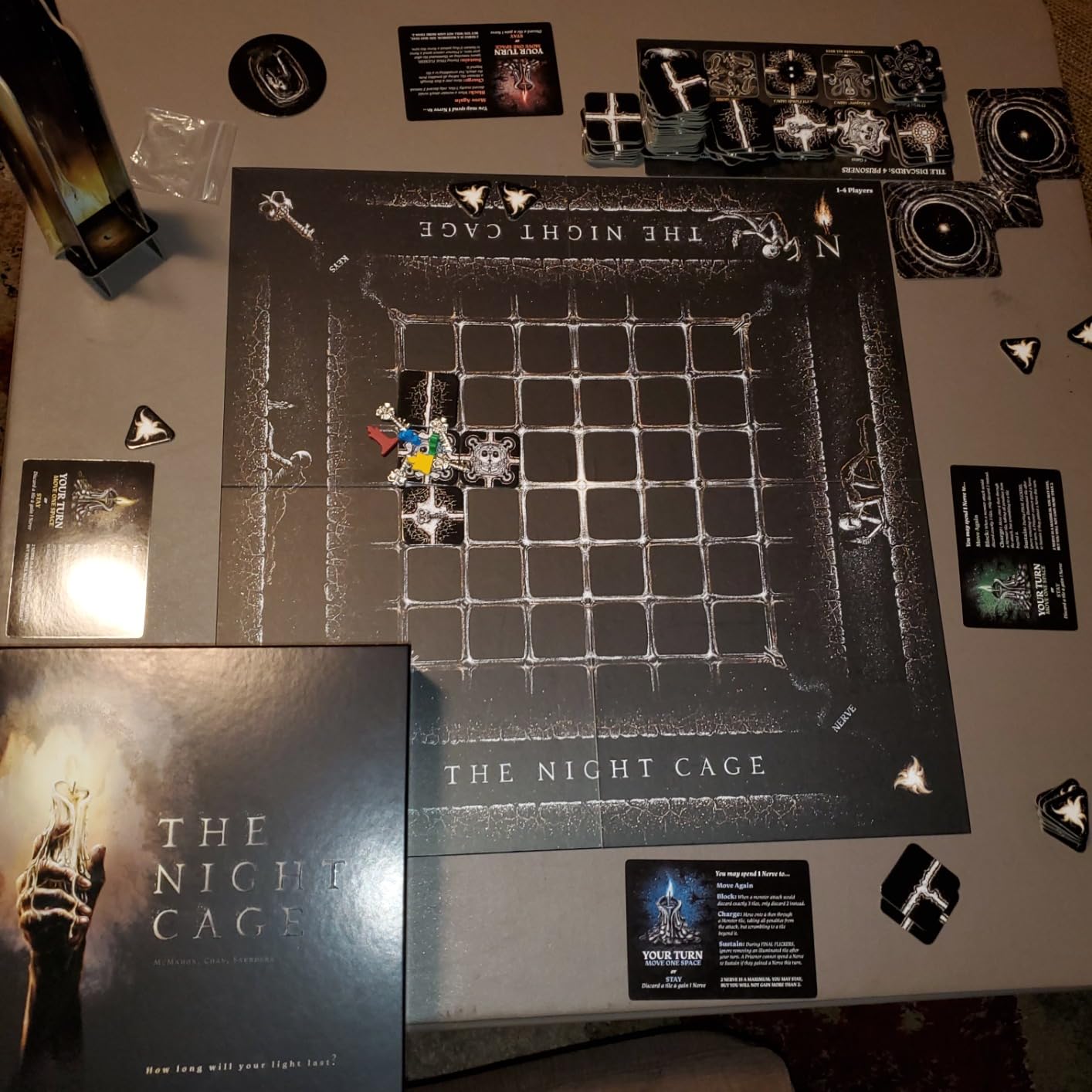
The artwork deserves special praise. The candlelit aesthetic is rendered beautifully on the tiles, and the monster designs are genuinely creepy without being gory.
It is a family-friendly horror game that relies on atmosphere rather than shock value. The rules are a bit tricky to learn initially.
There are several edge cases about tile placement, candle movement, and monster behavior that the rulebook does not explain perfectly. I recommend watching a playthrough video before your first session.
Once you understand the flow, turns are quick and dramatic. One practical note: the dark artwork can be hard to see in low light.
Ironic, given the candlelit theme, but you may want a small desk lamp. The small text on some tiles is difficult to read without direct light.
Is This Game Right for Your Group Size
The Night Cage works equally well as a solo game or with up to four other players. In solo mode, you control multiple prisoners, which makes the decisions harder because you must spread your limited movement across several characters.
The tension actually increases with fewer players because there are fewer candles to light the maze. If you want a game that transitions smoothly between solo weeknights and group game nights, this is a strong choice.
I have played it solo six times and with friends four times, and both modes feel equally intended by the designer.
Setup Time and Storage Footprint
The box is 10.75 inches square and 3 inches deep. Setup takes about 5 minutes because you simply shuffle the tiles, place the starting candle, and draw your starting prisoner cards.
There is no complex board assembly or token sorting. Table space is moderate.
The maze grows as you play, but it rarely expands beyond a 24-inch square. I play it comfortably on a small card table.
The compact footprint makes it a great choice for apartments or shared living spaces where a full dining table is not always available.
5. Final Girl – Solo Slasher Horror Survival
Van Ryder Games – Final Girl Starter Set – Core Box & Happy Trails Feature Film – 1 Player Board Game for Solo Play – 20-60 Minutes Gameplay – Ages 14+
1 Player
20-60 Min
Horror Survival
Ages 14+
Pros
- Excellent dedicated solo experience
- High replayability with mix-and-match system
- Immersive horror theme
- Quality components
- Accessible rules hard to master
Cons
- Rulebook confusing without video tutorials
- Limited stock availability
- Expansions sold separately
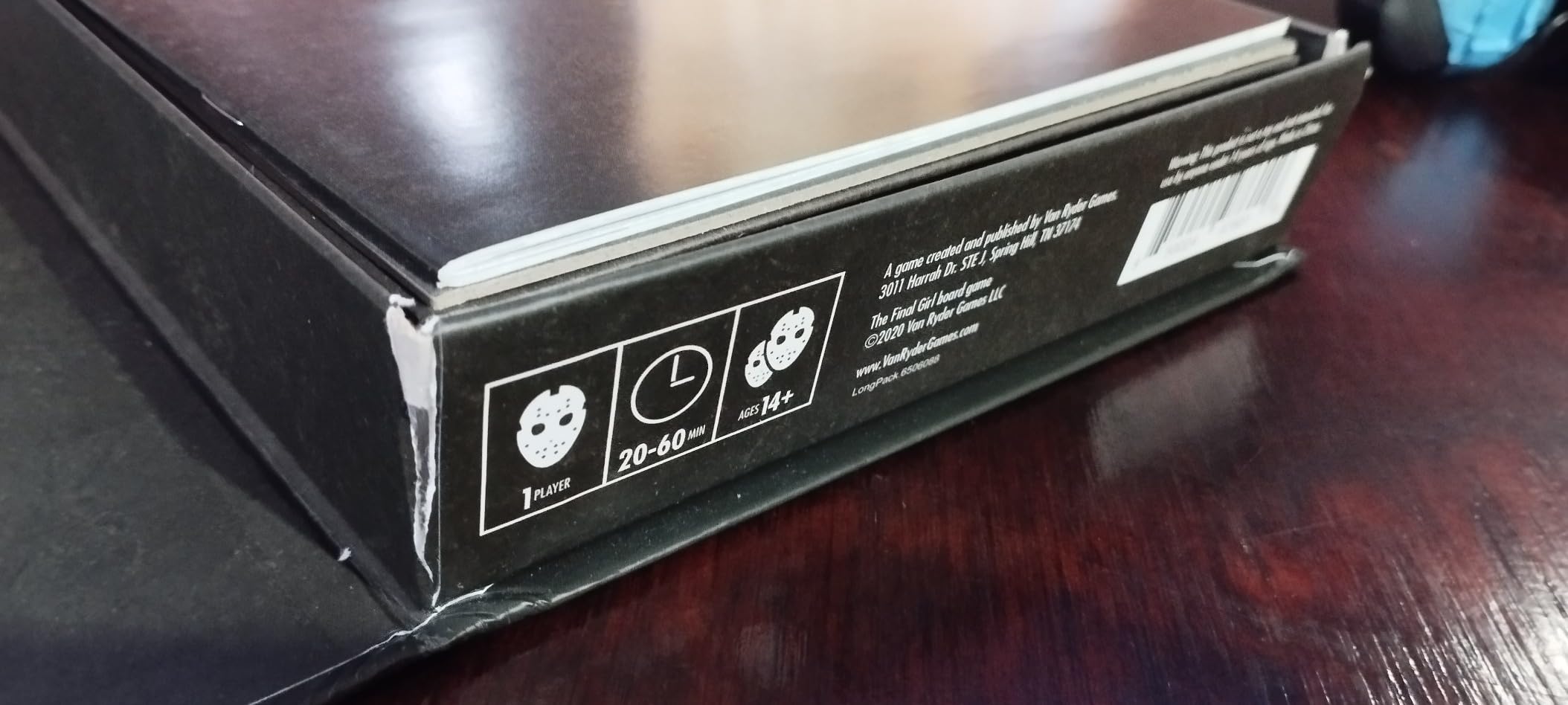
Final Girl is the only game on this list that was built exclusively for one player. There is no multiplayer mode.
The entire design is laser-focused on making you feel like the last survivor in a slasher film, and that focus pays off in every mechanic. I have played through three different feature film combinations, and each one felt like a different movie.
The starter set includes the core box and one feature film box that pairs a killer with a location. You choose a final girl character, each with unique abilities, and then you explore the location, search for items, set traps, and fight the killer.
The combat is tense and swingy. One bad roll can end your game, but smart planning can turn a desperate situation into a narrow victory.
The mix-and-match system is brilliant. You can buy additional feature film boxes and combine any killer with any location.
That means the starter set alone has replayability, but the full system offers hundreds of combinations. I have my eye on the Camp Happy Trails expansion because the base killer was genuinely unnerving to play against.
The solo gameplay is smooth because there is no automa to manage. Every decision is yours.
The killer moves according to a simple AI chart on their board, and the card draws determine what they do each turn. It is the most streamlined solo experience I have tested, and I can set up a game in under three minutes.
The rulebook is the weakest point. Several important timing rules are buried in examples rather than stated clearly.
I watched a video tutorial after my first play, and I realized I had been playing two rules wrong. Once I corrected them, the game became much more challenging and fair.
Stock availability is also worth mentioning. The starter set sells out quickly, and some feature film boxes are already hard to find.
If you see it in stock and the theme appeals to you, I would grab it sooner rather than later.
Expansion Potential and Replayability
The starter set includes two final girls and one killer-location pair. That gives you a solid campaign of 6 to 10 plays before the scenarios feel repetitive.
After that, each feature film box adds a new killer and location, which effectively doubles your content. I appreciate that the expansions are modular.
You do not need to buy them in order. If you love the camping theme, get Camp Happy Trails.
The system lets you curate your horror collection based on your tastes.
Table Space and Storage Requirements
The core box is small, about 6.5 inches by 3 inches. It stores everything from the starter set in a compact plastic insert.
On the table, you need space for the location board, the killer board, your character board, and a small card display. A card table or desk is plenty.
If you buy multiple expansions, storage becomes a minor issue. The feature film boxes are slim, but they add up.
I keep mine in a small bin alongside the core box, and the entire collection takes less shelf space than a single large Euro game.
6. Grove – Compact 9-Card Solitaire
Giga Mech Games Grove: A 9 Card Solitaire Game (Grow Your Fruit Grove with The Help, or hindrance, of a Cheeky Squirrel )
1 Player
10 Min
9 Card Solitaire
Ages 10+
Pros
- Easy to learn with quick instructions
- 5-10 minute gameplay sessions
- Compact and portable design
- Fun solitaire challenge
- Adorable squirrel components
Cons
- Can be tricky to master initially
- Limited components
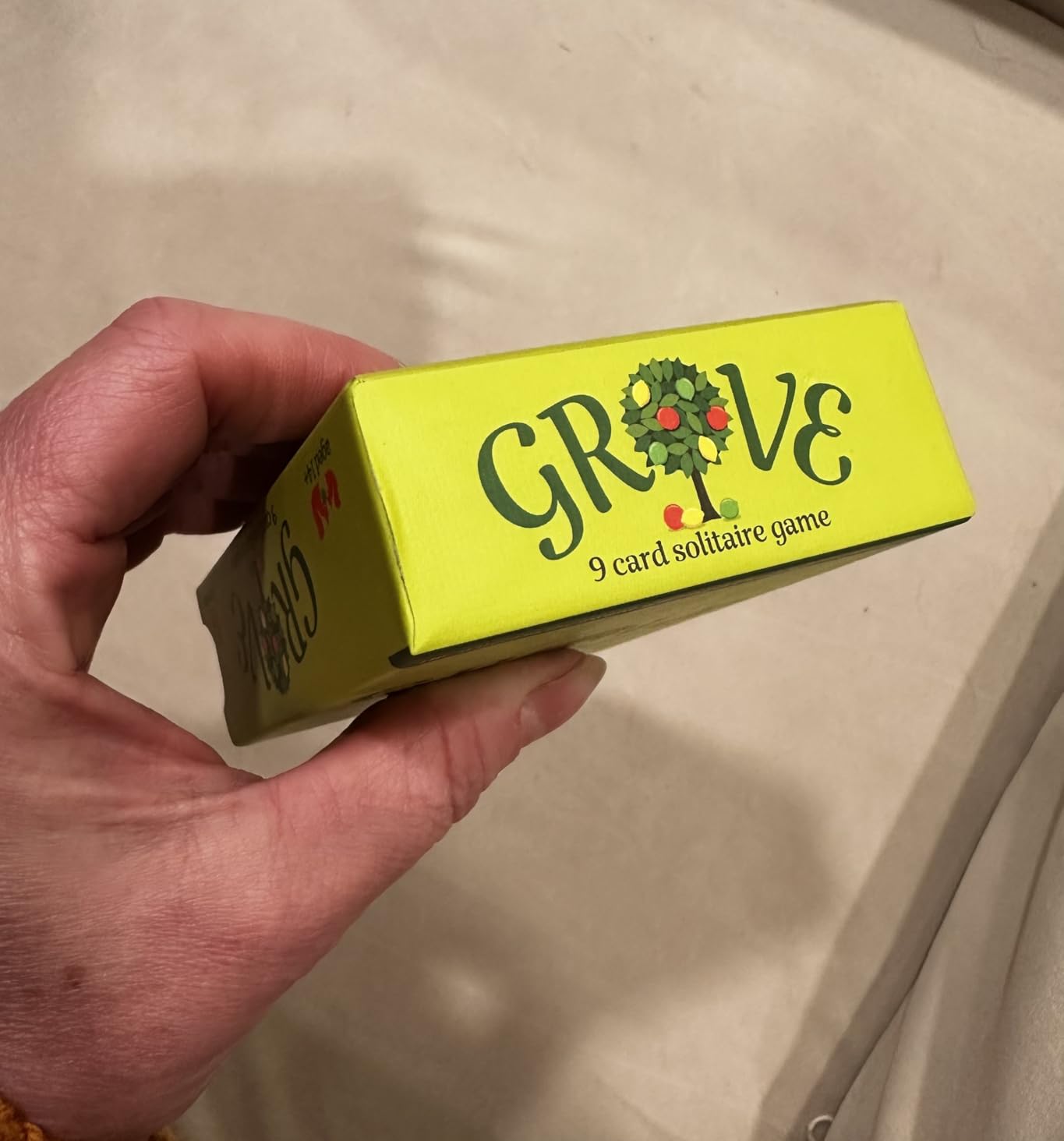
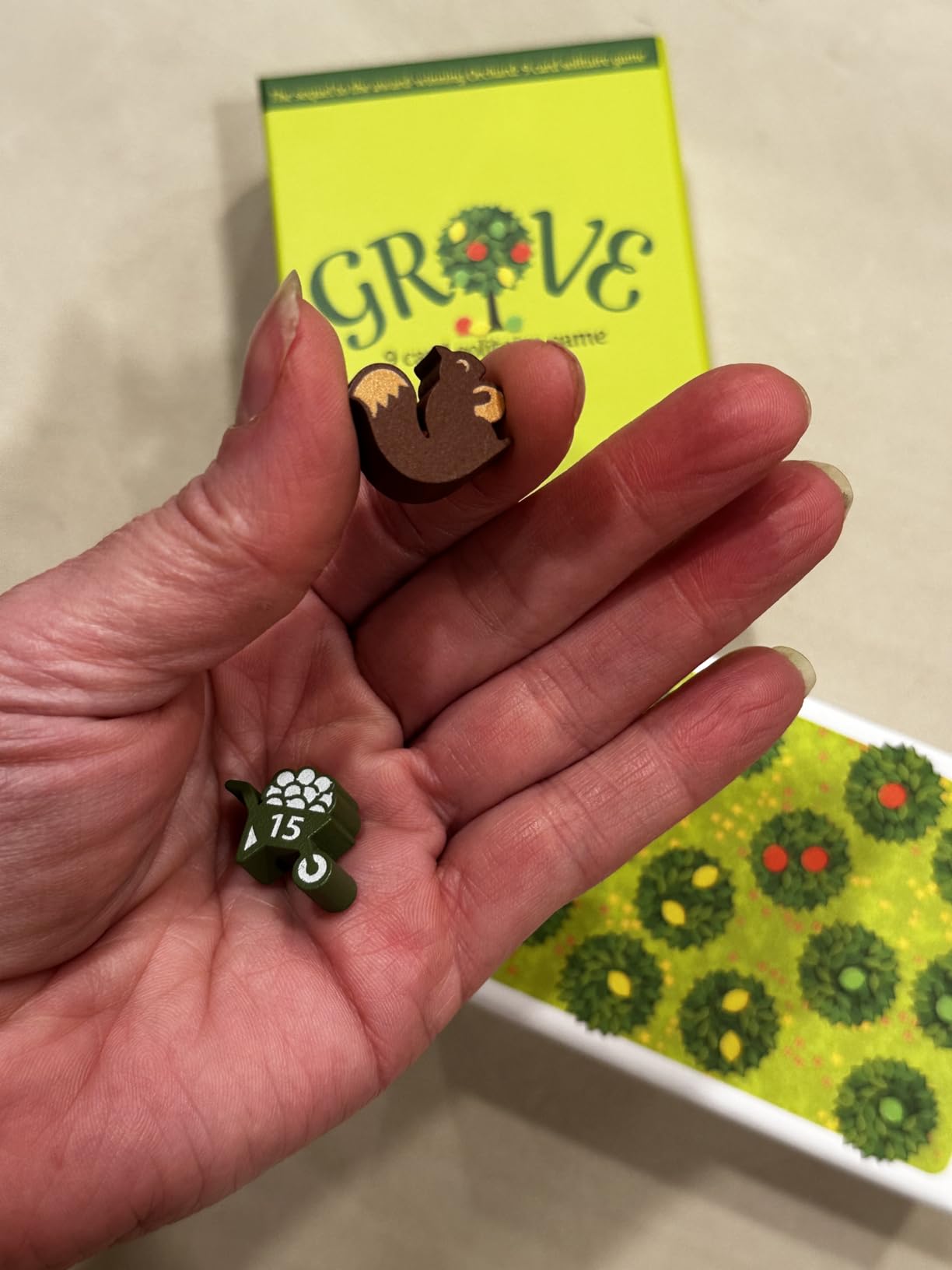
Grove is a tiny game that punches well above its weight. It uses only 18 cards, a small wooden squirrel, and a wheelbarrow token, yet it delivers a genuine puzzle that I have played at least 40 times.
I keep it in my backpack and pull it out during coffee breaks, lunch hours, and waiting rooms. The goal is simple: arrange your fruit tree cards to maximize your harvest while the squirrel either helps or hinders your plans.
The wild card glades add scoring flexibility, and the recipe challenges on the card backs give you specific target scores to chase. A single game takes 5 to 10 minutes, which makes it perfect for filling small gaps in your day.
I tested this during a three-week travel period, and it was my most-played game by a wide margin. It requires no table space beyond a small coffee shop table, and setup is literally just shuffling the cards.
The squirrel and wheelbarrow are cute enough to draw questions from strangers, which started several fun conversations about board games.
The difficulty curve is real. The first few games feel easy because the target scores are forgiving.
Once you start aiming for the advanced recipes, you realize how tight the math is. Every card placement matters, and one early mistake can ruin an entire game.
I still have not beaten the hardest recipe after many attempts. The limited component count is both a strength and a weakness.
It is incredibly portable, but there is no variability beyond the card shuffle. After 40 plays, I know the deck well, which reduces some of the surprise.
The recipe challenges mitigate this by giving you new goals, but if you crave endless novelty, this is not the game for you. For the price, it is an absolute steal.
I have paid more for a sandwich and enjoyed it less. It is a must-have for any solo gamer who wants a pocket-sized challenge.
Who Is This Best For
Grove is ideal for players who want a quick mental warm-up without a long setup. If you have 10 minutes between meetings or you want something to play while your coffee brews, this fits perfectly.
It is also a fantastic travel game because the entire package fits in a pocket. It is not for players who want narrative depth, campaign progression, or complex engine building.
This is a pure abstract puzzle with a light theme. If you enjoy Sudoku, solitaire card games, or other quick puzzles, Grove will feel like a natural addition to your routine.
Setup Time and Storage Footprint
The game measures 4 by 3 by 1 inches in its box. It is smaller than a deck of standard playing cards.
Setup takes 30 seconds: open the box, shuffle the cards, place the squirrel. That is it.
Table space is minimal. You need roughly the area of a large smartphone to spread the cards.
I have played it on airplane tray tables, park benches, and hotel nightstands. If storage space or table space is your biggest constraint, this is the best solo board game you can buy.
7. One Deck Dungeon – Campaign Dungeon Crawler
Asmadi Games One Deck Dungeon, For 168 months to 9600 months
1-2 Players
30 Min
Campaign Mode
Ages 14+
Pros
- Excellent solo with campaign mode
- Compact size with big replayability
- Intuitive dice mechanics
- 30-45 minute sessions
- Can combine for 2 player
Cons
- Relies more on luck than some prefer
- Card art may not appeal to all
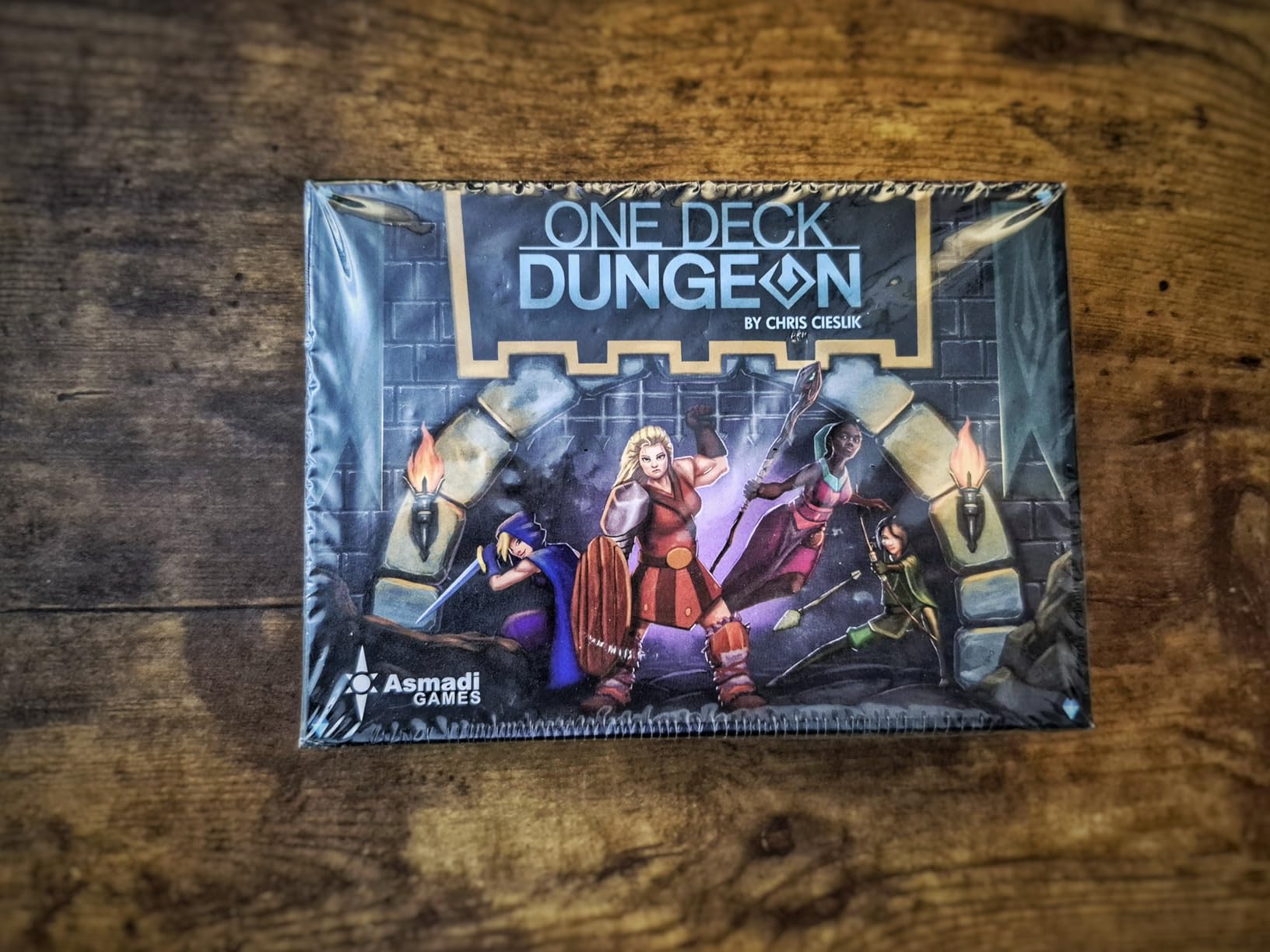
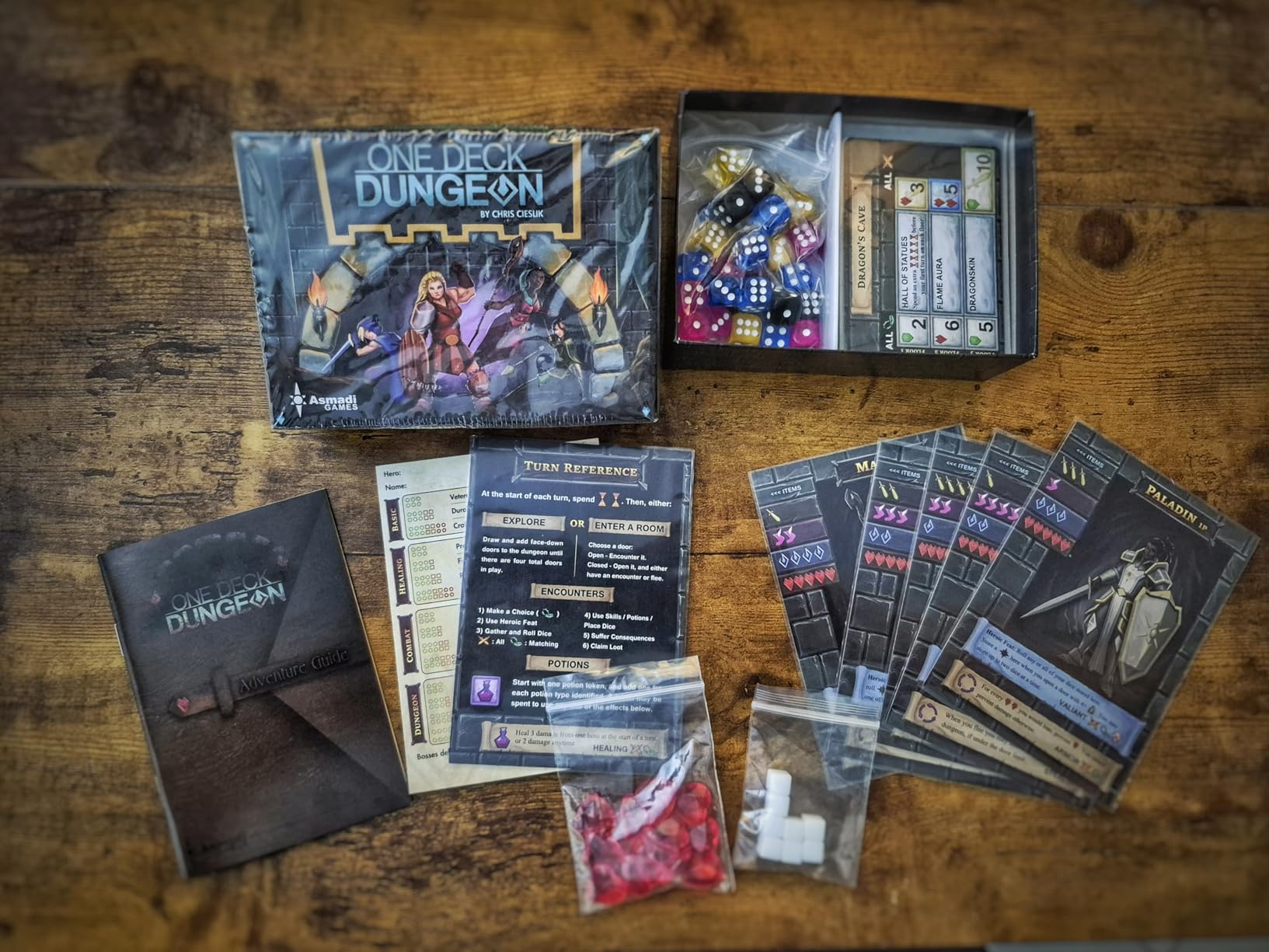
One Deck Dungeon distills the dungeon crawl experience into a single deck of cards, a handful of dice, and a character sheet. I was skeptical that a game this small could deliver the same thrill as a big box dungeon crawler, but after finishing the full campaign with two different characters, I am convinced it can.
The solo mode is built into the core rules. You choose a character class, each with unique starting stats and abilities, then you flip door cards to explore rooms and fight monsters.
Combat is resolved by rolling dice and matching colors to the challenge requirements. It is fast, tactile, and surprisingly tense when you are one die short of defeating a boss.
The campaign mode is what elevates this above other micro games. After each dungeon, you mark experience points, new abilities, and potions on your character sheet.
Across five or six sessions, your character grows from a weak beginner into a powerful hero. That sense of progression is deeply satisfying in a box that fits in a jacket pocket.
The dice rolling does introduce significant luck. Some players dislike games where a bad roll can ruin a carefully planned turn.
I enjoy the risk management aspect because you can spend potions and abilities to reroll, but there is no escaping the fact that probability governs much of the outcome. If you despise luck in games, you may find this frustrating.
The card art is stylized and colorful, but it is not for everyone. It has a slightly cartoonish look that contrasts with the darker themes of some competitors.
I grew to like it, but I know players who passed on this game because the visuals did not match their taste. The physical size is a major advantage.
The box is 4 by 1.4 by 5.5 inches. It travels easily, sets up in 2 minutes, and plays in 30 to 45 minutes.
I have played it in airport terminals, hotel rooms, and on camping trips. It is the most portable campaign experience I own.
How Complex Is the Learning Curve
The rules are straightforward. You learn the four turn options, the dice matching system, and the leveling mechanics in about 10 minutes.
The reference card included in the box covers 90 percent of the edge cases. I taught a friend in a single game, and he played his second session solo without help.
The campaign sheets add a light bookkeeping layer, but it is simple addition and checkboxes. Nothing is confusing.
If you have played any dungeon crawl video game, the concepts here will feel immediately familiar. It is one of the most accessible campaign experiences in physical board gaming.
Campaign Progression and Storage
The box includes several campaign sheets that track your character across multiple dungeons. You can photocopy them or laminate them for reuse.
I use a laminated sheet and a dry-erase marker, which has worked perfectly for months. Storage is effortless.
The entire game fits in a box smaller than a paperback book. The dice and cards fit neatly, and the character sheets slide into the back.
If you buy a second copy, the two sets combine for a two-player cooperative experience, but the solo mode is complete with just one box.
8. Friday – Robinson Crusoe Solo Adventure
Rio Grande Games Friday – Solo Deck Building Adventure Survival Game
1 Player
30 Min
4 Difficulty Levels
Ages 10+
Pros
- Excellent dedicated 1-player game
- 4 difficulty levels for replayability
- Quick 30 minute gameplay
- Good value for quality
- Quality lasting components
Cons
- Instructions confusing initially
- Heavy luck element can frustrate
- Card art not visually exciting
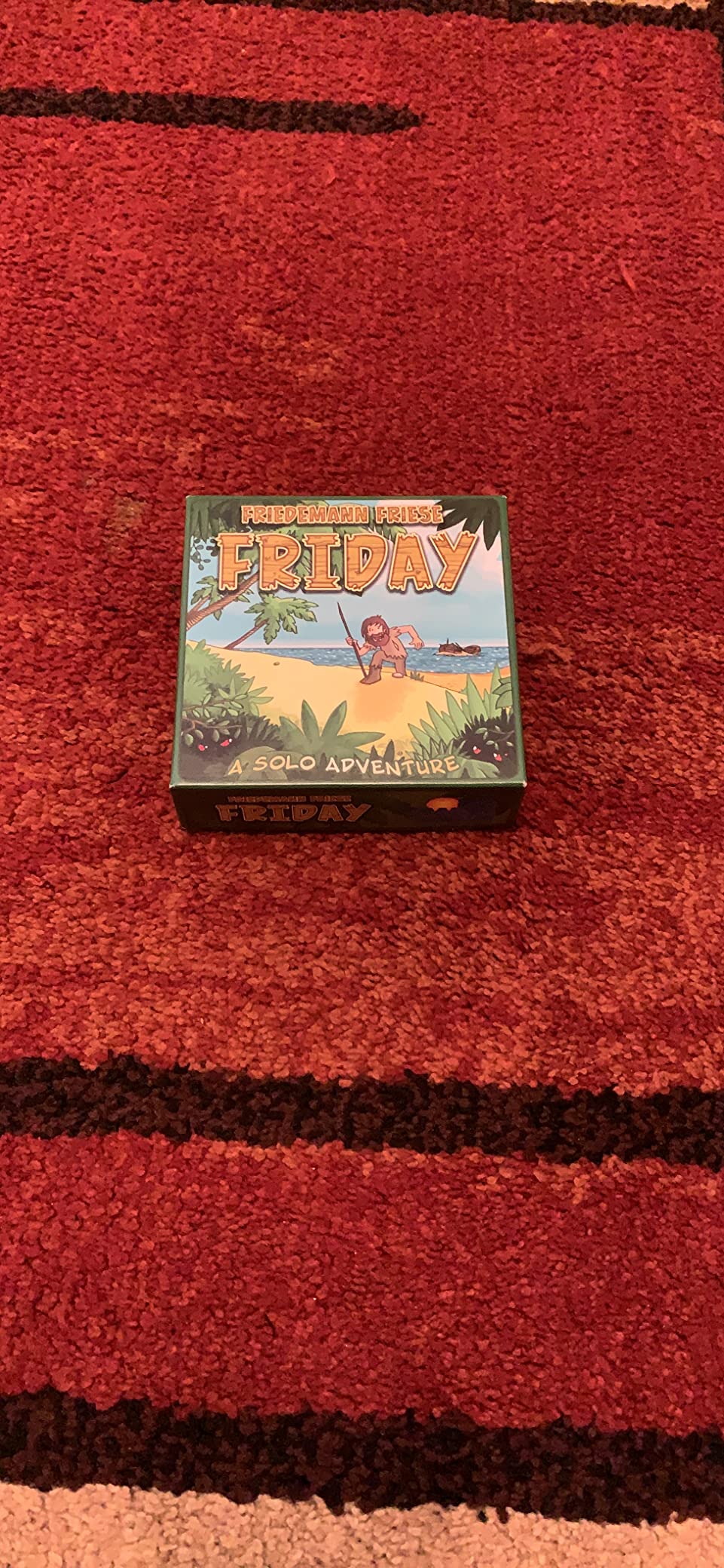
Friday is the classic solo deck builder that has been a staple of the hobby since its release. You play as Friday, helping Robinson Crusoe survive and escape an island by building a deck of skills and fighting off hazards.
The deck building is inverted: you start with a weak deck of Robinson cards, and you must replace them with better cards by winning encounters. The aging mechanic is the brilliant twist.
Every time you lose an encounter, you add an aging card to your deck. Aging cards are terrible.
They clog your hand, reduce your options, and make future turns harder. The game becomes a race to build a strong enough deck before the aging cards overwhelm you.
It is a simple concept that creates genuine drama. I played Friday almost daily for two weeks when I first bought it.
The four difficulty levels provide a smooth progression. Level 1 is gentle and forgiving.
Level 4 is brutal. I beat Level 2 on my third attempt, but Level 3 took me eight tries.
That difficulty ramp gives the game serious longevity for a single deck of cards.
The solo gameplay is pure and uninterrupted. There are no automa rules, no dummy players, and no multi-handed control.
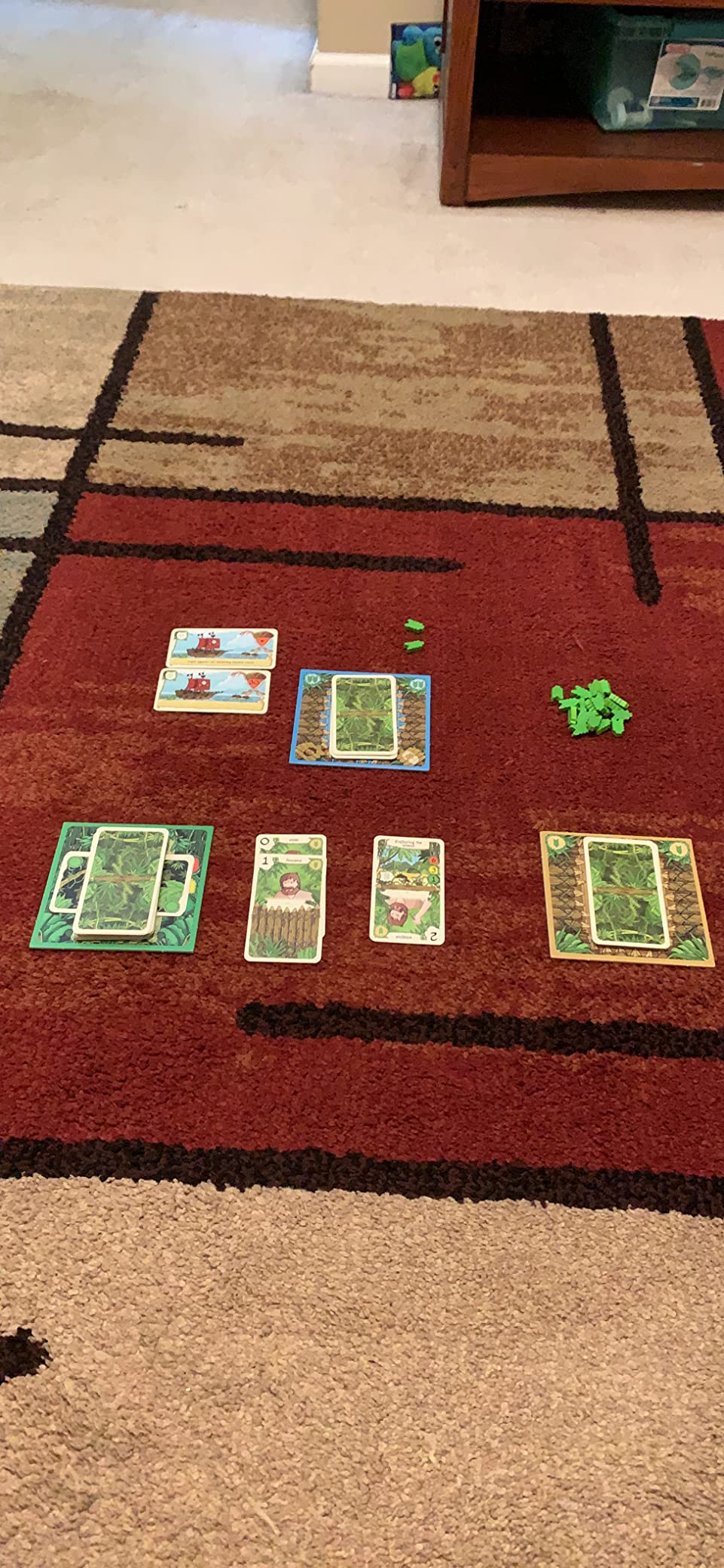
It is just you, your deck, and the hazard stack. Turns are quick, and a full game lasts 20 to 30 minutes.
I often play two or three games in a row, trying to beat my previous score. The rulebook is a known weak point.
The first edition has a confusing layout, and several timing rules are unclear. I found a fan-made FAQ online that answered my questions.
Later printings may have improved this, but I still recommend watching a video tutorial before your first play. The card art is functional but not beautiful.
It has a simple cartoon style that does not evoke much atmosphere. I do not play Friday for the visuals; I play it for the tight math and the satisfying deck-building loop.
If you need gorgeous production to enjoy a game, this might disappoint you.
Who Is This Best For
Friday is perfect for solo gamers who want a dedicated single-player deck builder without a high price tag. It is also a great entry point for players curious about deck building but intimidated by heavier games.
The rules are simple, the turns are fast, and the feedback loop is immediate. If you enjoy push-your-luck mechanics and incremental improvement, Friday will click with you.
If you prefer zero luck and pure strategy, the dice rolls and card draws here will frustrate you. I fall somewhere in the middle, and I find the luck level to be fair and exciting.
Table Space and Storage Requirements
The box is 8 inches square and 2 inches deep. On the table, you need space for three small decks and a discard pile.
A coffee table is more than enough. I have played Friday on my couch with a TV tray.
Storage is compact. The cards fit in a small stack, and the box is sturdy.
It takes up about the same shelf space as a small novel. For players with limited collections or tight budgets, this is one of the most efficient purchases in solo gaming.
9. Ingenious – Travel Tile Puzzle with 200 Challenges
Ingenious: Single-Player Travel Edition – Domino-Style Color Tile Puzzle Game with 200 Challenges and 4 Difficulty Levels for Ages 8 and Up by Thames & Kosmos
1 Player
15 Min
200 Challenges
Ages 8+
Pros
- Perfect compact travel game
- 200 challenges across 4 difficulty levels
- No setup required ready to play
- Good for all ages from kids to adults
- Hexagonal tile matching adds variety
Cons
- Small lid may not stay closed
- Small pieces can scatter
- Tiles are single-sided
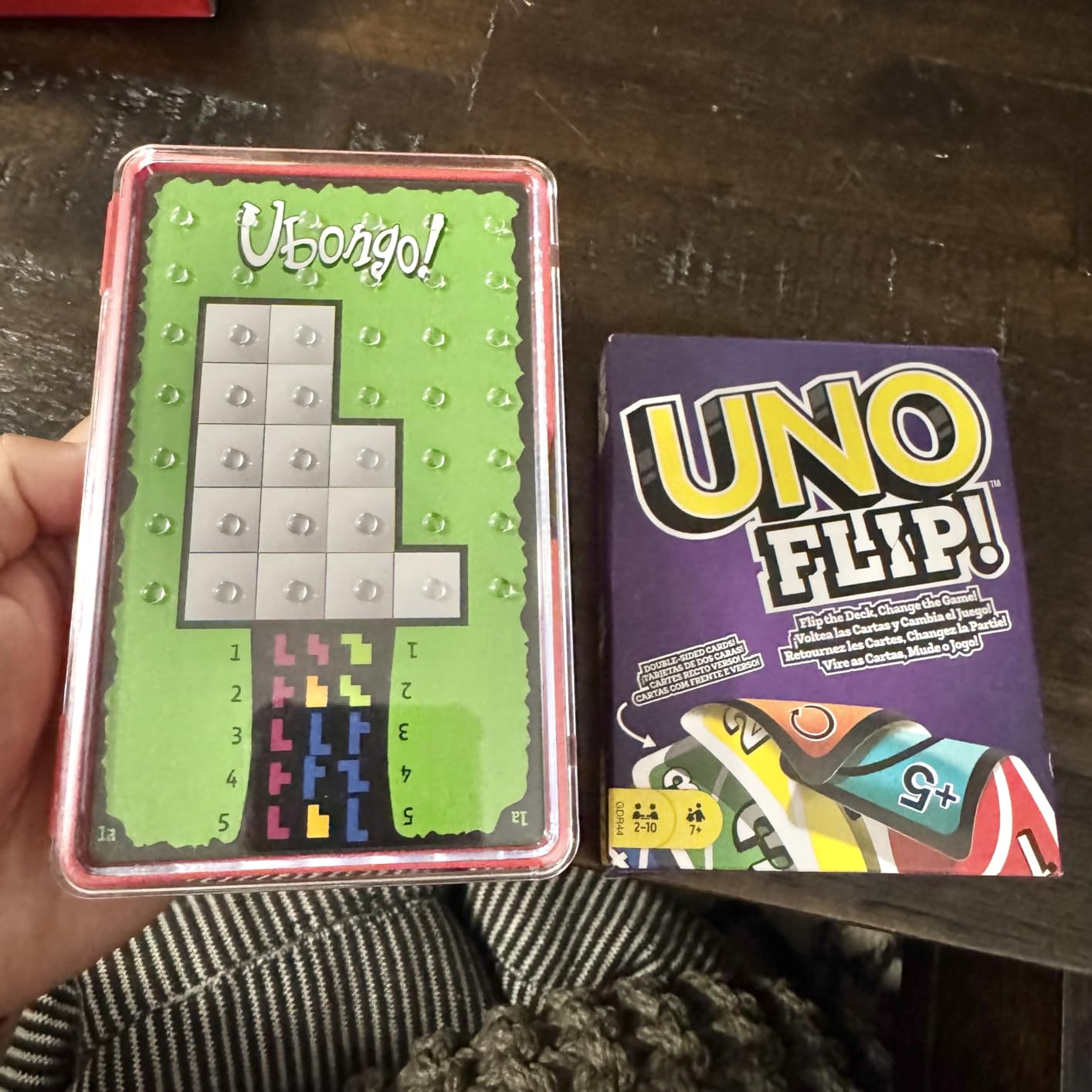
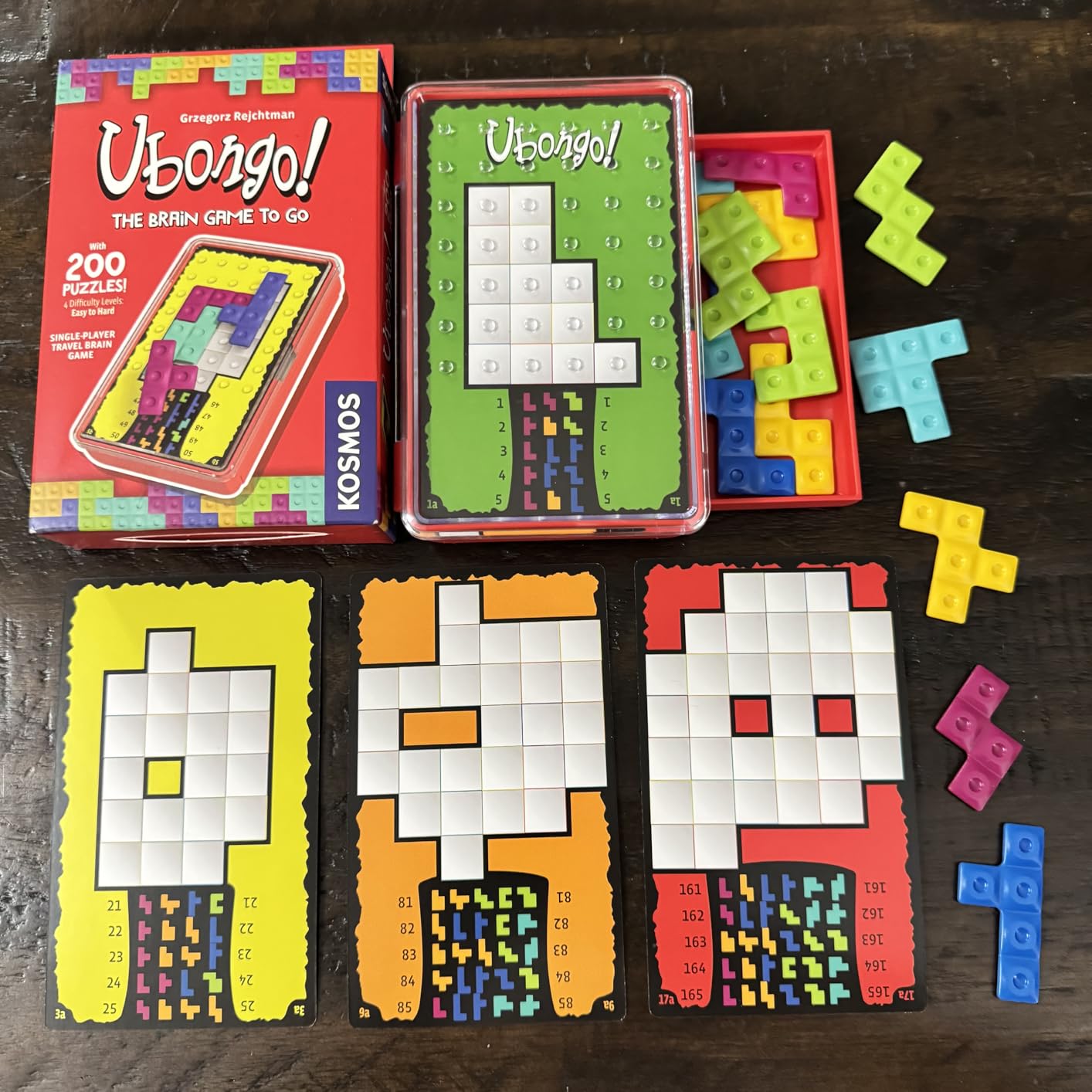
Ingenious is the brainchild of legendary designer Reiner Knizia, and this travel edition is built specifically for solo puzzle solving. You get a slim plastic case, 15 hexagonal tiles, and 25 challenge cards that present 200 puzzles across four difficulty levels.
The goal is to place all tiles on the grid so that matching colors and symbols touch each other. I keep this in my glove compartment and pull it out during long waits.
The challenges start simple and escalate quickly. By level 3, you are staring at a layout for five minutes before making your first move.
Level 4 puzzles have genuinely stumped me for entire evenings. The included helper app can provide hints if you get stuck, which is a nice modern touch.
The hexagonal tile placement adds a spatial dimension that most card-based puzzles lack. You are not just matching colors; you are managing six-sided adjacency, which creates far more complex possibilities than a square grid.
It is a small but meaningful design choice that keeps the puzzles fresh across hundreds of attempts.
The game is genuinely accessible to all ages. I played it with my nephew, who is 10, and he solved several level 1 puzzles faster than I did.
Then I handed him a level 4 card, and he was silent for 20 minutes. That range makes it a rare game that works for both children and adults without dumbing down the core challenge.
The physical case is a mixed bag. The plastic shell is durable and slim, but the lid does not snap securely.
I use a small rubber band to keep it closed in my bag. The tiles are also small enough to scatter if you drop the case.
I recommend opening it over a table rather than on your lap. For a purely abstract puzzle experience, this is one of the best travel options available.
It requires no setup, has no batteries, and offers 200 distinct challenges. That is exceptional value for a game that fits in a pocket.
Who Is This Best For
Ingenious suits puzzle lovers who want a self-contained challenge they can play anywhere. If you enjoy Sudoku, Kanoodle, or other spatial puzzles, the hexagonal tile matching here will feel like a natural evolution.
The 15-minute play time also makes it ideal for short breaks. It is not a narrative experience.
There is no story, no campaign, and no engine building. This is pure logic and pattern matching.
If you need theme and immersion to enjoy a game, look elsewhere. But if you want a clean mental workout, this delivers beautifully.
Portability and Storage
The case is 3.8 by 1.3 by 0.1 inches. It is slimmer than most smartphones.
I carry it in my back pocket without noticing it. The self-contained design means you never need extra components, dice, or reference sheets.
Storage is effortless. The case holds everything, and there are no loose cards to sleeve or tokens to sort.
If you want a solo game that adds zero clutter to your life, this is the most minimalist option on our list. I consider it essential travel gear for any solo gamer.
10. Unbroken – Dark Fantasy Solo Survival
Golden Bell Studios Unbroken: a Solo Game of Survival and Revenge , Black
1 Player
20-30 Min
Dark Fantasy
Ages 14+
Pros
- One of the best physical solo experiences
- Resource management with strategic depth
- Great flavor text and theme
- High replayability with achievements
- Quick setup and gameplay
Cons
- Cards are reportedly thin
- Some component quality issues
Unbroken is a dark fantasy solo survival game that puts you in the boots of a warrior who has survived a dungeon raid but must now escape with nothing but a few scraps of equipment. The narrative setup is immediate and compelling, and the flavor text on the cards adds genuine storytelling to every encounter.
I played Unbroken during a weekend when I wanted something challenging but not as heavy as Spirit Island. It hit that middle ground perfectly.
Each game is a tight resource management puzzle where you must decide whether to explore deeper for better loot or rush for the exit before your health and food run out. The dice and card combat is simple but tense, and the achievement system gives you long-term goals beyond just winning.
The replayability comes from the many achievements and the randomized dungeon deck. After 10 plays, I had only unlocked about a third of the achievements.
Some require specific strategies, like winning without using weapons or escaping with minimal health. Those challenges force you to rethink your approach entirely.
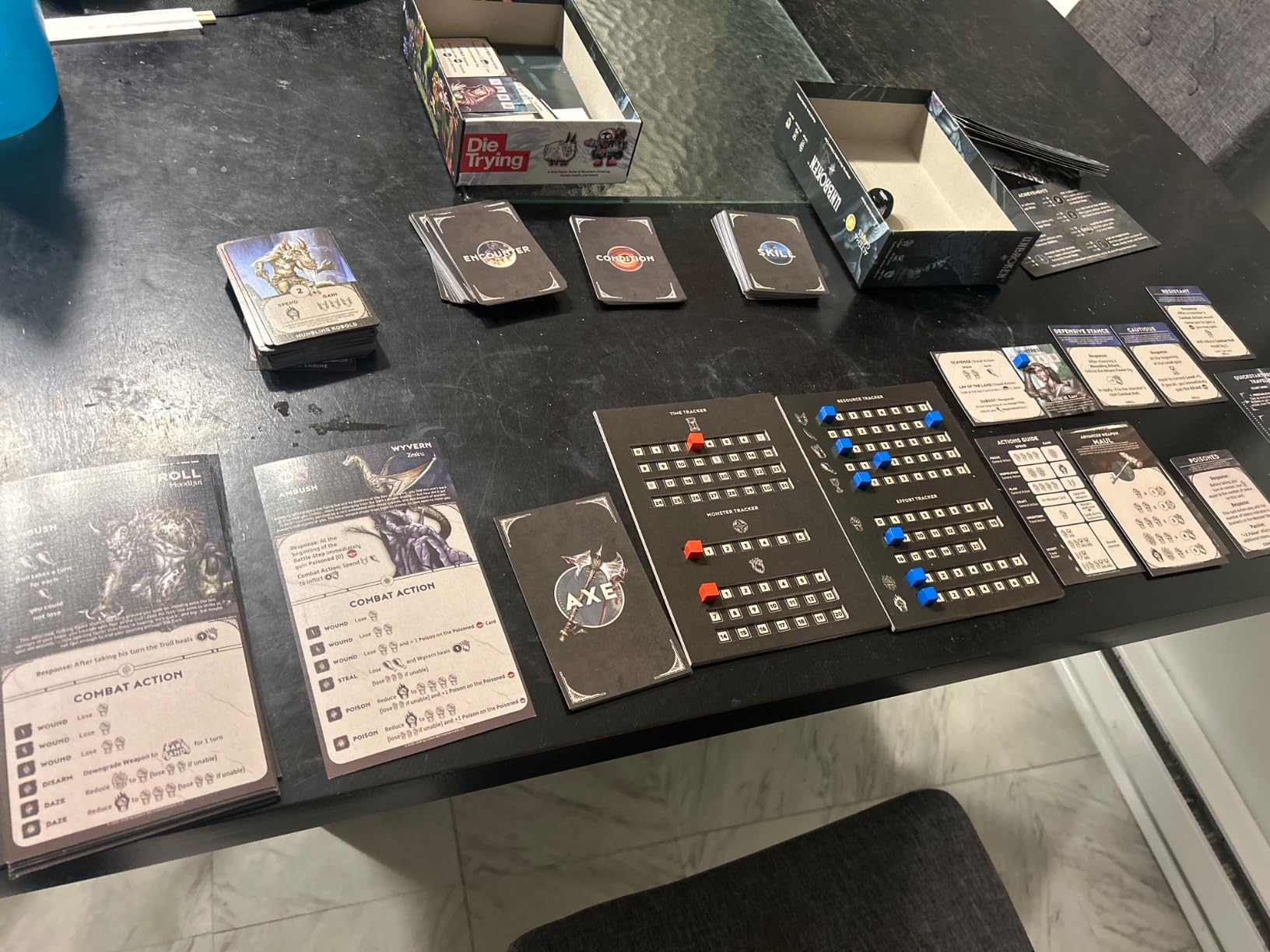
The theme is dark without being depressing. The flavor text is well-written, and the monster designs are evocative.
I found myself imagining the dungeon corridors between turns, which is exactly what a thematic solo game should do. It is not as mechanically deep as some heavy games, but the atmosphere carries the experience.
The component quality is the main downside. The cards are thinner than I prefer, and some of my copies show wear after repeated shuffling.
The dice are standard, and the box is functional but not luxurious. I sleeved the cards to protect them, which adds a small extra cost.
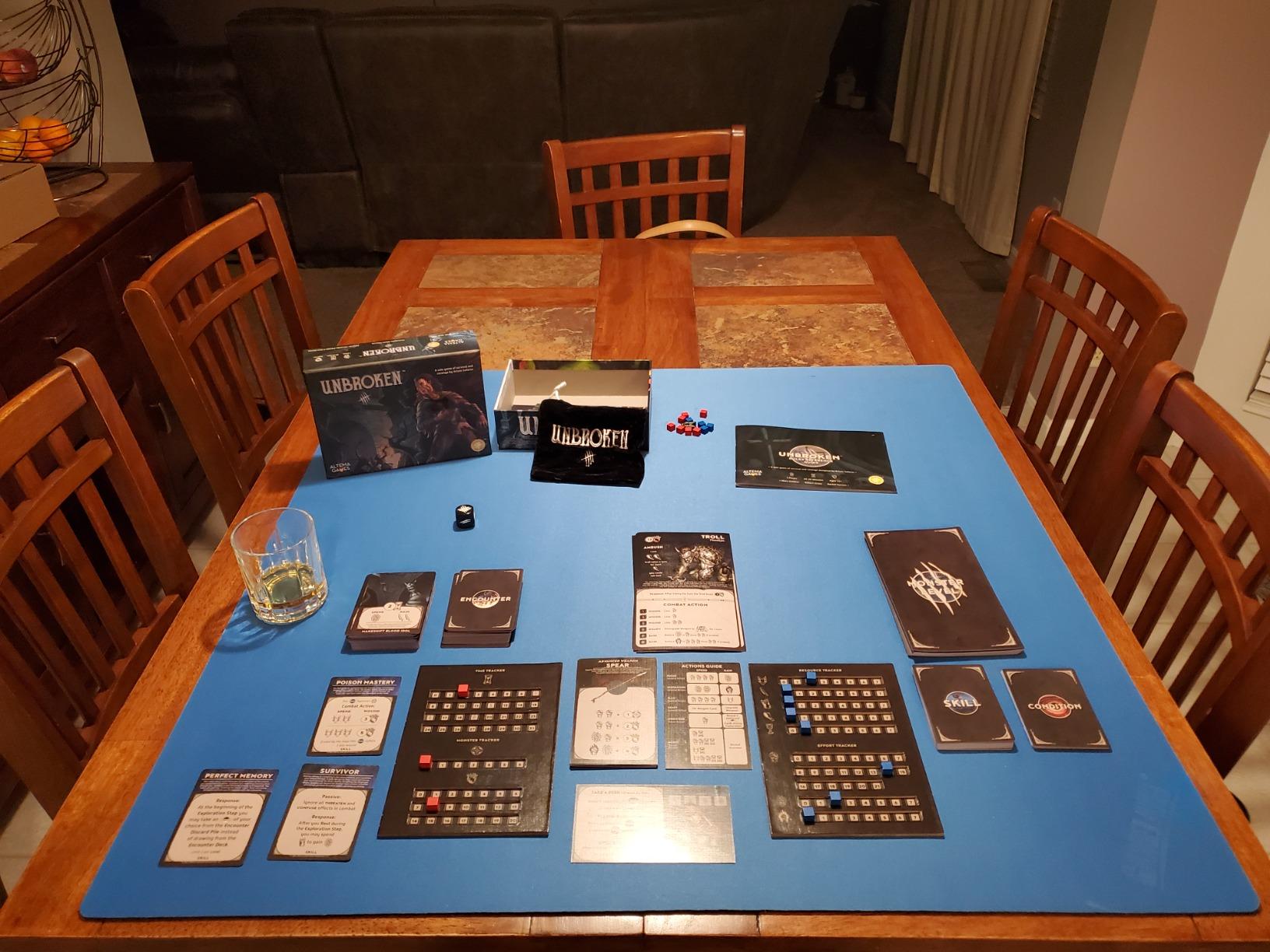
Setup is fast, which is a huge advantage. I can open the box, shuffle the decks, and start playing in under 3 minutes.
That makes it easy to play on weeknights when I do not have time for a 20-minute setup. The 20 to 30 minute play time also fits comfortably into most schedules.
How Long Does It Take to Learn
The rules are simple enough to learn in one reading. You have four phases per turn: explore, encounter, combat, and camp.
Each phase has clear steps, and the reference card covers the common questions. I understood the flow after my first game and played my second without opening the rulebook.
The difficulty comes from the decisions, not the rules. Knowing how to play is easy.
Knowing when to fight, flee, or rest is hard. That design philosophy makes Unbroken accessible to new players while still offering depth for experienced gamers.
It is a rare balance that solo games often miss.
Table Space and Storage Requirements
The box is 7.6 by 5.6 by 2.2 inches, which is about the size of a small hardcover novel. On the table, you need space for a small player board, the dungeon deck, and a few dice.
A card table or small desk is perfect. I play it on a 24-inch square table with room to spare.
Storage inside the box is decent. The cards fit in a single stack, and the dice and tokens store in a small bag.
It is not as organized as some modern games with custom inserts, but it is perfectly functional. For the shelf space it occupies, it delivers a lot of gameplay.
How to Choose the Right Solo Board Game
The best solo board games share one common trait: they respect your time. After testing dozens of games, I have learned that the right choice for you depends on three factors: your experience level, your available time, and your table space.
If you ignore those variables, you will end up with a game that gathers dust instead of hitting the table. One of the most common pain points I see in solo gaming communities is the overwhelm of too many choices.
New players buy a complex game like Spirit Island, bounce off the rules, and assume solo board gaming is not for them. That is a shame, because there are fantastic entry points like Cascadia and Friday that build confidence before you tackle the heavy hitters.
Consider Your Experience Level
If you are new to solo board games, start with a light or medium-light title. Cascadia, Friday, and Grove are excellent first purchases because they teach quickly, play fast, and give you a satisfying win without hours of study.
Once you understand what you enjoy, you can invest in heavier games like Spirit Island or The Night Cage. Experienced gamers should look for depth and replayability.
Spirit Island offers near-infinite combinations with its spirits and adversaries. Wingspan delivers engine-building complexity with a relaxing theme.
One Deck Dungeon provides campaign progression in a tiny box. Match the weight to your appetite.
Match Play Time to Your Schedule
Time commitment is often unclear when shopping for board games, so here is the honest breakdown from our testing. Grove and Ingenious take 10 to 15 minutes.
Friday, Unbroken, One Deck Dungeon, and Cascadia take 20 to 45 minutes. Wingspan and The Night Cage take 60 to 90 minutes.
Spirit Island takes 90 to 120 minutes, especially with two spirits. If you only have small windows of free time, a micro game like Grove or Ingenious will see far more play than a 90-minute epic.
I play my quick games three times as often as my long games for exactly this reason. Be honest about your schedule before you buy.
Think About Table Space and Storage
Storage space requirements for large games are a real concern for apartment dwellers. Spirit Island and Wingspan need big boxes and big tables.
Grove and Ingenious need almost nothing. If your shelf space is limited, prioritize the compact games or invest in a game that justifies its footprint, like Wingspan with its massive content.
I store my small games in a single bin and my large games on a dedicated shelf. That system works well, but it means I think twice before buying another big box.
Solo mode implementation quality matters less if the game never leaves the shelf because you lack the space to play it.
Theme and Mechanics Matter
Your personal taste in theme and mechanics will determine which games stick. If you love horror, Final Girl and The Night Cage are obvious choices.
If you prefer nature and relaxation, Wingspan and Cascadia fit better. If you want fantasy combat, One Deck Dungeon and Unbroken deliver.
Mechanically, think about whether you enjoy dice, cards, tiles, or engine building. Dice lovers should try One Deck Dungeon and Unbroken.
Card fans will love Friday and Final Girl. Tile layers should grab Cascadia and The Night Cage.
Engine builders need Wingspan. There is no universal best game, only the best game for your preferences.
Replayability and Expansion Potential
Replayability is the hidden cost of board gaming. A cheap game that bores you after three plays is more expensive than a pricey game you play 50 times.
Wingspan justifies its cost with 170 unique cards. Spirit Island offers years of content with adversaries and spirits.
Final Girl has a modular expansion system. Friday and Grove are inexpensive but also have finite novelty.
Before buying, ask yourself how many plays you expect. If you want a campaign, choose One Deck Dungeon or Final Girl.
If you want an endless puzzle, choose Ingenious. If you want a game that grows with you, choose Spirit Island or Wingspan.
Frequently Asked Questions About Solo Board Games
What is the best board game to play alone?
The best solo board game depends on your taste and experience level. For beginners, Cascadia offers an easy entry point with beautiful components. For experienced players, Spirit Island delivers unmatched strategic depth. For horror fans, Final Girl provides a dedicated solo experience built entirely for one player.
What are the most fun single player games?
The most fun single player board games include Wingspan for bird-collecting engine building, Cascadia for quick nature puzzles, and Friday for compact deck-building adventure. The Night Cage and Final Girl are excellent choices for players who enjoy horror themes and cooperative mechanics adapted for solo play.
Are solo board games a thing?
Yes, solo board games are a significant and growing part of the hobby. Many modern board games include dedicated solo modes with automa systems or AI opponents. Some games, like Final Girl and Friday, are designed exclusively for one player. Online communities on Reddit and BoardGameGeek actively discuss and recommend solo titles daily.
What is the best solo board game for beginners?
Cascadia is the best solo board game for beginners because it teaches in under two minutes, plays in 30 minutes, and includes a smooth solo mode with adjustable difficulty. Grove and Ingenious are also excellent beginner choices because they are compact, inexpensive, and easy to learn while still offering genuine challenge.
Final Thoughts
Solo board gaming has never been better than it is right now in 2026. The ten games on this list represent the best solo board games across every weight, theme, and play time.
Whether you want a quick 10-minute puzzle with Grove or a deep 2-hour strategy session with Spirit Island, there is a game here that fits your life. My personal recommendation is to start with Cascadia if you are new, add Wingspan when you want more depth, and pick up Spirit Island when you are ready for a serious challenge.
For horror nights, Final Girl and The Night Cage are unbeatable. For travel and small spaces, Grove and Ingenious are essential.
Happy solo gaming. May your dice roll well, your engines run smoothly, and your candles never burn out.